Can You Sue the Rental Car Company?


Every article on this site is researched by our internal team, reviewed for legal accuracy against current Texas law, and held to State Bar of Texas advertising standards before publication. We do not publish content that overstates outcomes or makes promises about results.
Learn more about our
editorial standards .
Key Takeaways
- The Graves Amendment blocks suing a rental company just because it owned the car.
- Two exceptions survive: the company's own negligence or its criminal wrongdoing.
- Texas gives you two years from the crash date to file a personal injury suit.
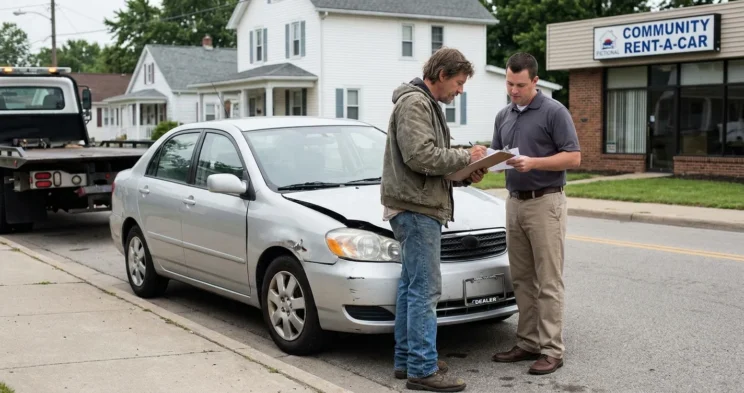
The other driver walked away from the crash and handed the officer a rental agreement. Now you are holding a police report with a national company’s name on it, a stiff neck, and a medical bill.
Under a federal law known as the Graves Amendment, 49 U.S.C. § 30106, you generally cannot sue a rental car company just because it owned the vehicle involved in the crash.
That law is the reason the rental company is normally not a defendant at all. Your claim almost always runs against the at-fault driver and the insurance available behind that driver.
The shield does have two openings. Both of them depend on what the rental company itself did, not on what its customer did behind the wheel.
Why the Rental Car Company Usually Isn’t the Defendant
The Graves Amendment preempts state vicarious liability law for vehicle lessors. A company in the business of renting or leasing vehicles cannot be held liable under Texas law for harm arising out of the use of that vehicle during the rental period simply because it holds the title.
Congress passed the provision in 2005 as part of the federal highway bill, SAFETEA-LU, Pub. L. 109-59.
The statute sets up a two-part test. The protection applies when the owner or an affiliate is engaged in the trade or business of renting or leasing motor vehicles, and when there is no negligence or criminal wrongdoing on the owner’s own part. Both conditions have to hold.
The law also carries a savings clause. Section 30106(b) does not preempt state financial responsibility or insurance laws, so states remain free to require rental companies to carry or make available minimum liability coverage. What Congress took off the table was vicarious tort liability for the renter’s driving, not insurance requirements.
For most people injured by someone in a rental car, that distinction decides strategy. The company that owns the car drops out, and car accident claims in Texas proceed against the at-fault driver much as they would if the car had been titled in his own name.
The Two Ways You Can Still Sue the Rental Company
Rental company liability comes back into play only when the harm traces back to the company’s own conduct. The statute preserves claims based on the company’s negligence and claims based on its criminal wrongdoing.
Two negligence theories account for nearly all of these cases. Both are narrow, and both live or die on documents.
Negligent Maintenance of the Specific Vehicle
A negligent maintenance claim says the company knew or should have known the specific vehicle was unsafe and rented it out anyway. Failing brakes, worn or defective tires, and unrepaired mechanical problems are the usual fact patterns.
This theory rests on ordinary Texas negligence principles applied to the company’s own inspection and repair practices. No Texas statute creates a rental-specific maintenance duty, so duty, breach, causation, and damages must be proven the standard way.
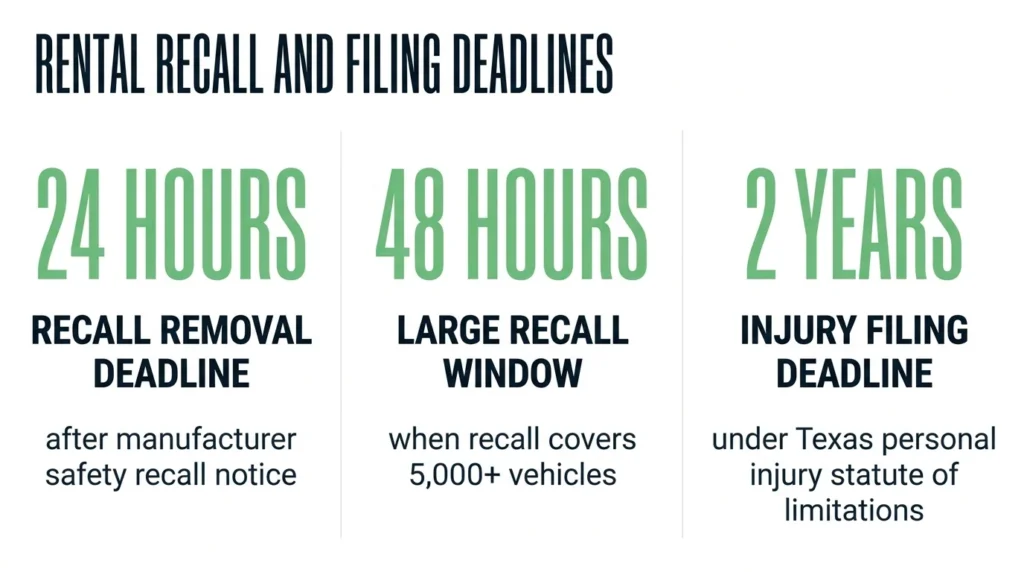
Federal law does impose one concrete, documented obligation. Under the Safe Rental Car Act rules added at 49 U.S.C. § 30120(i)(3), effective June 1, 2016, a rental company that receives a manufacturer’s safety recall notice must stop renting the affected vehicle as soon as practicable and no later than 24 hours after receiving that notice.
The window extends to 48 hours when the recall covers more than 5,000 of the company’s vehicles, and the vehicle may stay in service only where the manufacturer specified an interim safety measure the company performs first.
That rule counts most for what it leaves behind. Recall notices, grounding dates, and repair dates create a discoverable paper trail showing whether a particular unit belonged on the lot at all.
Renting to an Obviously Unfit Driver
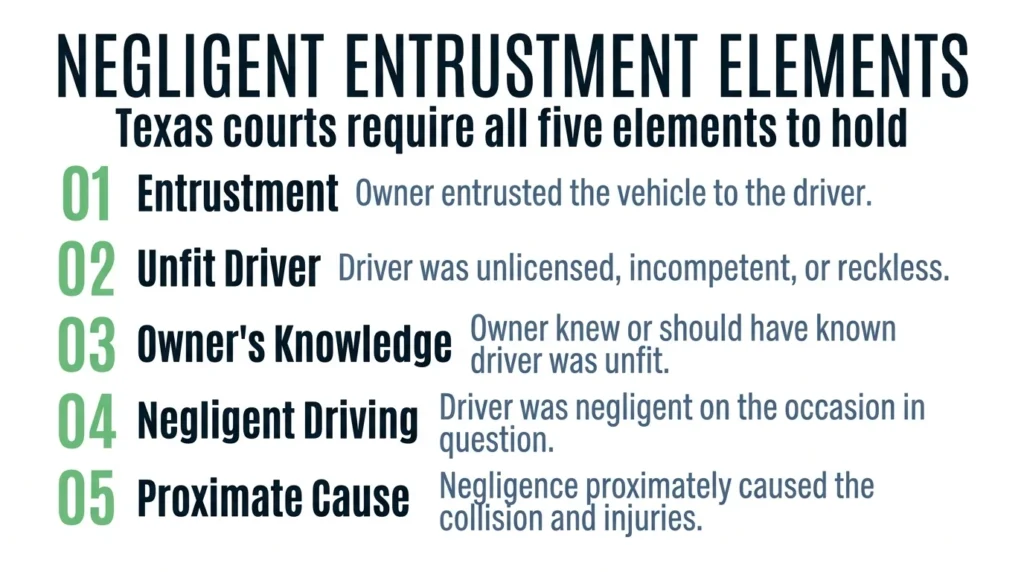
Negligent entrustment targets the decision to hand over the keys rather than the condition of the car. Texas courts apply a settled set of elements, drawn from the Texas Supreme Court’s decision in Schneider v. Esperanza Transmission Co., 744 S.W.2d 595 (Tex. 1987):
- The owner entrusted the vehicle to the driver.
- The driver was unlicensed, incompetent, or reckless.
- The owner knew or should have known the driver was unlicensed, incompetent, or reckless.
- The driver was negligent on the occasion in question.
- That negligence proximately caused the collision and the injuries.
The claim does not rest on imputed negligence. It rests on the owner’s own carelessness in entrusting the car, not on the fact of ownership alone, which is the distinction the statute’s negligence exception is built around.
Proving the company knew or should have known is the hard part. A documented pattern tends to carry the weight, whether that means prior complaints, repeat citations, or a license irregularity the counter staff should have caught. A single ambiguous fact is generally not enough.
Proximate cause is the second hurdle. In Allways Auto Group, Ltd. v. Walters, 530 S.W.3d 147 (Tex. 2017), a dealership gave a customer a loaner vehicle, and 18 days later that customer, by then intoxicated, caused a fatal collision. The Texas Supreme Court held the causal chain was too attenuated, because the person entrusting the vehicle must be shown to have reasonably anticipated injury as a natural and probable consequence of the entrustment.
One caution belongs here. Whether a negligent entrustment claim against a rental lessor survives Graves Amendment preemption at all is not fully settled, and one federal court sitting in Dallas moved past that question to decide the case on its merits. The injured party there still lost, for lack of evidence the company knew or should have known the driver was unfit.
The Second Exception: The Company’s Own Criminal Wrongdoing
The Graves Amendment also withholds its protection where there is criminal wrongdoing on the part of the owner or an affiliate. That language sits in the same provision that creates the shield, 49 U.S.C. § 30106(a)(2).
This prong points at the company, not at the customer. A renter who commits a crime behind the wheel does not open the door, because the wrongdoing has to be the company’s own conduct connected to the rental.
In practice this exception is rarely litigated, and no reported decision applies it to a rental car injury case. It is the plain rule the statute states, not a common route to recovery.
What Evidence a Claim Against the Rental Company Runs On

Both negligence exceptions run on the rental company’s own records, which is why preserving evidence early matters so much. Three categories do most of the work:
- Maintenance and service history for the specific unit. Repair orders, inspection records, and where they apply, recall notices with the corresponding grounding and repair dates under the federal recall rule.
- The rental agreement and license verification records. The signed agreement, the counter license check or state records query, and any declarations the renter signed show what the company knew when it handed over the keys.
- Prior complaint history. Internal complaints and incident reports tied to that vehicle support a maintenance theory, while records tied to that renter support the knowledge element of negligent entrustment.
The companies describe the counter check themselves. Enterprise, Avis, and Hertz all state in their published rental qualification policies that they require a valid, unexpired physical driver’s license and check it for tampering or expiration, with some running electronic checks against state records or using a declaration process, plus no-rent windows after a recent DUI conviction.
Those are the companies’ own statements about their practices, not legal standards. They matter because they show what a records request should ask for.
Where Your Claim Usually Goes Instead, and the Deadline to Act
Because the Graves Amendment ordinarily removes the rental company as a defendant, the working claim is against the at-fault driver and the insurance layers standing behind that driver.
Depending on who was driving, those layers can include the driver’s own auto policy, protection products the rental company sold at the counter, the renter’s personal auto coverage, or coverage attached to the credit card used to book the rental.
Texas sets minimum liability limits at $30,000 per person and $60,000 per collision for bodily injury, plus $25,000 for property damage, under Texas Transportation Code § 601.072. Those minimums apply to drivers generally, not to rental companies under the Graves Amendment, and a serious injury can run well past them.
The filing deadline does not shift based on which defendant you name. Texas Civil Practice & Remedies Code § 16.003(a) requires a personal injury suit to be filed within two years after the day the cause of action accrues, ordinarily the date of the crash. Tolling applies for minors and certain other statutory exceptions, but the two-year rule governs most cases.
Two years sounds generous until you count what has to happen inside it. Maintenance records, rental agreements, and internal complaint files sit with the company least interested in producing them. And if you were the one driving the rental, who pays when you crash a rental car in Texas is a separate question.
Talk to Angel Reyes & Associates About Your Rental Car Crash
Working out who is actually liable after a rental car crash comes down to specifics: who was driving, what the company knew, and what its own records show.
Angel Reyes & Associates has guided injured Texans through crash claims for more than 30 years, with board-certified personal injury attorneys, investigators, and accident reconstruction specialists on the team. Identifying the right defendant and locking down the maintenance history, rental agreement, and complaint records early is the work that shapes a case.
Texas gives you two years to act, and the documents that decide these claims get harder to secure as time passes. Contact Angel Reyes & Associates for a free consultation to review your options.
Past results do not guarantee future outcomes.
Rental Car Accident FAQs
Does buying a damage waiver or extra insurance at the counter change who you can sue for your injuries?
No. A damage waiver or extra insurance product sold at the counter is a coverage arrangement, not a basis for holding the rental company liable for your injuries. The Graves Amendment’s shield still turns on whether the harm traces back to the company’s own negligence or criminal wrongdoing, not on what optional products it sold you. Those add-on products can affect which insurance layer eventually pays a claim against the driver, but they do not change who counts as a proper defendant.
Does it matter whether you were the renter, a passenger, or hit by a rental car someone else was driving?
Not for the Graves Amendment shield itself. The statute blocks liability “by reason of being the owner” of the vehicle without carving out a particular category of injured person, so the shield works the same way whether you were the renter, a passenger in the rental, or a third party the rental driver hit.
What if the crash involved a rental vehicle under an active manufacturer recall the company hadn't addressed yet?
That fact pattern lines up with the maintenance exception. Federal law requires a rental company that has received a manufacturer’s recall notice to stop renting the affected vehicle no later than 24 hours after receiving it, or 48 hours if the recall covers more than 5,000 of the company’s vehicles, unless the manufacturer specified an interim safety measure the company performed first.
Is the two-year filing deadline different if your claim is against the rental company instead of the driver?
No. Texas’s personal injury statute of limitations, Texas Civil Practice & Remedies Code § 16.003(a), gives you two years from the day the cause of action accrues, ordinarily the crash date, no matter which defendant you ultimately name, subject to the same tolling rules for minors and other statutory exceptions. Naming the rental company instead of, or alongside, the driver does not extend or shorten that window.
Does the Graves Amendment shield apply the same way to a small local rental outfit as it does to a national chain?
Yes. The statute’s protection depends on whether the owner, or an affiliate, is engaged in the trade or business of renting or leasing motor vehicles, not on the company’s size or name recognition. A small independent rental company that meets that trade-or-business condition gets the same preemption from vicarious liability as a national chain, and remains exposed to the same two exceptions: its own negligence and its own criminal wrongdoing.
About the Authors

Angel Reyes
Writer
Angel L. Reyes, III is the Founder and Managing Partner of Angel Reyes & Associates. A nationally recognized trial attorney and business leader, Angel founded the firm in 1993, which has gone on to help over 70,000 injury victims recover more than $1 billion. Named to the Texas Super Lawyers list annually since 2008, Angel brings Wall Street experience, Ivy League education, and a deep commitment to client advocacy. He is a frequent legal commentator and published author with extensive contributions to legal scholarship, trial strategy, and consumer protection.

Kyle Nicolas
Editor
Kyle Nicolas is the Web Content & SEO Manager at Angel Reyes & Associates. He has more than 10 years of experience as a marketing co...

Angel Reyes
Reviewer
Angel L. Reyes, III is the Founder and Managing Partner of Angel Reyes & Associates. A nationally recognized trial attorney and business...