Dallas Uber and Lyft Accident Lawsuits


Every article on this site is researched by our internal team, reviewed for legal accuracy against current Texas law, and held to State Bar of Texas advertising standards before publication. We do not publish content that overstates outcomes or makes promises about results.
Learn more about our
editorial standards .
Key Takeaways
- Texas law gives rideshare injury victims two years from the crash date to file suit.
- The driver's app status at impact controls how much insurance coverage is available.
- Passengers, other drivers, and pedestrians can all file claims after a rideshare crash.
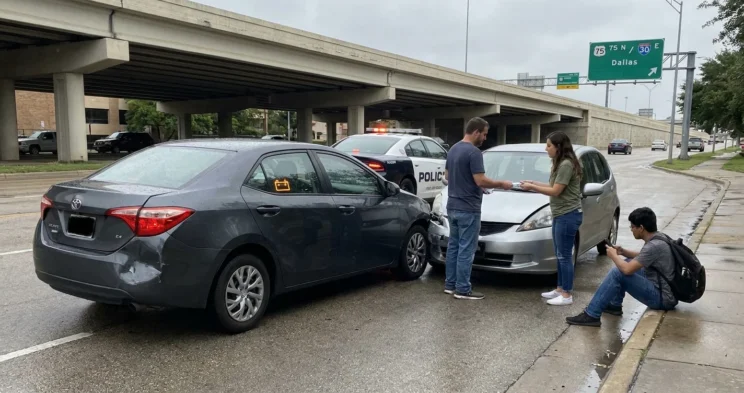
You were heading home from Deep Ellum when the Lyft driver ran a red light on Commerce Street and hit the car in front of you. The crash was clearly not your fault.
Now you have a medical bill you did not plan for, an insurance adjuster asking questions that feel like a trap, and no clear idea whether the rideshare company or the driver is responsible for paying your damages. That uncertainty is the defining feature of rideshare injury cases in Dallas.
Who Can File a Dallas Rideshare Lawsuit?
Passengers, other drivers, pedestrians, and cyclists can all file claims after an Uber or Lyft crash. Your role in the accident shapes which insurance policies are available, but it does not prevent you from seeking compensation.
If you were a passenger on an active trip when the crash happened, you have a direct claim against the at-fault driver. You also have access to the rideshare company’s $1 million liability policy, which is active from the moment the driver accepts a ride through the end of the drop-off.
If you were a driver or pedestrian hit by an Uber or Lyft vehicle, you can pursue the at-fault driver directly, with the rideshare company’s coverage applying depending on the driver’s app status when the accident occurred.
Fault still shapes your compensation, or damages. Texas uses a proportionate responsibility system under Texas Civil Practice and Remedies Code (CPRC) Chapter 33: your damages are reduced by your percentage of fault, and if your share of fault is greater than 50 percent, you cannot recover any compensation.
That rule applies to rideshare crashes the same way it applies to any other collision in Dallas.
How Rideshare Insurance Periods Affect Your Case
Which insurance policy responds to your claim is not a simple question. It depends entirely on what the driver was doing in the app at the exact moment of impact. Uber and Lyft use a period-based framework that controls how much coverage is available.
App Off or App On, No Ride Accepted
When the driver’s app is off, only the driver’s personal auto insurance applies. The rideshare company has no coverage obligation whatsoever during this phase.
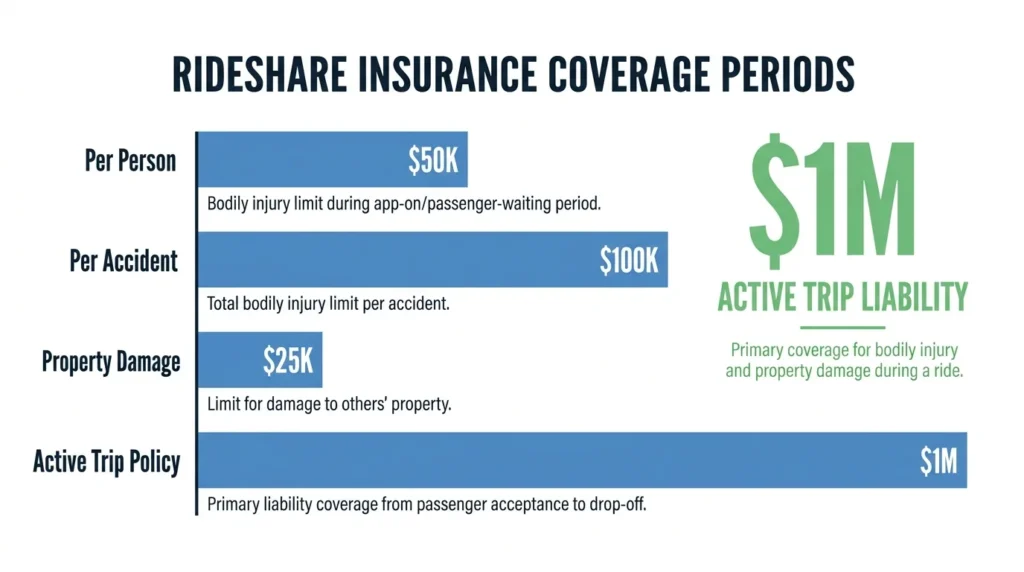
When the app is on but the driver has not accepted a ride yet (Period 1), Uber and Lyft provide limited contingent coverage: $50,000 per person, $100,000 per accident, and $25,000 for property damage.
That coverage is contingent, meaning it only kicks in if the driver’s personal auto policy does not apply or is insufficient. The gap between Period 1 limits and a serious injury can be enormous.
Ride Accepted Through Passenger Drop-Off
Once a driver accepts a ride request, the picture changes. From that moment through the end of the passenger’s drop-off (Periods 2 and 3), the rideshare company’s $1 million primary liability policy is active under Texas Insurance Code Chapter 1954, which sets minimum insurance requirements for transportation network companies operating in Texas. That policy also includes uninsured and underinsured motorist coverage.
The dispute over which period was active at the time of the crash is one of the most contested issues in rideshare litigation. You need the app’s activity log to prove it, and that record will not last forever.
Suing Uber or Lyft in Dallas County
Uber and Lyft classify their drivers as independent contractors, which is how they argue they cannot be held liable the way an employer would be. That defense has limits, and two legal theories let you name the company as a defendant.
The first is negligent hiring or retention. If the company failed to properly screen a driver with a disqualifying history, or kept a driver on the platform after red flags appeared, you may have a direct claim against the TNC itself.
The second path runs through Texas Occupations Code Chapter 2402 and the Insurance Code. When a driver is on an active trip and their personal policy lapses or fails, the TNC’s policy must respond from the first dollar.
Personal injury lawsuits filed in Dallas are heard by the Dallas County District Courts, based at the George L. Allen Sr. Courts Building at 600 Commerce Street in downtown Dallas. Smaller claims that fall below the district court’s jurisdictional minimum may be filed in Dallas County Courts at Law.
An attorney familiar with Dallas County practice will know which court fits your claim and how to file properly.
Where Dallas Rideshare Crashes Happen Most
Some parts of Dallas generate far more rideshare crashes than others, and knowing where your accident happened can help establish the factual context of your claim.
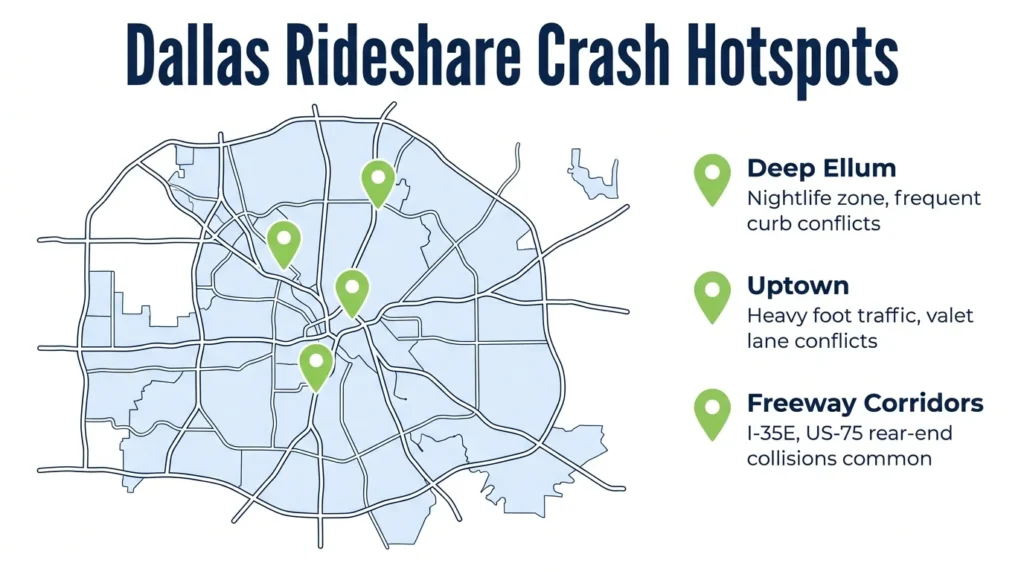
Deep Ellum is one of the highest-risk corridors. The dense nightlife pickup zones create constant curb-lane conflicts, where drivers stop in travel lanes rather than at designated spots and pedestrians step off curbs into moving traffic. Uptown sees similar conditions: heavy foot traffic, competing valet lanes, and high rideshare demand after dark make intersections along McKinney Avenue and Cedar Springs Road frequent incident locations.
Downtown Dallas and the Arts District around American Airlines Center concentrate rideshare pickups at intersections already handling event traffic. Dallas Love Field and DFW International Airports have designated staging areas that help organize volume but do not eliminate congestion-driven crashes in the pickup lanes themselves.
On the freeway side, I-35E, US-75 through Dallas, Mockingbird Lane, and the Dallas North Tollway all have heavy rideshare traffic and see frequent rear-end and lane-change collisions. If your crash happened in any of these corridors, your attorney will know what evidence to look for and where.
Filing Deadline & What to Do Now
Texas gives you two years from the date of your injury to file a personal injury lawsuit under Texas Civil Practice and Remedies Code (CPRC) § 16.003. Miss that deadline and your right to sue is almost certainly gone, regardless of how strong your underlying case is. The clock starts the day of the crash, not the day you find a lawyer.
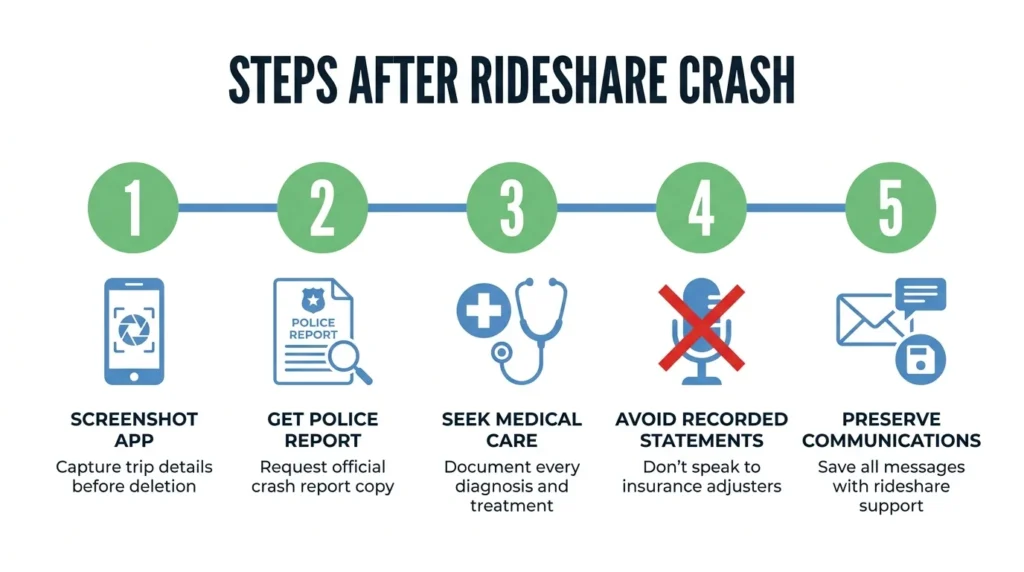
Before that deadline, take these steps:
- Screenshot the app. Capture your trip details, driver name, route, and timestamp from the Uber or Lyft app before the record is deleted or altered.
- Get the police report. Request a copy of the Dallas Police Department crash report through the department’s records division. That report documents the officer’s initial findings regarding fault.
- Seek medical attention. See a doctor and document every diagnosis, treatment, and expense. Gaps in medical care give insurance adjusters room to argue your injuries were not serious.
- Do not give a recorded statement. Do not speak with any insurance adjuster on the record before consulting an attorney. What you say can be used to reduce or deny your claim.
- Preserve your communications. Save every message, email, and in-app notification from Uber or Lyft’s support team.
Talk to a Dallas Rideshare Injury Attorney
Rideshare cases in Dallas involve multiple insurers, disputed app records, and corporate defendants whose legal teams work to close claims for as little as possible. You deserve to understand your options before you make any decisions.
Angel Reyes & Associates has guided injured Texans through personal injury cases for over 30 years, including rideshare accidents involving Uber and Lyft. We handle rideshare injury claims on a contingency fee basis, meaning you pay nothing unless we win. We have recovered more than $1 billion for clients across Texas.
If you were hurt in a rideshare crash in Dallas County, reach out to us for a free consultation. Our team is available 24/7, and you can read what past clients have said about working with us.
Past results do not guarantee future outcomes.
Dallas Uber & Lyft Accident Lawsuit FAQs
What happens if the Uber or Lyft driver's personal insurance has lapsed?
If a driver’s personal auto policy lapses during an active trip, Texas Insurance Code Chapter 1954 requires the TNC’s commercial policy to respond from the first dollar. Outside of an active trip, you may need to rely on your own uninsured motorist coverage.
Can I still sue if I already accepted a settlement from the insurance company?
Signing a settlement release almost always ends your right to seek additional compensation from that party. Before signing anything, having an attorney review the offer helps make sure it reflects the full value of your injuries and future medical needs.
How long does a rideshare injury case typically take to resolve?
Straightforward cases where liability is clear may settle in a few months. Cases involving serious injuries, disputed coverage periods, or corporate defendants can take a year or longer before reaching resolution.
What if there were multiple injured passengers in the same ride?
All injured passengers can file claims, but the policy limits are shared across all claimants. When injuries are serious and multiple people are competing for the same coverage pool, the available funds may not cover everyone’s losses fully.
Does my own health insurance cover injuries from an Uber or Lyft crash?
Your personal health insurance can cover medical treatment after a rideshare crash, but the insurer may have subrogation rights, meaning it could seek reimbursement from any liability settlement you receive. Careful handling avoids repaying more than expected.
About the Authors

Angel Reyes
Writer
Angel L. Reyes, III is the Founder and Managing Partner of Angel Reyes & Associates. A nationally recognized trial attorney and business leader, Angel has helped over 70,000 injury victims recover more than $1 billion since founding the firm in 1993. Named to the Texas Super Lawyers list annually since 2008, Angel brings Wall Street experience, Ivy League education, and a deep commitment to client advocacy. He is a frequent legal commentator and published author with extensive contributions to legal scholarship, trial strategy, and consumer protection.

Kyle Nicolas
Editor
Kyle Nicolas is the Web Content & SEO Manager at Angel Reyes & Associates. He has more than 10 years of experience as a marketing co...

Spencer Browne
Reviewer
Spencer Browne is a partner at Angel Reyes & Associates and a Board Certified personal injury trial lawyer with nearly 100 jury trials a...