Does Lyft Cover Accidents?


Every article on this site is researched by our internal team, reviewed for legal accuracy against current Texas law, and held to State Bar of Texas advertising standards before publication. We do not publish content that overstates outcomes or makes promises about results.
Learn more about our
editorial standards .
Key Takeaways
- Lyft coverage depends on the driver's app status, ranging from $50,000 up to $1 million.
- Texas gives you two years from a Lyft crash to file your injury lawsuit.
- Lyft's $1 million policy covers passengers and third parties during an accepted ride.
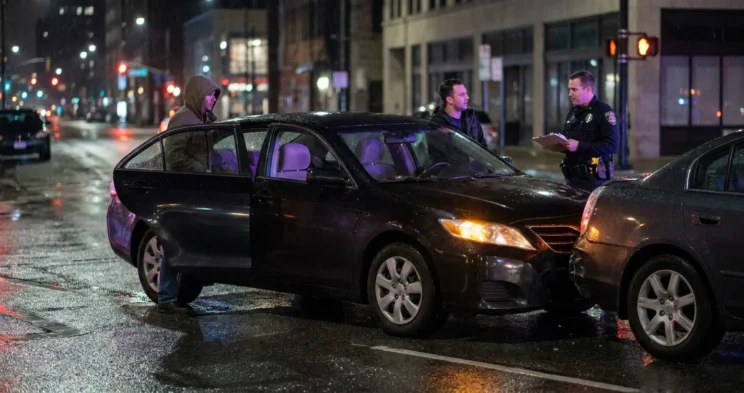
You were riding home from a night out in Deep Ellum when your Lyft driver got T-boned at a light off Commerce Street. Now your neck hurts, the bills are starting, and nobody will tell you who actually pays. Is it Lyft? The driver? Your own insurance?
Lyft’s Insurance Coverage Explained
Yes, Lyft’s insurance can cover you after a crash. How much you can recover depends entirely on what the driver was doing in the app when the accident happened.
Lyft does not offer one flat policy for every situation. Instead, it uses a tiered structure, and the coverage shifts based on the driver’s app status at the moment of the crash. Knowing your driver’s status is the first thing that decides how much money is on the table.
This setup exists because Texas law requires it. Texas Insurance Code Chapter 1954 sets the minimum coverage that every rideshare company, including Lyft, must carry.
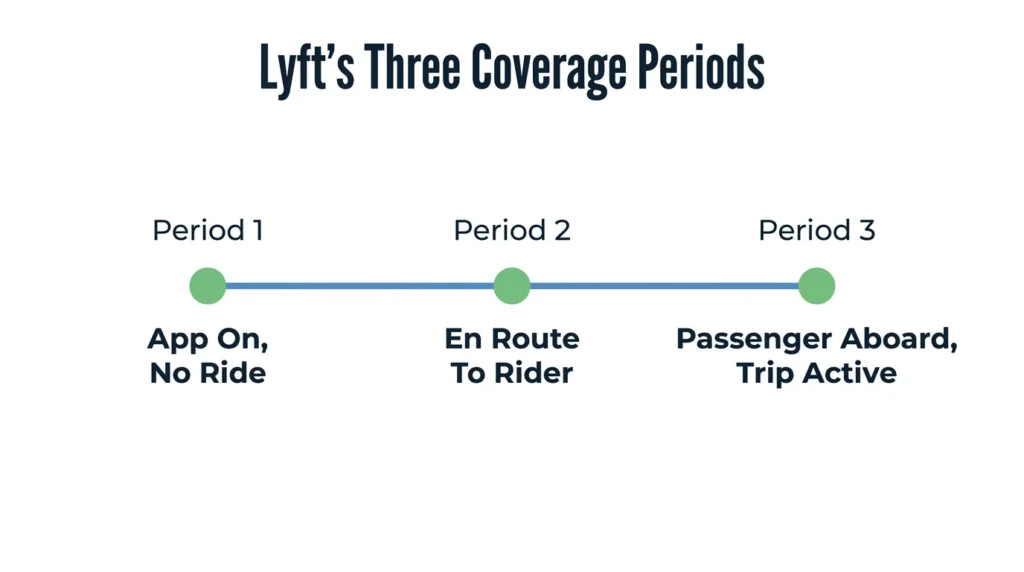
The law splits a Lyft trip into three coverage periods. Each period triggers different policy limits and different rules about which insurer pays first. The period that applies to your crash decides who responds and how much you can claim.
One more piece matters for your claim. Lyft treats its drivers as independent contractors, not employees. That classification makes it harder to hold Lyft directly responsible for a driver’s mistake, but it does not erase the company’s legal duty to carry the insurance Texas requires.
Period 1: App On, No Ride Accepted
Period 1 is the gap that leaves the most victims underinsured. When a Lyft driver has the app on but has not yet accepted a ride, the driver’s personal auto policy pays first. Lyft’s coverage is contingent, meaning it only kicks in if the driver’s own insurer denies or excludes the claim.
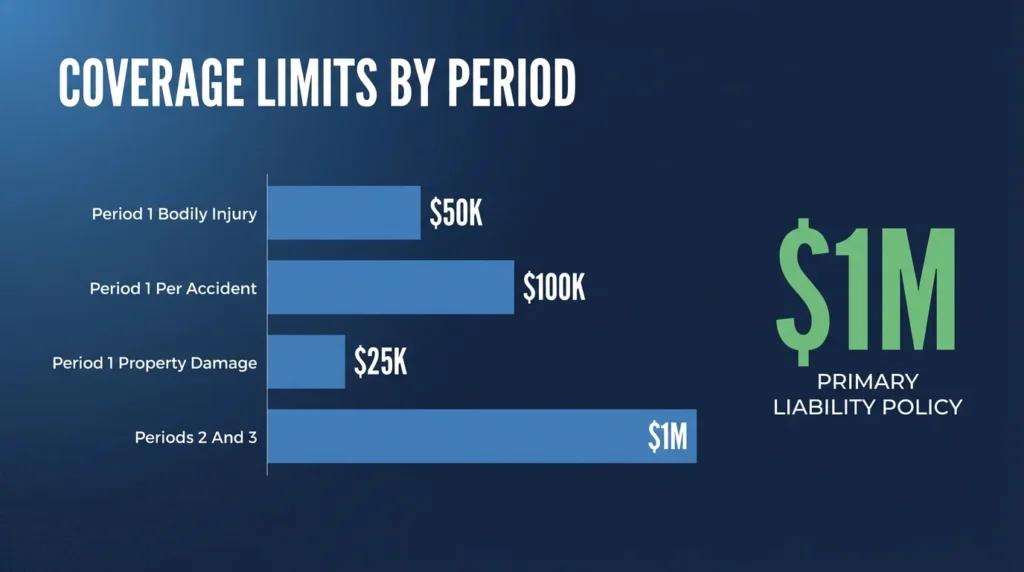
The limits here are low. Texas Insurance Code Section 1954.052 caps Period 1 contingent coverage at $50,000 per person for bodily injury, $100,000 per accident, and $25,000 for property damage. Those numbers fall far below what you can access in Periods 2 and 3.
There is a deeper problem. Many personal auto policies exclude commercial or rideshare driving. That means the driver’s personal insurer can deny the claim outright, leaving Lyft’s contingent policy as your only source of compensation.
This is why Period 1 is the riskiest window in the whole system. If your damages climb past those statutory limits and the driver carries no rideshare add-on, your compensation may hit a real ceiling, or limit. An attorney who handles these cases can find every policy layer that might apply.
Lyft confirms this contingent setup in its own published coverage details for drivers. Document which period was active at the exact moment of your crash, because that single fact controls your claim.
Periods 2 & 3: Ride Accepted Through Drop-Off
Once a Lyft driver accepts your ride, the coverage changes dramatically. From the moment of acceptance through drop-off, Lyft’s $1 million primary liability policy is active. The low Period 1 limits no longer apply.
Period 2: Ride Accepted, En Route to Passenger
Period 2 starts the second a driver accepts a ride request and ends when the passenger gets in the car. Lyft’s commercial policy is primarily under Texas Insurance Code Section 1954.053, with a $1 million limit.
That same section and that same $1 million limit also govern Period 3, covering the entire ride from acceptance through drop-off. The driver’s personal policy drops to secondary.
This coverage reaches beyond the driver. If a Lyft driver hits you while heading to a pickup, you can claim against that $1 million policy as a third party. That protection applies whether you were in another car, on a bike, or crossing the street on foot.
Period 3: Passenger Aboard Through Drop-Off
Period 3 covers the active trip, from the moment you climb in until the driver drops you off. The $1 million primary policy applies the entire time. As a passenger, you claim directly against Lyft’s commercial insurer.
You do not have to prove the driver’s personal policy applies or was denied first. The commercial coverage responds to your injuries right away.
Lyft also carries uninsured and underinsured motorist coverage during Periods 2 and 3, along with contingent collision coverage. If an uninsured driver hits your Lyft, that coverage can pay both you and the driver.
Can You Sue Lyft Directly in Texas?
Suing Lyft as a company is harder than filing against its insurance, because Lyft classifies drivers as independent contractors. Texas courts have largely backed that classification, which limits your ability to hold Lyft responsible for a driver’s negligence the way you could blame an employer.
That does not close every door. Lyft can still face direct claims based on its own conduct, such as negligent driver screening or breaking the rideshare rules enforced by the Texas Department of Licensing and Regulation.
Fault can also be split among several parties. Texas Civil Practice and Remedies Code Chapter 33 governs proportionate responsibility when more than one driver shares blame. Each party’s percentage of fault sets how much they owe, which can make a multi-car Lyft claim more complicated to sort out.
You also face a hard deadline. Texas Civil Practice and Remedies Code (CPRC) § 16.003 gives you two years from the crash to file suit. Miss it, and your right to recover is almost certainly gone, no matter how strong your case. The strategy behind a direct claim against Lyft often turns on acting well before that clock runs out.
Steps to Take After a Lyft Accident in Texas
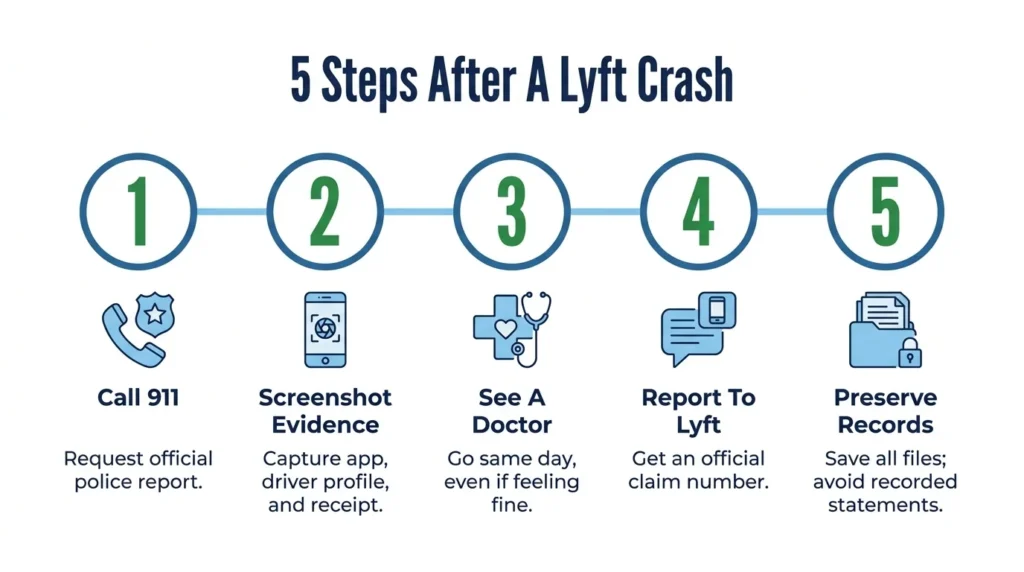
Your first move is to call 911 and lock down the facts before you leave the scene. The actions you take in the first hours protect your claim more than almost anything an attorney can do later:
- Step 1: Call 911 and request a police report. The report documents the driver’s app status at the time of the crash. That single detail is the foundation for figuring out which coverage period applies.
- Step 2: Screenshot the Lyft app, the driver’s profile, and the trip receipt. Lyft’s internal records can be pulled later through legal process, but your own screenshots fill the gaps if those records are ever disputed.
- Step 3: See a doctor the same day, even if you feel fine. Symptoms from a crash can take time to surface. A gap in treatment helps the insurer argue that the crash did not cause your injuries.
- Step 4: Report the accident to Lyft through the app. Lyft assigns a claim number that pulls its insurer into the process and starts the clock on the claims timeline.
- Step 5: Save every record and stay quiet with insurers. Keep all messages, medical files, and receipts. Do not give a recorded statement to any insurer before you talk to a lawyer.
Talk to an Attorney Today
Lyft accident claims pull together personal policies, contingent coverage, and a $1 million commercial policy, all governed by which period applied at the moment of the crash. Sorting through those layers alone, while you are hurt and facing bills, is a lot to ask of anyone.
Angel Reyes & Associates has guided injured Texans through situations like this for over 30 years, with more than $1 billion recovered for clients. We work on contingency, so there is no fee unless we win, and your first consultation is always free.
We can identify every coverage layer in your case, including uninsured motorist benefits, and handle the insurer calls so you can focus on healing. Reach out to us for a free consultation and let our attorneys review your options.
Past results do not guarantee future outcomes.
Lyft Accident Coverage FAQs
What if the driver who hit my Lyft wasn't my Lyft driver?
You would file a liability claim against the at-fault driver’s auto insurance first. If that driver was uninsured or their policy was too small to cover your damages, Lyft’s uninsured/underinsured motorist coverage, active during Periods 2 and 3, can cover the remaining losses.
Can not wearing a seatbelt reduce how much I recover after a Lyft accident?
Texas uses a modified comparative negligence rule, meaning any fault assigned to you reduces your recovery by that percentage. An insurer could argue that not wearing a seatbelt contributed to your injuries and use that to lower your payout.
Does Lyft's insurance cover the Lyft driver's own injuries?
Lyft’s liability and UM/UIM policies are designed to cover passengers and third parties, not the driver’s own medical bills. In Texas, the driver would need to rely on personal health insurance or any PIP coverage on their own policy, since Lyft’s occupational accident coverage is not currently available in Texas.
What if my Lyft driver was also logged into the Uber app at the time of the crash?
If a driver was active on two rideshare platforms at once, both companies’ insurers may dispute which policy responds, creating coverage delays. The claim can become significantly more complex, and sorting out which policy applies often requires legal review.
Are Lyft drivers in Texas required to carry their own rideshare insurance?
Texas law requires rideshare drivers to maintain coverage for all periods of a trip, which standard personal auto policies typically do not provide. Drivers need either a rideshare endorsement added to their personal policy or a separate commercial auto policy to stay compliant and covered.
About the Authors

Angel Reyes
Writer
Angel L. Reyes, III is the Founder and Managing Partner of Angel Reyes & Associates. A nationally recognized trial attorney and business leader, Angel has helped over 70,000 injury victims recover more than $1 billion since founding the firm in 1993. Named to the Texas Super Lawyers list annually since 2008, Angel brings Wall Street experience, Ivy League education, and a deep commitment to client advocacy. He is a frequent legal commentator and published author with extensive contributions to legal scholarship, trial strategy, and consumer protection.

Kyle Nicolas
Editor
Kyle Nicolas is the Web Content & SEO Manager at Angel Reyes & Associates. He has more than 10 years of experience as a marketing co...

Angel Reyes
Reviewer
Angel L. Reyes, III is the Founder and Managing Partner of Angel Reyes & Associates. A nationally recognized trial attorney and business...