How Do You Prove Mental Anguish in Texas?


Every article on this site is researched by our internal team, reviewed for legal accuracy against current Texas law, and held to State Bar of Texas advertising standards before publication. We do not publish content that overstates outcomes or makes promises about results.
Learn more about our
editorial standards .
Key Takeaways
- Texas requires proof that you suffered mental anguish and evidence that supports the amount of damages awarded.
- The evidence must show a substantial disruption to your daily life or a high degree of mental pain and distress.
- Specific details about changes in your daily life are stronger than general statements and can help support an award on appeal.

You are trying to explain to a jury what a crash has done to you long after your physical injuries have started to heal. You have trouble sleeping, you no longer enjoy things you once did, and you feel the emotional effects throughout your daily life.
When it comes to proving mental anguish damages in Texas, simply telling a jury that you are suffering may not be enough.
A successful claim generally requires evidence supporting two questions:
- Did you experience compensable mental anguish?
- What amount of damages reasonably reflects that harm?
To answer the first question, you need specific evidence about the nature, duration, and severity of your emotional suffering. General statements that you were “upset,” “stressed,” or “devastated” may not provide enough detail.
Texas appellate courts have repeatedly focused on whether the record contains enough evidence to show what the plaintiff experienced. Specific evidence about how an injury has affected your life can help give the jury a clearer picture of your suffering.
The Two Requirements for Mental Anguish Damages
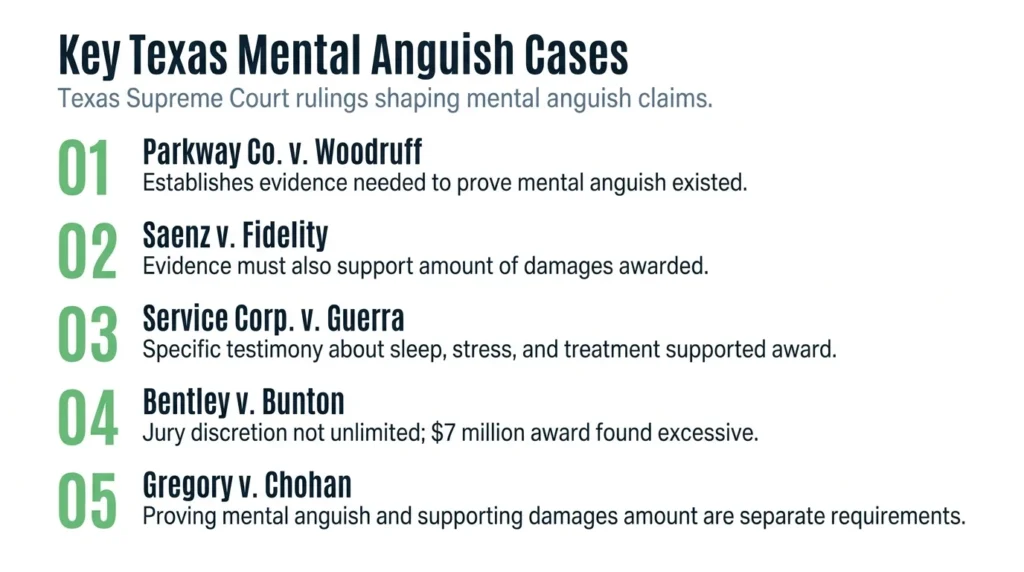
Mental anguish is a type of noneconomic damage recognized under Texas law. To recover these damages, you must provide evidence that you suffered mental anguish and evidence that supports the amount awarded.
Two Texas Supreme Court cases help explain what you need to prove by addressing both parts of a mental anguish claim:
- Parkway Co. v. Woodruff addresses the evidence needed to establish mental anguish.
- Saenz v. Fidelity & Guaranty Insurance Underwriters explains that the evidence must also support the amount of damages awarded.
How Texas Courts Evaluate Mental Anguish
Texas courts look for evidence showing the nature, duration, and severity of your mental anguish.
Texas courts have recognized two ways that evidence can establish legally sufficient mental anguish:
- A significant disruption to your daily life: The evidence should describe how your mental anguish has affected your daily routine.
- A high degree of mental pain and distress: If direct evidence of disruption is limited, then the evidence must show more than just worry, anxiety, embarrassment, frustration, or anger.
You do not have to prove both. Either type of evidence can support a mental anguish award.
Texas also does not recognize negligent infliction of emotional distress as a separate general claim. Mental anguish damages must be tied to another legal duty breached by the defendant.
How to Build Evidence of Mental Anguish

Your testimony can be an important part of your claim. It is most useful when you describe specific changes in your life that other people could have observed.
Examples include:
- Sleep: How much sleep you lost and how long it lasted
- Eating: Changes in your appetite or eating habits
- Work: Time you missed from work or work tasks you can no longer perform
- Driving: Being unable to drive after the crash
- Parenting and household tasks: Routines you can no longer manage
- Hobbies and social activities: Hobbies, church activities, or social events you have stopped attending
- Treatment: Counseling you started or medications your doctor prescribed
Explain how long each change lasted. Specific, observable changes to your daily life are more useful than general descriptions.
Family members, friends, and coworkers can also describe changes in your behavior that you may not notice yourself. Their observations can help show how your emotional condition has affected your daily life.
Texas law does not require a psychiatric diagnosis or expert testimony in every mental anguish case. Your testimony, along with observations from people who know you, can provide important evidence.
If you received counseling, therapy, or medication, these records can also support your claim. Tell your treating doctor about changes in your sleep, mood, and appetite, so they can be documented in your medical records.
Build this record while the details are still fresh. Keep a short weekly note about what you could not do, when it happened, and how long it lasted. Other records (such as pay stubs and messages) may also help show how your injuries have affected your daily life.
What Texas Cases Show About Mental Anguish Evidence
Texas appellate courts have reversed mental anguish awards when the evidence was too general.
These cases show why specific details about how your life has changed are important:
- In Parkway Co. v. Woodruff, general statements about being upset were not enough to support the mental anguish award.
- In Service Corp. International v. Guerra, some family members described the emotional effects in general terms. However, Mrs. Guerra provided more specific testimony about sleep problems, severe stress, physical symptoms, and treatment.
These cases show the value of details. Telling a jury that you were devastated or upset gives them a general description of how you felt. Explaining what changed in your daily life, how long those changes lasted, and how severely they affected you gives the jury more evidence to consider.
How to Prove the Value of Mental Anguish Damages
Proving that you suffered mental anguish is only the first step. You also need evidence that supports the amount of compensation awarded.
Texas courts have made clear that juries have some flexibility when deciding how much to award for noneconomic harm, but that flexibility does not mean an award can be based on speculation or unsupported numbers.
Two Texas Supreme Court cases help illustrate how courts evaluate the evidence that supports the amount awarded for mental anguish:
- Bentley v. Bunton: The Texas Supreme Court held that the evidence supported some mental anguish damages but not the jury’s $7 million award. The case shows that a jury has discretion when valuing noneconomic damages, but that discretion is not unlimited.
- Gregory v. Chohan: The Texas Supreme Court explained that proving the existence of mental anguish and supporting the amount awarded are separate requirements. Evidence must provide a basis for the amount of noneconomic damages awarded.
Talk to Angel Reyes & Associates About Your Mental Anguish Claim in Texas
Detailed evidence can make an important difference when you seek compensation for how an injury has changed your life. Keep a written record of changes in your daily activities, work, relationships, and other parts of your life, and update it as your recovery progresses.
Angel Reyes & Associates has guided injured Texans through this process for over 30 years, and we have recovered more than $1 billion for our clients. We work on contingency, which means you pay no fees unless we win your case.
Reach out to Angel Reyes & Associates for a free consultation today to discuss your situation, the evidence that may support your claim, and your legal options.
Past results do not guarantee future outcomes.
Mental Anguish FAQs
Can I recover mental anguish damages without a physical injury?
Yes, but not as a standalone claim. Texas does not recognize a general claim for negligent infliction of emotional distress, so your mental anguish must be connected to the defendant’s breach of another legal duty. Your distress does not have to cause physical symptoms.
Can witnessing someone get injured in a crash cause emotional distress?
Yes. Seeing another person seriously injured or killed can cause fear, anxiety, nightmares, or other emotional problems. Whether you can recover damages depends on the specific facts and legal claim involved.
What happens if I was already dealing with anxiety or depression before the accident?
You may still have a claim for mental anguish that was caused or worsened by the accident. The important question is how the crash affected your condition and what changed afterward.
Can I recover damages for mental anguish if my physical injuries have already healed?
Potentially. Emotional suffering can continue even after physical injuries improve. Your evidence would need to show that the accident caused compensable emotional harm.
How long do I have to file a mental anguish claim after a car accident in Texas?
Mental anguish is generally part of a personal injury claim rather than a separate lawsuit. Texas generally gives you two years to file a personal injury lawsuit, although exceptions can change the deadline in some cases.
About the Authors

Angel Reyes
Writer
Angel L. Reyes, III is the Founder and Managing Partner of Angel Reyes & Associates. A nationally recognized trial attorney and business leader, Angel founded the firm in 1993, which has gone on to help over 70,000 injury victims recover more than $1 billion. Named to the Texas Super Lawyers list annually since 2008, Angel brings Wall Street experience, Ivy League education, and a deep commitment to client advocacy. He is a frequent legal commentator and published author with extensive contributions to legal scholarship, trial strategy, and consumer protection.

Kyle Nicolas
Editor
Kyle Nicolas is the Web Content & SEO Manager at Angel Reyes & Associates. He has more than 10 years of experience as a marketing co...

Angel Reyes
Reviewer
Angel L. Reyes, III is the Founder and Managing Partner of Angel Reyes & Associates. A nationally recognized trial attorney and business...