Injured Waiting for an Uber or Lyft in Texas?


Every article on this site is researched by our internal team, reviewed for legal accuracy against current Texas law, and held to State Bar of Texas advertising standards before publication. We do not publish content that overstates outcomes or makes promises about results.
Learn more about our
editorial standards .
Key Takeaways
- Period 2 turns on the $1 million rideshare policy the moment your driver accepts the ride.
- App screenshots showing the driver's status at injury are your strongest evidence.
- Texas gives you two years from the injury date to file a pickup zone injury lawsuit.
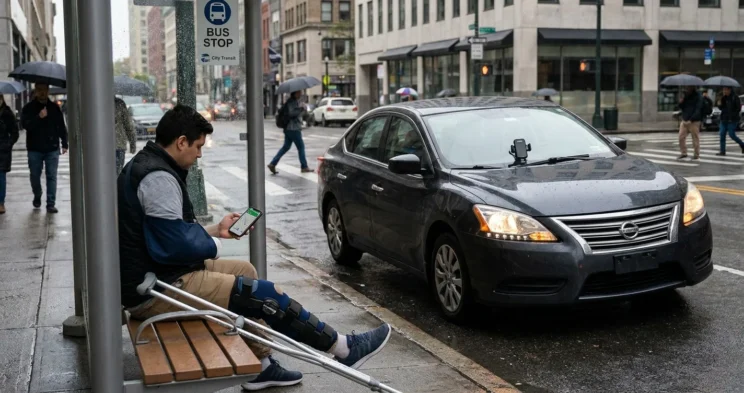
You were standing on the curb outside a bar in Midtown Houston, watching your driver’s icon crawl toward you on the map. Then a car clipped you before you ever reached for the door handle. Now you are hurt, your ride never happened, and you have no idea whose insurance applies.
You Don’t Have to Be in the Car to Be Covered
Standing outside the vehicle at a pickup curb does not automatically lock you out of insurance coverage. The law ties coverage to the driver’s app status at the moment you were hurt, not to whether you had a seatbelt on yet.
This is one of the most common rideshare pickup location accident scenarios, and it confuses people for a reason. You feel like a passenger. You requested the ride, the driver was coming, and you were waiting where the app told you to wait. The insurance system looks at something narrower than that.
What it looks at is the coverage period. Texas sets the rules for transportation network company insurance under Texas Insurance Code Chapter 1954. The period that was active the instant you were injured controls which policy responds to your claim.
So the single most useful thing you can do is pin down the driver’s exact status. Was the driver offline? Available but not yet matched with anyone? On the way to pick you up? Already carrying another passenger?
The answer lives in your phone. Screenshots of the app showing the trip acceptance, the driver’s name, the ETA, and the time of the match are your primary proof that the driver had accepted your ride.
Which Coverage Period Applies at Pickup?
For most people hurt while waiting on an already-matched driver, the answer is Period 2, and that is the period that unlocks the large commercial policy. The app status at the moment of injury decides everything, so getting the timeline right is worth more than almost any other detail.
Period 1 vs. Period 2: The Coverage Gap That Matters
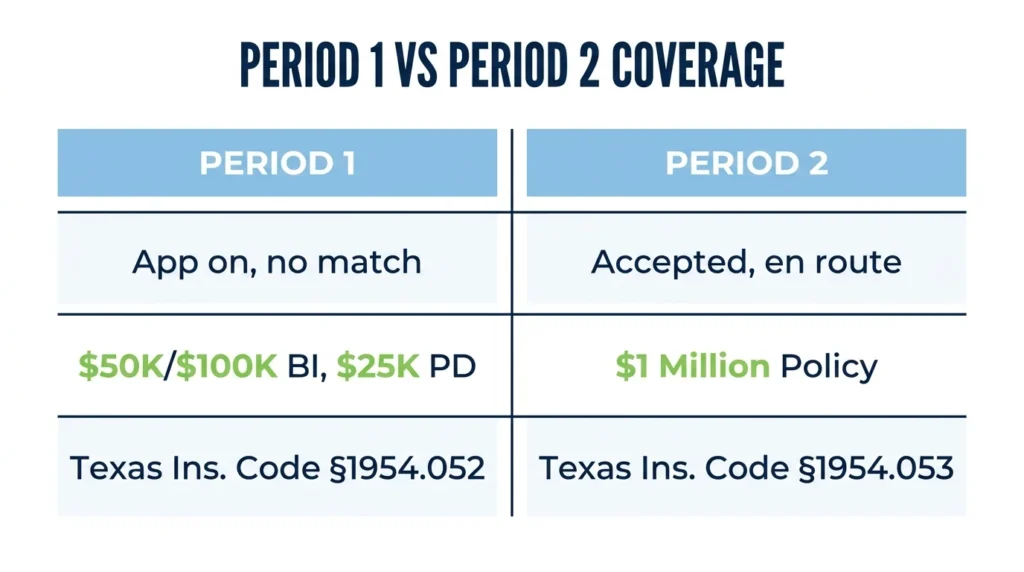
In Period 1, the driver’s app is on but no ride has been accepted yet. Texas law requires lower minimum limits here under Texas Insurance Code § 1954.052: $50,000 per person and $100,000 per accident for bodily injury, plus $25,000 for property damage.
Period 2 changes the math completely. The driver has accepted your ride and is on the way to you.
Under Texas Insurance Code § 1954.053, the $1,000,000 commercial liability policy turns on the moment the driver accepts, not the moment you climb in.
That timing is the whole point for someone hurt at the curb. If a driver had already accepted your request and was en route, you are likely in a Period 2 situation. The full $1 million policy is in play even though you never got in the car.
What If Another Car Hit You at the Pickup Zone?
If a different vehicle struck you while you waited, the at-fault driver’s personal auto liability coverage is your primary claim path, not the rideshare policy. The driver who hit you is responsible for the harm they caused.
That changes if the driver who hit you has no insurance or not enough of it. At that point your own uninsured and underinsured motorist coverage can come into play, so check whether your personal auto policy includes UM/UIM. Unless you requested to remove this coverage in writing, your plan should include it.
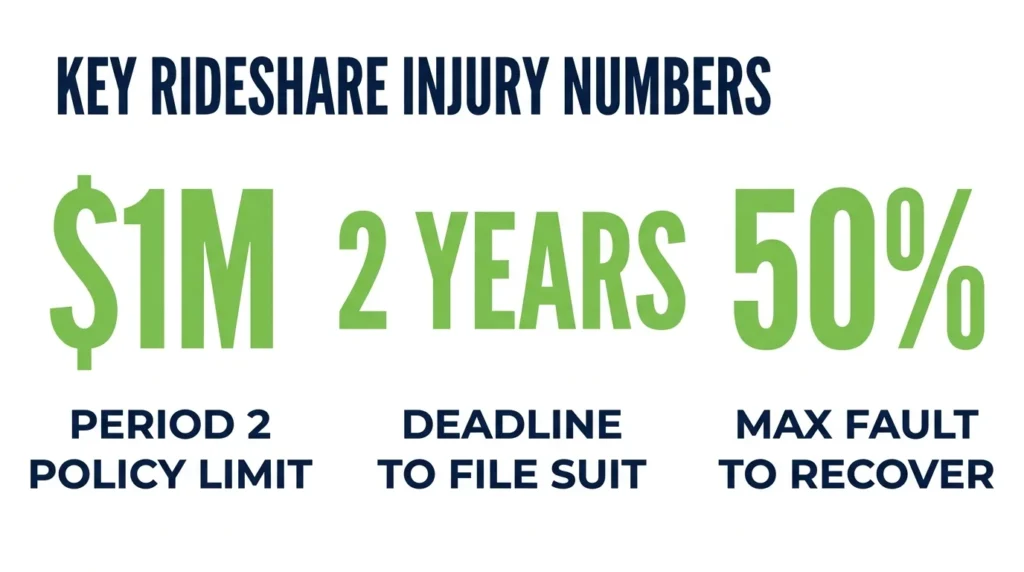
It helps to understand what the rideshare policy does and does not do here. Uber and Lyft’s $1 million policy covers the liability of the rideshare driver. It is not a catch-all that pays for every at-fault party at the scene.
Texas also splits fault among everyone involved. Under Texas Civil Practice and Remedies Code (CPRC) § 33.001, your recovery drops by your share of the blame. You can still recover as long as your share of fault does not pass 50%.
Pickup Zone Injuries Beyond Vehicle Strikes
Not every pickup zone injury comes from a moving car. Uneven pavement, poor lighting, missing barriers, and wet surfaces at hotel curbs, airport staging areas, and mall drop-off lanes injure waiting riders too.
When that happens on property someone else controls, the picture shifts toward premises liability. An airport authority, a hotel, or a shopping center may owe a duty to keep its pickup area reasonably safe for the people using it as intended.
To win a premises liability claim in Texas, you have to show the property owner knew or should have known about the dangerous condition and failed to warn you or fix it.
Steps to Take After a Pickup Zone Injury
Your first move is medical care, and your second is preserving the app data before it disappears. These steps protect both your health and your claim:
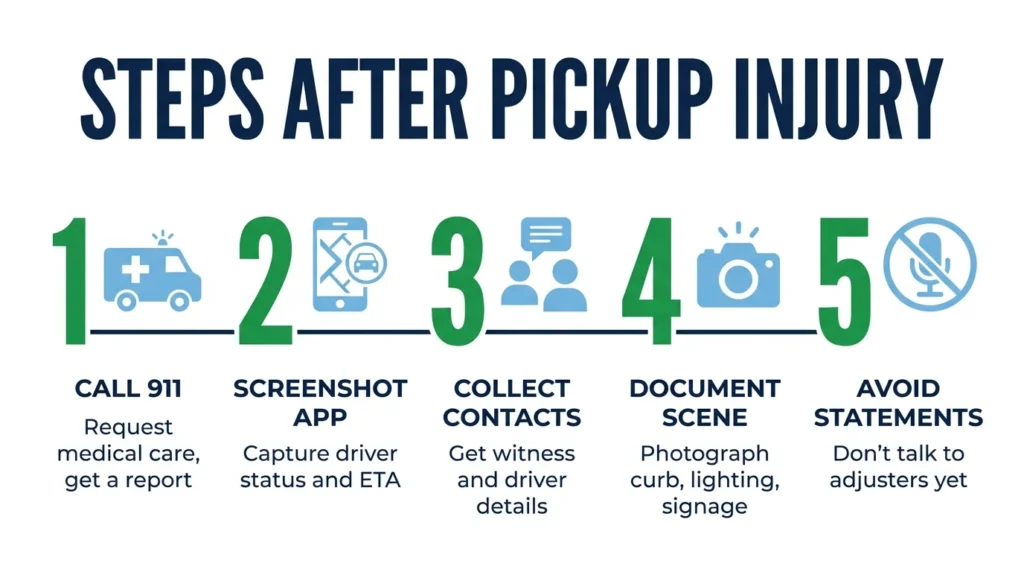
- Step 1: Call 911 and request medical attention. Even if the injury feels minor, a formal report documents the location, date, and everyone involved.
- Step 2: Screenshot the rideshare app before it updates. Capture the driver’s name, the matched status, the ETA, and the map showing the driver’s position. This data is your best evidence of which coverage period was active.
- Step 3: Collect contact information from everyone present. Get details from all drivers, witnesses, and any property owners or managers. At commercial properties, ask for the manager on duty.
- Step 4: Document the physical scene. Photograph the curb, signage, lighting, barriers, pavement, and any markings designating the pickup zone.
- Step 5: Do not give a recorded statement to any insurance adjuster. That includes the rideshare company’s insurer. Wait until you have spoken to an attorney.
One deadline sits over all of this. Texas gives you two years from the date of your injury to file a personal injury lawsuit under Texas Civil Practice and Remedies Code § 16.003.
Talk to an Experienced Attorney
Getting hurt at a pickup spot leaves you with a confusing mix of policies, deadlines, and adjusters who would rather you settle fast and cheap. You do not have to sort it out alone. Angel Reyes & Associates has handled rideshare injury claims across Texas for over 30 years, and we know how to trace coverage when you were hurt outside the car.
Your first consultation is free, and we work on contingency, which means no fee unless we win. Our work has produced more than $1 billion recovered for clients. Reach out to us for a free consultation.
Past results do not guarantee future outcomes.
Uber & Lyft Wait-Related Injury FAQs
What if I don't own a car and have no personal auto insurance of my own?
You can still pursue the at-fault driver’s liability coverage, and if the driver who hit you had no insurance, the rideshare company’s UM/UIM coverage during Period 2 is another potential source of recovery. Not having your own auto policy does not bar you from making a claim against other available policies.
Does Period 2 still apply if the driver cancels the trip right after I was hurt?
Coverage is determined by the driver’s app status at the exact moment of injury, not by what happened afterward. If the driver had accepted your ride and was en route when you were hurt, the injury falls within Period 2 regardless of any cancellation that followed.
Does personal injury protection (PIP) have any role in a pickup zone injury claim in Texas?
If you have a personal auto policy in Texas and did not opt out of PIP in writing, your PIP coverage can pay for immediate medical expenses and lost wages regardless of fault. It can provide faster access to funds than waiting for a liability claim to resolve.
About the Authors

Angel Reyes
Writer
Angel L. Reyes, III is the Founder and Managing Partner of Angel Reyes & Associates. A nationally recognized trial attorney and business leader, Angel has helped over 70,000 injury victims recover more than $1 billion since founding the firm in 1993. Named to the Texas Super Lawyers list annually since 2008, Angel brings Wall Street experience, Ivy League education, and a deep commitment to client advocacy. He is a frequent legal commentator and published author with extensive contributions to legal scholarship, trial strategy, and consumer protection.

Kyle Nicolas
Editor
Kyle Nicolas is the Web Content & SEO Manager at Angel Reyes & Associates. He has more than 10 years of experience as a marketing co...

Angel Reyes
Reviewer
Angel L. Reyes, III is the Founder and Managing Partner of Angel Reyes & Associates. A nationally recognized trial attorney and business...