Rideshare Accidents Involving Off-Route or Lost Drivers


Every article on this site is researched by our internal team, reviewed for legal accuracy against current Texas law, and held to State Bar of Texas advertising standards before publication. We do not publish content that overstates outcomes or makes promises about results.
Learn more about our
editorial standards .
Key Takeaways
- An off-route detour does not void Uber or Lyft coverage during an active trip in Texas.
- A passenger crash during Period 3 triggers the $1 million primary liability policy.
- Texas gives injured rideshare passengers two years from the crash date to file a claim.
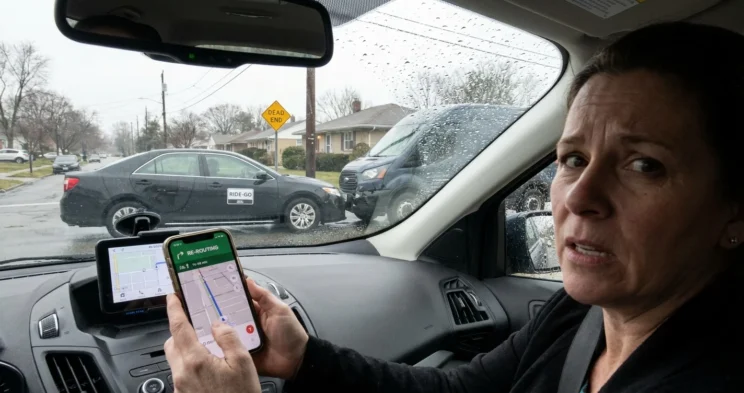
You were riding home through Austin late one night when your Uber driver kept glancing at the GPS, unsure which exit to take off Loop 1. The car drifted, then jerked back, and the next thing you felt was the impact. Now, you’re injured, and you are wondering whether the driver’s confusion changes who pays your hospital bills.
Rideshare Driver Negligence Caused by GPS Distraction
A rideshare driver who looks at a navigation app while the car is moving is considered to be driving distracted under Texas negligence law. The driver owes the passenger and everyone else on the road a duty of reasonable care, and the distraction does not have to be dramatic to cause a problem. Glancing at a phone-mounted GPS, reentering a destination, or suddenly yanking the wheel after missing a turn all take the driver’s attention off the road. The problem is the inattention, not the GPS device itself.
Driving in an unfamiliar area can strengthen a negligence claim. A driver who knows they are lost is expected to slow down, pull over, or pay closer attention to the road. Juries consider this when they decide whether the driver acted reasonably.
A navigation app is no substitute for traffic law. An incorrect GPS prompt does not excuse an illegal turn, a failure to yield, or a wrong-way entry onto a one-way street. The driver is responsible for every move they make behind the wheel.
If you believe a distracted driver caused your crash, you can learn how distracted driving claims apply under Texas law.
Rideshare Insurance Coverage Periods in Texas
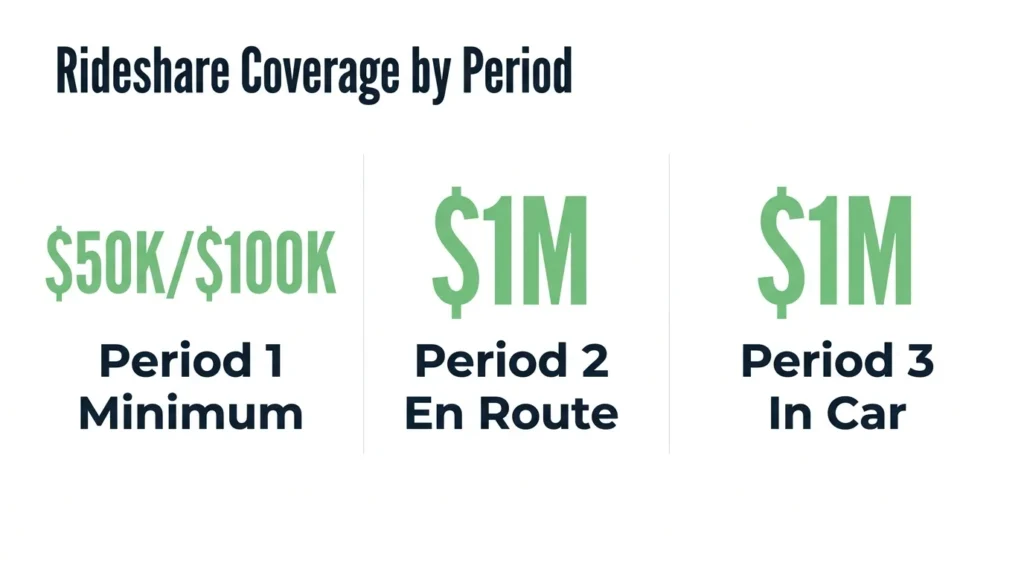
The Texas Insurance Code Chapter 1954 uses three different operating periods to determine rideshare insurance coverage, and the amount of insurance available depends on what period was in effect at the moment of the crash:
- Period 1 occurs if the app is on but no ride has been accepted yet.
- Period 2 starts when the driver accepts a trip and is heading toward the passenger.
- Period 3 occurs while a passenger is in the car.
During Period 1, the Texas Insurance Code § 1954.052 requires contingent liability coverage of at least $50,000 per person and $100,000 per accident. This lower tier applies only before the driver accepts a trip.
Periods 2 and 3 trigger a $1 million primary liability policy under Texas Insurance Code § 1954.053. If you were a passenger, this is almost certainly the coverage you are dealing with, because your trip was already active at the time of the crash.
For a closer look at how each period works, view our guide on the full coverage structure and common crash scenarios.
These requirements are also laid out in the Texas Occupations Code Chapter 2402, which sets the operating rules for companies like Uber and Lyft. You can see how our firm handles these claims on our rideshare accident page.
Does an Off-Route Deviation Affect Your Coverage?
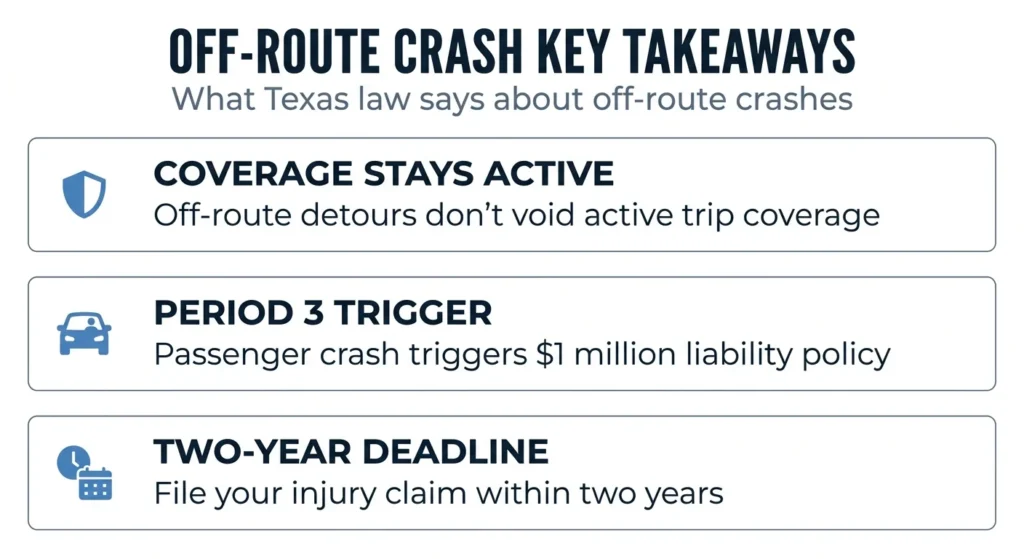
The driver’s app status at the moment of impact decides which coverage applies, not whether the driver was on the right route. A crash during Period 3 triggers the $1 million policy, whether the driver was on course or driving around in circles.
Uber and Lyft do not cancel coverage because a driver wandered off the best route. The insurance obligation begins the moment the driver accepts the trip and applies until the moment you are dropped off. A wrong turn inside that window does not negate the policy. See our breakdown of what happens after an Uber crash for a detailed explanation.
However, if the driver was off the route, it may provide evidence that the driver was confused, repeatedly course-correcting, or reacting to navigation prompts, which supports a distracted driving claim. So, if the driver was off the route, it’s more relevant to who is at fault than which coverage applies.
Determining the active insurance period at the time of the crash is one of the first steps in evaluating a rideshare injury claim. See our guide on what to do after a rideshare crash for a step-by-step explanation.
Evidence, Fault, & Filing Deadlines
GPS trip data, timestamped route logs, and driver activity records can prove what actually occurred during a crash that happened off route. These records can confirm whether the driver deviated from the route or used a navigation app. They can also confirm the driver’s app status at the time of impact. You can obtain these records through the insurance claims process or litigation.
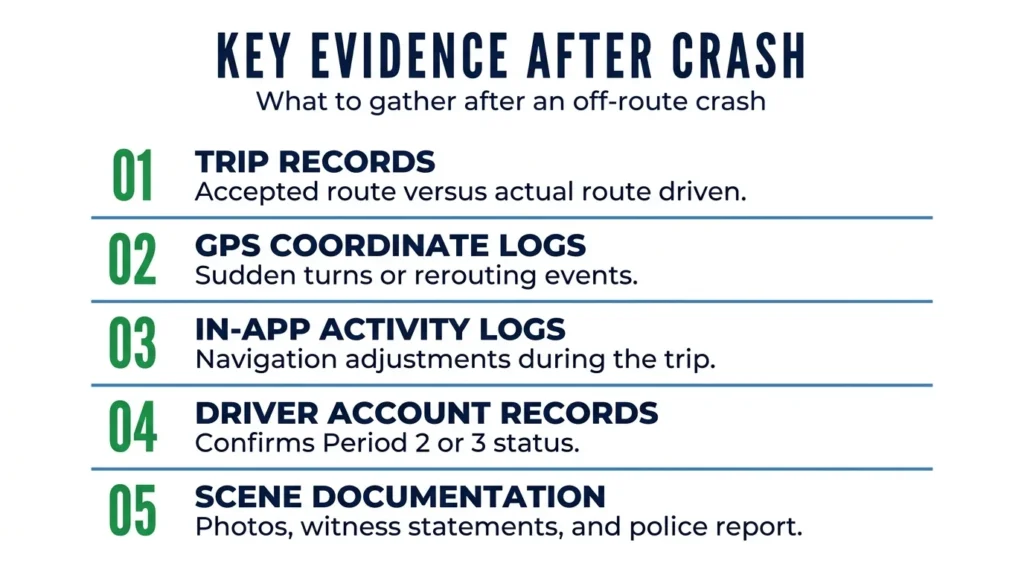
After a rideshare crash that happened off route, these categories of evidence are the most important to procure:
- Trip records showing the accepted route versus the route that was actually driven
- GPS coordinate logs reflecting sudden turns or rerouting events
- In-app activity logs capturing navigation adjustments during the trip
- Driver account records confirming Period 2 or Period 3 status at the time of impact
- Photos, witness statements, and the police report documenting the scene
Texas uses a fault-sharing rule under the Texas Civil Practice and Remedies Code Chapter 33. This means if you are found to be 51 percent or more at fault in a crash, you cannot recover any compensation for your injuries. However, in rideshare crashes that happen off route, fault almost always lands on the driver, not the passenger.
The CPRC § 16.003 gives you a deadline of two years from the crash date to file a personal injury claim. If you miss that deadline, then you lose the right to recover any compensation.
Talk to an Attorney About Your Off-Route Rideshare Accident in Texas
If your rideshare driver got lost and it resulted in a crash, you may be dealing with injuries and a complicated insurance situation at the same time.
Angel Reyes & Associates has spent over 30 years helping injured Texans sort out these exact situations, and we have recovered more than $1 billion for clients. Read what past clients have said about working with us. outcomes.
Your initial consultation is free, and we work on contingency, which means you pay no fee unless we win. Contact us for a free consultation, so we can walk through your options.
Past results do not guarantee future
Lost or Off-Route Driver Accident FAQs
Can a passenger sue Uber or Lyft directly for an off-route crash, or only the driver?
Uber and Lyft classify drivers as “independent contractors,” which limits direct liability claims against the companies in most cases. Your primary claim will typically be filed against the driver through the platform’s insurance policy, which is separate from suing the company itself.
Does a rideshare driver's personal auto insurance cover passengers during an active trip?
In Texas, most personal auto policies exclude coverage while the driver is working for a rideshare platform. The rideshare company’s commercial policy is the primary source of coverage during Period 2 and Period 3, so the driver’s personal insurance is generally not responsible when a passenger is in the vehicle.
What happens if a third-party driver caused the crash while the rideshare driver was off-route?
If another driver is at fault, then your claim will be filed with that driver’s liability insurance first. The rideshare platform’s policy can also provide underinsured motorist coverage if the at-fault driver’s policy is not enough to cover your losses.
What if the rideshare driver turned off the app or went offline during the trip?
Coverage is tied to active trip status. If the driver dropped the app connection during an ongoing trip, then the coverage classification becomes disputed, and the circumstances of when the app went offline becomes a key issue in the claim.
Does Texas law require Uber and Lyft to have uninsured or underinsured motorist coverage?
Texas Insurance Code Chapter 1954 does not require rideshare companies to have uninsured or underinsured motorist coverage during Periods 2 and 3, but Uber and Lyft voluntarily include it in their commercial policies anyway. This coverage can apply if the driver who caused the crash had no insurance or not enough insurance to cover your damages.
About the Authors

Angel Reyes
Writer
Angel L. Reyes, III is the Founder and Managing Partner of Angel Reyes & Associates. A nationally recognized trial attorney and business leader, Angel has helped over 70,000 injury victims recover more than $1 billion since founding the firm in 1993. Named to the Texas Super Lawyers list annually since 2008, Angel brings Wall Street experience, Ivy League education, and a deep commitment to client advocacy. He is a frequent legal commentator and published author with extensive contributions to legal scholarship, trial strategy, and consumer protection.

Graham Griffin
Editor
Graham Griffin is the Web & Content Manager at Angel Reyes & Associates, where he oversees content strategy, AI-powered workflows, a...

Angel Reyes
Reviewer
Angel L. Reyes, III is the Founder and Managing Partner of Angel Reyes & Associates. A nationally recognized trial attorney and business...