When an Uber Hits a Pedestrian at a Crosswalk


Every article on this site is researched by our internal team, reviewed for legal accuracy against current Texas law, and held to State Bar of Texas advertising standards before publication. We do not publish content that overstates outcomes or makes promises about results.
Learn more about our
editorial standards .
Key Takeaways
- Texas drivers must yield to pedestrians lawfully crossing in a marked crosswalk.
- Uber's $1 million policy applies when the driver has a ride matched or in progress.
- You have two years from the crash date to file a Texas pedestrian injury lawsuit.
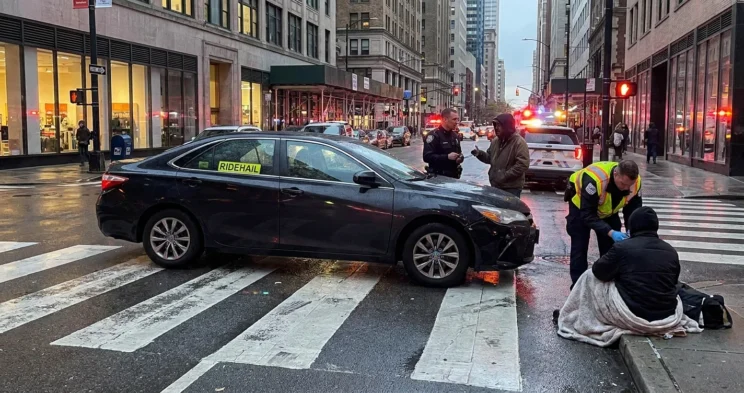
You stepped into the marked crosswalk on Westheimer Road with the walk signal in your favor, the way you have a hundred times before. Then an Uber turning toward a pickup clipped you, and now you are sitting in an emergency room with bills you never planned for. You did everything right, so why does the path to getting paid feel so uncertain?
Texas Law & Crosswalk Duty to Yield
Texas law puts the duty to stop squarely on the driver, not on you. When you were lawfully in a marked crosswalk, the driver was required to yield the right-of-way to you under Texas Transportation Code § 552.003.
A driver who fails to yield to a pedestrian in that crosswalk has violated a clear statutory duty. That violation becomes the anchor of the fault analysis in your case.
The duty does not stop there. Drivers must also use due care to avoid hitting any pedestrian on the roadway under Texas Transportation Code § 552.008, no matter who technically had the right-of-way.
This second rule closes a common escape hatch. The driver cannot point to a technicality in the right-of-way rules to wash their hands of hitting you.
When a rideshare driver strikes someone in a marked crosswalk, both rules come into play at once.
That combination makes liability far clearer than in most intersection crashes, where fault is often muddy and contested. If you want to understand how the pedestrian right-of-way works in practice, you can review pedestrian right-of-way rules in Texas.
Your position at the moment of impact still matters to a court. Judges look at whether you used a marked or unmarked crosswalk and whether you were crossing lawfully when the vehicle hit you.
Which Uber Insurance Period Applies?
Which insurance pays depends entirely on what the driver’s app was doing when you were hit. Texas Insurance Code Chapter 1954 requires Uber to carry different coverage levels for each stage of a driver’s app activity.
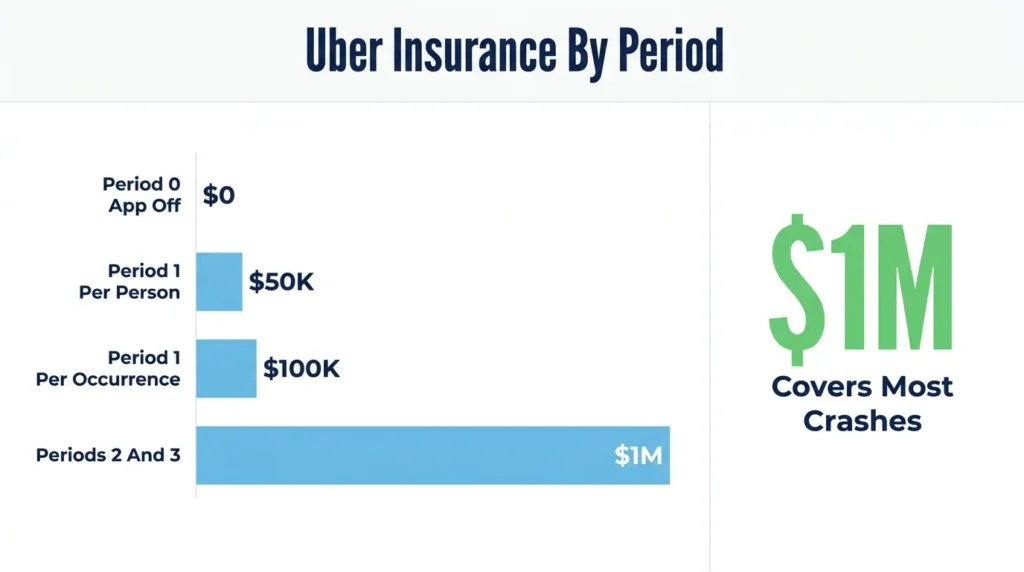
There are four stages. Period 0 means the app was off. Period 1 means the app was on but no ride was matched. Periods 2 and 3 cover everything from the moment a ride is matched through the drop-off.
In Period 0, Uber’s commercial policy does not apply at all. Only the driver’s personal auto insurance is in play, and most personal policies exclude rideshare driving. If you were hit during Period 0, you face the hardest road to full recovery.
Period 1 changes the picture. Once the app is on and the driver is waiting for a match, Uber must provide liability coverage of $50,000 per person and $100,000 per occurrence, plus $25,000 for property damage. This coverage applies independently. It does not require the driver’s personal insurer to deny the claim first.
Periods 2 and 3 are where the real protection lives. From the moment a ride is matched through the end of the trip, Uber’s $1 million primary commercial liability policy applies directly. Most crosswalk crashes happen while a driver is heading to a pickup or carrying a passenger, which places the majority of these cases squarely in that window.
The stage that was active when you were struck shapes everything that follows. You can learn more about Uber and Lyft insurance coverage periods, including how each one works and what it means for your claim. If you are not sure which period applied, you can learn how to obtain the driver’s app-status record as part of the rideshare accident claims process.
Fault, Comparative Responsibility & the 51% Bar
You can still recover compensation even if you were partly at fault, as long as your share does not climb too high. Under Texas Civil Practice and Remedies Code (CPRC) Chapter 33, you can recover only if your own fault does not exceed 51 percent. Cross that line and your recovery disappears entirely.
In a crosswalk crash where you were crossing lawfully, arguments that shift blame onto you tend to fall apart. The driver’s duty to yield under § 552.003 makes it hard to pin meaningful fault on a pedestrian who was in the marked crosswalk.
That will not stop Uber’s adjusters from trying. They often claim you crossed against the signal, that you were distracted by your phone, or that you stepped off the curb without warning. These claims deserve scrutiny, and solid evidence can knock them down.
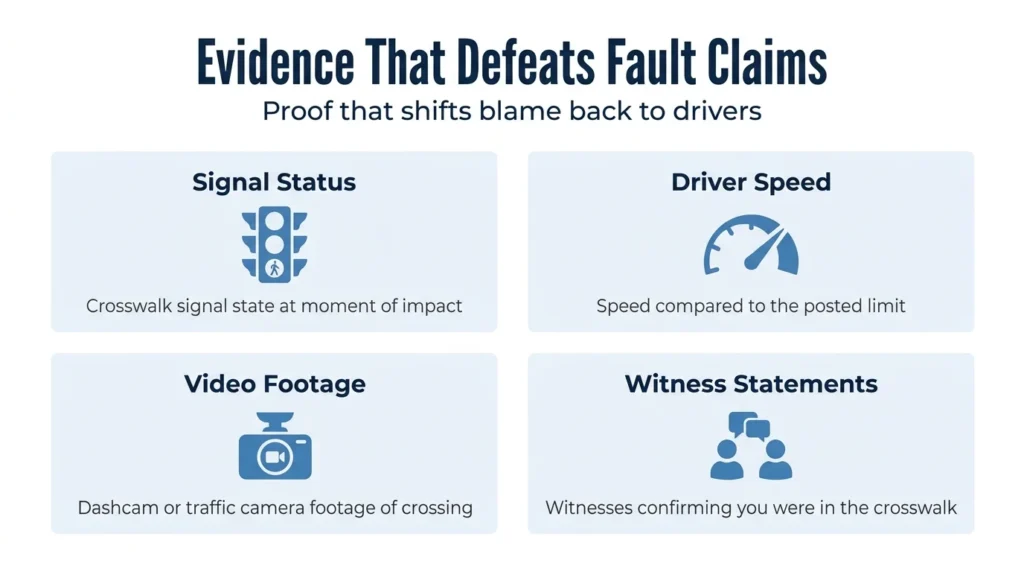
Certain proof tends to defeat a pedestrian-fault argument before it gains traction:
- The state of the crosswalk signal at the moment of impact
- The driver’s speed compared to the posted limit
- Dashcam or traffic camera footage of the crossing
- Witness statements confirming you were in the marked crosswalk
The sooner you gather this evidence, the harder it becomes for an insurer to rewrite what happened.
Compensation a Pedestrian Victim Can Pursue
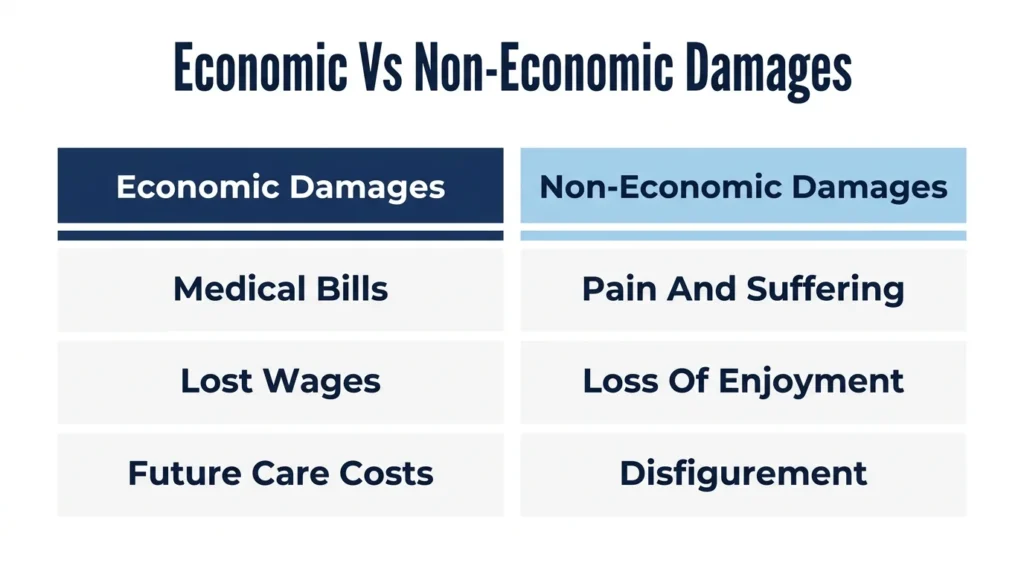
You can pursue two broad categories of damages after a rideshare crash. Economic damages cover your hard costs, such as medical bills, lost wages, and future care. Non-economic damages cover what you cannot put a receipt on, including pain and suffering, loss of enjoyment of life, and disfigurement.
Economic damages in these cases often run high. Crosswalk impacts tend to cause serious trauma, long recoveries, and lasting loss of earning power. If you want a sense of how these claims are valued, review average pedestrian accident settlements.
When a pedestrian dies from a rideshare crash, the family can file a wrongful death claim. Texas law lets a spouse, children, and parents recover compensation for lost companionship, mental anguish, and financial support.
Uber’s $1 million policy in Periods 2 and 3 is large enough to cover serious and even fatal injuries. A big policy does not mean an easy payout, though. The company will still fight you on both liability and the value of your damages. An attorney who knows rideshare claims can document your damages from day one and position the case for full recovery instead of a fast lowball offer.
Texas Statute of Limitations for Pedestrian Claims
You have two years from the date of the crash to file a personal injury lawsuit in Texas, set by Texas Civil Practice and Remedies Code § 16.003. Miss that window and you lose the right to seek compensation in court, no matter how strong your case is.
The two-year clock runs from the day you were hurt. It does not wait until you learn the full extent of your injuries or figure out who was at fault. A delay in recognizing how serious things are will not buy you more time.
If a family member died from the crash, the wrongful death claim carries its own two-year deadline. That clock runs from the date of death.
Acting early protects more than your deadline. It protects your evidence. Uber driver app-status data, dashcam recordings, and traffic camera footage all sit on short retention schedules and can be erased within weeks.
Work with an Experienced Attorney Today
Getting hit in a crosswalk by a rideshare driver leaves you facing medical bills, lost income, and an insurance system built to pay you as little as possible. Angel Reyes & Associates has spent over 30 years helping injured Texans handle rideshare and pedestrian injury claims across the state.
We work on contingency, which means no fee unless we win and no upfront cost to you. Our consultations are free, and our track record includes more than $1 billion recovered for clients. You can see how we have handled past claims through our case results.
When you are ready, reach out to us for a free consultation so we can review your crosswalk accident claim and walk you through your options.
Past results do not guarantee future outcomes.
Uber Driver Pedestrian Accidents FAQs
Can a pedestrian sue Uber directly, or only the driver?
A pedestrian can pursue claims against both the driver and Uber. Texas Insurance Code Chapter 1954 requires Uber to carry commercial liability insurance covering pedestrian injuries, so the victim has direct access to Uber’s policy regardless of how the driver is classified.
Can I use my own health insurance or car insurance while the Uber claim is pending?
Yes. Your health insurance can cover immediate medical bills, and if your auto policy includes uninsured or underinsured motorist coverage, it may apply even if you were on foot when you were hit. Using your own coverage does not waive your right to pursue Uber’s policy for the full value of your claim.
How do I find out which insurance period was active when I was hit?
A preservation letter sent to Uber shortly after the crash can lock down the driver’s app-status data, GPS logs, and ride history before they are deleted. Uber’s internal trip records will show whether the app was off, waiting for a match, or mid-trip at the moment of impact.
What if the Uber driver fled the scene after hitting me?
Fleeing the scene is a separate criminal offense under Texas law, but it does not end your civil claim. Uber’s internal trip records can help identify the driver, and your own UM coverage may provide compensation while that process plays out.
Does the two-year filing deadline change if the pedestrian was a child?
When the injured pedestrian is a minor, the two-year deadline is paused until their 18th birthday, giving them until age 20 to file suit. A parent can bring the claim on the child’s behalf before that date, and acting early preserves the strongest evidence.
About the Authors

Angel Reyes
Writer
Angel L. Reyes, III is the Founder and Managing Partner of Angel Reyes & Associates. A nationally recognized trial attorney and business leader, Angel has helped over 70,000 injury victims recover more than $1 billion since founding the firm in 1993. Named to the Texas Super Lawyers list annually since 2008, Angel brings Wall Street experience, Ivy League education, and a deep commitment to client advocacy. He is a frequent legal commentator and published author with extensive contributions to legal scholarship, trial strategy, and consumer protection.

Kyle Nicolas
Editor
Kyle Nicolas is the Web Content & SEO Manager at Angel Reyes & Associates. He has more than 10 years of experience as a marketing co...

Angel Reyes
Reviewer
Angel L. Reyes, III is the Founder and Managing Partner of Angel Reyes & Associates. A nationally recognized trial attorney and business...