Who Is Liable for a Work Zone Crash in Texas?


Every article on this site is researched by our internal team, reviewed for legal accuracy against current Texas law, and held to State Bar of Texas advertising standards before publication. We do not publish content that overstates outcomes or makes promises about results.
Learn more about our
editorial standards .
Key Takeaways
- A Texas work zone crash often has three defendants, not just the other driver.
- The contractor's traffic control plan decides whether Section 97.002 immunity holds.
- Claims against TxDOT can require written notice within six months of the crash.
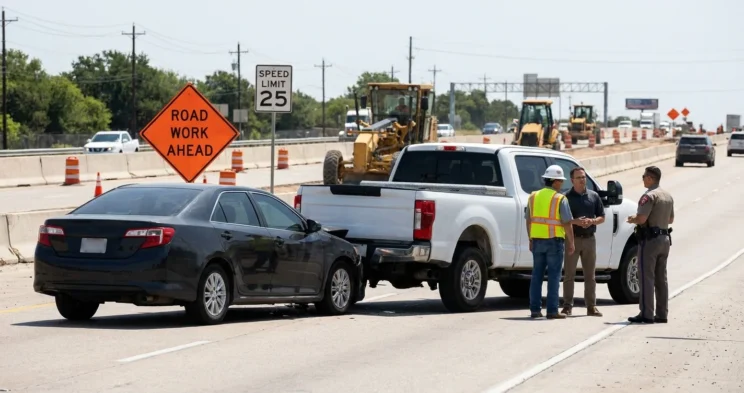
The orange barrels start a half mile back on I-35, two lanes squeeze into one, and the pickup behind you never slows down. The other driver may appear responsible, but a work zone crash can involve other parties as well.
Who Can Be Liable After a Construction Zone Accident?
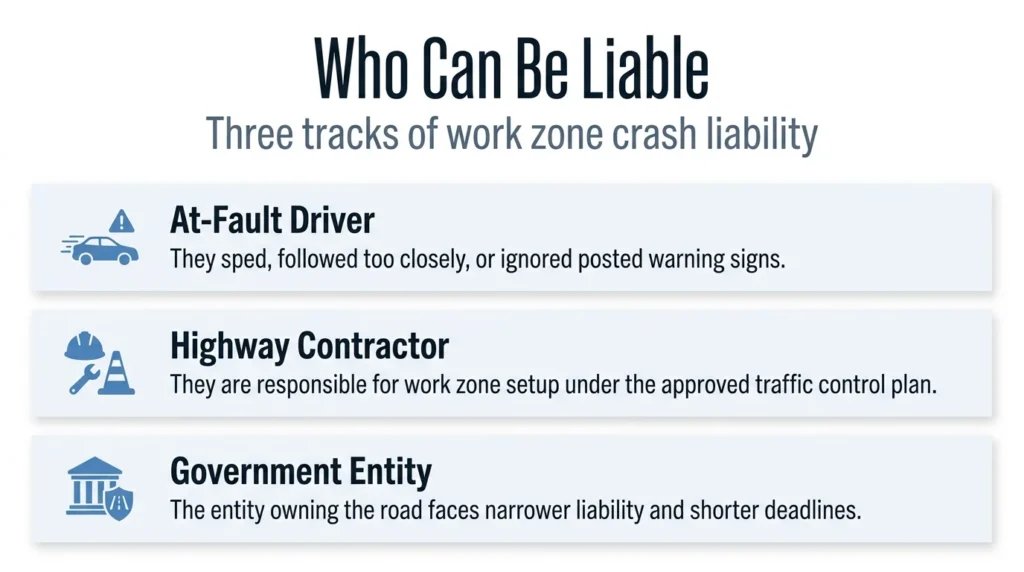
A construction zone accident in Texas rarely has only one responsible party. Work zone crash liability usually runs along three separate tracks.
- The at-fault driver who sped, followed too closely, or ignored the warning signs.
- The highway contractor responsible for laying out and maintaining the zone under the approved traffic control plan.
- TxDOT, a city, or a county that owns the road, in narrower circumstances and under much shorter deadlines.
The at-fault driver is often the most obvious place to begin a Texas car accident claim. However, the investigation should also consider whether the highway contractor’s work zone setup or maintenance contributed to the crash.
Texas already treats a work zone as a heightened-risk setting. Under Tex. Transp. Code § 542.404, both the minimum and maximum fines for a Subtitle C traffic offense double when the offense occurs in a construction or maintenance work zone while workers are present.
Tex. Transp. Code § 472.022 defines a work zone as a portion of a highway or street where construction or maintenance is underway. Signs must show where the zone begins and ends, including the familiar “Fines double when workers present” sign. The section also makes it an offense to disobey a warning sign or drive around a barricade.
The doubled fine applies to the traffic offense. It does not double civil damages or determine who was at fault for the crash. A work zone citation may help show what the other driver did, but you still have to prove the civil case.
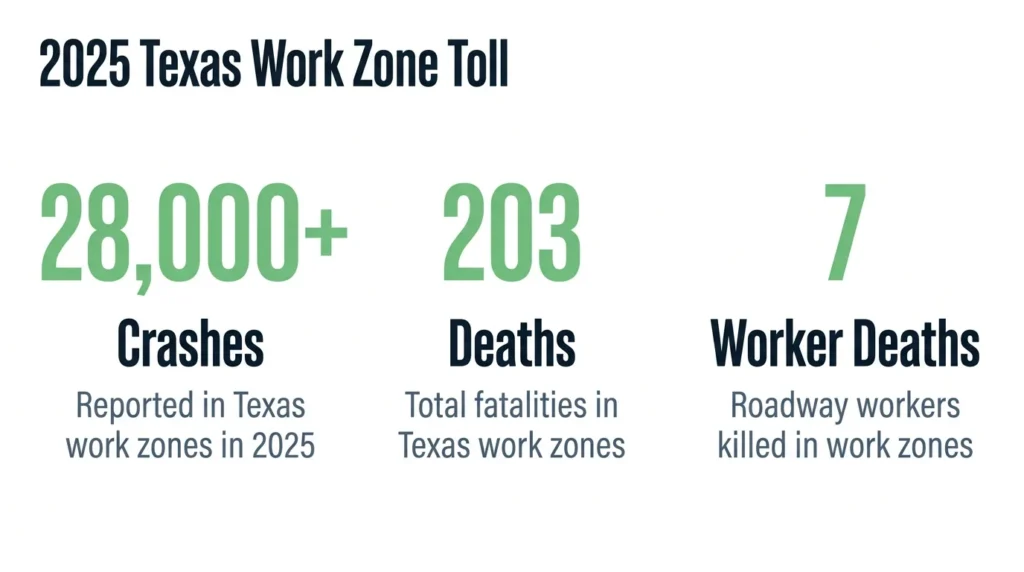
TxDOT reports more than 28,000 crashes in Texas work zones in 2025 and 203 deaths, including 7 roadway workers. Most of the people who died were drivers or passengers. TxDOT’s 2025 statewide crash data is also available county by county.
The Standard a Texas Work Zone Has to Meet
Texas work zones must follow published layout standards. Many of those requirements include specific measurements.
Tex. Transp. Code § 544.001 requires the Texas Transportation Commission to adopt a manual and specifications for a uniform system of traffic-control devices. Section 544.002 allows TxDOT to place devices in accordance with that manual and requires that any device placed by a local authority conform to it. These laws make the Texas Manual on Uniform Traffic Control Devices, or TMUTCD, the standard for work zone layouts.
The applicable edition depends on when the project was put out to bid. The 2025 TMUTCD was adopted on November 13, 2025, and took effect on January 18, 2026.
The project’s letting date and plan set help determine which edition of the TMUTCD applied to the work zone layout.
Part 6 of the TMUTCD covers temporary traffic control. Section 6B.01 describes a temporary traffic control plan as the document explaining how road users will move through a work zone.
How Long a Taper Is Supposed to Be at Highway Speed

The taper is the stretch where a closed lane funnels traffic over, and Part 6 specifies its length. A merging taper should be at least L, a shifting taper at least half of L, and a shoulder taper at least a third of L, while one-lane two-way and downstream tapers run 50 to 100 feet.
Section 6B.08 sets L with a formula, using L = WS²/60 at posted speeds of 40 mph or less and L = WS at 45 mph or more. Texas Table 6B-4A converts that formula into a table by posted speed and offset width. At a 12-foot offset:
- 45 mph: 540-foot minimum desirable merging taper, with devices 45 feet apart on the taper and 90 feet apart on the tangent
- 60 mph: 720-foot taper, devices 60 feet and 120 feet
- 70 mph: 840-foot taper, devices 70 feet and 140 feet
The TMUTCD presents taper lengths and device spacing as guidance for designing and reviewing a work zone. Investigators can compare those measurements with the setup at the crash scene.
What the Rules Say About Barrels, Cones, & Flaggers
Section 6K.01 sets stricter requirements for channelizing devices. All devices must be crashworthy, and any that are no longer serviceable must be replaced. They must also remain clean, visible, and properly positioned. The section recommends spacing devices no farther apart than the posted speed in feet along a taper, or twice the posted speed along a tangent.
Flaggers should be trained in proper traffic control practices.
Section 6D.06 sets mandatory requirements for flagger stations. Drivers approaching the station must have enough distance to see the flagger and stop safely. Warning signs are required except in emergencies, and the station must be illuminated when flagging takes place at night.
Texas Table 6D-1 lists a stopping sight distance of 360 feet at 45 mph, 570 feet at 60 mph, and 730 feet at 70 mph.
When a Highway Contractor May Be Responsible
A TxDOT highway contractor is not automatically immune from a work zone crash claim. The shield Texas gives it carries a condition most injured drivers never hear about.
Tex. Civ. Prac. & Rem. Code § 97.002 provides that a contractor who constructs or repairs a highway, road, or street for TxDOT is not liable for personal injury, property damage, or death arising from the performance of that work if, at the time of the injury, the contractor is in compliance with contract documents material to the condition or defect that was the proximate cause. Compliance gets measured against documents that can be obtained and read.
What the Contractor Promised TxDOT It Would Do
Item 502 of the TxDOT 2024 Standard Specifications, “Barricades, Signs, and Traffic Handling,” requires the contractor to provide, install, move, replace, maintain, clean, and remove all traffic control devices shown on the plans and as directed.
The contractor must implement the traffic control plan shown on the plans and may change it only as approved.
A contractor-proposed change has to be signed and sealed by a licensed professional engineer for approval, conform to TMUTCD guidelines, and use products from TxDOT’s Compliant Work Zone Traffic Control Device List. The contractor must also take corrective action when notified, keeping devices properly positioned, spaced, legible, and retroreflective, day or night and in all weather conditions.
Why a Departure From the Approved Plan Breaks the Immunity
The contractor’s protection depends on how these requirements work together.
1. Section 97.002 protects the contractor only if it complied with contract documents.
2. Item 502 makes the traffic control plan a contract document.
3. The TMUTCD supplies the numbers that the plan has to satisfy.
4. So taper length, sign placement, device spacing, and flagger station location are the elements of the contractor’s own defense.
A taper shorter than the approved plan, a missing sign, barrels spaced farther apart than required, or a poorly positioned flagger can each show that the contractor departed from the contract documents used to determine whether the protection applies.
Section 97.002 applies specifically to contractors working for TxDOT. A contractor working only on a city or county project may not receive the same protection under this statute.
When TxDOT or a City Is the Defendant
A government agency may be liable for a work zone crash, although these claims have strict requirements, short notice deadlines, and limits on compensation.
Tex. Civ. Prac. & Rem. Code § 101.021 waives immunity for property damage, personal injury, and death proximately caused by an employee’s negligence arising from the operation or use of a motor-driven vehicle or equipment, in which the employee would be personally liable. It also waives immunity for personal injury and death caused by a condition or use of tangible personal or real property where a private person would be liable.
Section 101.022 normally reduces the unit’s duty to the one owed a licensee, but subsection (b) removes that limit for the duty to warn of special defects such as excavations or obstructions on highways, roads, or streets, and for the duty to warn of the absence, condition, or malfunction of traffic signs, signals, or warning devices as required by Section 101.060. Excavations and roadway obstructions are the textbook work zone fact pattern, which is why these claims can resemble a dangerous property condition case more than a routine collision claim.
Section 101.060 excludes claims arising from a discretionary failure to place a sign, signal, or warning device in the first instance, and from the absence, condition, or malfunction of such a device unless the responsible governmental unit fails to correct it within a reasonable time after notice.
Under Section 101.101, a governmental unit is entitled to notice not later than six months after the day of the incident, reasonably describing the injury or damage, the time and place, and the incident. A municipal work zone can carry a far shorter deadline.
Section 101.023 caps recovery:
- State government, including TxDOT: $250,000 per person and $500,000 per single occurrence for bodily injury or death, plus $100,000 per occurrence for property damage
- Municipalities: the same $250,000, $500,000, and $100,000 limits
- Other units of local government: $100,000 per person, $300,000 per single occurrence, and $100,000 for property damage
Those caps and the notice deadline apply only to claims against the government agency. A claim against a private contractor is not subject to the same limits, so the contractor’s role should be investigated early.
The Evidence That Decides a Work Zone Crash Claim
The TMUTCD includes specific measurements for work zone layouts. Scene documents and measurements can help show whether the setup followed the approved plan. Four types of records may be especially useful.
1. The traffic control plan and the plan set. Item 502 ties the contractor to the TCP shown on the plans, so the approved plan sheets, the Barricade and Construction, Work Zone, and TCP standard sheets, and any engineer-approved revisions are the baseline the field layout is compared against.
2. TxDOT project records. Request these in writing under the Texas Public Information Act. Use TxDOT’s Open Records Management and Tracking System.
3. Inspection reports. TMUTCD Sections 6A.01 and 6A.02 assign responsibility for safety in a TTC zone. Call for monitoring under varying volume, light, and weather conditions, and contemplate an engineering study of reported crashes in the zone when warranted.
4. Photographs of the actual device layout. Dated photographs and measurements can be directly compared with Tables 6B-3 and 6B-4A in Section 6K.01, and with Table 6D-1. Devices that were dirty, knocked down, or no longer serviceable are themselves a maintenance failure under Section 6K.01 and Item 502.
The crash report belongs in the file too. The Texas Peace Officer’s Crash Report, the CR-3, is purchased through TxDOT’s Crash Report Online Purchase System at cris.txdot.gov for $6 for a regular copy or $8 for a certified copy, plus possible processing fees.
Everyone else receives a redacted copy, and TxDOT keeps reports for the previous 10 full calendar years plus the current year. The CR-3 also includes the officer’s work zone and workers present notations.
Three Deadlines That May Apply to a Work Zone Claim
A work zone crash claim may involve three separate deadlines. Each serves a different purpose and must be handled separately.
- Six months to give a governmental unit written notice under § 101.101, and less than that where a city charter or ordinance says so
- Two years to file suit under Tex. Civ. Prac. & Rem. Code § 16.003, which also sets two years for a Texas wrongful death claim, running from the injured person’s death
- The 60th day before trial for a defendant to move for leave to designate a responsible third party under Section 33.004(a), absent good cause found by the court
These clocks run independently. The two-year limitations period does not rescue a missed six-month Tort Claims Act notice deadline.
Talk to Angel Reyes & Associates About Your Texas Work Zone Crash
Identifying the contractor, obtaining the traffic control plan and TxDOT project records, and meeting any applicable notice deadline are all time-sensitive. The work zone layout may change quickly, and a city charter may require notice sooner than expected.
Angel Reyes & Associates has guided injured Texans through situations like this for over 30 years. Contact Angel Reyes & Associates for a free consultation to review your situation and explain your options.
Every case is different, and past results do not guarantee future outcomes.
Texas Work Zone Crash FAQs
Can a passenger injured in a Texas construction zone accident file a claim against more than one party?
Yes. An injured passenger may have claims against multiple parties whose conduct contributed to the crash, even though the passenger was not driving.
What happens if a construction worker is injured in a Texas work zone crash?
A worker injured in the course and scope of employment may qualify for workers’ compensation benefits and may also have a claim against a negligent third party, such as another driver. Texas Labor Code Chapter 417 allows an injured employee to pursue both when its requirements are met.
Can dashcam or surveillance video help prove a Texas work zone accident claim?
Yes. Video may preserve evidence of traffic flow, warning signs, lane closures, vehicle movements, and the placement or condition of traffic-control devices before the work zone changes.
Can a construction company blame another subcontractor for a work zone crash?
Potentially. Texas law allows responsibility to be allocated among parties and to designated responsible third parties when the evidence supports their involvement, so identifying every contractor or subcontractor responsible for traffic control can be important.
What if the construction zone changed before investigators could inspect the crash scene?
Photos, videos, witness accounts, project documents, inspection records, and other contemporaneous evidence may help reconstruct how the work zone appeared at the time of the collision. Because temporary traffic-control devices can be moved as construction progresses, it can be important to preserve this evidence quickly.
About the Authors

Angel Reyes
Writer
Angel L. Reyes, III is the Founder and Managing Partner of Angel Reyes & Associates. A nationally recognized trial attorney and business leader, Angel founded the firm in 1993, which has gone on to help over 70,000 injury victims recover more than $1 billion. Named to the Texas Super Lawyers list annually since 2008, Angel brings Wall Street experience, Ivy League education, and a deep commitment to client advocacy. He is a frequent legal commentator and published author with extensive contributions to legal scholarship, trial strategy, and consumer protection.

Kyle Nicolas
Editor
Kyle Nicolas is the Web Content & SEO Manager at Angel Reyes & Associates. He has more than 10 years of experience as a marketing co...

Angel Reyes
Reviewer
Angel L. Reyes, III is the Founder and Managing Partner of Angel Reyes & Associates. A nationally recognized trial attorney and business...