Who Pays for a Wrongful Death Lawsuit?


Every article on this site is researched by our internal team, reviewed for legal accuracy against current Texas law, and held to State Bar of Texas advertising standards before publication. We do not publish content that overstates outcomes or makes promises about results.
Learn more about our
editorial standards .
Key Takeaways
- In most fatal crashes, the at-fault driver's insurance pays the wrongful death claim.
- Your own uninsured motorist coverage can pay when the at-fault driver has too little.
- A contingency fee means your family pays nothing upfront to begin a wrongful death claim.

The call came at the worst possible moment. Your husband was driving home on I-35W near Fort Worth when another driver crossed into his lane and hit him head-on.
Now, on top of the grief, people keep telling you that you may have a claim. And you are quietly wondering something you feel guilty even asking: can your family afford to pursue it?
Who Pays for Wrongful Death in Car Accidents?
The person or company whose careless act caused the death is legally responsible for the damages. In almost every fatal crash, insurance pays that responsibility, not someone’s personal savings.
The Texas Wrongful Death Act gives surviving family members the right to recover damages from the at-fault party. It lets a spouse, child, or parent seek payment for their loss.
Most fatal wreck claims start the same way other Texas car accident claims do. The at-fault driver’s insurance carrier becomes the practical source of payment, at least up to the policy limit.
That is why your early questions should focus on coverage, not on the driver’s bank account. Our look at fatal crashes and wrongful death claims shows how these cases take shape.
Families often wait to act because money feels impossible to think about right now. The deadline to file runs anyway, so it helps to know how much time Texas gives you before you make any decisions.
Does Insurance Cover Wrongful Death Claims?
Yes, insurance usually covers wrongful death claims, and Texas law requires drivers to carry it. Your attorney will track down every policy that could apply, starting with the driver who caused the crash.
The At-Fault Driver’s Liability Insurance
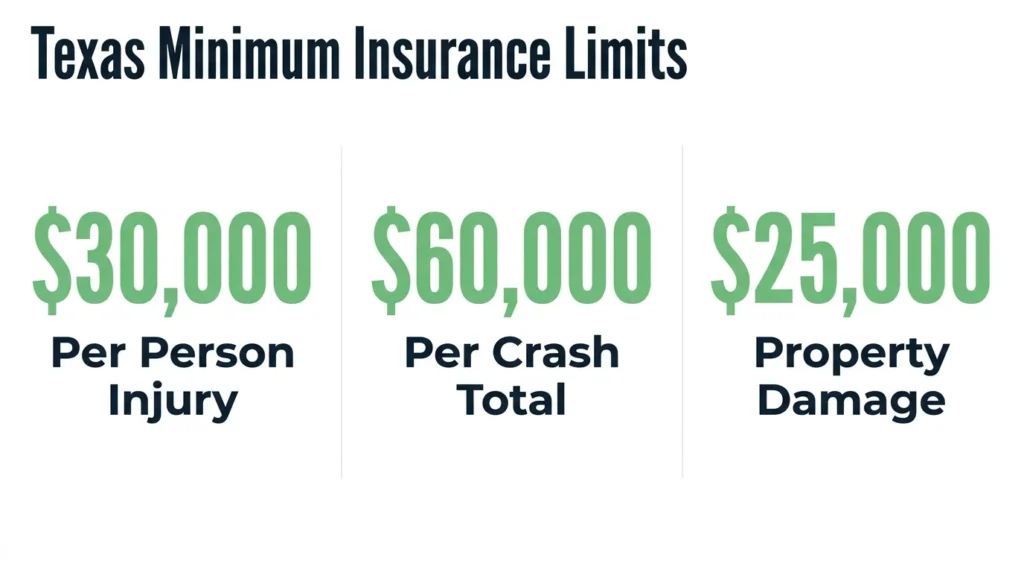
The at-fault driver’s liability insurance is the first place the money comes from. Texas sets minimum limits of $30,000 per person and $60,000 per crash for injuries, plus $25,000 for property damage, under Texas Transportation Code § 601.072.
Those minimums rarely cover the full value of a life, and a single hospital stay before death can erase the entire policy, leaving nothing for the family’s larger loss.
Not every policy is built the same way, and coverage gaps are common. You can see how different policies stack up with our auto insurance policy grading tool.
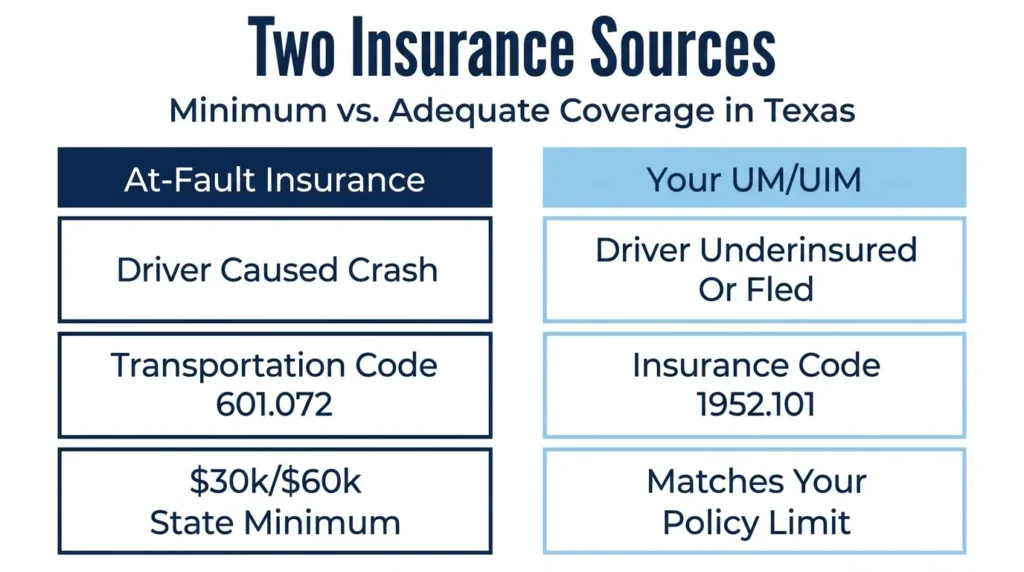
Your Own Uninsured/Underinsured Motorist Coverage
When the at-fault driver has no insurance or too little, your own auto policy can step in. Texas requires insurers to offer uninsured and underinsured motorist coverage under Texas Insurance Code § 1952.101, and it pays exactly when the other driver cannot.
This coverage often surprises families who assume the at-fault driver is the only source. If the person who caused the crash was driving without proper insurance or a license, your own policy may cover the claim.
The picture changes when a commercial truck or company vehicle caused the death. Federal rules like 49 CFR § 387.9 set much higher financial responsibility minimums, and a business may also carry umbrella coverage that expands what is available.
How Are Wrongful Death Settlements Paid Out?
When a wrongful death claim settles, your family does not receive the full amount in one clean check. Several costs come out of the settlement first, and Texas law then divides the rest among the surviving family.
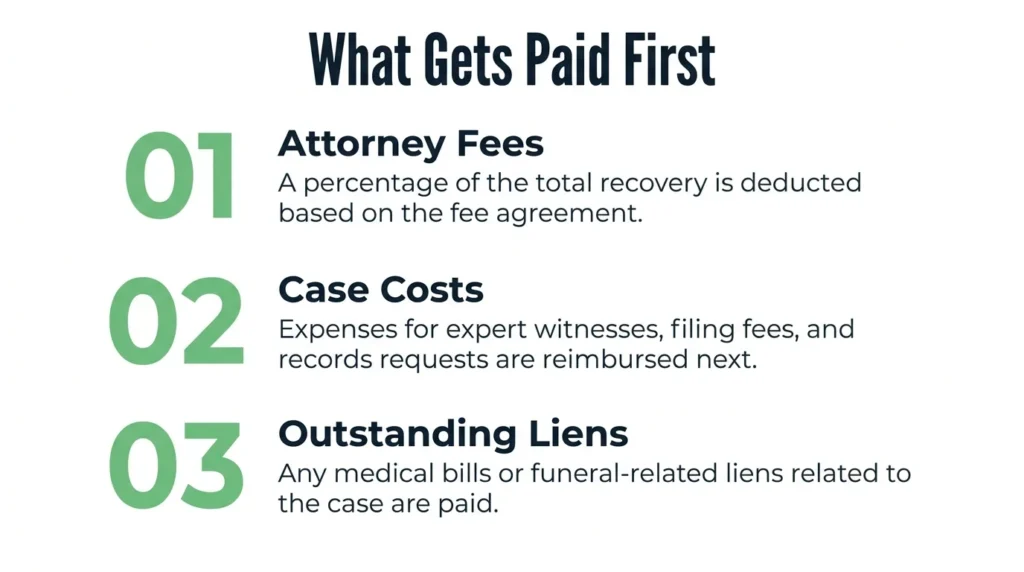
Before any money reaches your family, three things typically get paid out of the recovery:
- Attorney fees, calculated as a percentage of the recovery under your fee agreement.
- Case costs, such as expert witnesses, filing fees, and records requests.
- Outstanding liens, including medical bills or funeral-related liens tied to the death.
Whatever remains then goes to the surviving family. That is a separate matter from who paid the claim, though many people searching for who gets the money in a wrongful death lawsuit assume the two are the same.
Our past case results show how these recoveries have been structured, and in each one the family paid nothing out of pocket along the way.
How Does a Wrongful Death Attorney Get Paid?
Your attorney gets paid only if you win. Texas wrongful death cases run on a contingency fee, which means the attorney takes a percentage of the financial recovery rather than billing you upfront or charging a retainer. These arrangements are fully authorized and must be set out in writing per the Texas Disciplinary Rules of Professional Conduct.
Under this arrangement, you owe no legal fees unless the case recovers compensation. Court costs and case expenses come out of that recovery too, and your fee agreement spells out whether those costs are subtracted before or after the attorney’s fee is calculated.
Because the fee comes out of the recovery, a family facing funeral bills and lost income can start a wrongful death claim without paying anything to begin.
Work with a Texas Wrongful Death Attorney
Losing someone this way changes everything, and figuring out the money should not fall on you alone. Angel Reyes & Associates has guided Texas families through wrongful death claims for over 30 years, and you can learn more about who we are and how we work.
We work on a no-fee-unless-we-win basis, so you pay nothing upfront and nothing at all unless we recover for you. That work has produced more than $1 billion recovered for clients.
Your first consultation is free. When you are ready, contact us, and we will walk you through your options.
Past results do not guarantee future outcomes.
Who Pays for Wrongful Death Claims FAQs
Who is entitled to receive money from a wrongful death lawsuit in Texas?
Texas law limits recovery to the surviving spouse, children, and parents of the person who died. A judge or jury divides the money based on each person’s relationship to the deceased and their loss.
How long do you have to file a wrongful death lawsuit in Texas?
Texas law generally gives families two years from the date of death to file a wrongful death lawsuit. Missing that deadline usually means the court will dismiss the claim, with only a few narrow exceptions.
Is money from a wrongful death settlement taxable?
Most wrongful death settlement money is not taxable because federal law excludes compensation for a physical injury or death from income tax. Punitive damages and interest earned on a settlement are the main exceptions, and those are usually taxable.
What happens if the person who died was partly at fault for the crash?
Texas follows a rule called proportionate responsibility, so the family’s recovery is reduced by the deceased person’s share of fault. If that share reaches 51 percent or more, Texas law bars the family from recovering anything.
Does uninsured motorist coverage pay if the driver who caused the crash fled the scene?
Yes, uninsured motorist coverage in Texas typically treats an unidentified hit-and-run driver the same as an uninsured driver. Insurers usually require a police report and prompt notice of the accident to pay this type of claim.
About the Authors

Angel Reyes
Writer
Angel L. Reyes, III is the Founder and Managing Partner of Angel Reyes & Associates. A nationally recognized trial attorney and business leader, Angel has helped over 70,000 injury victims recover more than $1 billion since founding the firm in 1993. Named to the Texas Super Lawyers list annually since 2008, Angel brings Wall Street experience, Ivy League education, and a deep commitment to client advocacy. He is a frequent legal commentator and published author with extensive contributions to legal scholarship, trial strategy, and consumer protection.

Kyle Nicolas
Editor
Kyle Nicolas is the Web Content & SEO Manager at Angel Reyes & Associates. He has more than 10 years of experience as a marketing co...

Angel Reyes
Reviewer
Angel L. Reyes, III is the Founder and Managing Partner of Angel Reyes & Associates. A nationally recognized trial attorney and business...