Joby Aviation Air Taxi Safety Record


Every article on this site is researched by our internal team, reviewed for legal accuracy against current Texas law, and held to State Bar of Texas advertising standards before publication. We do not publish content that overstates outcomes or makes promises about results.
Learn more about our
editorial standards .
Key Takeaways
- Joby's safety record is test-phase data and regulatory milestones, not years of passenger flight history yet.
- A 2022 prototype crash exposed propeller and tilt mechanism failures that the NTSB formally documented.
- Texas fault rules can split liability across the operator, manufacturer, and others if an air taxi incident occurs.
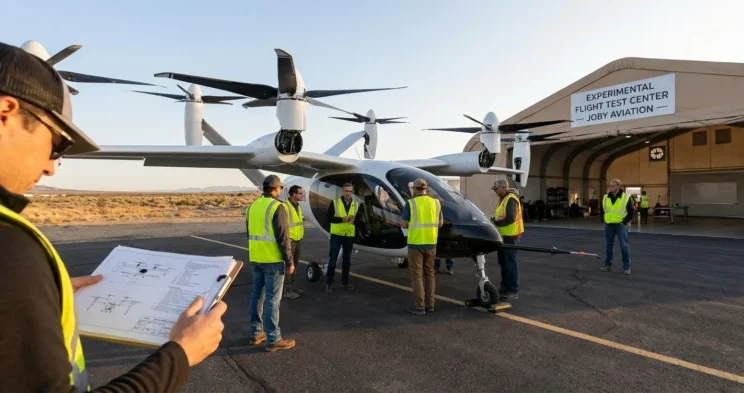
Electric air taxis are moving toward Texas, and Joby Aviation is the name you keep hearing. If you’re thinking about booking a ride once they launch, or wondering what your rights would be if something went wrong, the honest answer is: the safety picture is thinner than the press releases make it look.
Joby hasn’t carried a single paying passenger yet. What we actually have to go on is a testing history, a set of FAA approvals, and one documented crash. Here’s what those things actually tell us.
What “Safety Record” Really Means for Joby Right Now
When people talk about airline safety, they’re usually pointing to decades of real flights carrying real passengers. Joby doesn’t have that yet. As of April 2026, the company is still working toward its first commercial flights, so there’s no track record of day-to-day service to point to, in Texas or anywhere else./iamge
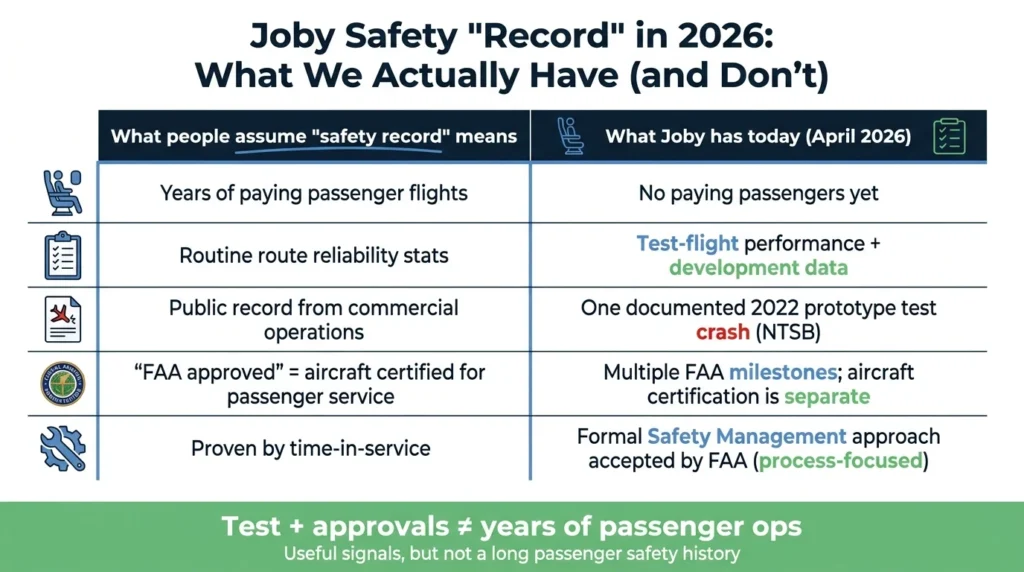
What Joby does have is a testing history, some important government approvals, and a formal safety program that the FAA has signed off on. A safety program like this is basically a documented system a company uses to spot hazards, assess risks, and learn from close calls before they turn into something worse. These things matter. They’re just not the same as years of people safely getting from point A to point B.
Three things shape what we can actually say about Joby’s safety:
- The 2022 prototype crash and what investigators found
- The government approvals Joby has received so far
- What all of this means if you’re a Texas rider or you get hurt on one of these flights
What Happened in Joby’s 2022 Prototype Crash
On February 16, 2022, one of Joby’s test aircraft crashed during a remote-controlled test flight. Nobody was on board. The flight was part of what engineers call envelope-expansion testing, which just means they were deliberately pushing the aircraft harder than normal to see where the limits are and catch problems before a passenger ever gets on.
The National Transportation Safety Board, which is the federal agency that investigates plane crashes, looked into it and published a report, accident report DCA22FA082. What they found was that a propeller blade failed. That threw the aircraft off balance, which set off a chain reaction that brought it down. Investigators also found a problem with the tilt mechanism, which is the part that shifts the aircraft from hovering straight up to flying forward. On an aircraft like this, that shift is one of the most critical moments of any flight. A malfunction there is serious.
What the Crash Tells Us and What It Doesn’t
Finding problems during testing is actually part of the process. Companies run these aggressive test flights specifically to catch design flaws and manufacturing issues before the aircraft ever carries a passenger. The 2022 crash gave Joby real information to work with.
But a test crash doesn’t tell us how the finished aircraft will hold up in normal everyday use. The aircraft that went down was a test version, pushed harder than it would ever be in actual service, with no one on board. That’s a very different situation from a production aircraft flying a commuter route.
If you’re thinking about riding one of these, the questions worth asking are: Did Joby actually fix the propeller and tilt problems the crash revealed? What specifically changed in the design? How will they catch similar issues during routine maintenance? Look for clear answers to those questions as the approval process moves forward.
The Government Approvals Joby Has Received
The FAA, which sets and enforces safety rules for all air travel in the U.S., has given Joby several approvals. Each one is real and meaningful. But they’re often described in ways that make them sound like more than they are.
Air Carrier Certificate
In May 2022, Joby got what’s called a Part 135 Air Carrier Certificate from the FAA. In plain terms, this says Joby is authorized to operate as an air carrier under a specific set of rules. That’s a real milestone. But this approval covers the company as an operator. It does not certify the aircraft itself as safe for passengers. That’s a separate approval, and you need both before anyone can actually book a seat.
Safety Program and Pilot School
In December 2024, the FAA accepted Joby’s voluntary safety program and also approved its pilot training school under federal standards. The safety program, described above, shows Joby has committed to a formal process for catching and responding to problems.
That’s worth something. It doesn’t mean nothing will ever go wrong. It means there’s a real system in place to learn from it when something does.
Software Authorization
The FAA also signed off on Joby’s ElevateOS software, which runs the scheduling, pilot tools, and the passenger app. Think of this as approval for the booking and operations system, not the aircraft. It’s a step toward being ready to operate commercially. It’s not a sign-off on the aircraft’s safety.
So Is Joby Approved to Fly Passengers?
Not fully, not yet. Joby has the company-level operating approval, but the aircraft itself still needs to go through its own certification process. Both are required. You can hold one without the other, and Joby is still working toward the second.
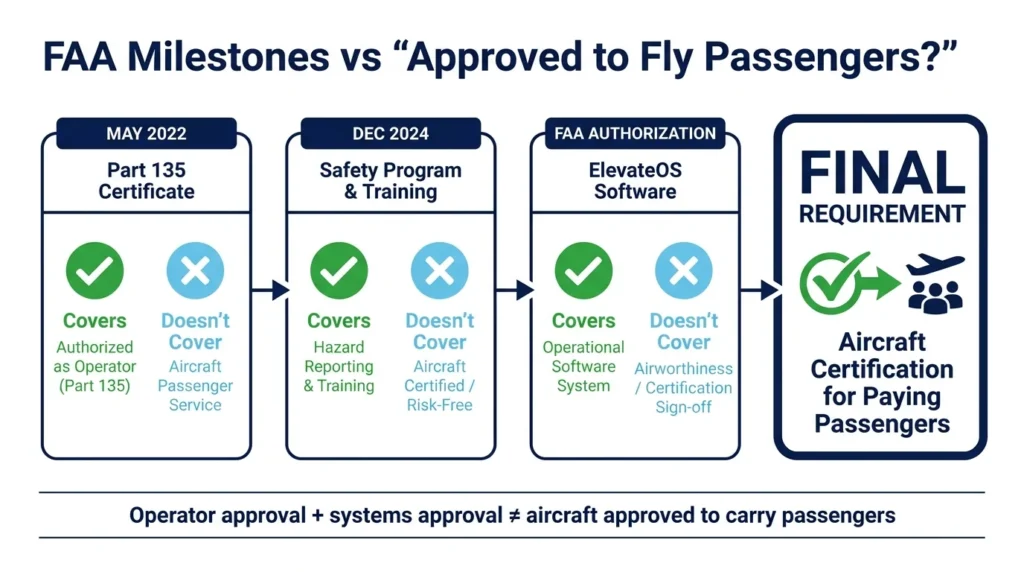
Before you take any air taxi company’s marketing at face value, look specifically at whether the aircraft has been certified, not just the company. Those are two different things, and the difference matters.
What to Look for as a Texas Rider
If you’re weighing whether to ride an air taxi in Houston, Dallas, Austin, or anywhere else in Texas, here are the practical questions to ask before you book.
How does the operator handle safety? Do they have a formal safety program? What happens when a pilot reports a close call or a maintenance concern?
How is the aircraft maintained? How often is it inspected? Who does the work? Is there a paper trail?
How are pilots trained? What licenses do they hold? How many hours of training did they go through? Do they go through regular check rides, meaning periodic tests to make sure their skills are current?
What are the limits? What weather conditions will cancel a flight? If something goes wrong mid-flight, what’s the plan?
Some unknowns come with any new type of transportation. What separates a responsible operator from an irresponsible one is whether they’re honest about those unknowns.
Testing Is Different From Flying Passengers
During testing, the whole point is to push things until something breaks. Engineers want to find the weak spots before a passenger does.
Once a service is actually running, the goal flips completely. Now the job is to stay well inside limits that are already known to be safe, keep the aircraft in good shape, and follow consistent procedures every single flight. A company that handles that transition well will have clear policies, well-trained pilots, and documented maintenance. Those are the things to look for.
If Something Goes Wrong on an Air Taxi in Texas
If you’re hurt on an air taxi flight, more than one company may be responsible. The list could include the operator who ran the flight, the manufacturer who built the aircraft, the company that supplied specific parts, whoever maintained the aircraft, and potentially even the software provider. Who actually bears responsibility depends on what caused the incident.
Texas handles situations like this through what’s called proportionate responsibility, meaning fault can be divided among multiple parties based on how much each one contributed to what happened. Under Texas Civil Practice and Remedies Code Chapter 33, if the manufacturer was 60% responsible and the operator was 40% responsible, any damages may be divided the same way. You don’t have to prove one party was entirely to blame to have a valid claim.
What to Do Right After an Air Taxi Incident
If you’re involved in a crash or injury on an air taxi in Texas, do these things as soon as you can:
- Get medical attention right away. Even injuries that feel minor at first can turn out to be more serious. Document everything.
- Take photos. The aircraft, the scene, and your injuries, as soon as it’s safe.
- Get witness information. Names and phone numbers from anyone who saw what happened.
- Hold onto your ride records. Your booking confirmation, app receipts, and any messages you exchanged with the operator.
- Don’t sign anything quickly. An insurance company may reach out fast with a settlement offer. Don’t accept anything before you understand the full extent of what happened and what your injuries may cost you.
- Write down everything. Medical bills, days of work missed, and any symptoms that persist.
We also have a detailed guide on what to collect after a crash if you want more specifics.
How the Crash Investigation Can Affect Your Case
When the NTSB investigates an aviation accident, their findings become part of the public record. Attorneys can use those findings to build legal arguments about whether the aircraft had a design flaw, whether maintenance was done properly, or whether the operator followed the right procedures.
The 2022 crash report already documents specific problems with the propeller and tilt mechanism. If a production aircraft has a similar failure, that report becomes directly relevant. Every case depends on its own facts, including which version of the aircraft was involved, what the maintenance records show, what the weather was, and what decisions the operator made.
When to Call a Lawyer
If you’re seriously hurt, if there’s a dispute about what happened, if multiple companies are involved, or if an insurance company reaches out to you quickly, talk to an attorney before you respond to anyone. These cases involve corporate operators, manufacturers, and multiple layers of insurance. Getting someone in your corner early makes a real difference.
Before your first call, pull together whatever you have: medical records, photos, witness names, any messages from the operator or insurer, and a record of expenses and missed work.
Angel Reyes & Associates has helped injured Texans work through complex claims for over 30 years. We offer free consultations and take cases on contingency, meaning you pay nothing unless we recover for you. If you’ve been hurt in a transportation incident anywhere in Texas, contact us today to talk through your situation.
Past results do not guarantee future outcomes.
Joby Aviation FAQs
Can a company be authorized to operate as an air carrier before its aircraft is approved for passengers?
Yes. The approval that lets a company operate as an air carrier and the approval that certifies a specific aircraft as safe for passengers are two completely separate things. A company can have one without the other.
Is a test crash the same as a crash involving passengers?
No. The NTSB investigates to figure out what caused the crash, not to assign legal blame. Their findings can be powerful evidence in a lawsuit, but a court looks at a much wider set of facts, including maintenance history, training records, contracts, and the specific decisions made by everyone involved.
Is a test crash the same as a crash involving passengers?
Not really. Test flights are deliberately pushed harder than normal service flights, and the aircraft may be a different version than what passengers would eventually fly. A test crash is meaningful information, but it doesn’t tell you how the finished aircraft performs under normal conditions.
What records are most important if someone gets hurt on a Texas air taxi?
The most useful records are typically your booking confirmation, the aircraft’s maintenance logs, pilot training and licensing records, data showing who authorized the flight, any available video from the aircraft or the scene, witness statements, and your medical records. Pulling these together early matters because digital records don’t always stay available for long.
Does the FAA approving the passenger app mean the whole operation is safe?
No. Approving the scheduling software or passenger app means the FAA reviewed that specific system. It has nothing to do with whether the aircraft itself is certified as safe to carry passengers.
About the Authors

Angel Reyes
Writer
Angel L. Reyes, III is the Founder and Managing Partner of Angel Reyes & Associates. A nationally recognized trial attorney and business leader, Angel has helped over 70,000 injury victims recover more than $1 billion since founding the firm in 1993. Named to the Texas Super Lawyers list annually since 2008, Angel brings Wall Street experience, Ivy League education, and a deep commitment to client advocacy. He is a frequent legal commentator and published author with extensive contributions to legal scholarship, trial strategy, and consumer protection.

Graham Griffin
Editor
Graham Griffin is the Web & Content Manager at Angel Reyes & Associates, where he oversees content strategy, AI-powered workflows, a...

Angel Reyes
Reviewer
Angel L. Reyes, III is the Founder and Managing Partner of Angel Reyes & Associates. A nationally recognized trial attorney and business...