What Are the Most Common Types of Car Accidents?


Every article on this site is researched by our internal team, reviewed for legal accuracy against current Texas law, and held to State Bar of Texas advertising standards before publication. We do not publish content that overstates outcomes or makes promises about results.
Learn more about our
editorial standards .
Key Takeaways
- Texas ties fault for each crash type to a specific rule of the road, not assumption.
- Rear-end drivers are presumed at fault, but that presumption can be rebutted.
- Single-vehicle, run-off-the-road crashes cause the most Texas traffic deaths.
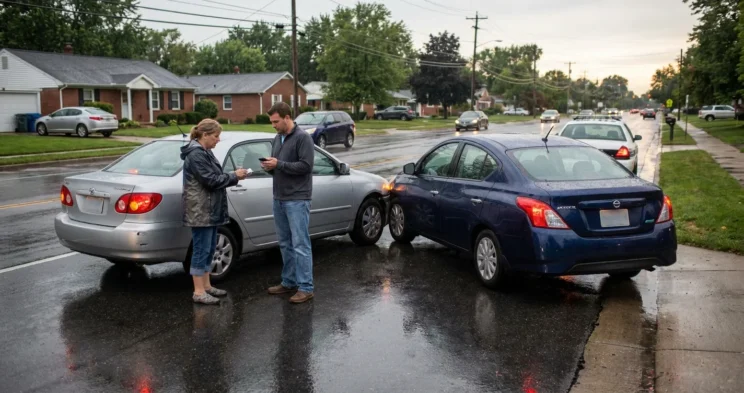
You feel the jolt before you understand what just happened. In Dallas traffic, a crash can come from any direction, straight behind you, from the side, or head-on, and each pattern points to a different driver being at fault. Knowing which type of crash you were in is the first step toward understanding what happened and who is likely responsible.
The Most Common Types of Car Accidents in Texas
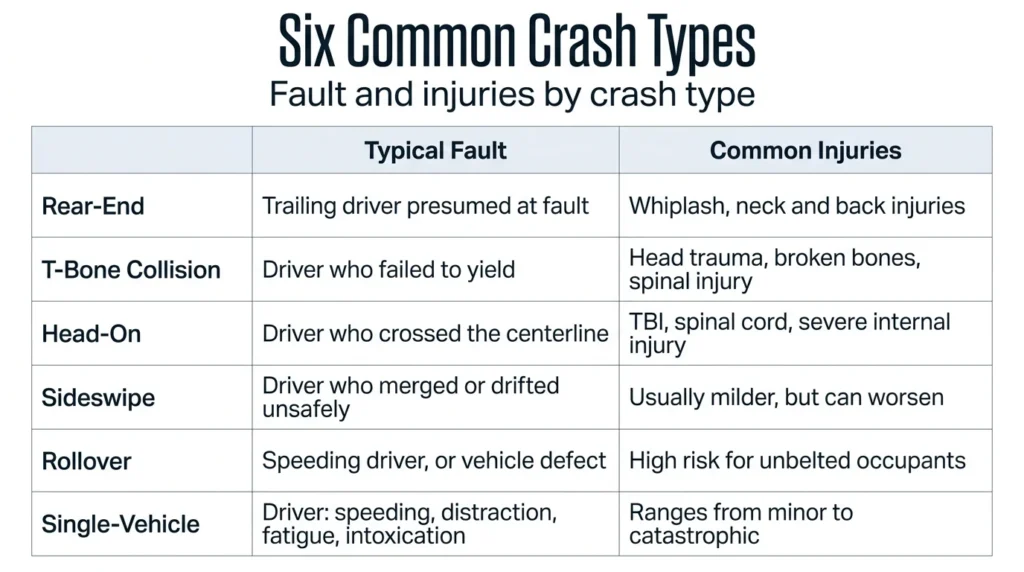
Most Texas car accidents fall into one of six patterns: rear-end, T-bone and intersection, head-on, sideswipe, rollover, and single-vehicle. Each pattern tends to follow its own fault rule and produce its own set of common injuries.
Texas ties fault to specific rules of the road rather than to gut instinct about who “should have” been more careful.
Current Texas Crash Data by Collision Type
Texas recorded 14,913 serious-injury crashes and 3,770 traffic deaths in 2025, according to the Texas Department of Transportation’s crash reporting data. Some collision types carry a disproportionate share of those deaths.
Single-vehicle, run-off-the-road crashes alone accounted for roughly a third of all Texas traffic deaths in the most recent year with published data. That single pattern kills more people statewide than any other crash type.
Rear-End Collisions
A rear-end collision happens when one vehicle strikes another from behind. It is one of the most frequent crash patterns on Texas roads, especially in stop-and-go traffic.
In Texas, the trailing driver is presumed at fault under the assured-clear-distance rule in Texas Transportation Code Section 545.062, which requires drivers to leave enough room to stop safely. That presumption can be rebutted if the lead driver braked suddenly for no reason, had broken brake lights, or cut in without leaving safe space.
Rear-end crashes most often cause whiplash and other soft-tissue neck and back injuries. Injuries grow more serious as the speed difference between the two vehicles increases.
A broken brake light on the lead car or an unsignaled lane cut-in are two of the defenses that can rebut that presumption, and Texas courts weigh each case’s specific evidence rather than applying the presumption automatically.
T-Bone & Intersection Collisions
A T-bone collision happens when the front of one vehicle strikes the side of another, forming a T shape, almost always at an intersection. It is among the most dangerous crash patterns because the struck vehicle’s side offers less protection than its front or rear crumple zones.
Fault in Texas typically falls on the driver who ran the red light, ignored a stop sign, or failed to yield the right-of-way under Texas Transportation Code Section 544.007, which governs how drivers must respond to traffic-control signals. Evidence like traffic camera footage and skid marks can fade within days, so documenting a T-bone crash scene quickly often determines whether that fault is provable at all.
Occupants on the struck side face a high risk of head trauma, broken bones, and spinal cord and internal injuries. Safety features like side airbags and reinforced door beams reduce but do not eliminate that risk.
Head-On Collisions
A head-on collision happens when two vehicles traveling in opposite directions strike each other front-end to front-end. It is one of the deadliest crash patterns because the combined speed of both vehicles determines the force of impact.
Fault in Texas usually falls on the driver who crossed the centerline, drove the wrong way, or attempted an unsafe pass into oncoming traffic, in violation of Texas Transportation Code Section 545.051, which requires drivers to stay on the right side of the roadway outside of specific exceptions.
Head-on crashes frequently cause traumatic brain injury, spinal cord injury, and severe internal injury. These injuries often require months of treatment before reaching a stable recovery point.
Sideswipe Collisions
A sideswipe collision happens when the sides of two vehicles traveling the same or opposite direction make contact, often while drifting or passing. It tends to be less severe than a head-on or T-bone impact, but not always.
Fault in Texas typically falls on the driver who drifted out of their lane or changed lanes without confirming it was safe, under Texas Transportation Code Section 545.060, which requires drivers to stay within a marked lane unless the move can be made safely.
Sideswipe injuries are usually milder than other crash types, but a sideswipe at highway speed can push a vehicle into a spin, a rollover, or a secondary collision with more serious injuries.
Rollover Collisions
A rollover collision happens when a vehicle tips onto its side or roof, usually after a sharp turn, a loss of control, or a collision with another vehicle or object. It can happen to any vehicle, but SUVs, vans, and trucks roll over more often because of their higher center of gravity.
Fault in Texas often falls on the driver, particularly for excessive speed under Texas Transportation Code Section 545.351, which requires drivers to maintain a speed that is reasonable for the conditions. When a vehicle defect, such as a tire failure or a design flaw, contributes to the rollover, fault can extend to the manufacturer as a separate claim.
Rollovers carry a high risk of serious injury for unbelted occupants, who can be thrown inside the vehicle or ejected. Passenger vehicle rollovers accounted for 28% of all passenger vehicle occupant deaths in 2023, with pickups and SUVs representing the highest rollover-fatality share among vehicle types, according to the Insurance Institute for Highway Safety.
Single-Vehicle Collisions
A single-vehicle collision involves only one car, such as running off the road, striking a fixed object like a telephone pole, or rolling over without another vehicle involved. It is the deadliest crash pattern statewide by raw numbers.
Fault in Texas usually falls on the driver, whether from speeding, distraction, fatigue, or intoxication. Intoxication specifically can trigger criminal liability under Texas Penal Code Section 49.04 in addition to civil fault. That said, a road defect, debris in the roadway, or another driver who forced you off the road and fled can shift or share fault even though only one car was involved in the final impact.
Injuries in single-vehicle crashes range widely. A low-speed guardrail strike may cause only minor injury, while a high-speed run-off-the-road crash can cause traumatic brain injury or spinal cord injury.
A skid mark showing an evasive swerve, or a 911 call describing another car forcing you off the road, can be the difference between a driver being solely at fault and sharing that fault with someone who was gone before police arrived.
Work with an Experienced Attorney Today
Angel Reyes & Associates has represented Texas crash victims across every collision type above for more than 30 years. That range of experience means we know which fault rule applies to your specific pattern of crash, and how insurers typically try to argue around it.
Texas’s proportionate-responsibility rule under Texas Civil Practice and Remedies Code Section 33.001 means shared fault reduces your recovery, but it does not automatically eliminate it unless your own share passes 50%. Our case results reflect more than $1 billion recovered for clients, and you pay nothing unless we win.
Contact us for a free consultation to talk through what happened and what it means for your claim.
Past results do not guarantee future outcomes.
Car Accident Type FAQs
Who is at fault when three or more cars are involved in a chain-reaction crash?
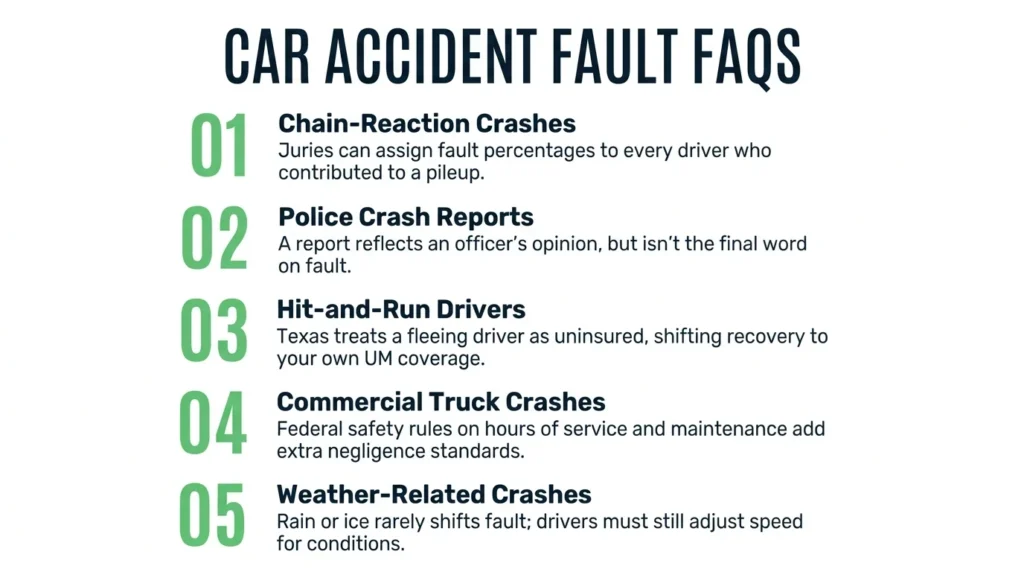
Texas law lets a jury assign a specific percentage of fault to every driver who contributed to a multi-car pileup, not just the driver who caused the first impact, under Texas Civil Practice and Remedies Code Section 33.003.
Does a police crash report decide who's at fault?
No. A report records the responding officer’s opinion, but insurers and courts weigh it alongside other evidence rather than treating it as the final word.
What happens if the driver who hit you flees the scene?
Texas treats an unidentified hit-and-run driver as an uninsured motorist, so your own uninsured motorist coverage typically becomes your main source of recovery under Texas Insurance Code Section 1952.101.
Does fault work differently when a commercial truck causes the crash?
Yes. Federal motor carrier safety rules on hours of service and vehicle maintenance create additional negligence standards that do not apply to an ordinary passenger-car crash, under the Federal Motor Carrier Safety Regulations.
Can weather conditions like rain or ice shift fault away from a driver?
Rarely on their own. Texas’s speed statute requires drivers to slow for hazardous conditions, so a crash blamed on rain or ice often still points back to a driver who failed to adjust, under Texas Transportation Code Section 545.351.
About the Authors

Spencer Browne
Writer
Spencer Browne is a partner at Angel Reyes & Associates and a Board Certified personal injury trial lawyer with nearly 100 jury trials across Texas. He focuses on car, truck, and wrongful death cases, with notable verdicts including a landmark win in the Choctaw Casino bus crash case. A recognized speaker and legal educator, Spencer is a member of the American Board of Trial Advocates and has been honored as a Texas Super Lawyer and one of D Magazine’s Best Lawyers in Dallas. He brings deep trial experience and relentless advocacy to every client he represents.

Kyle Nicolas
Editor
Kyle Nicolas is the Web Content & SEO Manager at Angel Reyes & Associates. He has more than 10 years of experience as a marketing co...

Angel Reyes
Reviewer
Angel L. Reyes, III is the Founder and Managing Partner of Angel Reyes & Associates. A nationally recognized trial attorney and business...