Air Taxi Vertiport Injury Liability in Texas


Every article on this site is researched by our internal team, reviewed for legal accuracy against current Texas law, and held to State Bar of Texas advertising standards before publication. We do not publish content that overstates outcomes or makes promises about results.
Learn more about our
editorial standards .
Key Takeaways
- eVTOL injuries can involve the operator, vertiport owner, vendors, and manufacturers as liable parties.
- FAA rules may set the care standard, but Texas law governs causation, damages, and your deadline.
- Evidence like footage and flight data can disappear within days, so acting quickly protects your case.
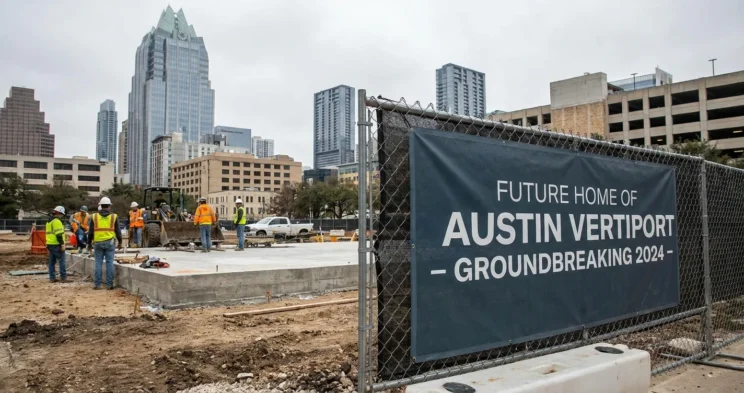
Electric air taxis are coming to Texas. You may have already spotted test aircraft near the Texas Medical Center or read about vertiport construction planned for downtown Austin. When commercial service launches, the liability questions that follow an injury will be unlike anything most Texas riders have faced before.
Texas law gives you two years to file a personal injury claim, and understanding who is responsible before something goes wrong puts you in a far stronger position.
Why eVTOL Air Taxi Cases Will Involve Multiple Defendants
If you are hurt and already watching medical bills stack up, the first question is usually: who pays? Texas tort law governs causation and damages, but FAA regulations often define what “reasonable care” looks like for operators and facilities. Knowing this split tells you what evidence matters and which parties may owe you compensation.
Electric vertical takeoff and landing (eVTOL) aircraft represent a new category of urban air mobility. A single incident could involve:
- The Part 135 operator flying the aircraft
- The vertiport owner or operator responsible for the facility
- Maintenance vendors who service the aircraft or ground equipment
- Manufacturers of the aircraft, batteries, or components
Texas Civil Practice and Remedies Code § 16.003 sets a two-year statute of limitations for personal injury claims. Missing this deadline typically bars your case entirely.
What Is a Vertiport & Why It Matters for Your Claim
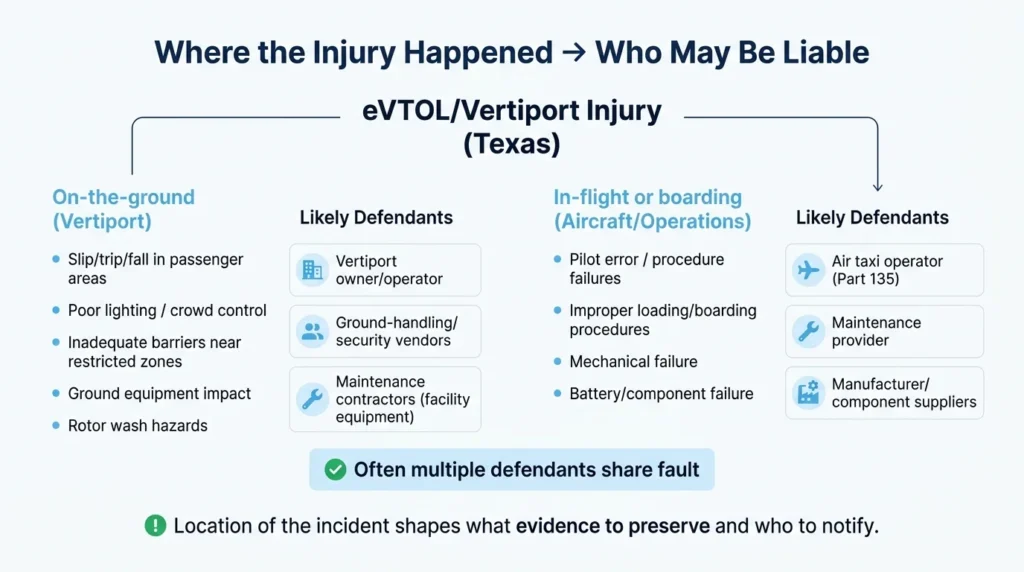
A vertiport is a facility designed for vertical takeoff and landing aircraft, essentially a specialized heliport built for eVTOL air taxis. The FAA’s Advanced Air Mobility infrastructure guidance treats vertiports as a type of heliport, subject to design standards covering approach paths, landing areas, and passenger zones.
Vertiports create two distinct risk environments:
On-the-ground hazards include slips and falls in passenger areas, inadequate lighting, poor crowd control, rotor wash from landing aircraft, and restricted zones without proper barriers. These scenarios often trigger traditional premises liability claims against the property owner or operator.
In-flight or boarding hazards involve the aircraft itself: mechanical failures, pilot error, improper loading procedures, or defective components. These typically point toward the air taxi operator, maintenance providers, or manufacturers.
Where your injury occurred shapes which defendants are most likely responsible and what evidence you need to preserve.
How Texas Law Determines Liability in Aviation Injury Cases
Proving a personal injury claim in Texas requires four elements: duty, breach, causation, and damages. In eVTOL and vertiport cases, each element can involve technical evidence.
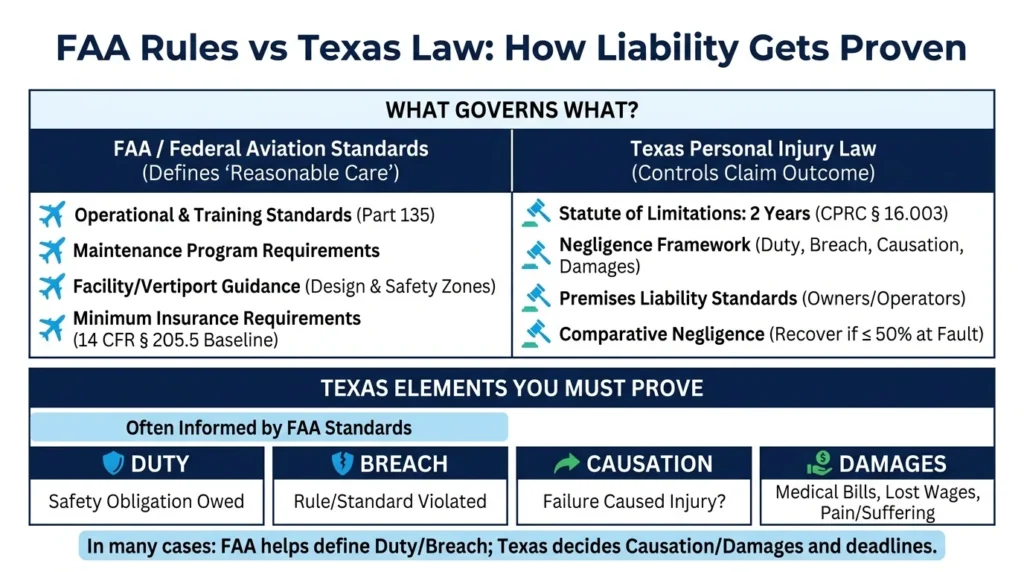
Duty asks what safety obligations each party owed you. For aircraft operators, FAA regulations under Part 135 certification establish baseline requirements for operations, training, and maintenance. For vertiport owners, Texas premises liability law requires reasonable care to keep the property safe for visitors.
Breach examines whether a party failed to meet that standard. Did the operator skip required inspections? Did the vertiport owner ignore a known hazard in the boarding area?
Causation connects the breach to your injuries. This is where Texas law controls, regardless of federal aviation rules.
Damages include medical expenses, lost wages, pain and suffering, and other losses. Texas law governs how these are calculated and recovered.
When multiple parties share fault, Texas applies a modified comparative negligence rule. You can recover damages as long as you are not more than 51% responsible for your own injuries. If the facts point to more than one defendant, our aviation and transportation injury attorneys can help you sort out who is responsible.
Mapping the Likely Defendants in Your Case
In most eVTOL incidents, at least two or three parties will have some role in what happened. The facts of your case determine who bears the most responsibility.
The Air Taxi Operator
Most commercial air taxi services will operate under FAA Part 135 certification, which covers on-demand and commuter operations. Part 135 operators must maintain approved operations manuals, ensure pilot qualifications, follow maintenance programs, and meet certain insurance requirements.
When an operator fails to follow these requirements, that failure can serve as evidence of negligence. Key records include flight logs, pilot training documentation, maintenance sign-offs, and dispatch procedures.
If you were injured as a passenger in a commercial aircraft, the operator’s compliance history becomes central to your claim.
The Vertiport Owner or Operator
The entity that owns or operates the vertiport may be liable under Texas premises liability law if unsafe conditions on the property caused your injury. This applies whether you slipped on a wet floor in the terminal, were struck by ground equipment, or were injured by inadequate barriers near active landing zones.
Evidence to preserve includes surveillance footage, inspection logs, incident reports, and maintenance records for facility equipment. Many planned vertiport sites in the Houston area and near the Dallas Galleria corridor are still in early development, and their safety protocols may not be fully established by launch.
Maintenance Providers & Third-Party Vendors
A vendor who performs improper repairs, misses a defect, or fails to follow the manufacturer’s maintenance program can be held liable for resulting injuries. Beyond aircraft maintenance, vertiports will rely on contractors for charging infrastructure, fire suppression systems, ground handling, and security. Each vendor’s scope of work and performance can become relevant if their negligence contributed to your injury.
Manufacturers
Product liability claims can arise when a defect in the aircraft, battery system, or component causes harm. Texas recognizes three theories:
- Design defect: The product was inherently unsafe as designed
- Manufacturing defect: Something went wrong during production
- Failure to warn: Inadequate instructions or warnings about risks
eVTOL aircraft use advanced battery and power systems. When these systems fail, preserving the physical components and any downloadable flight data is critical. Everyone who made or sold the defective part, from the primary manufacturer to component suppliers, may be liable depending on where the defect originated.
Insurance & Recovery in Aviation Injury Cases
Air carriers operating under Part 135 must maintain liability insurance. Federal regulations under 14 CFR § 205.5 establish minimum coverage requirements for certain operations, providing a baseline for passenger injury claims.
Beyond operator coverage, your claim may also involve commercial general liability policies held by the vertiport owner, contractor and vendor insurance for maintenance providers, and product liability coverage from manufacturers.
Dealing with multiple insurers adds complexity. Each may try to shift blame to another party. Do not give recorded statements to any insurer before consulting an attorney. What you say can be used to reduce or deny your claim.
Protecting Your Claim After an eVTOL or Vertiport Injury
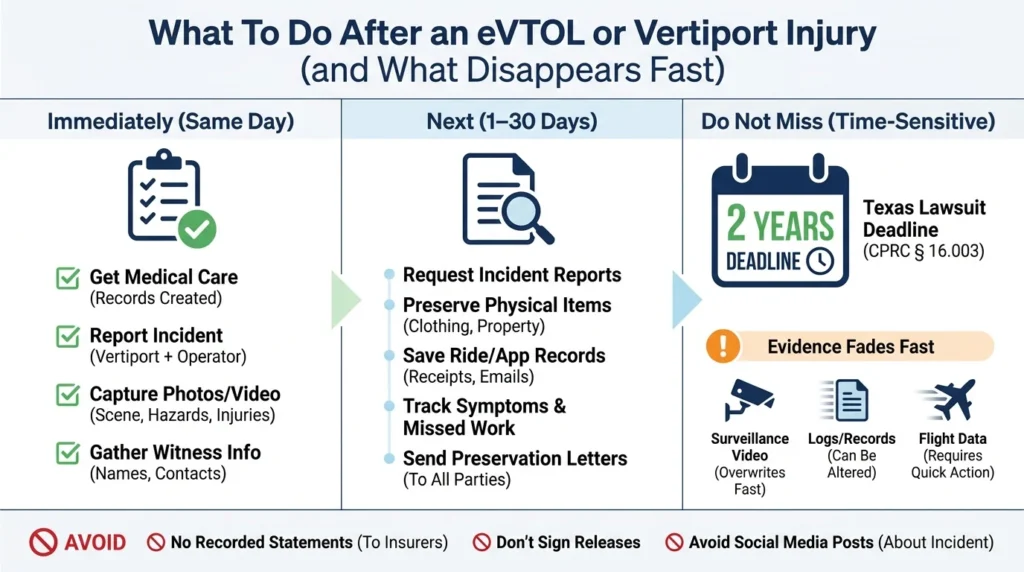
The steps you take immediately after an injury can determine whether your claim succeeds.
- Get medical attention first. Your health is the priority, and medical records document your injuries.
- Request an incident report from the vertiport operator and the air taxi company. Ask for copies before you leave if possible.
- Preserve evidence. Take photos of the scene, your injuries, and any equipment involved. Keep the clothing and personal items you had with you. Identify witnesses and get their contact information.
- Document your damages. Keep a journal of your symptoms, save all medical bills, and track any work you miss.
- Avoid social media posts about the incident. Insurers monitor these for statements they can use against you.
Time-Sensitive Evidence in Aviation Cases
Surveillance footage from vertiports and nearby businesses may be overwritten within days or weeks. Maintenance logs and training records can be altered or lost. Flight data from the aircraft may only be recoverable if someone acts quickly.
A preservation letter sent to all potentially responsible parties can help protect this evidence. An attorney can handle this process while you focus on recovery.
The Two-Year Deadline & Why Early Action Matters
Under Texas Civil Practice and Remedies Code § 16.003, you generally have two years from the date of injury to file a personal injury lawsuit. This deadline applies regardless of how many defendants are involved or how complex the investigation becomes.
Two years may sound like plenty of time, but aviation cases require identifying the correct legal entities, obtaining contracts and insurance information, and preserving technical evidence. Waiting too long can mean lost footage, destroyed records, and faded witness memories.
How Angel Reyes & Associates Can Help
If you are injured in an eVTOL air taxi incident or at a vertiport anywhere in Texas, our firm can help you understand your options. With over 30 years of experience guiding injured Texans and more than $1 billion recovered for clients, Angel Reyes & Associates has the resources to investigate complex cases involving multiple defendants.
We offer free initial consultations and work on contingency: no fee unless we win. Our team is available 24/7 and can handle most of your case remotely. We also offer service in Spanish (se habla español). Contact us today to discuss your case and protect your right to compensation.
Air Taxi & Vertiport Liability FAQs
Can I still have a claim if I was hurt before takeoff or during boarding?
Yes. If the injury happened in a boarding area, waiting zone, or other vertiport space, the claim may look more like a premises or ground-operations case than an in-flight aviation claim.
What if more than one company blames the others for the same eVTOL injury?
That is common in transportation cases involving operators, property owners, vendors, and manufacturers. A claim can be investigated against multiple parties at the same time while the facts are sorted out.
What should I do if an insurer contacts me before I have an attorney?
Do not give a recorded statement or sign anything. Politely tell them you will have an attorney contact them, then reach out to a lawyer before responding further.
Does a government-owned vertiport change how an injury claim works in Texas?
It can. If a city, county, or other public entity owns or operates the property, special notice rules and shorter deadlines may apply, so the timing and procedure may differ from a standard private-party claim.
What records should I keep if my injuries seem minor at first?
Keep discharge papers, receipts, photos, ride records, emails or app confirmations, and notes about when symptoms started. Seemingly small injuries can worsen, and early records help connect the injury to the incident.
About the Authors

Angel Reyes
Writer
Angel L. Reyes, III is the Founder and Managing Partner of Angel Reyes & Associates. A nationally recognized trial attorney and business leader, Angel has helped over 70,000 injury victims recover more than $1 billion since founding the firm in 1993. Named to the Texas Super Lawyers list annually since 2008, Angel brings Wall Street experience, Ivy League education, and a deep commitment to client advocacy. He is a frequent legal commentator and published author with extensive contributions to legal scholarship, trial strategy, and consumer protection.

Graham Griffin
Editor
Graham Griffin is the Web & Content Manager at Angel Reyes & Associates, where he oversees content strategy, AI-powered workflows, a...

Angel Reyes
Reviewer
Angel L. Reyes, III is the Founder and Managing Partner of Angel Reyes & Associates. A nationally recognized trial attorney and business...