Who Is Liable for an Uber–Rivian Robotaxi Crash in Texas?


Every article on this site is researched by our internal team, reviewed for legal accuracy against current Texas law, and held to State Bar of Texas advertising standards before publication. We do not publish content that overstates outcomes or makes promises about results.
Learn more about our
editorial standards .
Key Takeaways
- Texas law treats the automated driving system as the operator, shifting liability to fleet operators, platforms, and manufacturers.
- Multiple insurance policies may apply after a robotaxi crash, and Texas fault rules can reduce or bar recovery based on your share of responsibility.
- Robotaxi sensor logs and software data can be overwritten within days, making early evidence preservation one of the most critical steps after a crash.
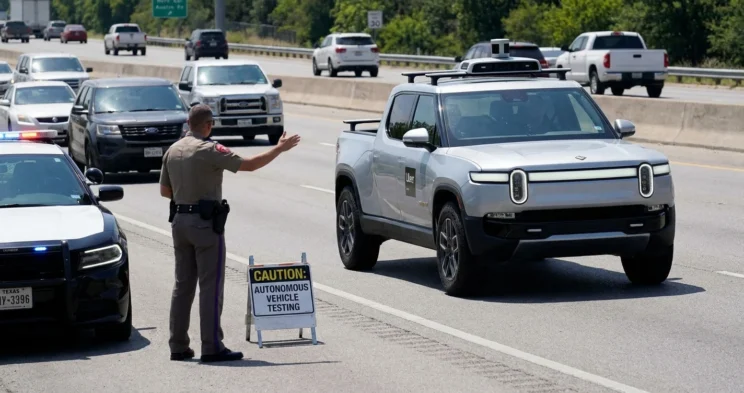
You saw one on the news, or maybe you passed one on the highway near Austin or Dallas, a vehicle moving through traffic with no one behind the wheel.
The question that follows is reasonable: if that car hits you, who do you hold responsible?
Texas law is starting to answer that. But the answer isn’t simple, and it’s not one company.
How Texas Law Treats Autonomous Vehicles & Their Operators
Texas Transportation Code Chapter 545, Subchapter J gives automated vehicles legal standing to operate on public roads, and it also assigns responsibility when something goes wrong.
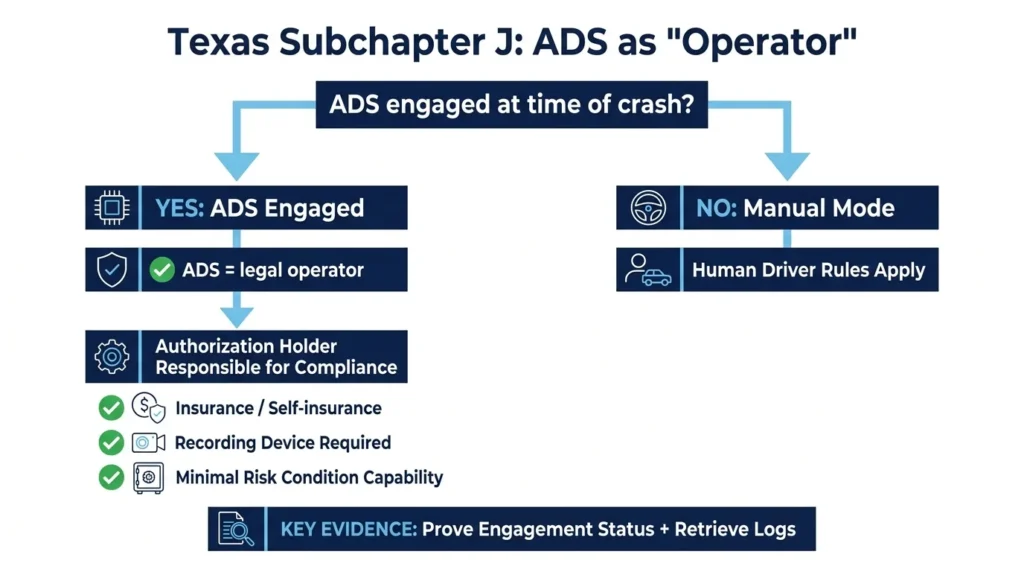
The statute defines an “automated motor vehicle” as one equipped with an automated driving system (ADS) capable of handling the entire driving task without a human. When that system is engaged, Texas law treats the ADS itself as the operator. That single shift changes everything about how fault is assigned after a crash.
The statute also defines an “authorization holder,” the entity that holds legal permission to run automated vehicles on Texas roads. That role carries real obligations:
- Maintaining insurance or self-insurance
- Equipping vehicles with recording devices
- Ensuring the ADS can reach a “minimal risk condition” if something goes wrong
Those obligations create accountability. They also create evidence. The recording device requirement means the vehicle should have data showing exactly what its systems detected and how they responded in the moments before impact.
Who Could Actually Be Responsible After a Robotaxi Crash
Robotaxi crashes rarely have one responsible party. Several entities may share fault depending on what caused the collision, and identifying all of them early is critical to a full car accident claim.
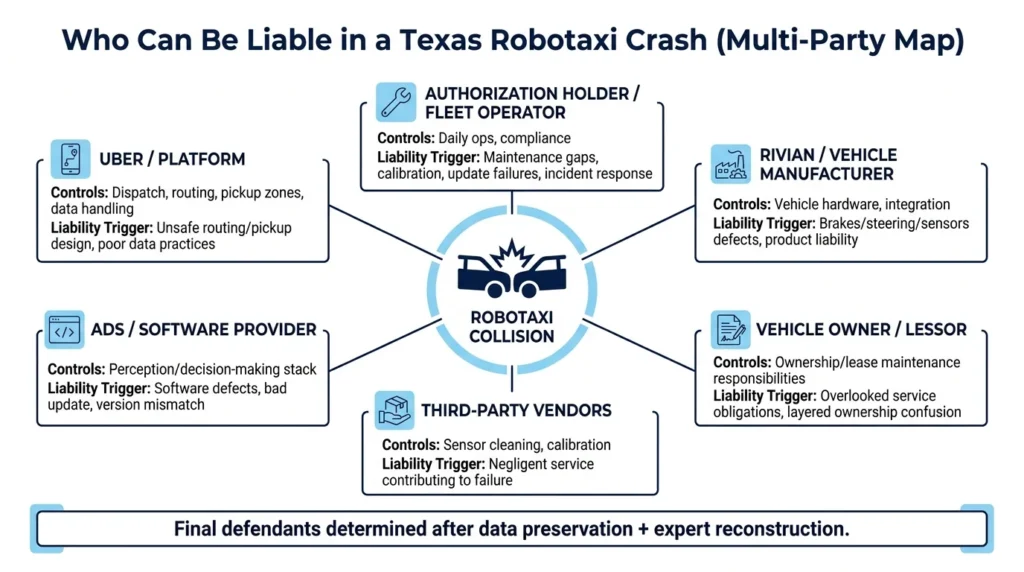
The Platform (Uber): Uber doesn’t manufacture the vehicle, but its dispatch decisions, routing logic, pickup zone design, and post-crash data handling all fall within its control. If any of those contributed to unsafe conditions, the platform faces scrutiny.
The Authorization Holder or Fleet Operator: This entity manages daily operations and statutory compliance. Failures in maintenance schedules, sensor calibration, software update protocols, or incident response can each support a negligence claim. The authorization holder also typically carries the primary insurance required under Subchapter J.
Rivian (Vehicle Manufacturer): If hardware failed, product liability law may apply. That includes braking systems, steering components, sensors, and how the ADS integrates with the physical vehicle. Separating a hardware failure from a software failure usually requires expert analysis.
The ADS or Software Provider: The automated driving system’s logs showing what it perceived, what it decided, and what it did become central evidence in most crashes. Software version history and any updates pushed before the collision can matter significantly.
Vehicle Owner or Lessor: Robotaxi ownership structures can be layered. The entity that owns or leases the vehicle may carry maintenance obligations of its own. Third-party vendors handling sensor cleaning or calibration may also bear some responsibility if their work was a contributing factor.
The right combination of defendants often becomes clear only after data is preserved and an expert reconstruction is completed. Early investigation is about making sure no responsible party disappears from the picture before that work happens.
How Insurance Actually Works in a Robotaxi Claim
Most injury victims expect one policy to cover their damages. Robotaxi claims don’t work that way.
Subchapter J requires authorization holders to carry financial responsibility for their automated vehicles. That’s the baseline. But commercial auto policies, umbrella coverage, and product liability insurance from manufacturers may all apply depending on which parties bear fault and why.
The friction points that slow victims down most often include:
- Insurers disputing who was “operating” the vehicle at the time of the crash
- Priority fights between multiple carriers over which policy pays first
- Each company pointing at another while the injured person waits
Insurance companies are businesses. When multiple insurers are involved, each has a financial incentive to shift responsibility to a different policy. This dynamic is a primary reason why identifying all potentially liable parties early matters as much as it does in a rideshare accident claim.
Your status as a claimant also affects which policies you can access. A passenger, a pedestrian, and an occupant of another vehicle may have different coverage routes even in the same crash.
Texas Proportionate Responsibility & What It Means for Your Claim
Texas Civil Practice and Remedies Code Chapter 33 governs how fault is divided when multiple parties are involved. Your damages can be reduced by your percentage of fault. If you are found more than 50% responsible, you may be barred from recovery entirely.
In a robotaxi case, that fault may be spread across the platform, the fleet operator, the manufacturer, the software provider, and potentially other drivers. Each additional defendant changes the negotiation.
Defense teams in these cases tend to use predictable tactics. They may argue the injured person was speeding, distracted, or failed to yield. They may point to another driver or claim conditions were unavoidable. Objective data from the vehicle’s onboard recording systems is often the most direct counter to those arguments. Getting that data before it’s overwritten is essential.
Naming every responsible party correctly also matters. Misidentifying who controlled the vehicle’s operation or maintenance can skew fault allocation in ways that affect your total recovery. Attorneys experienced in complex vehicle accident cases know how to trace those ownership and operational layers.
Evidence You Need to Preserve After a Texas Robotaxi Crash
Autonomous vehicle cases are built on data. The strength of a claim often comes down to what was preserved and how quickly.
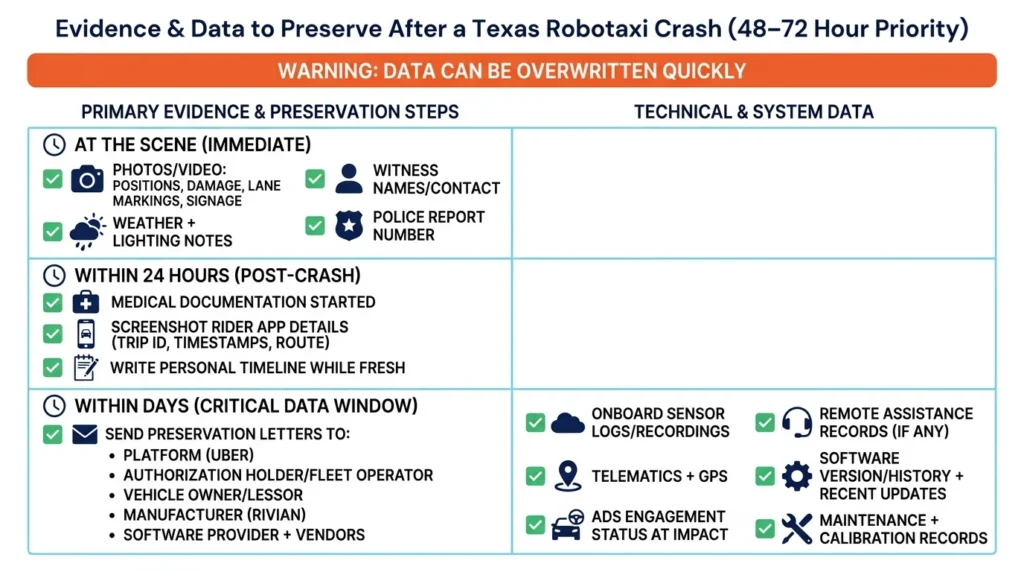
From the scene:
- Photos and video of vehicle positions, road conditions, and damage
- Weather and lighting at the time of impact
- Witness names and contact information
- Police report number
From the vehicle and platform:
- Onboard sensor logs and recordings
- Telematics and GPS data
- Rider app trip records (screenshot your trip ID immediately)
- Remote assistance records if applicable
- Software version and ADS engagement status at the time of the crash
Multiple entities may hold different pieces of this data. Preservation letters need to go to the platform, the authorization holder, the vehicle owner, the manufacturer, and any relevant vendors. Routine data retention schedules can overwrite crash logs within days. Once that window closes, “we don’t have it” is very hard to challenge.
Knowing what to do after a rideshare accident covers the immediate steps that protect your ability to recover.
What to Do After a Robotaxi Crash in Texas
Get medical attention first. Even injuries that seem minor need documentation.
Call police and request a report. Don’t assume the robotaxi company’s data capture replaces an official record.
Document everything at the scene. Photos, witness names, and a screenshot of your trip details from the app.
Don’t give recorded statements. Insurance adjusters may contact you quickly. Don’t speak on record without legal guidance, and don’t sign any releases early.
Move fast on evidence. The data window is short. Speaking with an attorney before key logs are overwritten can make a significant difference.
Understanding what to do after a car accident in Texas provides a foundation, but robotaxi crashes add layers of complexity that go well beyond a standard collision.
How Angel Reyes & Associates Can Help
When a robotaxi crash happens, the companies involved move quickly. They have engineers, data teams, and legal counsel working from the moment of impact.
Angel Reyes & Associates has guided Texans through complex vehicle accident cases for over 30 years. We handle the investigation, evidence preservation, and negotiations so you can focus on recovering.
We offer free consultations and work on contingency. No fee unless we win. We’re available 24/7 and serve clients across Texas from 16 locations.
If you’ve been injured in a robotaxi or autonomous vehicle crash, contact us today to talk through your options.
Uber & Rivian Robotaxi FAQs
Does Texas law require a human safety driver in a fully autonomous robotaxi?
Not necessarily. Texas Transportation Code Subchapter J allows automated vehicles to operate without a human present if the vehicle satisfies the statute’s requirements.
Can a robotaxi company receive a traffic citation after a crash in Texas?
In some situations, yes. Texas law allows certain traffic enforcement responsibilities to be directed to the authorization holder or vehicle owner when an automated driving system is operating.
What if the robotaxi was in manual mode when the crash happened?
That can shift liability significantly. If a human was actually controlling the vehicle at the time of impact, responsibility may move toward that driver or attendant. Proving ADS engagement status at the moment of the crash becomes a key issue.
Can road conditions or construction zones affect fault in a robotaxi crash?
Yes. Faded markings, missing signage, road debris, or a confusing work zone can affect whether fault is placed on the robotaxi system, another driver, or in some cases a road-related entity.
Are sensor logs and software data always recoverable after a robotaxi crash?
Not always. Data may be overwritten, held by different companies, or subject to retention limits. Early legal action to preserve trip records, vehicle logs, and maintenance history is often the difference between having that evidence and losing it.
About the Authors

Angel Reyes
Writer
Angel L. Reyes, III is the Founder and Managing Partner of Angel Reyes & Associates. A nationally recognized trial attorney and business leader, Angel has helped over 70,000 injury victims recover more than $1 billion since founding the firm in 1993. Named to the Texas Super Lawyers list annually since 2008, Angel brings Wall Street experience, Ivy League education, and a deep commitment to client advocacy. He is a frequent legal commentator and published author with extensive contributions to legal scholarship, trial strategy, and consumer protection.

Kyle Nicolas
Editor
Kyle Nicolas is the Web Content & SEO Manager at Angel Reyes & Associates. He has more than 10 years of experience as a marketing co...

Angel Reyes
Reviewer
Angel L. Reyes, III is the Founder and Managing Partner of Angel Reyes & Associates. A nationally recognized trial attorney and business...