Can Texas Cities Ban Robotaxis?


Every article on this site is researched by our internal team, reviewed for legal accuracy against current Texas law, and held to State Bar of Texas advertising standards before publication. We do not publish content that overstates outcomes or makes promises about results.
Learn more about our
editorial standards .
Key Takeaways
- Texas Transportation Code Chapter 545, Subchapter J preempts most local regulation of autonomous vehicles, preventing cities from banning robotaxis outright.
- The TxDMV commercial AV authorization program becomes enforceable May 28, 2026, adding new compliance requirements for robotaxi operators in Texas.
- When an autonomous vehicle causes a crash, the ADS can be treated as the "operator" for traffic citations, but civil liability depends on facts, evidence, and applicable insurance coverage.
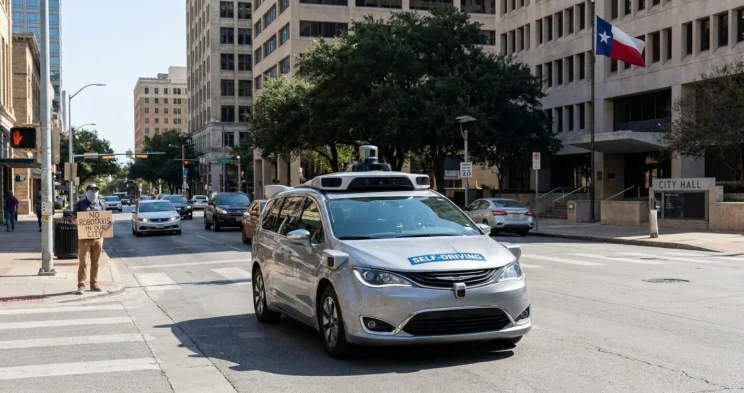
You spotted an autonomous vehicle (AV) cruising around Downtown Dallas last week. People have mixed feelings about self-driving technology. Regardless of whether you are pro-AV or anti-AV, you might be curious: can your city actually stop them from operating on local streets?
The answer is more nuanced than a simple yes or no. Texas law largely prevents cities from banning robotaxis outright. But Dallas, Fort Worth, and other municipalities still have real influence over how these vehicles operate day-to-day.
Texas Law Preempts Most Local Robotaxi Regulation
The foundation of robotaxi regulation in what’s called “state preemption, found in Texas Transportation Code Chapter 545, Subchapter J. In plain terms, this section says the state government has claimed authority over automated vehicle operations.
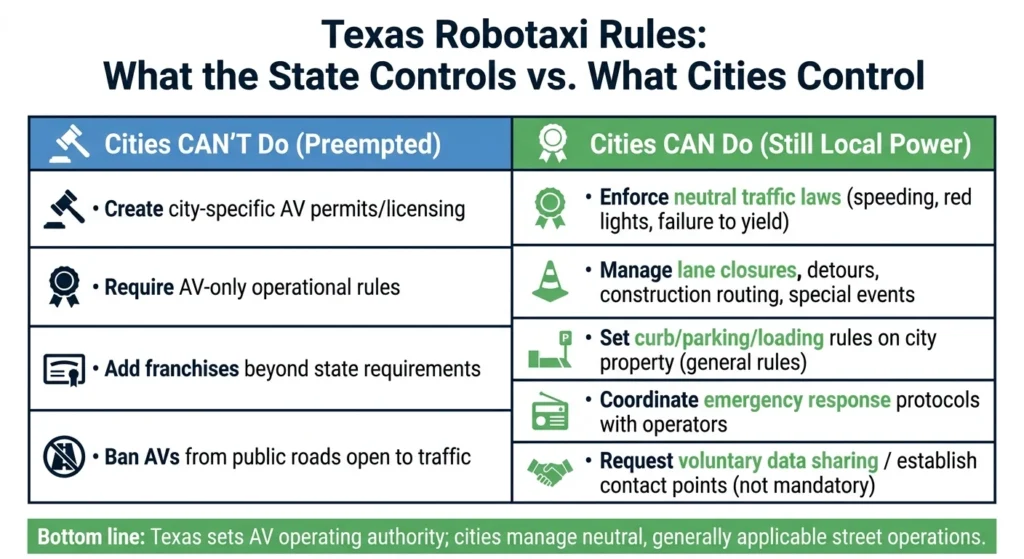
Political subdivisions (cities, counties, and other local governments) cannot impose franchises or other regulations related to automated motor vehicle or automated driving system operations.
What does this mean practically? A city cannot create its own permitting program specifically for robotaxis. It cannot require special licenses for autonomous vehicles that the state doesn’t require. It cannot pass an ordinance singling out driverless cars for extra operational restrictions.
The City of Austin’s official guidance summarizes this clearly: Texas law preempts local AV regulation. The same principle applies to Dallas, Fort Worth, and every other Texas city.
This preemption framework has been in place since 2017. As Houston Public Media reported, the law was designed to encourage autonomous vehicle development in Texas by creating regulatory certainty. Companies know they won’t face a patchwork of different city rules across the state.
What Cities Cannot Do Under Preemption
The prohibition covers several types of local action:
- Creating city-specific AV permits or licensing schemes targeting the technology itself
- Passing ordinances that impose extra operational rules only on autonomous vehicles
- Establishing franchise requirements for robotaxi companies beyond state requirements
- Banning driverless vehicles from public roads that are otherwise open to traffic
If a robotaxi can legally operate under state rules, a city typically cannot create a separate barrier to stop it.
What Texas Cities Can Still Control
Preemption doesn’t mean cities are powerless. Municipalities retain significant practical influence through tools that apply to all vehicles equally.
Neutral traffic enforcement remains fully within city authority. Police can cite any vehicle (autonomous or human-driven) for speeding, running red lights, failing to yield, or obstructing traffic. The key is that enforcement must apply the same rules to everyone.
Roadway access decisions also stay local. Cities control lane closures, construction zone routing, special-event detours, and temporary restrictions. During the State Fair of Texas, Dallas can reroute traffic around Fair Park.
Public property rules give cities another lever. Curb management, parking regulations, loading zones, and pickup areas at city-owned facilities fall under municipal control. These rules must apply generally rather than targeting AVs specifically.
Emergency response coordination represents perhaps the most important ongoing municipal role. Police, fire, and EMS need to know how to interact with driverless vehicles at crash scenes. Cities work with AV operators to establish communication channels and incident protocols.
Cities can communicate with robotaxi companies, request voluntary data sharing, and establish contact points for reporting problems. They cannot mandate these arrangements as conditions for operating.
If you want Texas to change how robotaxis are regulated, the path runs through the state legislature and state agencies. City hall can advocate for changes, but it cannot unilaterally impose new rules that conflict with state preemption.
The TxDMV Commercial AV Authorization Program
A newer layer of state regulation is taking shape. The TxDMV Autonomous Vehicles Regulatory Program establishes a statewide authorization requirement for commercial automated-vehicle operations. Created by Senate Bill 2807 during the 89th legislative session, this program adds compliance obligations specifically for companies offering robotaxi and similar commercial services.
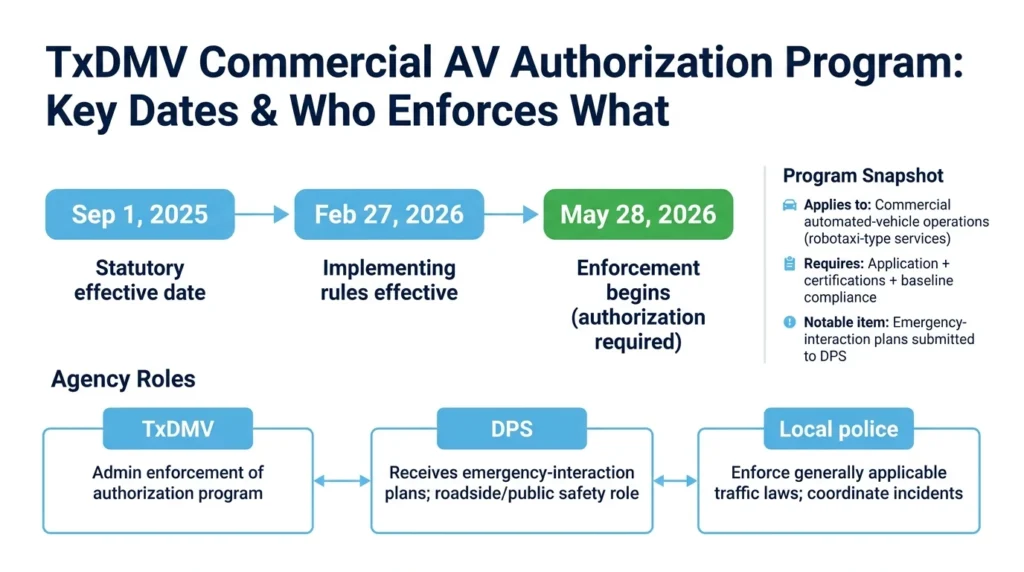
The timeline matters for anyone tracking robotaxi expansion in the Metroplex:
- Statutory effective date: September 1, 2025
- Implementing rules effective: February 27, 2026
- Enforcement begins: May 28, 2026
After May 28, 2026, commercial robotaxi operators must hold TxDMV authorization to operate legally in Texas. The program requires application submissions, certification acknowledgments, and baseline compliance items.
One notable requirement: operators must submit emergency-interaction plans to the Texas Department of Public Safety. These plans help first responders understand how to safely approach and manage driverless vehicles at car accident scenes.
Agency roles split between TxDMV (administrative enforcement of the authorization program) and DPS plus local law enforcement (roadside enforcement of traffic laws).
Who Is the “Operator” if a Robotaxi Crashes?
This question comes up constantly. Texas Transportation Code addresses it directly. When a vehicle operates autonomously using an automated driving system, the ADS itself can be treated as the operator for certain traffic-law purposes. Citations for traffic violations can be issued to the entity responsible for the ADS rather than to a human driver who isn’t present.
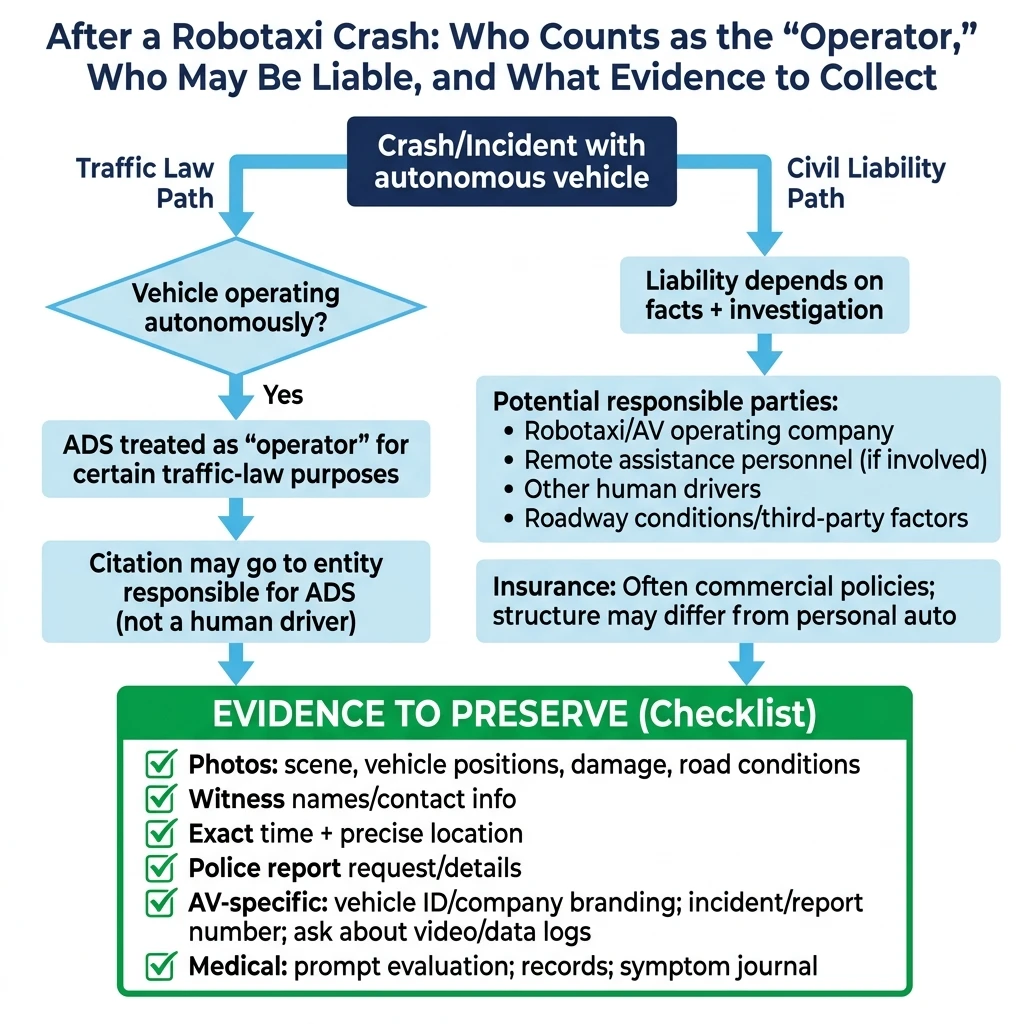
Civil liability after a crash is more complex. Multiple parties may bear responsibility depending on the facts:
- The AV company operating the robotaxi
- Any remote assistance personnel involved
- Other human drivers who contributed to the collision
- Roadway conditions or third-party factors
Determining liability requires investigation. Evidence matters enormously. Insurance claims may involve commercial policies with coverage structures different from typical personal auto insurance.
Evidence That Matters in Robotaxi Crashes
If you’re involved in a collision with a driverless vehicle on I-30 near Arlington or anywhere else in the Metroplex, certain evidence becomes especially important.
Standard crash documentation applies: photos of the scene, vehicle positions, damage, and road conditions. Get contact information from witnesses. Note the time and location precisely. Request a copy of the police report.
AV-specific evidence may also exist. Robotaxis typically carry extensive sensor arrays and recording systems. Ask responding officers if the vehicle has an incident report number. Note any company identification on the vehicle. The AV operator may have video footage and data logs that could prove critical to your claim.
Documenting your injuries thoroughly remains essential. Seek medical evaluation even if you feel fine initially. Some injuries don’t present symptoms immediately. Keep records of all treatment and track how symptoms affect your daily life.
What to Do if You Encounter a Robotaxi Incident
Whether you witness a near-miss on the Dallas North Tollway or find yourself in a collision with a driverless vehicle, knowing the right steps helps protect your interests.
For any collision:
- Move to safety if you can do so without risking further injury
- Call 911 immediately
- Request medical evaluation at the scene
- Do not admit fault or argue about what happened
- Document everything you can safely capture
For non-crash problems (stalled vehicle blocking traffic, erratic behavior): Call 911 if the situation creates an immediate hazard. For less urgent issues, contact local non-emergency lines. Document the location, time, and what you observed.
When legal help makes sense: Injuries from a robotaxi collision often involve complications that don’t arise in typical car accidents. Multiple insurance policies may apply. The “operator” question can affect who you pursue for compensation. Evidence controlled by the AV company may require legal process to obtain.
How Angel Reyes & Associates Can Help
Crashes involving autonomous vehicles present unique challenges. Identifying responsible parties, preserving digital evidence, and navigating commercial insurance policies all require experience and resources.
Angel Reyes & Associates has spent over 30 years helping injured Texans recover compensation after serious accidents. Our firm has recovered more than $1 billion for clients across the state. We handle cases on a contingency basis: no fee unless we win.
We have more than 20 office locations across Texas and can handle most aspects of your case remotely. Our team is available 24/7, and we offer free initial consultations in English and Spanish.
If a robotaxi collision has left you injured and uncertain about your options, contact us to discuss your situation. Understanding your rights is the first step toward protecting them.
Witness Statement FAQs
Do robotaxis have to follow the same Texas traffic laws as other cars?
Yes. Texas law allows automated vehicles on public roads only if they comply with applicable traffic laws and meet the state’s operating requirements.
Can a Texas city keep robotaxis out of airports, stadiums, or other pickup zones it controls?
A city or public facility can usually set general rules for access, parking, and pickup areas it manages, as long as those rules are not written as robotaxi-o
Are private self-driving cars treated the same as commercial robotaxi services in Texas?
Not exactly. Texas’s newer TxDMV authorization framework is aimed at commercial automated-vehicle activity, so a for-hire robotaxi service may face state requirements that do not apply in the same way to private noncommercial use
If a robotaxi blocks a lane or stalls in traffic, who should report it?
If it creates an immediate safety hazard, call 911; if it is not an emergency, use the local non-emergency line. Be ready to share the exact location, time, and what the vehicle is doing.
Can local police still ticket or tow a robotaxi in Texas?
Police can still enforce generally applicable laws such as obstruction, parking, and traffic-safety rules, and towing may be allowed under ordinary local procedures when any vehicle creates a lawful basis for removal.
About the Authors

Angel Reyes
Writer
Angel L. Reyes, III is the Founder and Managing Partner of Angel Reyes & Associates. A nationally recognized trial attorney and business leader, Angel has helped over 70,000 injury victims recover more than $1 billion since founding the firm in 1993. Named to the Texas Super Lawyers list annually since 2008, Angel brings Wall Street experience, Ivy League education, and a deep commitment to client advocacy. He is a frequent legal commentator and published author with extensive contributions to legal scholarship, trial strategy, and consumer protection.

Kyle Nicolas
Editor
Kyle Nicolas is the Web Content & SEO Manager at Angel Reyes & Associates. He has more than 10 years of experience as a marketing co...

Angel Reyes
Reviewer
Angel L. Reyes, III is the Founder and Managing Partner of Angel Reyes & Associates. A nationally recognized trial attorney and business...