Can You Sue Waymo for a Robotaxi Accident?


Every article on this site is researched by our internal team, reviewed for legal accuracy against current Texas law, and held to State Bar of Texas advertising standards before publication. We do not publish content that overstates outcomes or makes promises about results.
Learn more about our
editorial standards .
Key Takeaways
- Texas law allows injury claims after robotaxi crashes, with potential liability falling on Waymo, manufacturers, software vendors, and other drivers depending on what caused the collision.
- Under Texas proportionate responsibility rules, you cannot recover damages if you are found more than 50% at fault for the crash.
- The two-year statute of limitations is the legal deadline, but critical digital evidence from robotaxi systems can disappear within days or weeks without formal preservation demands.
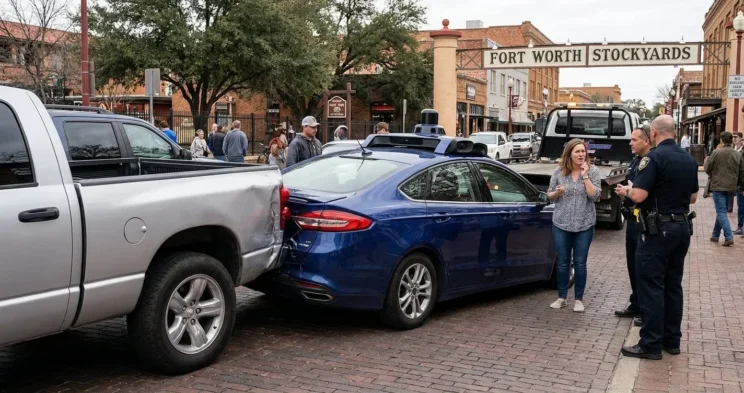
You were riding in a Waymo robotaxi in Austin when the vehicle braked suddenly and was rear-ended. You’re hurt, confused, and wondering who pays for this.
Crashes involving autonomous vehicles raise questions that don’t come up in typical wrecks. There’s no driver to exchange information with. The “operator” might be a software system. And the company behind the vehicle has teams of lawyers ready to protect its interests.
Texas law does allow you to pursue compensation after a robotaxi crash. The path forward depends on understanding who may be responsible, what evidence matters most, and how quickly you need to act.
Why Waymo Robotaxi Crashes Are Different
In a standard car accident, fault usually comes down to one or two drivers. Robotaxi crashes are more complicated.
Responsibility may involve software decisions made by an automated driving system, remote assistance operators monitoring the vehicle, mapping data that guided the route, maintenance crews who serviced sensors, and sometimes a human driver in another vehicle who caused the collision.
This creates what attorneys call a “robotaxi stack” of potential defendants. Each layer may point fingers at the others.
The evidence is also different. Instead of relying mainly on witness statements and police reports, robotaxi cases often turn on system logs, sensor data, and onboard video that only the company controls. This data can disappear quickly if you don’t take steps to preserve it.
Early action matters more in these cases than in ordinary crashes. A preservation demand sent within days of the incident can protect critical digital evidence before routine data overwrites erase it.
Can You Sue Waymo After a Robotaxi Crash in Texas?
Yes. Texas law allows injury claims after robotaxi crashes. The question is who you sue and under what legal theory.
Negligence claims focus on careless conduct. If Waymo’s operations team failed to respond appropriately to a known hazard, or if maintenance was inadequate, negligence theories may apply.
Products liability claims focus on defects. If a sensor malfunctioned, software made a dangerous decision, or the vehicle’s design created an unreasonable risk, Texas Civil Practice and Remedies Code Chapter 82 provides a framework for holding manufacturers accountable.
Many robotaxi cases use both theories. Your standing to sue depends on your role in the crash: passenger in the robotaxi, occupant of another vehicle, pedestrian, or cyclist. Each scenario involves different proof challenges, but all can support valid claims when the evidence is there.
Texas proportionate responsibility rules will affect your recovery. Under Texas Civil Practice and Remedies Code § 33.001, fault is allocated among all responsible parties. If you bear more than 50% of the responsibility, you cannot recover damages at all.
Who May Be Legally Responsible in a Texas Waymo Crash
Liability in a robotaxi crash can spread across multiple parties. Identifying the right defendants early shapes your entire case.
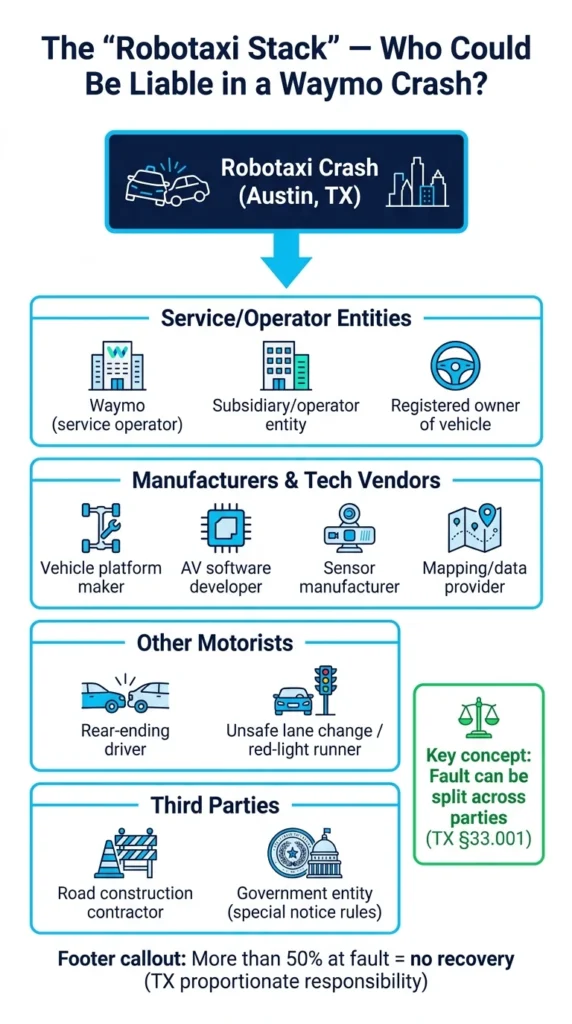
Service and operator entities include Waymo itself, any subsidiary operating the robotaxi service, and the registered owner of the vehicle. These parties may face negligence claims based on operations, oversight, and maintenance.
Manufacturers and software vendors include the company that built the vehicle platform, developers of the autonomous driving software, sensor manufacturers, and mapping providers. If a defect contributed to the crash, these parties may face products liability claims.
Other motorists remain potential defendants when human error caused or contributed to the collision. A driver who ran a red light near Camp Bowie Boulevard and struck a robotaxi may bear primary responsibility, even though an autonomous vehicle was involved.
Third parties like road construction contractors or governmental entities may also share fault in some cases, though claims against government bodies involve special notice requirements.
When Another Human Driver May Be Mostly at Fault
Many robotaxi crashes are caused by human drivers making unsafe choices around an autonomous vehicle. Rear-end collisions, unsafe lane changes, and red-light violations remain common causes.
The robotaxi’s own data can actually help prove the human driver’s fault. Speed logs, braking records, lane position data, and video footage may show exactly what happened in the seconds before impact.
This affects insurance strategy. You may pursue the at-fault driver’s liability coverage while also exploring whether additional policies tied to the robotaxi service provide supplemental coverage.
When Waymo or Service Operators May Be at Fault
A robotaxi service can face negligence exposure based on how it runs its operations.
Potential issues include inadequate monitoring of vehicles, poor safety protocols, failure to respond to known hazards, and negligent maintenance scheduling. If remote assistance operators failed to intervene when they should have, that conduct may support a negligence claim.
Corporate records become critical evidence: incident reports, internal safety tickets, ride logs, and remote assistance communications. These records are controlled by the company and require formal legal demands to obtain.
When the Vehicle or Software May Be Defective
If a defect contributed to your crash, products liability theories under Chapter 82 may apply.
Texas recognizes three defect types:
- Design defects exist when the product’s design itself creates unreasonable danger
- Manufacturing defects occur when something goes wrong during production
- Marketing defects involve failure to warn users about known risks
In robotaxi cases, defect claims might involve sensor calibration errors, software bugs, or design choices that created blind spots in the vehicle’s perception system.
Evidence that matters includes software version logs, update histories, recall or service bulletins, sensor calibration records, and prior similar incidents involving the same system.
The “Operator” Question in Texas Automated Driving Law
Texas Transportation Code Chapter 545 addresses how automated driving systems are treated for certain purposes, including who receives citations after a crash.
Important distinction: The “operator” designation for traffic citations is not the same as civil liability for damages. A robotaxi company might be treated as the operator for citation purposes, but your injury claim still requires proving negligence or a defect caused your harm.
Your lawsuit focuses on what actually happened: who controlled what systems, what failed, and how that failure caused your injuries. Labels matter less than evidence.
Deadlines to Sue After a Waymo Crash in Texas
Texas generally allows two years from the date of injury to file a personal injury lawsuit. This deadline comes from Texas Civil Practice and Remedies Code § 16.003. Wrongful death claims follow the same timeline.
But waiting anywhere close to two years can seriously damage your case.
Digital evidence disappears fast. Surveillance footage from nearby businesses may be overwritten within weeks. Robotaxi system logs may have limited retention periods. Witness memories fade. Insurance companies may take recorded statements that lock in unfavorable versions of events.
If your crash involved a governmental entity (like a city vehicle or road defect), additional notice requirements may apply with much shorter deadlines.
What to Do Immediately After a Waymo Robotaxi Crash
These steps protect both your health and your legal rights.
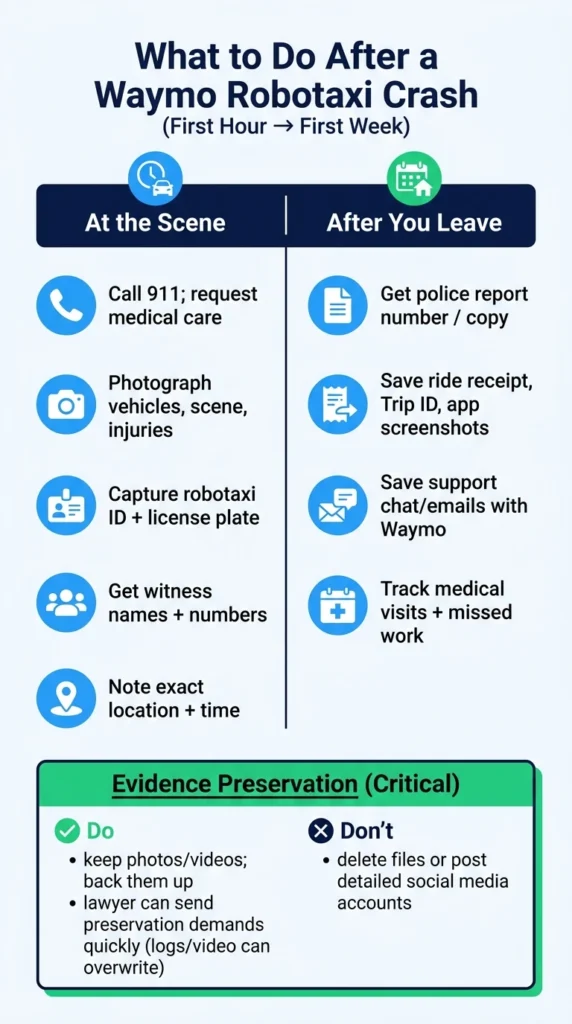
At the scene:
- Call 911 and request medical attention
- Document the robotaxi’s identification (vehicle number, license plate)
- Photograph the scene, all vehicles, and your injuries
- Get contact information from any witnesses
- Note the exact location and time
Documentation:
- Request a copy of the police report
- Save your ride receipt, trip ID, and any app screenshots
- Preserve all communications with the robotaxi company’s support system
Evidence preservation:
- Do not delete photos or videos from your phone
- Do not post detailed accounts on social media
- Contact an attorney who can send formal preservation demands to the robotaxi company
Robotaxi cases turn on data sources you don’t see in normal wrecks: system status logs, disengagement records, sensor outputs, onboard video, and remote assistance communications. This evidence is controlled by corporate entities who have no obligation to preserve it unless they receive proper legal notice.
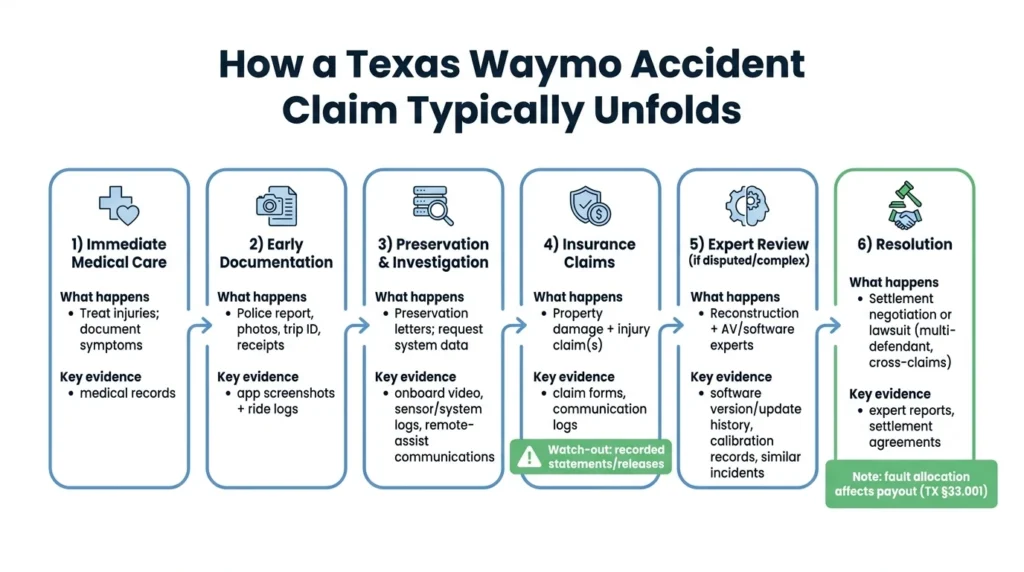
How a Waymo Accident Claim Typically Unfolds
Most cases begin with insurance claims, but robotaxi crashes often require deeper investigation before fault and value become clear.
Early phase: Document your medical treatment, gather wage loss proof, and handle property damage. Be cautious about recorded statements to insurance adjusters. Their goal is to resolve claims for the lowest possible payout, and early statements can be used against you later.
Investigation phase: Complex cases may require accident reconstruction experts, human factors specialists, and autonomous vehicle technology experts. If defect issues are suspected, software and engineering experts become essential.
Resolution: Many cases settle through negotiation once liability and damages are established. If settlement isn’t possible, litigation may involve multiple defendants, cross-claims between them, and proportional fault allocations that affect everyone’s exposure.
Understanding how rideshare accident claims work provides helpful context, though robotaxi cases involve additional complexity.
When to Talk to a Texas Waymo Accident Lawyer
Consider contacting an attorney promptly if:
- You were hospitalized or face ongoing medical treatment
- You suffered permanent injury or disability
- Fault is disputed or unclear
- Multiple vehicles were involved
- The insurance company is requesting recorded statements or signed releases
- You’re unsure who operated or owned the robotaxi
At Angel Reyes & Associates, we’ve spent over 30 years helping Texans injured in complex crashes. We offer free consultations and work on contingency, meaning no fee unless we win. Our team has helped clients recover more than $1 billion in compensation.
We have more than 20 office locations across Texas and can handle most of your case remotely. If your crash involved a truck or motorcycle, we handle those cases too.
Contact us today to discuss your robotaxi crash. The sooner we can send preservation demands and begin investigating, the stronger your case will be.
Waymo Liability FAQs
Does Texas require a police report after a Waymo crash?
Texas law requires immediate reporting to police if the crash causes injury, death, or a vehicle cannot be safely driven, and a report can be important evidence even when a robotaxi is involved. If officers do not come to the scene, keep your own photos, witness names, and trip records.
Can a passenger in a Waymo be blamed for the crash?
Usually, passengers are not at fault just for riding in a robotaxi, but their conduct can still matter in limited situations, such as distracting another driver or not wearing a seat belt. Texas fault rules are case-specific, so the exact facts still matter.
What if the Waymo crash only caused property damage?
You may still have a claim for vehicle repairs, towing, rental costs, and other out-of-pocket losses even if you were not physically hurt. The evidence is still important because fault disputes can affect whether the insurer pays the full amount.
Can a recalled part help prove a robotaxi case?
A recall does not automatically prove liability, but it can be important evidence if the recalled part or system is tied to how the crash happened. Timing also matters, including when the recall was issued and whether any repair or software update was completed.
Do Waymo app screenshots and ride receipts really matter after a crash?
Yes—they can help show the trip time, pickup and drop-off details, vehicle information, and your connection to the ride. Those basic records may become useful later if there is a dispute about which company, vehicle, or trip was involved.
About the Authors

Angel Reyes
Writer
Angel L. Reyes, III is the Founder and Managing Partner of Angel Reyes & Associates. A nationally recognized trial attorney and business leader, Angel has helped over 70,000 injury victims recover more than $1 billion since founding the firm in 1993. Named to the Texas Super Lawyers list annually since 2008, Angel brings Wall Street experience, Ivy League education, and a deep commitment to client advocacy. He is a frequent legal commentator and published author with extensive contributions to legal scholarship, trial strategy, and consumer protection.

Kyle Nicolas
Editor
Kyle Nicolas is the Web Content & SEO Manager at Angel Reyes & Associates. He has more than 10 years of experience as a marketing co...

Angel Reyes
Reviewer
Angel L. Reyes, III is the Founder and Managing Partner of Angel Reyes & Associates. A nationally recognized trial attorney and business...