





April Is Distracted Driving Awareness Month: What Every Texas Driver Should Know


Every article on this site is researched by our internal team, reviewed for legal accuracy against current Texas law, and held to State Bar of Texas advertising standards before publication. We do not publish content that overstates outcomes or makes promises about results.
Learn more about our
editorial standards .
Key Takeaways
- Distracted driving killed more than 3,200 people nationally in 2024, with Texas ranking among the hardest-hit states in the country.
- Texting while driving is uniquely dangerous because it triggers all three types of distraction at once: visual, manual, and cognitive.
- Under Texas House Bill 62, sending or reading an electronic message while driving is a criminal offense, and that violation can become critical evidence in a personal injury claim.
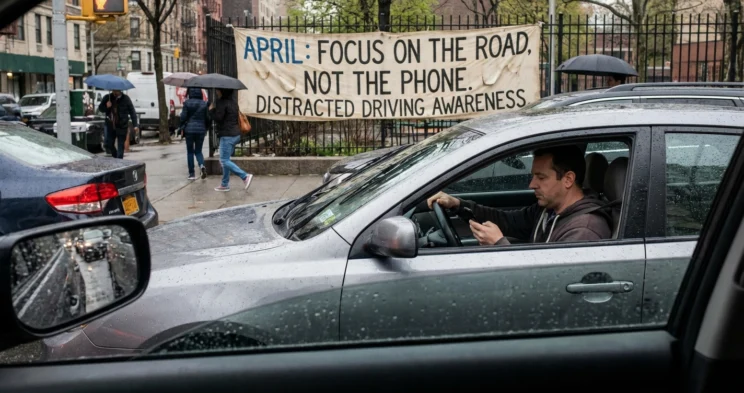
Each year, there are thousands of distracted driving accidents in Dallas County alone. April is National Distracted Driving Awareness Month, and it exists because these crashes keep happening even though many of them are preventable.
What Is Distracted Driving Awareness Month?
In 2010, Congress established Distracted Driving Awareness Month, a nationwide effort to reduce deaths and injuries caused by distracted drivers. The goal is to change behavior, not just raise awareness.
Distracted driving is 100 percent preventable, yet it continues to kill thousands of people every year. That’s why the organizations below choose to focus their efforts on stopping distracted driving every April.
Every April, the National Highway Traffic Safety Administration (NHTSA) promotes its Put the Phone Away or Pay campaign. This campaign was established to remind drivers of the dangers and consequences – including fines and jail time – of distracted driving. From April 9th through the 13th, drivers can expect to see an increase in texting and distracted-driving laws being enforced by police officers.
The NSC Just Drive campaign asks drivers, employers, and families to take a pledge to keep their attention fully on the road.
Why Distracted Driving Is More Dangerous Than Most People Realize
It’s easy to become distracted behind the wheel, but the consequences of distraction can be serious.
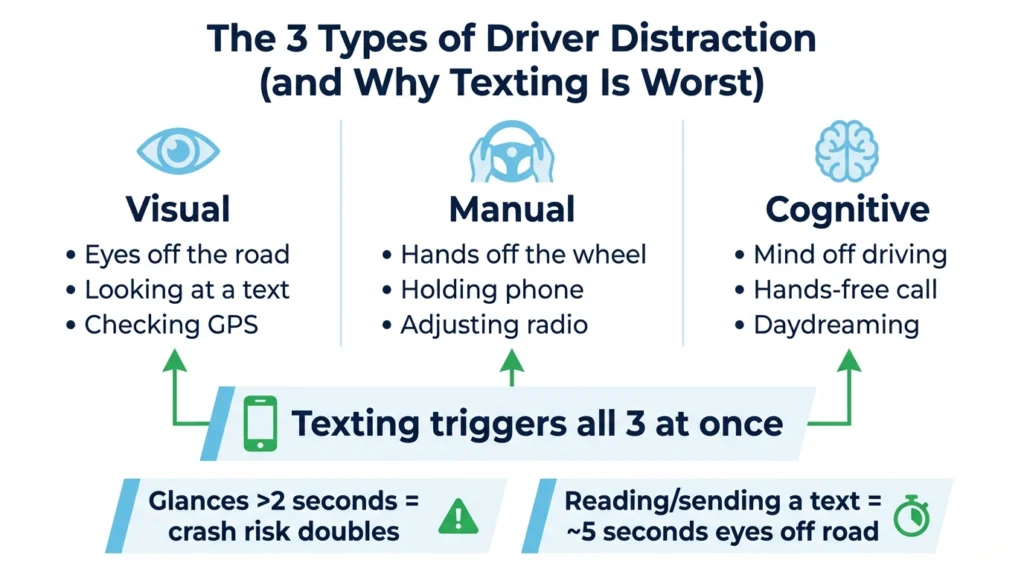
Researchers and safety officials recognize three distinct types of distraction, and each one puts you at risk of a car accident. These include:
- Visual distraction means your eyes are off the road. A glance away lasting more than two seconds doubles your crash risk.
- Manual distraction means your hands are off the wheel. Reaching for a drink, adjusting the radio, or holding a phone all qualify.
- Cognitive distraction means your mind is somewhere other than driving. Even a hands-free phone call can cause “inattentional blindness,” where your brain fails to register a visible hazard in front of you.
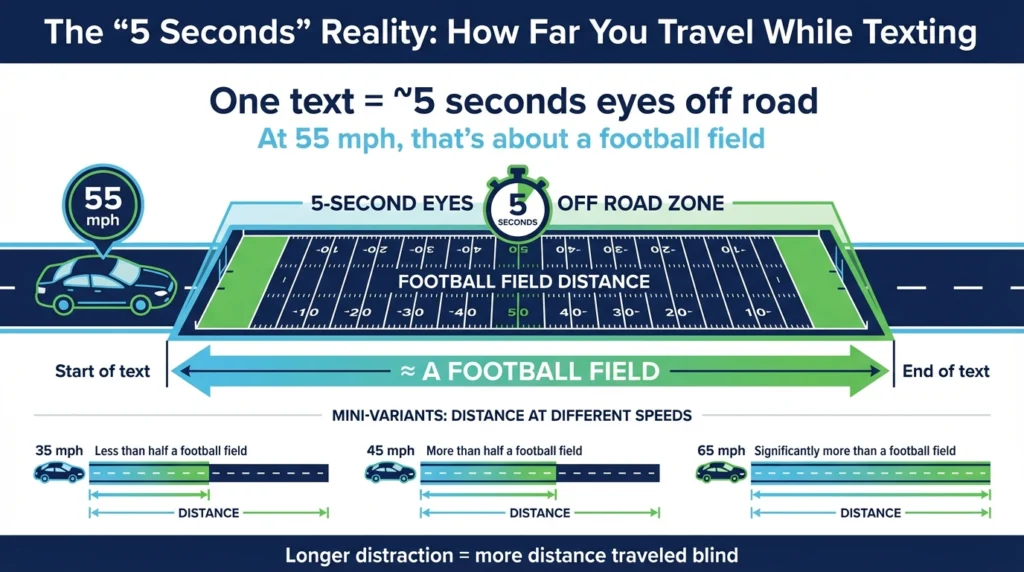
Texting is the most dangerous behavior because it triggers all three types of distraction at once. According to NHTSA, sending or reading a single text takes your eyes off the road for about five seconds. At 55 miles per hour, that’s equivalent to driving the length of a football field with your eyes completely closed.
In 2024, distracted driving killed 3,208 people across the United States. That’s roughly nine people every single day. More than 315,000 others were injured. Safety researchers also note that those numbers are likely undercounted because distracted driving is difficult to confirm after a crash.
Hands-free is not risk-free. Research shows that drivers using hands-free devices can still fail to notice up to half of what’s happening around them. These devices reduce the manual aspect of distraction, but not the cognitive element.
Consequences of Distracted Driving in Texas
Distracted driving is consistently one of the leading causes of crashes in Texas, playing a role in roughly one in five collisions statewide and contributing to tens of thousands of crashes every year. The I-35E corridor through Dallas is one of the busiest stretches of road in the state, and high-volume highways like that leave very little room for divided attention.
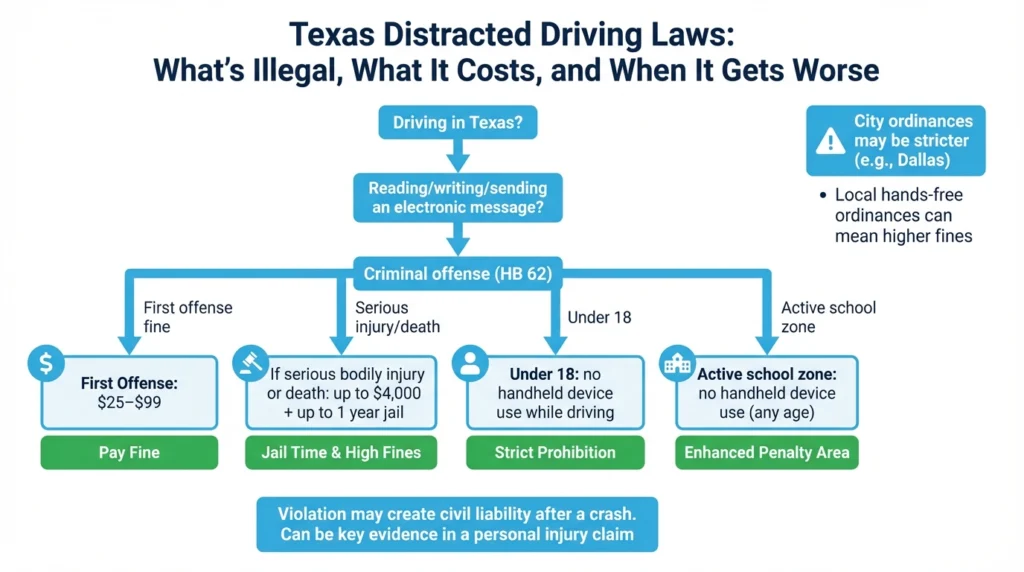
In 2017, House Bill 62 made it a criminal offense to read, write, or send an electronic message while driving. A first offense carries a fine of anywhere from $25 to $99. If the distraction caused a serious bodily injury or death, penalties can reach up to $4,000 and a year in jail. Drivers under 18 are prohibited from using any handheld device at all. And in active school zones, no driver may use a handheld device regardless of age.
Beyond state law, cities like Dallas have their own hands-free ordinances with fines that can run significantly higher. Violating these laws also creates civil liability, meaning the person who caused harm, injury, or loss is held responsible (usually by providing compensation for damages).
What You Can Do This April (& Every Other Month)
Distracted Driving Awareness Month is a good time to reset habits, not just for yourself but for the people you share the road with.
Here is what you can do to avoid distracted driving:
- Put your phone out of reach before you start driving. Putting it in the back seat, glove box, or trunk means you can’t act on the temptation to check it.
- Use your phone’s driving mode. Both Android and iOS have settings that silence notifications and send automatic replies while you’re behind the wheel.
- Set your destination before you leave. Adjusting your GPS while moving is a serious manual and visual distraction.
- Designate a passenger as your texter. If you need to respond to something urgent, hand your phone to whoever is riding with you.
- Model the behavior for younger drivers. Teen drivers are statistically among the most vulnerable to distraction-related crashes, and they pay close attention to how the adults in their lives behave behind the wheel.
- Speak up. If you’re a passenger and the driver is on their phone, it’s reasonable to say something. Your safety is at stake.
These aren’t complicated changes. They’re small habits that add up to a much safer road for everyone, including you and the people driving around you each day.
If a Distracted Driver Hurt You, We Can Help
Distracted Driving Awareness Month is about prevention. But if you’ve already been hurt by a driver who wasn’t paying attention, the path forward starts with understanding your rights and talking to someone who can help you protect them.
At Angel Reyes & Associates, we’ve spent over 30 years representing Texans injured in distracted driving crashes and other serious collisions. Our attorneys have recovered more than $1 billion for our clients across the state. We offer free initial consultations, take cases on a no-fee-unless-we-win basis, and are available 24/7 when you need to reach us.
If a driver’s decision to look at their phone changed your life, contact us today to talk through your options. We can handle your case remotely from anywhere in Texas, and we offer service in Spanish as well. You deserve to have someone in your corner.
About the Authors

Spencer Browne
Writer
Spencer Browne is a partner at Angel Reyes & Associates and a Board Certified personal injury trial lawyer with nearly 100 jury trials across Texas. He focuses on car, truck, and wrongful death cases, with notable verdicts including a landmark win in the Choctaw Casino bus crash case. A recognized speaker and legal educator, Spencer is a member of the American Board of Trial Advocates and has been honored as a Texas Super Lawyer and one of D Magazine’s Best Lawyers in Dallas. He brings deep trial experience and relentless advocacy to every client he represents.

Kyle Nicolas
Editor
Kyle Nicolas is the Web Content & SEO Manager at Angel Reyes & Associates. He has more than 10 years of experience as a marketing co...

Angel Reyes
Reviewer
Angel L. Reyes, III is the Founder and Managing Partner of Angel Reyes & Associates. A nationally recognized trial attorney and business...