Are Robotaxi Crashes Usually the Robotaxi’s Fault?


Every article on this site is researched by our internal team, reviewed for legal accuracy against current Texas law, and held to State Bar of Texas advertising standards before publication. We do not publish content that overstates outcomes or makes promises about results.
Learn more about our
editorial standards .
Key Takeaways
- NHTSA crash reports describe robotaxi crashes but never decide who was legally at fault.
- About half of reported ADS incidents were coded as stopped or parked, but stopped isn't blameless.
- Company video and vehicle data are key evidence. Only 33 reports in the NHTSA's Standing General Order crash data flagged a police report.
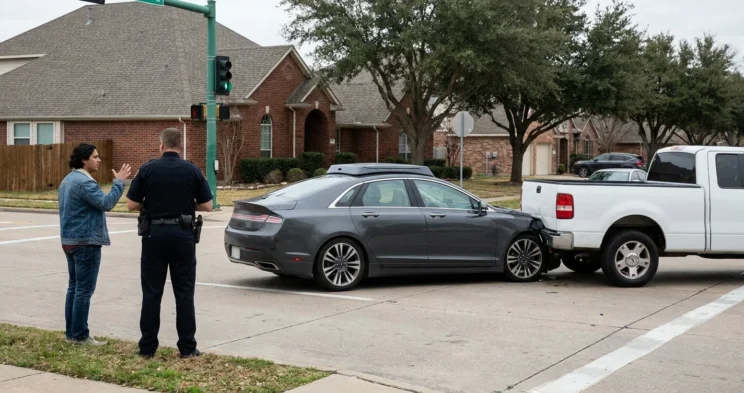
Federal crash reports cannot tell us whether robotaxis are usually at fault. They describe reported circumstances without deciding legal responsibility. If you’re asking what happens if you hit a Waymo in Texas, the answer depends on evidence from your crash, including records the company holds.
Damage, injuries, and a disputed account can leave you unsure what to do. Start by separating what the reports show from what you must prove.
Do Federal Crash Reports Show Who Is Usually at Fault?
No. NHTSA’s Standing General Order crash reports record what companies say happened. They are not police findings, court rulings, or fault decisions. The third amended Standing General Order requires reporting of certain crashes involving automated driving systems (ADS), not every contact.
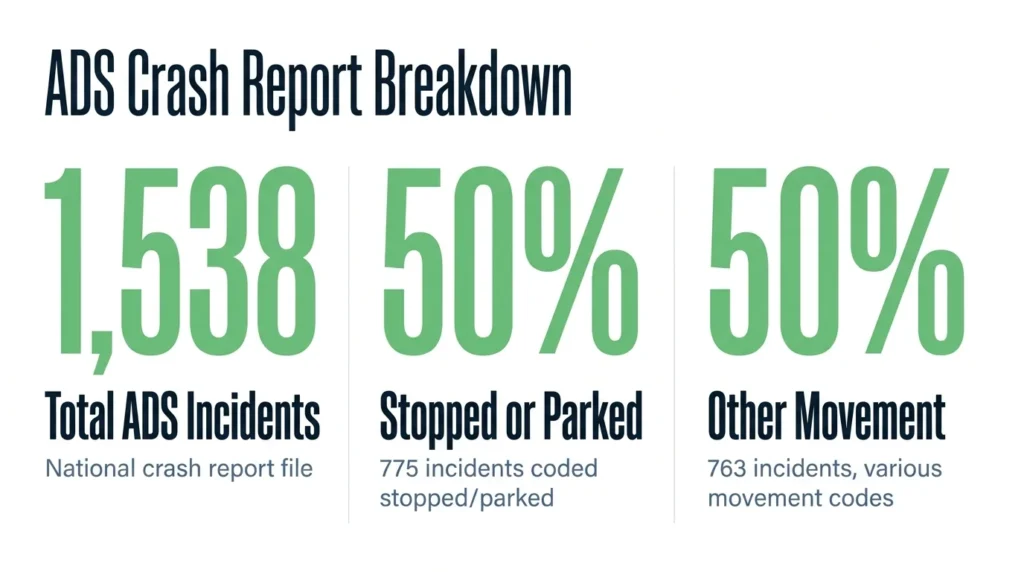
After deduplication, the analyzed ADS file contains 1,538 incidents. Most occurred from June 2025 through August 2026. September 2026 crashes are excluded, one incident dates to April 2025, and public dates show only the month and year.
That total includes robotaxis, along with automated trucks, delivery vehicles, test fleets, and shuttles. It is a national file, not a Texas sample.
Reported pre-crash movement of the ADS vehicle | Incidents | Share |
Coded as stopped or parked | 775 | 50% |
All other movement codes | 763 | 50% |
These are counts, not rates. Without miles driven, the reports cannot establish comparative safety.
A stopped vehicle can still contribute to a crash, depending on its stopping location and earlier conduct; contact location alone does not settle fault.
What Happened When the ADS Vehicle Was Coded Stopped or Parked?
In 775 reports, the ADS vehicle was coded Stopped (657) or Parked (118). Companies most often coded the other vehicle as going straight (327), passing (159), or backing up (132), and they flagged rear contact on the automated vehicle in 242 reports.
The other vehicles in this group included passenger cars (260), SUVs (185), heavy trucks (108), pickup trucks (95), buses (48), and vans (37). Those categories don’t cover every crash in the group.
Of 147 reported heavy-truck contacts, 108 involved a stopped or parked ADS vehicle. Of 55 bus contacts, 48 did. A bus contact alone does not show the robotaxi was stopped in a bus lane.
Across the full dataset, companies coded the other vehicle as traveling the wrong way in 13 reports and crossing into an opposing lane in 18. These are company classifications, not police findings or fault decisions.
NHTSA’s data element definitions allow multiple contact areas per crash. A rear-contact flag does not reconstruct the sequence.
What Other Movement Codes and Injury Reports Show
The 763 reports outside Stopped or Parked cover several movement categories, without establishing fault. Companies coded 538 as going straight, 68 as left turns, 41 as right turns, 36 as lane changes, 21 as passing, 26 as backing, 8 as lane or road departures, and 25 under other categories.
Not all 763 vehicles were moving at impact. In one Other-coded report, Motional describes its vehicle as stopped when struck from behind.
Within this group, reports flagged front contact in 105, rear contact in 98, and an intersection in 166. Companies also coded 82 crashes as involving an “Other Fixed Object” and 11 more as involving a pole or tree. A contact location or crash partner code does not name the negligent party.
Injury Reports
The file includes 154 incidents with an alleged injury or fatality, including two fatal incidents. That number counts incidents, not injured people.
Of those, 82 were coded Stopped or Parked (73 stopped, 9 parked). The other 72 carried other movement codes: 57 going straight, 5 left turns, 4 right turns, 3 lane changes, 2 lane or road departures, and 1 other. An injury report does not show who was negligent.
Who Was Driving
Companies reported the ADS as verified engaged in 1,493 crashes and verified not engaged in 41, including 33 Waymo reports. Two were alleged engaged and two were unknown.
“Engaged” covers a window that starts 30 seconds before the crash. So an engaged code does not prove the software was in control at the moment of impact.
Reports also listed a human operator in the vehicle in 230 crashes, both an in-vehicle and a remote operator in 15, and a remote operator only in 7. A remote category can mean assistance or backup support. It does not prove someone was driving remotely at impact.
Why Do Pickups, Drop-offs, and Opening Doors Make Fault Harder to Sort Out?
A rider stop can raise questions about the stopping location, the door opening, and the passing road user’s conduct.
Waymo’s reports describe four San Francisco incidents. In one, a cyclist in a bike lane fell after hitting a rear door that was opened while the vehicle waited at a red light. Another involved a scooter rider passing on the right who collided with a door during a curbside drop-off.
In a third, a motorcycle passing between an in-lane Waymo with hazards on and parked cars hit an opening door. In the fourth, a rider ended a trip early at a red light; during the in-lane drop-off, a cyclist collided with the opening door and, according to Waymo, was taken by ambulance.
These are company accounts of California events, not legal outcomes. In a similar Texas crash, video would need to show where the vehicle stopped, when the door opened, how traffic was moving, and what each person did.
Pickup and drop-off incidents coded as stopped or parked are already included in the 775, not additional crashes.
How Is Fault Investigated After a Texas Robotaxi Crash?
Texas fault depends on proof of what each driver, rider, and automated system did, measured against specific legal duties. Current law treats an engaged ADS as the operator for traffic-law purposes, but that doesn’t automatically make the company liable for your injuries.
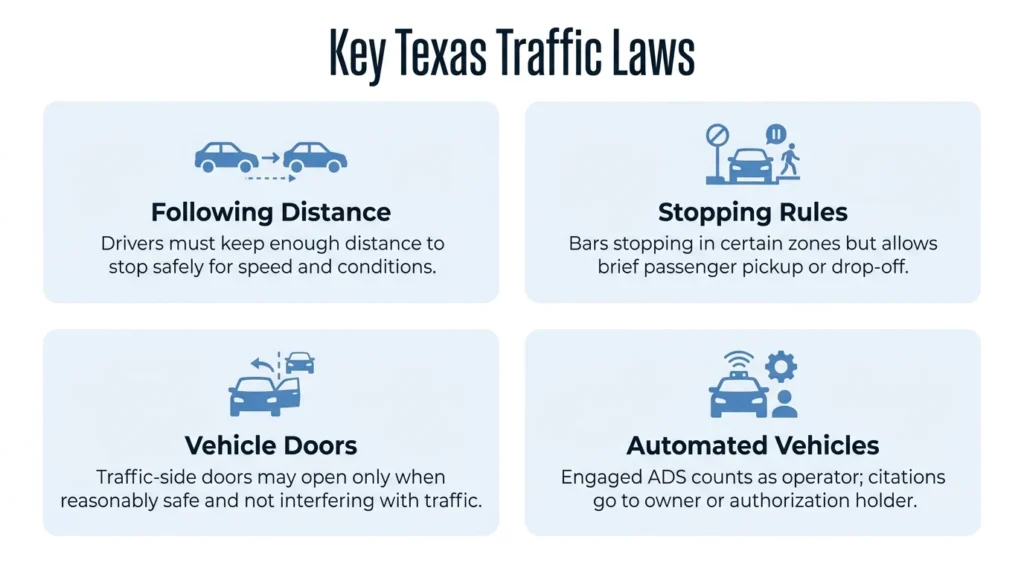
Several provisions of Texas Transportation Code Chapter 545 often come into play:
- §545.062(a), following distance: A following driver must keep enough distance to stop safely, considering speed, traffic, and road conditions. Rear contact alone is not a fault ruling.
- §545.302, stopping and standing: The law bars stopping in specified places, including double parking alongside a curbside vehicle, intersections, crosswalks, and posted no-stopping zones. It also has exceptions, including momentary passenger pickup or discharge in certain restricted areas. Hazard lights alone don’t make a stop legal or illegal.
- §545.418, vehicle doors: A person may open a traffic-side door only when it is reasonably safe and won’t interfere with moving traffic. The door may stay open only as long as needed to load or unload passengers.
- §545.454, automated vehicles: When the ADS is engaged, the system is considered the operator. A traffic citation goes to the vehicle owner or, for a vehicle operating under state authorization, the authorization holder.
The current operator and citation rule came from SB 2807. The TxDMV Automated Vehicles Regulatory Program confirms the law took effect September 1, 2025, with commercial authorization enforcement beginning May 28, 2026. The law in effect on the date of your crash controls how the current operator is determined.
A rider’s door opening, the stopping location, and passing conduct can each affect responsibility.
Where the Evidence Lives
Companies marked video as available in 1,526 reports and telematics data in 1,480. Only 33 flagged a police report as available. An unflagged record may still exist. Availability flags do not mean a claimant has obtained those records.
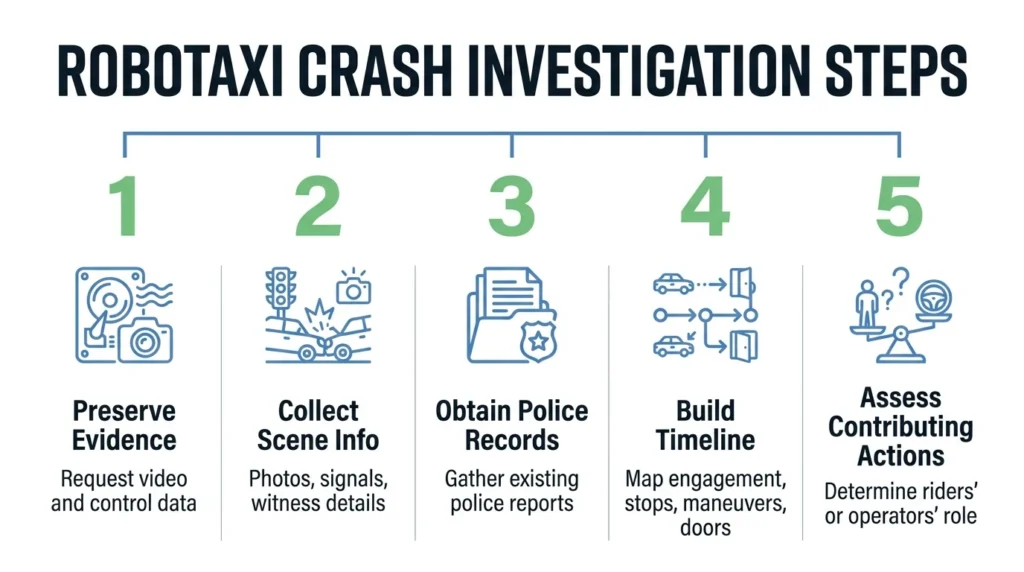
A careful robotaxi crash investigation generally follows these steps:
- Send a prompt request that the company preserves video and vehicle movement and control data.
- Collect scene photos, sign and signal information, and witness contact details.
- Obtain any police records that exist.
- Build a timeline of ADS engagement, the stop, any passing maneuver, and any door opening.
- Determine whether a rider or human operator took any action that contributed.
A car accident lawyer can seek preservation of evidence needed to assess whether Waymo or another party was at fault.
Talk with Angel Reyes & Associates About a Robotaxi Crash
If you’ve been in an accident with a robotaxi, contact a lawyer before assuming fault. Angel Reyes & Associates can review your Texas crash involving a Waymo or another automated vehicle and seek preservation of relevant evidence. We’ve helped Texans with car accident claims for over 30 years and have recovered over $1 billion for our clients.
Schedule a free consultation to discuss your options.
Past results do not guarantee future outcomes.
Robotaxi Crash FAQs
If I hit a Waymo in Texas, am I automatically at fault?
No. Fault depends on what each person and the automated vehicle did in that crash; contact with a Waymo alone settles nothing. NHTSA’s Standing General Order crash reports record company-submitted circumstances, not fault findings.
Can a robotaxi share fault if it stopped for a pickup or drop-off?
Yes, depending on where and why it stopped and whether the stop contributed to the collision. Texas Transportation Code §545.302 restricts stopping in specified places but includes passenger-loading and other exceptions; hazard lights alone do not decide whether a stop was lawful. The conduct of a passing driver also matters.
Who may be responsible when a robotaxi passenger opens a door into a cyclist or passing vehicle?
The rider’s door opening, the robotaxi’s stopping location, and the passing road user’s conduct may each matter. Texas Transportation Code §545.418 requires a person opening a traffic-side door to do so only when reasonably safe without interfering with moving traffic. Video can help establish when the door opened and how traffic was moving.
Does a report of ADS engagement prove the software was driving at impact?
No. The reporting category can reflect automated driving system use within 30 seconds before the crash, even if control changed before impact. In Texas, the current operator rule in §545.454 applies when the ADS is engaged; the law in effect on the crash date and the actual control sequence need review. That traffic-law designation does not automatically assign civil fault.
What evidence can help establish fault if no police report is flagged as available?
Company video and vehicle movement and control data can help reconstruct the crash alongside scene photos, signs, signals, witnesses, and any police records that exist. In the analyzed ADS reports, companies flagged video as available in 1,526 incidents and telematics in 1,480, while only 33 flagged a police report. An unflagged police report may still exist, and an availability flag does not mean a claimant has obtained the company data.
About the Authors

Angel Reyes
Writer
Angel L. Reyes, III is the Founder and Managing Partner of Angel Reyes & Associates. A nationally recognized trial attorney and business leader, Angel founded the firm in 1993, which has gone on to help over 70,000 injury victims recover more than $1 billion. Named to the Texas Super Lawyers list annually since 2008, Angel brings Wall Street experience, Ivy League education, and a deep commitment to client advocacy. He is a frequent legal commentator and published author with extensive contributions to legal scholarship, trial strategy, and consumer protection.

Kyle Nicolas
Editor
Kyle Nicolas is the Web Content & SEO Manager at Angel Reyes & Associates. He has more than 10 years of experience as a marketing co...

Angel Reyes
Reviewer
Angel L. Reyes, III is the Founder and Managing Partner of Angel Reyes & Associates. A nationally recognized trial attorney and business...