How Do You Get a Car Accident Report in Texas?


Every article on this site is researched by our internal team, reviewed for legal accuracy against current Texas law, and held to State Bar of Texas advertising standards before publication. We do not publish content that overstates outcomes or makes promises about results.
Learn more about our
editorial standards .
Key Takeaways
- TxDOT crash reports cost $6 uncertified or $8 certified through the CRIS portal.
- It can take up to 14 days after a crash for your report to appear in CRIS.
- If your report has an error, ask the investigating agency to amend it directly.
You have just been in a car accident in Texas, and now you need the official record of what happened. Getting a copy of your car accident report usually is not complicated, once you know where to look and what the process actually requires.
Steps to Get a TxDOT Crash Report
The Texas Department of Transportation (TxDOT) is the statewide custodian of crash records. Every Texas Peace Officer’s Crash Report, the official CR-3 form, ends up in TxDOT’s system after a wreck.
The CR-3 matters for more than curiosity. Insurance adjusters and car accident attorneys both rely on it to sort out what happened and who is responsible.
You can request a copy of your report online, by mail, or in person. The same process applies to a car crash or a truck accident: TxDOT tracks both under the same crash reporting system.
Once you have your copy, it becomes one of the key documents an insurer reviews before settling a claim. Our guide on using a police report for an insurance claim walks through what typically happens next.
Are Texas Crash Reports Public Record?
Crash reports are available to specific people with a direct interest in the crash, not to the general public. Under Texas Transportation Code § 550.065, TxDOT may release a report to anyone directly involved in the crash. That includes an authorized representative, an insurer covering a vehicle involved, or anyone entitled to sue over a death from the crash.
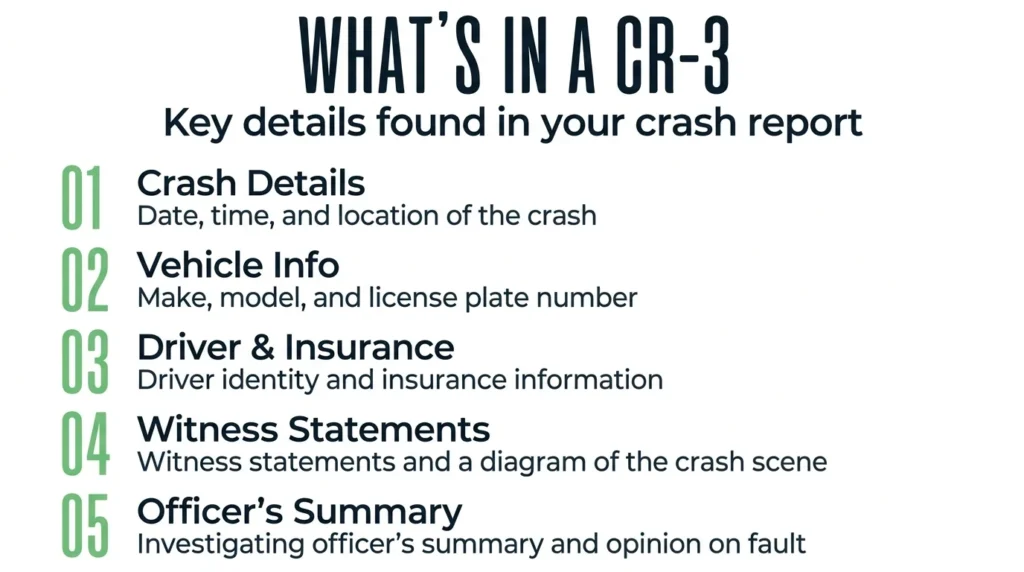
A CR-3 report typically includes:
- The date, time, and location of the crash
- Vehicle details, including make, model, and license plate number
- Driver and insurance information
- Witness statements and a diagram of the crash scene
- The investigating officer’s summary and opinion on fault
Some details stay private even from eligible requesters. Contact information for other drivers and witnesses is redacted unless you qualify for a non-redacted copy under the statute.
How to Look Up Your Report Online
You can search for your report through TxDOT’s Crash Report Online Purchase System, known as CRIS. The portal offers two ways to search.
You can search by the first and last name of anyone involved in the crash, including drivers, passengers, or pedestrians. You can also search using a driver’s license or state identification card number for any driver involved.
If your search returns more than one possible match, CRIS lets you narrow the results with more details:
- County and city where the crash happened
- The crash date
- License plate number of a vehicle involved
- The investigating agency’s name
- The investigating officer’s first or last name
- The agency’s case ID number
- A driver’s date of birth
- Roadway or street information for the crash location
If you would rather not use the online portal, you can request a copy in person at the responding police department, or by mail directly from TxDOT.
How Long Until Your Report Is Ready?
Your report is not available the moment the crash happens. Under Texas Transportation Code § 550.062, the investigating officer has up to 10 days after the crash to submit the report to TxDOT.
Once submitted, it can take up to 14 days total from the crash date for the report to show up in a CRIS search. That is longer than some older guidance suggests, so plan around two weeks rather than assuming a faster turnaround.
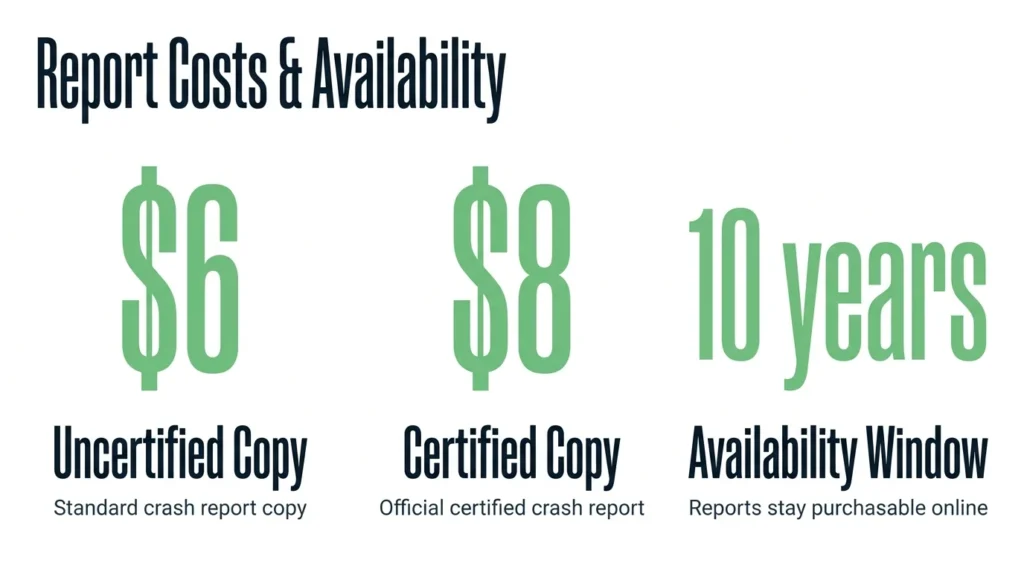
Reports generally stay available for purchase online for about 10 years after the crash date, under TxDOT’s records retention schedule. Pricing is straightforward: an uncertified copy costs $6, and a certified copy costs $8. TxDOT confirms both figures on its crash reports and records page.
Paying by credit or debit card adds a small Texas.gov processing fee. Paying by electronic check has no processing fee, but adds a 10-day holding period before your report becomes available for download.
Report Not Found or Has Errors
If it has been less than two weeks since your crash, a missing report usually just needs more time; wait a few days and search again.
If more than two weeks have passed and CRIS still shows nothing, contact the investigating agency directly to confirm the officer actually submitted the report. TxDOT’s own purchase guide recommends this exact step.
If a search genuinely returns no match, you can request a Certified Letter of No Record. It confirms, at no charge, that no report exists in the system.
Factual mistakes happen too: a wrong date, an incorrect vehicle detail, or a misspelled name. If you find one, contact the investigating agency and ask them to amend it.
Officers are not required to change their own conclusions, such as who they believe was at fault. If you disagree with that part of the report, you have options. You can still submit your own statement or supporting evidence to your insurer, or present it in court if needed.
How Angel Reyes & Associates Can Help
Angel Reyes & Associates has spent over 30 years helping injured Texans use crash reports like these to support their claims, winning more than $1 billion for our clients. We know how to read a CR-3 report to identify the details that matter most and how to push back when an officer’s account does not match the evidence. Supported by a team of over 600 dedicated professionals across more than 30 office locations in Texas, we offer bilingual services in English and Spanish with 24/7 availability.
We work on a contingency basis, so there is no fee unless we win, and your initial consultation is always free. Learn more about our firm’s experience helping Texas accident victims, or browse more of our auto accident guides for related topics.
If your crash report raised more questions than it answered, or if you are not sure what to do next, contact us today.
Past results do not guarantee future outcomes.
TxDOT Crash Report FAQs
Does every car accident in Texas get an official crash report?
No. Officers are generally only required to file a CR-3 report when a crash causes injury, death, or at least $1,000 in property damage.
What if no officer ever responded to my accident?
TxDOT will not have a CR-3 on file if no officer investigated the crash, and TxDOT no longer accepts a separate driver-submitted report as a substitute. Document the scene yourself and report the crash to your insurer directly.
Is a crash report the same thing as an insurance claim?
No. A crash report is a law enforcement record of what happened, while an insurance claim is a separate process you file with your insurer, though insurers often rely heavily on the report’s findings.
Can I still file an insurance claim in Texas without a crash report?
Yes. Texas law does not require a police report before you can start a claim, though your insurer will likely ask for one if it exists.
About the Authors

Angel Reyes
Writer
Angel L. Reyes, III is the Founder and Managing Partner of Angel Reyes & Associates. A nationally recognized trial attorney and business leader, Angel has helped over 70,000 injury victims recover more than $1 billion since founding the firm in 1993. Named to the Texas Super Lawyers list annually since 2008, Angel brings Wall Street experience, Ivy League education, and a deep commitment to client advocacy. He is a frequent legal commentator and published author with extensive contributions to legal scholarship, trial strategy, and consumer protection.

Kyle Nicolas
Editor
Kyle Nicolas is the Web Content & SEO Manager at Angel Reyes & Associates. He has more than 10 years of experience as a marketing co...

Angel Reyes
Reviewer
Angel L. Reyes, III is the Founder and Managing Partner of Angel Reyes & Associates. A nationally recognized trial attorney and business...