Can You Turn Right on Red in Texas? Understanding the Rules and Risks


Every article on this site is researched by our internal team, reviewed for legal accuracy against current Texas law, and held to State Bar of Texas advertising standards before publication. We do not publish content that overstates outcomes or makes promises about results.
Learn more about our
editorial standards .
Key Takeaways
- Texas allows right turns on red after a complete stop unless a sign prohibits it.
- Failing to stop completely or yield to traffic can result in fines around $200 and insurance rate increases.
- Drivers making right turns on red are typically liable for accidents because they must yield to all other traffic.
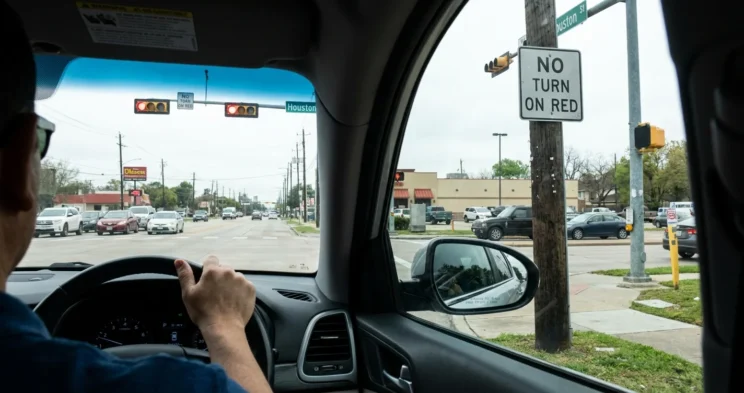
It’s late at night and you’re sitting at a red light on Westheimer Road in Houston, waiting to turn right. The intersection is clear. No cars are coming. The voice in your head is telling you to make the turn, but your conscience is wondering if you need to wait for the green.
Good news for the voice in your head: Texas allows right turns on red in most situations. But there are rules you need to follow and exceptions that can catch you off guard. Likewise, drivers who do make right turns on red need to be cautious, as they could be held liable for damages in the event their actions cause an accident.
Texas Right Turn on Red Laws & Requirements
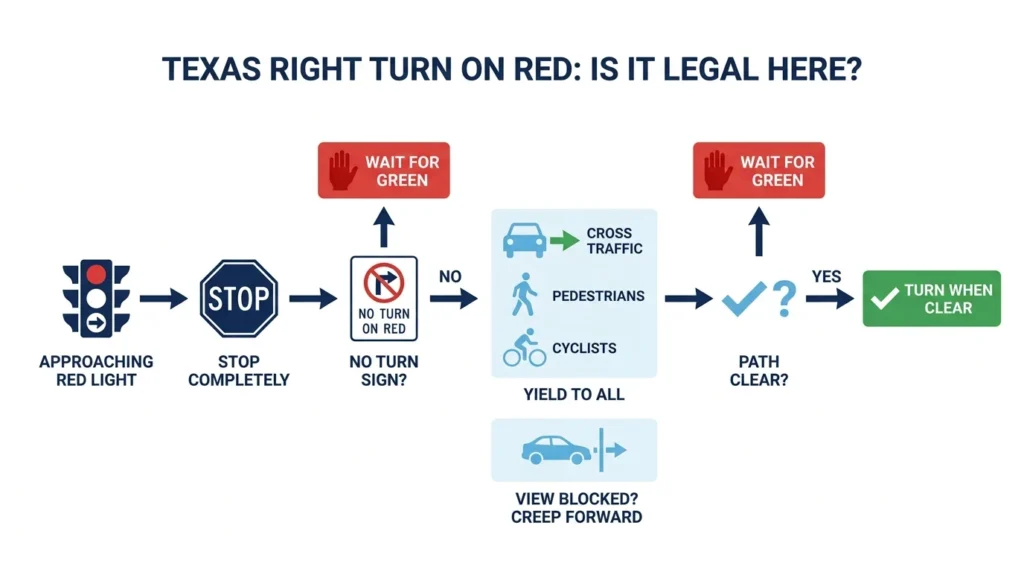
Under Texas Transportation Code § 544.007, drivers may turn right at a red light after coming to a complete stop, unless a sign prohibits it. The complete stop is not optional; you must stop at the stop line or crosswalk before entering the intersection. Rolling through without stopping is a traffic violation, even if the turn itself would have been legal.
After stopping, you must yield to all traffic that has the right of way. This includes vehicles traveling through the intersection on a green light, pedestrians in the crosswalk, and cyclists in bike lanes. Only when the way is clear can you complete your turn.
When Right Turns on Red Are Prohibited in Texas
Several situations override the general rule allowing right turns on red.
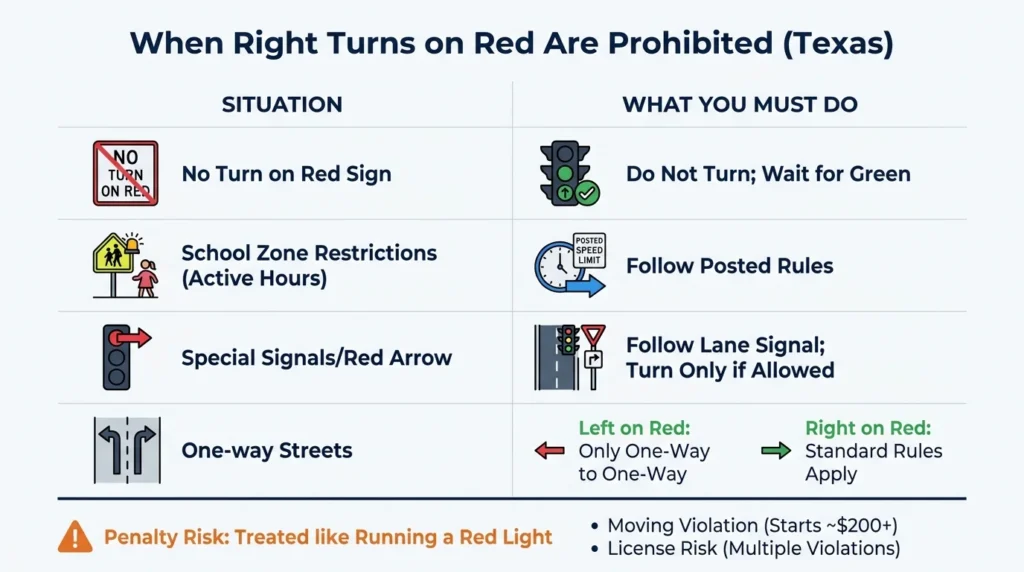
“No Turn on Red” signs are the most common exception. These signs are typically posted at intersections with heavy pedestrian traffic, limited visibility, or complex traffic patterns. When you see one of these signs posted, you must wait for a green light regardless of how clear the intersection appears.
One-way streets also have special rules. You can turn left on red from a one-way street onto another one-way street (turning into the nearest lane), but standard right-on-red rules still apply, even though you’re turning the opposite direction.
School zones often have additional restrictions during active hours. Watch for flashing lights and posted signs that may prohibit turns on red when children are present. This isn’t uncommon at intersections with crosswalks frequently occupied by children.
Violating one of these right-on-red restrictions is treated exactly the same as running a red light in any other context. This type of moving violation typically carries a fine that starts at around $200, though court costs and fees can push the total higher. The exact amount varies by municipality.
Likewise, while Texas no longer counts points for the purpose of your driving record, Texas Transportation Code § 521.292(b) says that your license can be suspended for accumulating four or more moving violations within 12 months or seven or more within 24 months. If you hold a commercial driver’s license (CDL), then this violation could impact your eligibility.
Safety Procedures for Right Turns on Red
Following the legal requirements is only part of safe driving. Proper technique helps you avoid accidents and tickets.
Come to a full stop behind the stop line or crosswalk. Count to three if you need to. Many drivers think they stopped when they actually just slowed down significantly. Law enforcement is trained to tell the difference.
Check your mirrors and blind spots for other cars before proceeding. Look left for oncoming traffic, then right for pedestrians, then left again. Pedestrians can enter the crosswalk quickly, and a vehicle you didn’t see could be approaching faster than you expected.
Use your turn signal before stopping. This alerts drivers behind you that you intend to turn rather than proceed straight when the light changes.
Creep forward carefully if your view is blocked. Sometimes parked cars or landscaping obstruct your sightline. Move forward slowly until you can see clearly, but do not enter the travel lanes until you’re certain it’s safe.
Commercial vehicles and motorcycles face the same rules but require extra caution. Large trucks have bigger blind spots and need more time to complete turns. Motorcyclists are harder for other drivers to see and should be especially vigilant about oncoming traffic.
Accident Liability for Right Turn Collisions
When a car accident happens during a right turn on red, the driver making the turn is often found at fault. The law requires you to yield to all other traffic before turning. If you hit someone, you likely failed to yield properly.
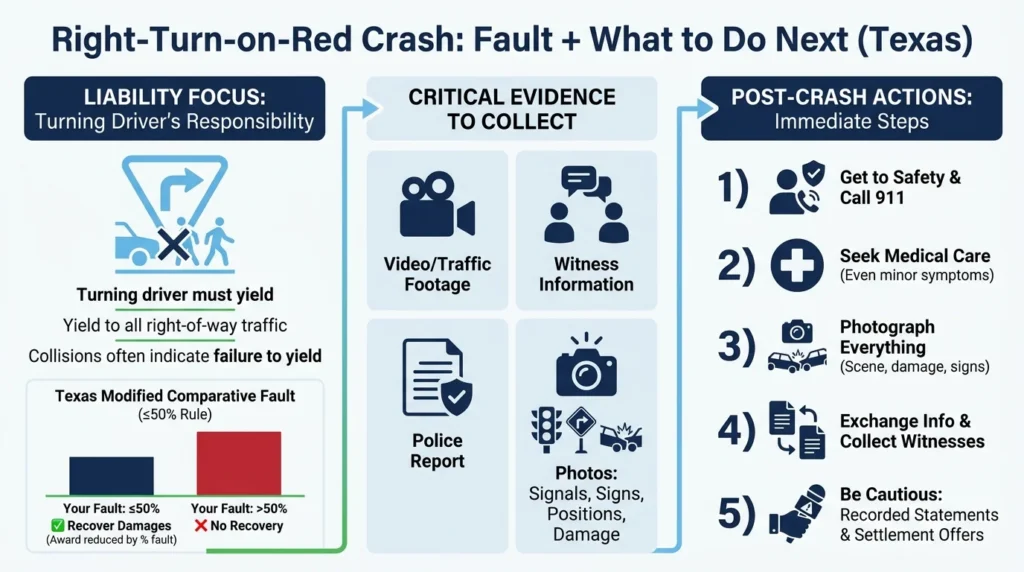
Texas follows a modified comparative fault rule. This means you can still recover damages if you were partially at fault, as long as your share of responsibility is 50% or less. Your compensation is reduced by your percentage of fault.
Evidence matters in these cases. Traffic camera footage, witness statements, and the police report all help establish what happened. If you’re involved in a right-turn accident, document the intersection conditions, signal timing, and any signs that may have been obscured or missing.
Insurance companies will investigate the accident and assign fault percentages with the goal of minimizing payouts. Having your own documentation and understanding of the law helps you push back against unfair assessments.
What to Do After a Right Turn Accident
If you’re injured in an accident involving a right turn on red, your first priority is safety. Move to a safe location if possible and call 911. Get medical attention even if your injuries seem minor. Some injuries don’t show symptoms immediately.
Document everything at the scene if you’re able. Take photos of the traffic signals, any “No Turn on Red” signs (or the absence of them), vehicle positions, and damage. Get contact information from witnesses.
When the insurance adjuster calls, remember that their company’s goal is to pay as little as possible. Be careful about recorded statements and don’t accept a quick settlement before you understand the full extent of your injuries.
Serious injuries from intersection accidents often require ongoing medical treatment. Lost wages, medical bills, and pain and suffering can add up quickly. An experienced personal injury attorney can help you understand what your claim is worth and negotiate with insurance companies on your behalf.
Angel Reyes & Associates has helped Texas accident victims recover more than $1 billion in compensation over more than 30 years. We offer free consultations and work on contingency, which means you pay nothing unless we win your case. If you were hurt in a right-turn accident anywhere in Texas, contact us today to discuss your options.
Right-on-Red FAQs
Can you turn right on red at an intersection with a red arrow instead of a solid red light?
Yes, unless a sign prohibits it. Texas law treats red arrows the same as solid red lights for right turns. You must still come to a complete stop and yield to all traffic before proceeding.
Does a right-turn-on-red violation affect your car insurance rates?
It can. Most Texas insurers review your driving record at renewal and may increase premiums for moving violations. The impact varies by carrier, but a red light violation typically stays on your record for three years.
Can a passenger file a claim if they are injured during an illegal right turn on red?
Yes. Passengers are almost never assigned fault in Texas car accidents. A passenger injured during a right-turn collision can file a claim against either driver’s insurance, regardless of which driver caused the accident.
Are right-turn-on-red rules different at intersections with dedicated turn lanes?
The same rules apply, but dedicated turn lanes can create confusion about which signal controls your lane. Some intersections use separate signals for turn lanes, and running a red turn signal carries the same penalties as running any other red light.
Can you be ticketed for turning right on red if a traffic camera captures the violation?
Generally, no. Texas banned red light camera enforcement statewide in 2019 under House Bill 1631. As of 2026, Leon Valley is the only city within the state still permitted to operate their red light cameras because of a grandfathered contract with their operating company that is in place until 2039.
About the Authors

Alex Ivanov
Writer
Alex Ivanov is a personal injury attorney at Angel Reyes & Associates, focused on car, truck, and motorcycle accident cases. Licensed in Texas and multiple federal districts, Alex brings international legal experience and a global education to his practice. He earned his LL.M. from Texas A&M University School of Law after graduating from Belarussian State University in 2016. Alex is fluent in Russian, English, Ukrainian, and Belarussian, and is recognized by multiple national trial lawyer associations for his results and leadership under 40.

Kyle Nicolas
Editor
Kyle Nicolas is the Web Content & SEO Manager at Angel Reyes & Associates. He has more than 10 years of experience as a marketing co...

Angel Reyes
Reviewer
Angel L. Reyes, III is the Founder and Managing Partner of Angel Reyes & Associates. A nationally recognized trial attorney and business...