Waymo in 10 Cities: How Rapid Expansion Increases Risk


Every article on this site is researched by our internal team, reviewed for legal accuracy against current Texas law, and held to State Bar of Texas advertising standards before publication. We do not publish content that overstates outcomes or makes promises about results.
Learn more about our
editorial standards .
Key Takeaways
- Waymo's February 2026 expansion brought commercial robotaxi service to Dallas, Houston, and San Antonio, increasing the likelihood of Texas drivers encountering autonomous vehicles.
- Evidence in robotaxi crashes (such as sensor data, event logs, or remote assistance records) is company controlled and may be lost without a prompt preservation request.
- Texas law allows multiple liability theories in AV crashes, including negligence, product liability, and proportionate responsibility among several potentially responsible parties.
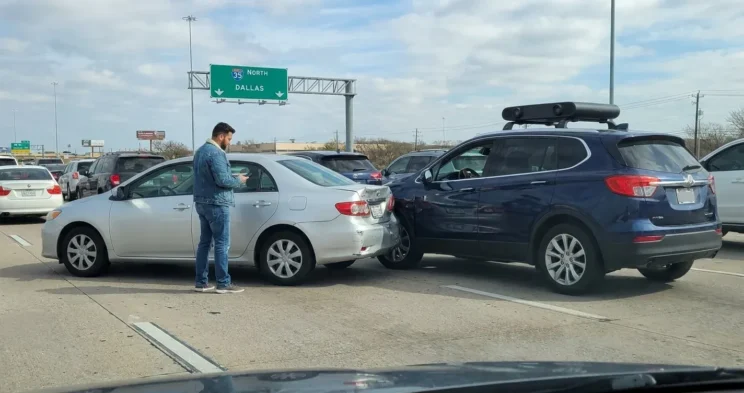
You were driving home on I-35 through Dallas yesterday when a white vehicle with no one behind the wheel merged into your lane. The collision happened fast. Now, you’re dealing with vehicle damage, a sore neck, and a strange realization: there’s no other driver to exchange information with. The car was a Waymo robotaxi.
As of February 24, 2026, Waymo began commercial robotaxi operations across 10 U.S. metro areas. Dallas, Houston, and San Antonio are now part of that network. This expansion means that more Texans will share roads with autonomous vehicles. It also means more questions about what happens when something goes wrong.
The February 24, 2026 Waymo Milestone & Why It Matters for Texas
Waymo’s announcement confirmed limited public rollouts in four new cities: Dallas, Houston, San Antonio, and Orlando. This brought their total commercial operations to 10 metro areas nationwide.
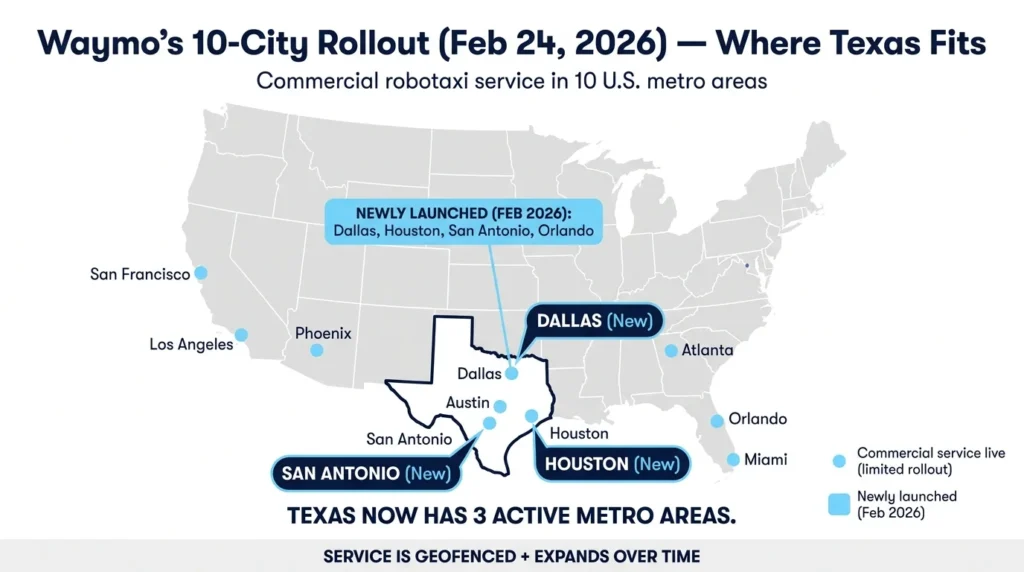
The rollout follows a phased approach. Initial access is invitation-based, with service boundaries expanding over time. According to AP News coverage, this “limited users first” model lets the company scale operations gradually before opening to broader public access.
For Texas road users, this expansion creates three practical concerns:
- Where exactly can these vehicles operate? Service areas have set boundaries that change often.
- What happens to crash evidence? Vehicle data logs and sensor recordings are controlled by the company.
- Who is responsible when crashes occur? Multiple parties may share liability under Texas law.
Understanding these issues now can save you significant frustration later if you’re ever involved in a car accident with an autonomous vehicle.
Where Waymo Operates & What “Dallas/Houston/San Antonio Service” Actually Means
Waymo’s 10-market milestone sounds straightforward, but the reality is more nuanced.
Service areas in new cities like Dallas, Houston, and San Antonio are geofenced. This means robotaxis only operate within specific neighborhood boundaries. These boundaries can shift as the company gathers data and expands coverage.
During early rollout phases, riders join through waitlists or invitation systems. You might live in Houston but find that service isn’t yet available in your neighborhood near the Galleria. Someone in San Antonio’s Stone Oak area might have access, while residents downtown are still waiting.
What This Means for Texas Drivers, Pedestrians, & Riders
Texas roads present unique challenges for any autonomous system. Service roads along I-10 and US-281 create complex merge patterns. Construction zones shift daily across the I-35 corridor. Summer heat can affect sensor performance.
Early operations typically start in controlled environments, meaning well-mapped areas with predictable traffic patterns, but even bounded service areas can include:
- Curbside pickup and drop-off zones
- Complex intersections (like those along Westheimer Road in Houston)
- Temporary construction signage
- Emergency vehicle interactions
Even when a vehicle operates without a human driver, collisions still involve human choices, corporate policies, and other motorists. The absence of a driver doesn’t mean the absence of responsibility.
Is Waymo Safe Compared to Human Drivers?
This question deserves a careful answer. Safety comparisons depend heavily on what you measure.
Overall crash rates tell one story, but rare or severe incidents tell another. A system might perform well in 99% of situations but struggle with unusual scenarios, such as a mattress in the roadway, confusing temporary lane markings, or a cyclist making an unexpected turn on South Congress Avenue in Austin.
Why Rapid Scaling Can Introduce New Variables
Each new city brings new variables:
- Road geometry differences (such as Texas service roads vs California grid patterns)
- Local driving culture (such as Houston’s aggressive highway merging vs San Antonio’s more relaxed pace)
- Weather events (such as flash flooding, hail, or extreme heat)
- Construction practices and signage standards
A system trained primarily in Phoenix or San Francisco may encounter situations in Texas that it hasn’t seen before. These exceptional circumstances are how crashes can happen.
The practical takeaway: Regardless of how safety statistics compare, knowing what to document and who may be responsible is crucial if you’re involved in a crash.
Why Autonomous Vehicle Crashes Can Be Harder to Prove
When a human driver causes a crash, the investigation follows familiar patterns. Witness statements, police reports, and insurance adjusters piece together what happened.
Autonomous vehicle crashes work differently. Critical evidence often exists inside company-controlled systems, including:
- Onboard sensor data: cameras, lidar, and radar recordings
- Event logs: what the system “saw” and how it responded
- Remote assistance records: communications between the vehicle and human operators
- Disengagement records: moments when the system handed control back to the human operator or encountered errors
This data can be invaluable. It can also disappear. Retention policies vary, and companies aren’t required to preserve evidence indefinitely without a formal request.
The first 24 to 72 hours after a crash are critical. Evidence that exists today may be overwritten or deleted tomorrow.
What to Do After a Robotaxi Crash in Texas
Your immediate steps should prioritize safety and documentation.
At the scene:
- Call 911 and request medical evaluation, even for minor injuries.
- Ensure that a police report is filed (specifically note “autonomous vehicle” involvement).
- Take wide photos showing the entire scene, plus close-ups of damage, road markings, and signage.
- Document weather conditions and any construction indicators.
- Get contact information from witnesses.
Role-Specific Evidence to Preserve
If you were a Waymo passenger: Preserve your trip confirmation, pickup and drop-off locations, timestamps, and any in-app incident reports or support messages. Screenshot everything before it disappears from your app history.
If you were another driver: Exchange insurance information as usual. Note the vehicle’s identifying features and any company branding. Ask the responding officer to document that an autonomous vehicle was involved.
If you were a pedestrian or cyclist: Prioritize medical care first. Then document exactly where you were standing or riding, crosswalk signals, and visibility conditions. Request that nearby businesses preserve any surveillance footage. Many systems overwrite this data within days.
Evidence Preservation: What to Request & Why It’s Important
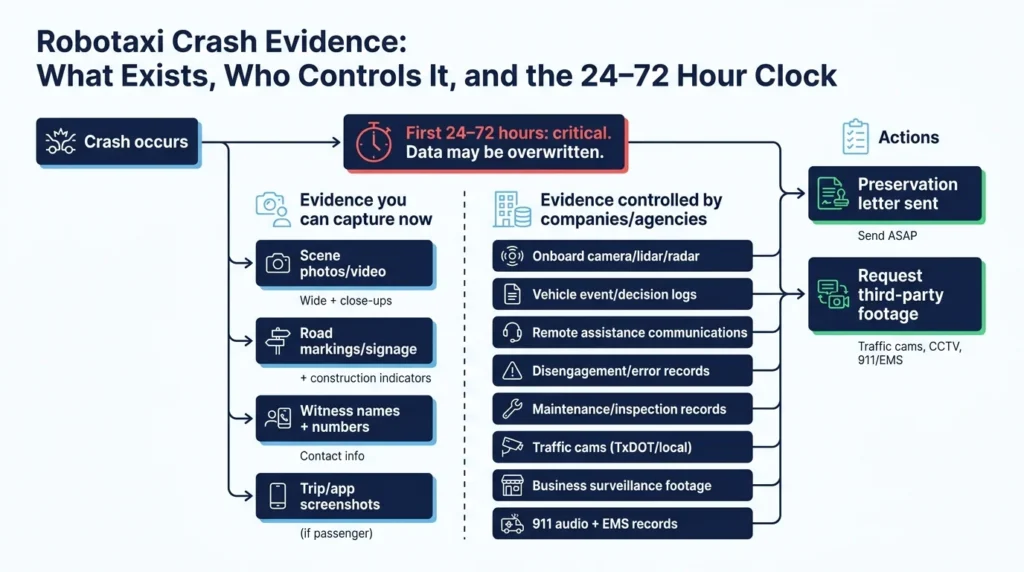
In truck accident cases, attorneys routinely send preservation letters to prevent companies from destroying electronic logs. The same principle applies to robotaxi crashes, often more urgently.
Key evidence categories to preserve:
- Onboard camera and sensor recordings
- Vehicle event and decision logs
- Remote assistance communications
- Maintenance and inspection records
- Mapping and route context data
Additional third-party evidence:
- Dashcam footage from other vehicles
- Traffic camera recordings (contact TxDOT or local authorities)
- Business surveillance footage
- 911 audio and EMS records
- Construction permits and work zone records
A timely preservation letter will notify the company that evidence must be retained. Without it, you may lose access to the most important proof of your claim.
Who Is Liable in a Self-Driving Car Accident in Texas?
Texas law provides multiple paths to hold responsible parties accountable. Understanding these options can help you identify key defendants or insurers early in the process.
The “Operator” Question Under Texas Law
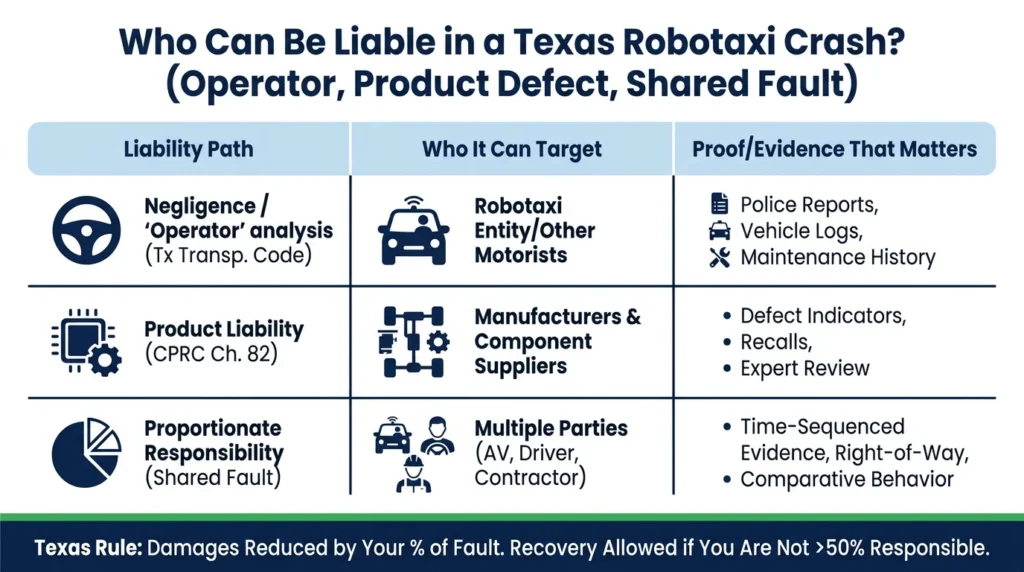
Texas Transportation Code addresses automated driving systems. When the system is engaged, the vehicle itself (or the entity responsible for it) may be considered to be the “operator,” rather than any human driver. This affects how responsibility is analyzed.
You can review the relevant provisions in Texas Transportation Code Chapter 545.
Product Liability for Autonomous Vehicle Technology
If a defect in the vehicle’s design, manufacturing, or warnings contributed to your crash, Texas product liability law may apply. Texas Civil Practice and Remedies Code Chapter 82 establishes the framework for these claims.
Potential theories include:
- Design defects (if the system was inherently unsafe)
- Manufacturing defects (if something went wrong in production)
- Warning defects (if limitations were not adequately communicated)
Proportionate Responsibility & Shared Fault
Texas follows a proportionate responsibility system. Under Texas Civil Practice and Remedies Code Chapter 33, fault can be allocated among multiple parties.
In a robotaxi crash, potentially responsible parties might include:
- The robotaxi company (for operational decisions, maintenance, or safety procedures)
- Other motorists (for distracted driving, speeding, or failure to yield)
- Construction contractors (for poorly marked work zones)
- Component manufacturers (such as sensor or software suppliers)
Your recovery may be reduced by your own percentage of fault, but Texas allows recovery as long as you’re not more than 50% responsible.
Insurance & Claims: What to Expect
Even straightforward-seeming crashes can move slowly when autonomous vehicles are involved. Adjusters and investigators may wait on technical reviews before making decisions.
Common early steps include:
- Claim reporting to relevant insurers
- Requests for recorded statements (be cautious about what you say)
- Vehicle inspections
- Medical authorization requests
Multiple insurance policies may apply, including the other driver’s coverage, the robotaxi company’s commercial policy, and potentially your own uninsured/underinsured motorist coverage.
Documentation that strengthens your claim:
- Consistent medical records showing treatment and progress
- Proof of lost wages and reduced earning capacity
- A clear crash narrative supported by physical evidence
- Preserved electronic data from all available sources
When to Talk to a Texas Injury Lawyer
Consider reaching out to an attorney sooner rather than later if:
- You suffered serious injuries requiring ongoing treatment
- Fault is disputed or unclear
- Who was “operating” the vehicle is in question
- You’re concerned about data retention and evidence preservation
- Multiple parties may share responsibility
At Angel Reyes & Associates, we’ve spent over 30 years helping Texans navigate complex injury claims. Our team has recovered more than $1 billion for clients across the state. We offer free initial consultations, and you pay nothing unless we win your case.
If you’ve been injured in a crash involving a Waymo or any autonomous vehicle, reach out to us today to discuss your options. We’re available 24/7 and can handle the majority of your case remotely, no matter where you are in Texas.
Robotaxi Liability FAQs
Do robotaxi crashes usually take longer to investigate than regular car accidents?
Often, yes. Claims can slow down when insurers or investigators are waiting on vehicle data, internal incident reviews, or footage that is not immediately available at the scene.
Can a Waymo passenger make an injury claim even if no other car was involved?
Possibly. If a sudden stop, unsafe pickup location, dooring event, or another issue caused injuries, then a claim may depend on what happened and what the evidence shows.
Will my own insurance cover me if I was hit by a robotaxi in Texas?
It can. Depending on the facts and available coverage, your MedPay, personal injury protection, collision coverage, or UM/UIM coverage may come into play while liability is being sorted out.
What if the crash happened in a construction zone or near temporary traffic control?
That can make the case more complicated because temporary signs, lane shifts, or contractor actions may have contributed to the collision. Photos, video footage, and records showing the work zone setup can become especially important.
Should I keep using the app after a robotaxi crash, or could that erase useful information?
Be careful not to delete ride history, messages, screenshots, or receipts tied to the trip. Saving that information early can help preserve details like timestamps, pickup locations, and in-app communications.
About the Authors

Angel Reyes
Writer
Angel L. Reyes, III is the Founder and Managing Partner of Angel Reyes & Associates. A nationally recognized trial attorney and business leader, Angel has helped over 70,000 injury victims recover more than $1 billion since founding the firm in 1993. Named to the Texas Super Lawyers list annually since 2008, Angel brings Wall Street experience, Ivy League education, and a deep commitment to client advocacy. He is a frequent legal commentator and published author with extensive contributions to legal scholarship, trial strategy, and consumer protection.

Kyle Nicolas
Editor
Kyle Nicolas is the Web Content & SEO Manager at Angel Reyes & Associates. He has more than 10 years of experience as a marketing co...

Angel Reyes
Reviewer
Angel L. Reyes, III is the Founder and Managing Partner of Angel Reyes & Associates. A nationally recognized trial attorney and business...