Texas Subpoenas After a Car or Truck Accident: A Plain-Language Guide


Every article on this site is researched by our internal team, reviewed for legal accuracy against current Texas law, and held to State Bar of Texas advertising standards before publication. We do not publish content that overstates outcomes or makes promises about results.
Learn more about our
editorial standards .
Key Takeaways
- A subpoena is a court-authorized demand that carries enforceable deadlines and potential contempt consequences if ignored.
- Social media, phone records, and location data are increasingly common subpoena targets in Texas injury cases and require careful handling to protect claim value.
- Texas rules allow you to object, seek protective orders, or file a motion to quash if a subpoena is overbroad, irrelevant, or creates undue burden.
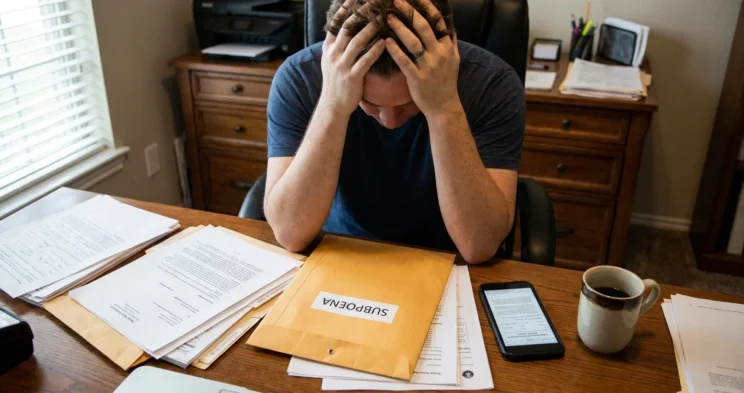
You were rear-ended in rush-hour traffic on I-35 last month. Your claim is dragging on, and now a thick envelope has arrived with the word “subpoena” printed across the top. The document demands medical records, phone logs, and social media data. You’re not sure whether to comply, push back, or call a lawyer.
A subpoena is a serious legal document. Handling it correctly protects both your rights and your claim’s value.
What a Subpoena Is & Why It’s Showing Up in Your Injury Claim
A subpoena is a court-authorized demand. It can require you to testify, produce documents, or both. Under Texas Rules of Civil Procedure Rule 176, ignoring a valid subpoena can result in contempt of court.
Subpoenas typically appear once a lawsuit is filed or when evidence is being gathered from third parties. In car accident and truck accident cases, they’re used to obtain proof of injuries, lost wages, and liability. If your claim has stalled or moved into litigation, subpoenas become part of the discovery process.
There’s an important distinction here. “You were subpoenaed” means you must respond directly. “Your records were subpoenaed” means a third party (your doctor, employer, or phone carrier) received the demand. You may never see the subpoena itself if it went to a records custodian.
Subpoena vs. Adjuster Request: Why the Wording Is So Important
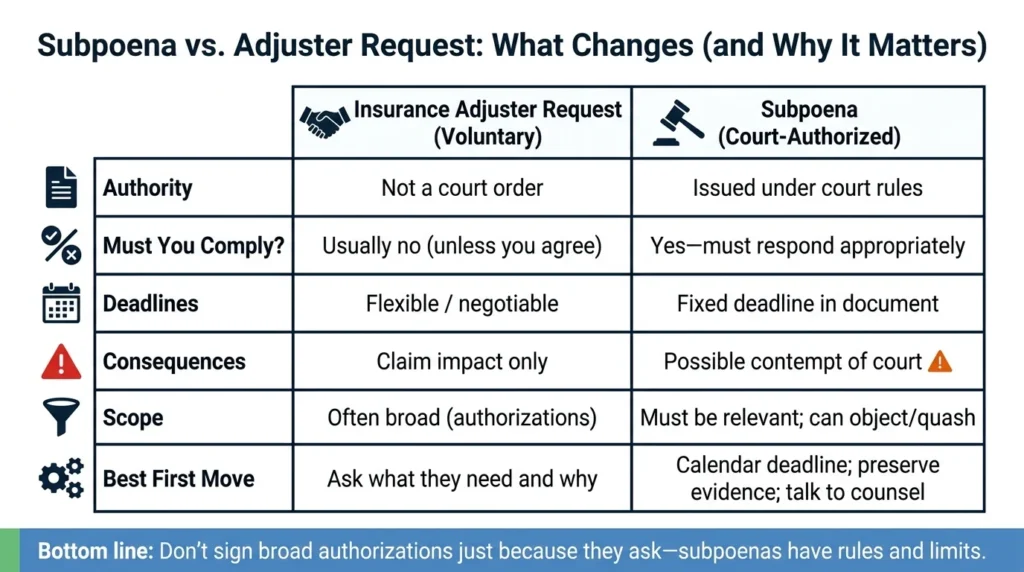
Insurance adjusters often ask for broad information voluntarily. They may request signed medical authorizations, recorded statements, or access to your social media. These requests are not subpoenas.
A subpoena is governed by court rules and carries enforceable deadlines. An adjuster’s request does not. Before signing any authorization, understand what you’re agreeing to release. Talking to the other driver’s insurance without guidance can reduce your claim’s value through unnecessary admissions or privacy overreach.
Subpoenas still have limits. They cannot be unlimited fishing expeditions. Texas rules allow challenges based on scope, burden, and privacy concerns.
The Main Types of Subpoenas You May See
Most injured claimants encounter two categories: subpoenas for documents and subpoenas for testimony.
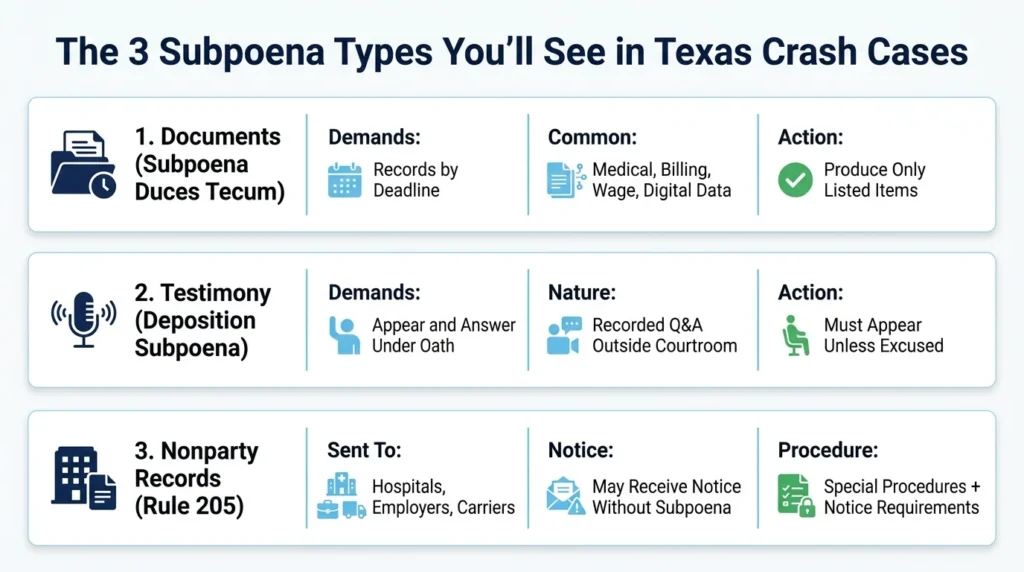
A subpoena duces tecum demands documents or records. “Produce” means you must gather and deliver the specified materials by a deadline. Common targets include medical records, employment files, billing statements, and digital data.
A subpoena for testimony requires you to appear and answer questions under oath. This often happens at a deposition. Under Texas Rules of Civil Procedure Rule 199, depositions are recorded question-and-answer sessions conducted outside the courtroom. Attorneys from both sides attend.
Nonparty subpoenas go to people or organizations that hold your records but aren’t parties to the lawsuit. Your employer, hospital, or cell phone provider might receive one. Special rules under Texas Rules of Civil Procedure Rule 205 govern these requests.
Common Subpoena Targets in Car & Truck Accident Cases
Defense attorneys use subpoenas to find arguments that reduce what your claim is worth. They’re looking for evidence to challenge your credibility or the severity of your injuries.
Medical providers receive subpoenas for treatment records, imaging, and billing. The defense may also seek prior medical history to argue pre-existing conditions caused your symptoms.
Employers receive subpoenas for attendance records, wage documentation, and job duty descriptions. This information relates to lost income claims and your ability to work.
Digital sources are increasingly common targets. Social media posts, phone records, location data, and telematics from your vehicle can all be subpoenaed. A photo of you at a family gathering might be used out of context to suggest you’re not really injured.
Avoiding common lawsuit mistakes includes being careful about what you post and how you respond to these requests.
First Steps After You’re Served
The biggest mistakes are ignoring the subpoena, missing deadlines, or handing over more than required. A calm, documented response protects your case.
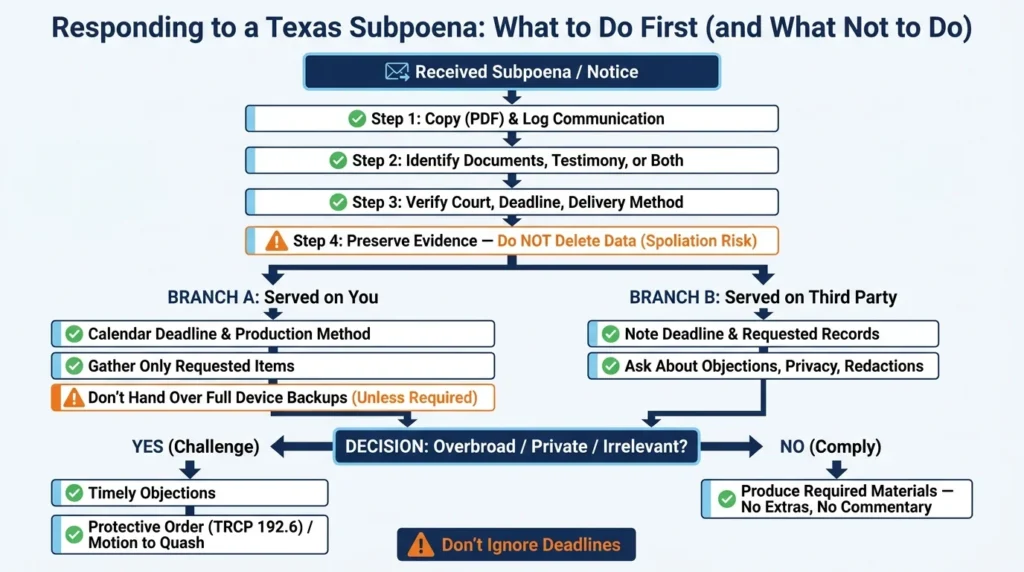
Confirm what you received. Read the document carefully. Note what it commands (testimony, documents, or both), the deadline, and where you must appear or send materials. Verify it relates to your case by checking the court and case caption.
Preserve evidence immediately. Do not delete social media posts, text messages, or any other data. Deleting evidence after litigation begins can create bigger legal problems than the content itself. This is called spoliation, and courts take it seriously.
Calendar your deadlines. Identify who should respond. If the subpoena went to you, you’re responsible. If it went to a records custodian, they handle compliance. Begin gathering only what’s specifically requested.
A Practical “Before You Respond” Checklist
- Make a copy or PDF of the subpoena and any accompanying documents
- Note the deadline, issuing court, and case number
- Create a log of all communications about the subpoena
- Gather only the documents specifically listed
- Contact an attorney before producing sensitive materials (medical history, phone data, social media)
How Subpoenas Can Affect Your Settlement Value
Subpoenas are often used to build arguments that reduce your compensation. The goal is to comply truthfully while limiting irrelevant or misleading disclosure.
The credibility attack. Defense attorneys look for posts or location data they can use out of context. A photo showing you smiling at a birthday party doesn’t mean you weren’t injured. But it might be presented that way to a jury or used to pressure a lower settlement.
Scope creep. Subpoenas sometimes request overly broad date ranges, unrelated medical history, or categories of documents that have nothing to do with your accident. You don’t have to accept unreasonable demands without question.
Careful compliance. Produce what’s required. Object where appropriate. Avoid adding commentary or extra narratives. Truthful, minimal responses protect your position.
High-Risk Categories: Social Media, Phone & Location Data
These requests reach further than many people realize.
Social media subpoenas can cover posts, comments, tags, direct messages, and photos you’re tagged in. Privacy settings don’t stop a valid subpoena. Context here is crucial, but you may not control how the other side presents what they find.
Phone records may include call logs, text message metadata, and sometimes message content. Carriers can produce different types of data. You shouldn’t hand over your entire device backup unless specifically required.
Location and telematics data from GPS apps, ride-share services, or your vehicle’s event data recorder can be used to argue about speed, activity level, or where you were at specific times.
Your Options If the Subpoena Is Unfair
Texas rules provide tools to challenge improper subpoenas. You can object, file a motion to quash, or seek a protective order.
Objections can be raised for relevance, overbreadth, undue burden, privacy concerns, or privilege. These must be made properly and timely.
Protective orders under Texas Rules of Civil Procedure Rule 192.6 can limit discovery scope, require confidentiality, or allow redactions of sensitive information.
Nonparty considerations under Rule 205 include notice requirements and specific procedures when records are sought from third parties.
Motion to Quash in Texas
A motion to quash asks the court to cancel or modify a subpoena. Common grounds include:
- Improper form or service
- Unreasonable time to comply
- Irrelevant document categories
- Excessive date ranges
Outcomes vary. The court might narrow the request, extend the deadline, issue a protective order, or (rarely) quash the subpoena entirely. Do not ignore a subpoena while planning to fight it. Deadlines may still run, and you could face contempt.
If You’re Asked to Testify: Deposition Basics
Testimony subpoenas often require deposition attendance. A deposition is a formal question-and-answer session conducted under oath, usually in a conference room with attorneys present. It’s recorded by a court reporter.
You must appear unless excused by the court or parties. Objections and privileges are handled through the legal process, not by skipping the deposition.
Safe testimony practices:
- Listen to each question completely before answering
- Answer only what’s asked
- Don’t guess or speculate
- Ask for clarification if you don’t understand
- Take breaks when needed
How Long Insurers Have to Respond & How That Connects to Subpoenas
Many people receive subpoenas after their claim stalls or a lawsuit is filed. Understanding Texas claim-handling deadlines helps you spot unreasonable delays.
Texas Insurance Code Chapter 542 sets deadlines for insurers. They must acknowledge claims promptly, complete investigations within specified timeframes, and pay accepted claims without unnecessary delay. The Texas Department of Insurance provides consumer-friendly explanations of these requirements.
When insurers engage in unfair settlement practices, Texas Insurance Code Chapter 541 may apply. Illegal claim denials and bad-faith tactics have consequences under Texas law.
Why Subpoenas Often Appear After Delays or Disputes
When liability, causation, or damages are contested, cases move toward litigation. Discovery begins. Subpoenas for records and testimony become common.
Digital subpoenas increase when there are disputes about injury severity, activity level, or prior conditions. The defense wants evidence to support their arguments.
Timely, careful compliance protects your leverage while your case value is being evaluated.
When to Get Legal Help
Some subpoena situations are manageable on your own. Others can seriously impact your claim if handled casually.
Get help now if you face:
- Short deadlines (days, not weeks)
- Threats of contempt
- Requests for full account or device access
- Broad multi-year medical history demands
- A deposition subpoena
What to bring to a consultation:
- The subpoena packet and any notices
- Your claim information and adjuster communications
- Your document log
- Any court case number
How We Can Help
At Angel Reyes & Associates, we’ve spent over 30 years helping Texans navigate injury claims and litigation. We offer free initial consultations and work on contingency. You pay no fee unless we win.
Our team understands how subpoenas fit into the bigger picture of protecting your claim’s value. We can help you comply correctly, challenge overreach, and prepare for testimony. Contact us to discuss your situation. We’re available 24/7 and serve clients across Texas from our more than 20 locations statewide.
Insurance Claim Subpoena FAQs
Do I have to be personally handed a subpoena in Texas for it to count?
Not always. Texas service rules can differ depending on whether the subpoena is for your testimony, documents, or records held by a third party, so the safest move is to review exactly how it was delivered and what it commands.
Can I move my social media accounts to private after an accident?
Usually yes, but you should not delete posts, messages, photos, or account history once a claim or lawsuit is underway. Changing privacy settings is different from destroying evidence, which can create serious problems.
Will a subpoena let the other side read all of my text messages?
Not automatically. In many cases, phone companies only have limited records such as call logs or text metadata, while message content may require a different source, a shorter retention window, or may no longer be available.
Can my employer fire me for missing work to comply with a subpoena?
Texas law can protect employees who miss work to obey a valid civil subpoena, but the protection is not unlimited and the facts are important. It is smart to give your employer notice as soon as possible and keep a copy of the subpoena for your records.
What if the subpoena asks for records that no longer exist?
You generally should not guess or create documents to fill gaps. The usual approach is to respond truthfully that the records do not exist, are no longer available, or are not in your possession or control.
About the Authors

Angel Reyes
Writer
Angel L. Reyes, III is the Founder and Managing Partner of Angel Reyes & Associates. A nationally recognized trial attorney and business leader, Angel has helped over 70,000 injury victims recover more than $1 billion since founding the firm in 1993. Named to the Texas Super Lawyers list annually since 2008, Angel brings Wall Street experience, Ivy League education, and a deep commitment to client advocacy. He is a frequent legal commentator and published author with extensive contributions to legal scholarship, trial strategy, and consumer protection.

Kyle Nicolas
Editor
Kyle Nicolas is the Web Content & SEO Manager at Angel Reyes & Associates. He has more than 10 years of experience as a marketing co...

Angel Reyes
Reviewer
Angel L. Reyes, III is the Founder and Managing Partner of Angel Reyes & Associates. A nationally recognized trial attorney and business...