Texas’s Deadliest Counties for Drivers: A Study of 2025 TxDOT Data


Every article on this site is researched by our internal team, reviewed for legal accuracy against current Texas law, and held to State Bar of Texas advertising standards before publication. We do not publish content that overstates outcomes or makes promises about results.
Learn more about our
editorial standards .
Key Takeaways
- Texas traffic fatalities fell to 3,809 in 2025, down more than 8 percent from 2024 and continuing a steady decline from the 2021 peak.
- Dallas County had the highest traffic fatality rate among Texas’ six biggest counties in 2025, with 280 deaths equal to 10.54 fatalities per 100,000 residents.
- Smaller counties accounted for 44.7 percent of Texas traffic fatalities in 2025 despite making up just 25.3 percent of the state’s population.
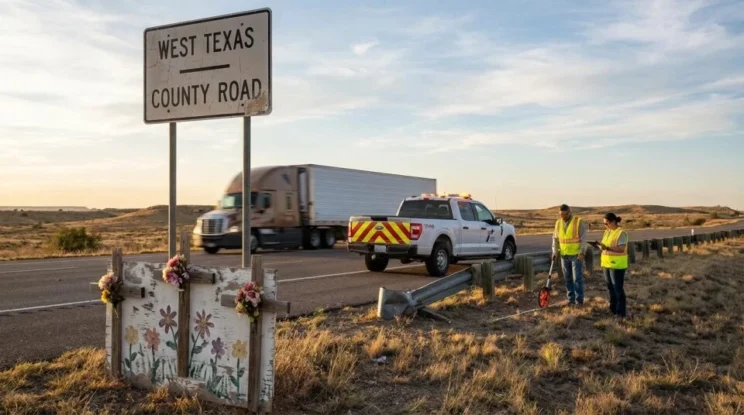
Texas’ Counties with the Highest Fatality Rates in 2025
As long as there have been drivers and cars, there have been crashes, and as long as there have been crashes, there have been crash-related fatalities. Last year, 3,809 people tragically lost their lives in auto accidents on Texas roads. That is a drop of over eight percent from 2024 and a continuation of a steady decline that has carried on since peaking at nearly 4,500 in 2021.
To better understand our communities and drivers around the state, we gathered auto accident data directly from the Texas Department of Transportation, focusing specifically on which counties are the most dangerous by seeing which ones had the highest accident-related fatality rates in the state.
Our Methodology
Because not all of our state’s counties are equal, trying to compare them on an equal footing can lead to some strange conclusions. Comparing raw accident data disadvantages larger counties that have bigger populations, and therefore more accidents.
On the other hand, adjusting fatality rates for county population can lead to some quirky conclusions that aren’t always fair to smaller counties. One fatality in a county of under 5,000 people has a much greater impact on the numbers than one fatality in Harris County, which has a population of over 5 million.
So, to combat this, we have split our data up into three groups: the “Big Six,” which includes the county homes of Texas’ six major cities, the “250k Club,” which covers all other counties with populations over 250,000, and then the “Smaller Counties,” which covers all others.
The “Big Six”
| THE BIG SIX | ||||||
| Rank | County | Population | Fatalities | Fatalities/100K | Top City | City Fatalities |
| 1 | Dallas | 2,656,028 | 280 | 10.54 | Dallas | 162 |
| 2 | Travis | 1,363,767 | 143 | 10.49 | Austin | 90 |
| 3 | Harris | 5,009,302 | 516 | 10.30 | Houston | 304 |
| 4 | Bexar | 2,127,737 | 190 | 8.93 | San Antonio | 164 |
| 5 | Tarrant | 2,230,708 | 194 | 8.70 | Fort Worth | 108 |
| 6 | El Paso | 875,784 | 70 | 7.99 | El Paso | 56 |
The six largest cities in Texas are very much a world of their own when it comes to their traffic statistics. With most of their populations exceeding a million people (four of them exceeding two million), extensive and almost constant construction, and hundreds, if not thousands of miles of roads, these metropolitan areas are the textbook example of how “everything is bigger in Texas.”
They are also bigger in terms of the volume of accidents they see every year. Accidents are a common occurrence in these counties, with most of them usually seeing multiple crashes every single day. As a result, their injury and fatality numbers are often higher.
It should come as little surprise that Harris County, the largest in the state by population, also takes the crown for our deadliest when it comes to the sheer number of fatalities in 2025. Its 516 total deaths more than doubles any other county outside of runner-up Dallas.
However, Dallas County takes the crown among the big six when adjusting for population. Dallas’s 280 total fatalities equate to 10.54 fatalities per 100,000 residents, making it the deadliest county among the Big Six when adjusted for each county’s population size.
El Paso County is the smallest member of this group, and actually has a smaller population than some in our next tier down. However, we have opted to include it as the biggest city in West Texas. Unsurprisingly, its smaller size means fewer accidents, but comparatively speaking, El Paso’s drivers are among the safest in the state. Its per-capita accident rate of just 7.99 ranks 215th out of 228 counties to record a fatality.
The “250k Club”
| 250K CLUB | ||||||
| Rank | County | Population | Fatalities | Fatalities/100K | Top City | City Fatalities |
| 1 | Jefferson | 253,948 | 44 | 17.33 | Beaumont | 20 |
| 2 | Nueces | 353,125 | 51 | 14.44 | Corpus Christi | 35 |
| 3 | Bell | 399,578 | 49 | 12.26 | Killeen | 13 |
| 4 | Lubbock | 327,394 | 38 | 11.61 | Lubbock | 22 |
| 5 | Brazoria | 413,224 | 42 | 10.16 | Alvin | 5 |
| 6 | Galveston | 367,407 | 33 | 8.98 | Galveston | 8 |
| 7 | Williamson | 727,480 | 65 | 8.93 | Round Rock | 12 |
| 8 | McLennan | 270,358 | 24 | 8.88 | Waco | 13 |
| 9 | Hays | 292,029 | 24 | 8.22 | San Marcos | 8 |
| 10 | Cameron | 431,874 | 34 | 7.87 | Brownsville | 11 |
| 11 | Montgomery | 749,613 | 58 | 7.74 | Conroe | 13 |
| 12 | Fort Bend | 958,434 | 59 | 6.16 | Sugar Land | 12 |
| 13 | Hidalgo | 914,820 | 52 | 5.68 | McAllen | 11 |
| 14 | Denton | 1,045,120 | 58 | 5.55 | Denton | 14 |
| 15 | Webb | 272,823 | 15 | 5.50 | Laredo | 12 |
| 16 | Collin | 1,254,658 | 66 | 5.26 | Plano | 18 |
Our mid-size group presents some interesting observations, including some potential candidates for the “sweet spot” of a larger population size combining with an effectively low fatality rate.
Denton and Collin counties lead this charge: both have populations in excess of a million residents, so it’s perhaps unsurprising that they rank 10th and 7th in terms of total fatalities. Yet, both have per-capita fatality rates of under six per 100K, making them statistically among the best in the state in that category at 224th and 226th, respectively. You could argue that this makes them among the safest counties in Texas relative to their population size.
Webb County also falls into this category, recording just 15 deaths with a population of nearly 275,000, giving a per-capita rate of 5.50, fitting between Denton and Collin counties at 225th.
This is particularly surprising because these counties (Denton and Collin, in particular) are among the fastest growing in not just the state, but the entire nation. Perhaps that might be a contributing factor as to why—this explosive growth and higher density create lower-speed roads both by design and in practice through brutal traffic both on local freeway stretches and surrounding surface streets. Lower speeds don’t always mean fewer accidents, but it does mean the average accident is more survivable.
This pattern is further supported by looking at suburbs and more rural counties that fit the other end of the spectrum: older and established cores with aging infrastructure, lower population density, and heavier truck traffic. Jefferson County stands out with the highest per-capita fatality rate in the group at 17.33 per 100K—more than three times the rate of Collin County. It is also home to one of the most crash-prone intersections in the state, found in the city of Beaumont.
Nueces County, home of Corpus Christi, and Bell County, home of Killeen, also run well above the group average.
Our Smaller Counties
| SMALLER COUNTIES (top 25 shown) | ||||||
| Rank | County | Population | Fatalities | Fatalities/100K | Top City | City Fatalities |
| 1 | Loving | 48 | 1 | 2083.33 | N/A | 0 |
| 2 | Kenedy | 330 | 3 | 909.09 | Armstrong | 0 |
| 3 | McMullen | 565 | 4 | 707.96 | Stanton | 0 |
| 4 | Oldham | 1,823 | 10 | 548.55 | Adrian | 0 |
| 5 | Glasscock | 1,153 | 3 | 260.19 | Garden City | 2 |
| 6 | Irion | 1,526 | 3 | 196.59 | Barnhart | 0 |
| 7 | Borden | 557 | 1 | 179.53 | Gail | 0 |
| 8 | Culberson | 2,254 | 4 | 177.46 | Van Horn | 1 |
| 9 | Hudspeth | 3,608 | 6 | 166.30 | Cornudas | 0 |
| 10 | Armstrong | 1,809 | 3 | 165.84 | Claude | 0 |
| 11 | La Salle | 6,679 | 8 | 119.78 | Cotulla | 0 |
| 12 | Martin | 5,179 | 6 | 115.85 | Eagle Pass | 1 |
| 13 | Leon | 16,698 | 18 | 107.80 | Flynn | 1 |
| 14 | Crockett | 2,799 | 3 | 107.18 | Ozona | 0 |
| 15 | Hartley | 4,996 | 5 | 100.08 | Brenham | 0 |
| 16 | Motley | 1,015 | 1 | 98.52 | Matador | 0 |
| 17 | Sutton | 3,269 | 3 | 91.77 | Hemphill | 0 |
| 18 | San Augustine | 7,767 | 7 | 90.12 | San Augustine | 1 |
| 19 | Presidio | 5,686 | 5 | 87.94 | Marfa | 0 |
| 20 | Lee | 18,451 | 15 | 81.30 | Giddings | 1 |
| 21 | Edwards | 1,383 | 1 | 72.31 | Rocksprings | 1 |
| 22 | Somervell | 10,098 | 7 | 69.32 | Glen Rose | 1 |
| 23 | Upton | 3,128 | 2 | 63.94 | Mccamey | 0 |
| 24 | Jack | 9,398 | 6 | 63.84 | Cut And Shoot | 0 |
| 25 | Parmer | 9,669 | 6 | 62.05 | Bovina | 0 |
Our Smaller Counties group is comprised of more than 200 counties in total, and it’s where we start to see some of those anomalies that make them statistically difficult to compare to their larger counterparts, notably because of staggering per-capita numbers driven by small population numbers.
Loving County is an extreme example of this trend. With a most recent recorded population of just 48 people, it is the least populous county in not just Texas, but the entire United States. It is so small that it has no incorporated cities anywhere! The county’s largest population center, Mentone, has been designated a Texas Historical Landmark as the “Smallest County Seat in Texas.”
But that small size didn’t stop the county from recording one solitary traffic fatality in 2025, and that single death produces a countywide per-capita fatality rate of 2,083 deaths per 100K people.
Quirks aside, the real story of this group lives in the mid-range of this list, where the numbers start to stabilize into meaningful patterns. Counties like Bastrop (33.06), Ector (29.41), and Bowie (29.35) have populations between 90,000 and 170,000 and double-digit fatality counts, making their elevated rates far more statistically reliable than the micro-counties at the top.
Geography tells a consistent story: many of the highest-rate small counties sit along major interstate and highway corridors—I-40 through Oldham County, I-10 through Culberson and Hudspeth counties, I-35 through Bastrop and Caldwell counties—where high-speed traffic passes through sparsely populated areas with limited emergency response infrastructure.
These aren’t places where residents are driving dangerously; they’re places where through-traffic on major roadways suffers fatalities disproportionately relative to the people who actually live there.
Oldham County is a perfect example of this trend. This small county in the panhandle, located west of Amarillo, is home to just under 2,000 people. There were 10 traffic fatalities here in 2025, with the majority being accidents along I-40. In terms of total deaths, that’s relatively low compared to many other counties.
However, 10 fatalities in a county with that small of a population produces a per-capita rate of 548.55, 4th highest in the state. The 10 recorded fatalities also place Oldham in 82nd for total traffic deaths. You could argue that this combination is a valid to consider Oldham County among the contenders for the title of “Texas’ Deadliest County for Drivers.”
Other Interesting Observations
- Just 10 counties (Dallas, Travis, Harris, Bexar, Tarrant, El Paso, Collin, Willamson, Fort Bend, and Denton) accounted for 1,641 fatalities, 43.1 percent of the entire total. These also happen to be 9 of the 10 most populous counties in the state, so the trend of higher populations meaning higher fatality counts holds true.
- With that being said, a disproportionate number of accidents occurred in Smaller Counties as well. These areas accounted for 44.7 percent of all traffic fatalities, yet they combine for only 25.3 percent of the population. By contrast, the Big Six accounts for 36.6 percent of traffic deaths but holds 45.7 percent of the population.
- El Paso performed the best out of the state’s major metros, but seven counties in the 250K Club group actually performed even better. While they weren’t grouped in the same category, Collin, Webb, Denton, Hidalgo, Fort Bend, Montgomery, and Cameron counties all had lower per-capita fatality rates, bucking the trend of smaller counties dominating this metric.
- Traffic deaths tend to be highly concentrated in major metros. Nearly two-thirds of all traffic deaths in the Big Six counties happened in their deadliest city. For counties in the 250K Club (which, mind you, are often suburban counties), the deadliest city tends to only account for around one-third of them.
- Finally, 26 counties did not record a single traffic fatality in 2025, awarding them the de-facto title of Texas’ Safest Counties for Drivers. Willacy County in particular is notable because of its population size: 20,027, making it by far the largest in that group.
Have You Been Injured in an Accident?
If you or a loved one has been injured in an accident, you may have options for recovering compensation. Texas law enables crash victims to recover damages in accordance with their percentage of fault. Depending on the nature of your accident, that could mean pursuing the other driver, their employer, a vehicle manufacturer, or even your own insurer.
For more than 30 years, Angel Reyes & Associates has been an advocate for Texans injured on our roads. Whether your crash was in an intersection, a parking lot, or on a high-speed freeway, we can work with you to evaluate your situation completely, analyze your options, and aggressively pursue a positive outcome.
We work on a contingency fee basis, meaning you never pay a dime unless we recover on your behalf. We even offer free, no-obligation consultations to help you get started. Contact us and see for yourself why more than 70,000 Texans have made us the firm they trust during one of the most difficult times of their lives.
Data source: Texas Department of Transportation Crash Records Information System (CRIS) public data extract | Jan 1 – Dec 31, 2025 | Total statewide fatalities: 3,809.
About the Authors

Angel Reyes
Writer
Angel L. Reyes, III is the Founder and Managing Partner of Angel Reyes & Associates. A nationally recognized trial attorney and business leader, Angel has helped over 70,000 injury victims recover more than $1 billion since founding the firm in 1993. Named to the Texas Super Lawyers list annually since 2008, Angel brings Wall Street experience, Ivy League education, and a deep commitment to client advocacy. He is a frequent legal commentator and published author with extensive contributions to legal scholarship, trial strategy, and consumer protection.

Kyle Nicolas
Editor
Kyle Nicolas is the Web Content & SEO Manager at Angel Reyes & Associates. He has more than 10 years of experience as a marketing co...

Angel Reyes
Reviewer
Angel L. Reyes, III is the Founder and Managing Partner of Angel Reyes & Associates. A nationally recognized trial attorney and business...