Why Self-Driving Car Accidents Statistics Can Be Misleading


Every article on this site is researched by our internal team, reviewed for legal accuracy against current Texas law, and held to State Bar of Texas advertising standards before publication. We do not publish content that overstates outcomes or makes promises about results.
Learn more about our
editorial standards .
Key Takeaways
- NHTSA crash report totals cannot prove whether self-driving cars are safer without exposure data showing miles driven under comparable conditions.
- Texas's TxDMV Automated Vehicles Regulatory Program becomes fully enforceable May 28, 2026, adding authorization and emergency responder plan requirements for commercial AV operators.
- Liability in Texas AV crashes depends on whether the system was Level 2 ADAS (driver must supervise) or ADS (system drives), with fault allocated under Texas proportionate responsibility rules.
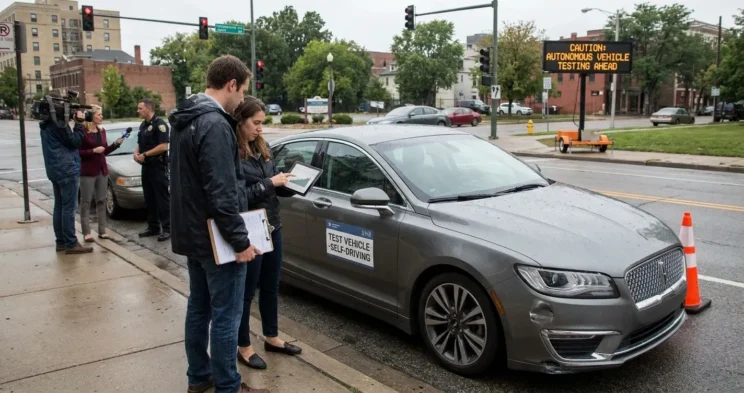
You were driving home on I-10 near the Galleria when a vehicle with a sensor tower on the roof and a rideshare company’s branding drifted into your lane. The crash happened fast.
Now you’re dealing with injuries, vehicle damage, and confusing questions about whether a computer or a person was actually in control.
Self-driving car accidents raise issues that traditional crashes don’t. National crash databases exist, but they can’t tell you whether these vehicles are “safer.” Texas has its own rules for automated vehicles, and those rules are changing. Figuring out who pays for your injuries requires understanding how fault works when software is involved.
Why Self-Driving Car Accident Answers Are Confusing
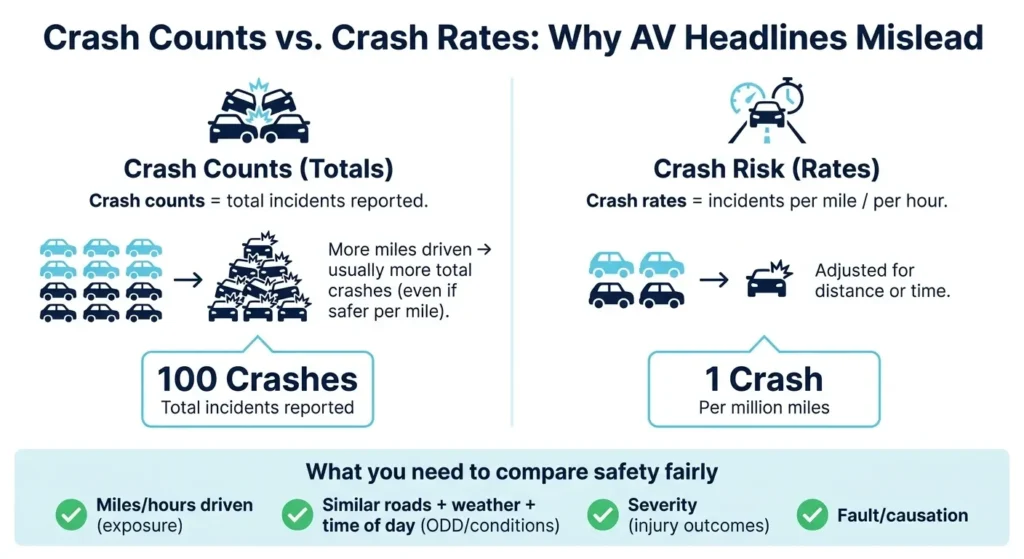
Headlines about autonomous vehicle safety often cite raw crash numbers. Those numbers can mislead without context. Crash reporting totals show how many incidents occurred. Crash risk rates show how often crashes happen per mile driven or per hour of operation.
A fleet logging millions of miles will have more total crashes than a small test program. However, that fleet might also be statistically safer per mile.
Three frameworks shape what happens after a Texas self-driving car accident:
- NHTSA’s Standing General Order (SGO) requires manufacturers to report certain crashes involving automated systems
- Texas TxDMV authorization rules (enforceable May 28, 2026) govern commercial automated vehicle operations
- Texas proportionate responsibility laws determine how fault gets allocated among multiple parties
If you’ve been in a crash involving any level of vehicle automation, document everything before giving statements to insurance adjusters. The technology adds complexity, but your rights to compensation remain.
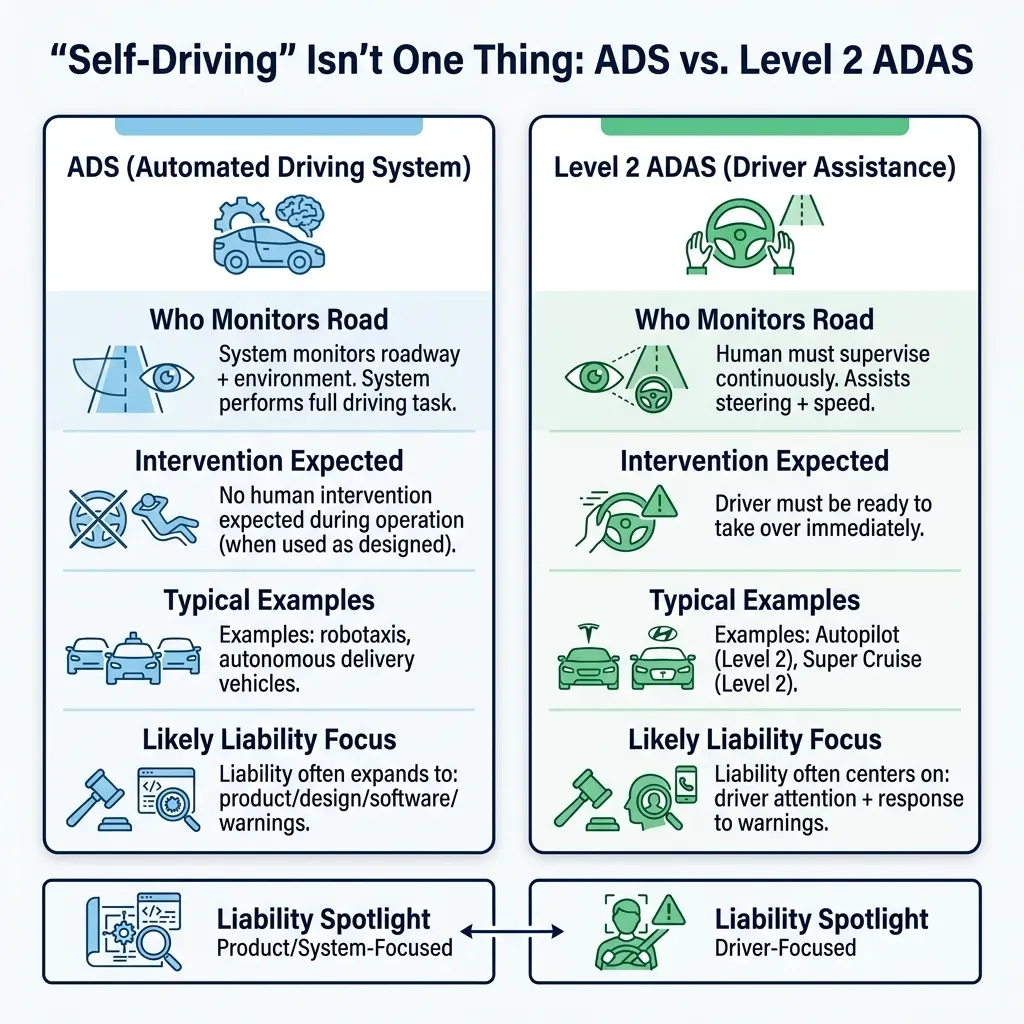
ADS vs. Level 2 ADAS
The term “self-driving” gets used loosely, and is sometimes used to describe technologies designed to operate at dramatically different levels of autonomy. Legally and technically, there’s a critical distinction.
Automated Driving Systems (ADS) perform the entire driving task. The vehicle monitors the road, steers, brakes, and accelerates without expecting human intervention during operation. Robotaxis and autonomous delivery vehicles fall into this category.
Level 2 Advanced Driver Assistance Systems (ADAS) help with steering or speed but require constant human supervision. The driver must remain alert and ready to take over. Tesla’s Autopilot and GM’s Super Cruise are Level 2 systems, despite marketing that suggests otherwise.
This distinction shapes liability arguments. Level 2 crashes often focus on whether the driver was paying attention. ADS crashes may involve product liability claims against the system’s developer.
What “ODD” Means for Fault & Evidence
Every automated system has an Operational Design Domain (ODD): the specific conditions where it’s designed to work. Common ODD limits include:
- Highway-only operation (no city streets)
- Clear weather (no heavy rain, snow, or fog)
- Mapped roads only
- Speed restrictions
- No construction zones
When a crash occurs outside the ODD, arguments shift. The manufacturer may claim the system wasn’t supposed to be active. The driver may argue warnings were inadequate.
Evidence that establishes ODD conditions includes weather reports, road classification data, construction zone signage, and time-of-day records. Preserving this information early can determine how fault gets allocated.
What NHTSA’s Standing General Order Crash Reports Do & Don’t Tell You
Since 2021, NHTSA has required manufacturers to report crashes involving vehicles equipped with ADS or Level 2 ADAS under the Standing General Order. The agency publishes downloadable datasets.
The reports contain incident-level information: date, location, system type, injuries, and whether the automated system was engaged. This transparency is valuable for researchers and regulators.
The reports cannot answer whether self-driving cars are safer than human drivers. Here’s why:
| What You Can Conclude | What You Cannot Conclude |
| Number of reported incidents | Crash rate per mile driven |
| General injury outcomes | Comparative safety to human drivers |
| Which manufacturers reported | Whether automation caused the crash |
| Trends over time | Fault determination |
A 2024 GAO report examined these limitations. Without consistent exposure data (miles driven, hours of operation, ODD conditions), comparing ADS crash totals to human driver statistics is misleading.
Why Crash Counts Alone Can’t Answer “Are Self-Driving Cars Safer?”
To determine whether automated vehicles are safer, you’d need:
- Frequency data: crashes per million miles for each system type
- Severity data: injury rates and outcomes
- Fault data: who or what caused each crash
- Exposure data: how many miles each system type logged under comparable conditions
The SGO provides some frequency and severity information. It doesn’t provide fault determinations or standardized exposure metrics.
For Texas crash victims, this means national statistics won’t resolve your claim. Your case depends on the specific facts: what the system was doing, what the driver was doing, and what evidence exists.
Texas AV Rules That Matter After a Crash
Texas operates an Automated Vehicles Regulatory Program through TxDMV. The program becomes fully enforceable on May 28, 2026.
Commercial operators of automated motor vehicles must obtain authorization from TxDMV. Applicants must certify compliance with safety requirements and provide the Texas Department of Public Safety with an emergency responder interaction plan.
The emergency responder plan matters at crash scenes. It should explain how first responders can safely disable the vehicle, communicate with remote operators, and secure the scene. When these plans are inadequate or weren’t followed, it becomes relevant evidence.
Texas Transportation Code Chapter 545 contains the statutory framework for automated motor vehicle operations. These provisions define what qualifies as an automated motor vehicle and establish operational requirements.
How Texas Authorization & Compliance Can Show Up in an Injury Claim
After a crash involving a commercial automated vehicle, investigators may examine:
- Whether the operator held valid TxDMV authorization
- Whether the vehicle was operating within program requirements
- Whether the emergency responder plan was adequate and followed
Noncompliance doesn’t automatically establish liability. It can, however, support negligence arguments about duty and breach. It affects credibility. In egregious cases, it might support punitive damage claims.
Texas authorization rules add a layer to crash investigation, but they don’t replace the basics. You still need evidence showing what happened and who was at fault. Understanding how Texas car accidents are investigated helps you know what to document.
Who Can Be Liable in a Texas Self-Driving or Driver-Assist Crash
Multiple parties may share responsibility:
- Human driver or safety operator: for failing to supervise or take over when required
- Vehicle owner: for negligent entrustment or maintenance failures
- Employer or fleet operator: for crashes during commercial operations
- AV developer or manufacturer: for design defects, software failures, or inadequate warnings
- Parts suppliers: for defective sensors, cameras, or other components
- Other motorists: for their own negligent driving
Level 2 ADAS crashes often turn on driver behavior. Was the driver watching the road? Were they distracted? Did they ignore takeover warnings?
ADS crashes may expand liability to include product defect claims. If the system was supposed to handle driving and failed, the developer’s design choices become central.
Texas Proportionate Responsibility & What It Means for Your Recovery
Texas Civil Practice and Remedies Code Chapter 33 establishes proportionate responsibility. Multiple parties can share fault, and your recovery gets reduced by your percentage of responsibility.
If you’re found 51% or more at fault, you recover nothing.
In AV/ADAS crashes, fault allocation disputes commonly involve:
- Driver inattention vs. system malfunction
- Inadequate warnings vs. failure to heed warnings
- Another driver’s negligence vs. automation failure
- Road conditions vs. ODD limitations
Early statements matter. What you tell the insurance adjuster about whether you were “paying attention” or whether the car was “driving itself” can influence how fault gets allocated. Be factual. Don’t speculate about what the system was doing until the evidence is examined.
What to Do After a Self-Driving or Driver-Assist Crash in Texas
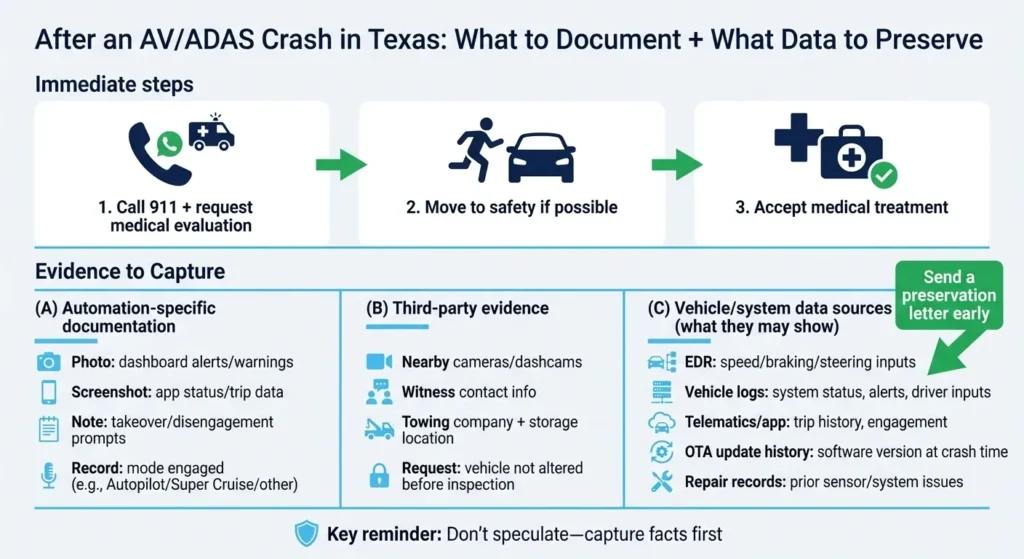
Immediate steps:
- Call 911 and request medical evaluation
- Move to safety if possible
- Accept medical treatment (injuries from crashes aren’t always immediately apparent)
Documentation specific to automation:
- Photograph the dashboard, including any alerts or warning messages
- Screenshot the vehicle’s app if it shows system status or trip data
- Note whether the system displayed any “takeover” or “disengagement” prompts
- Record the vehicle’s mode (was Autopilot, Super Cruise, or another system engaged?)
Third-party evidence:
- Identify nearby security cameras or dashcams
- Get witness contact information
- Note towing company and storage location
- Request that the vehicle not be altered before inspection
Evidence to Ask About
Automated vehicles generate data that traditional cars don’t. Potentially relevant sources include:
| Data Source | What It May Show |
| Event Data Recorder (EDR) | Speed, braking, steering inputs before crash |
| Vehicle logs | System status, alerts, driver inputs |
| Telematics/app data | Trip history, system engagement |
| Over-the-air update history | Software version at time of crash |
| Repair records | Prior issues with sensors or systems |
Accessing this data often requires formal legal process. A preservation letter sent to the manufacturer and any involved parties can prevent evidence from being deleted or overwritten.
Don’t assume the system was “at fault” or “in control.” Capture the facts first. Let the evidence determine what happened.
How Insurance & Claims Work When Automation Is Involved
Insurance adjusters still investigate negligence and causation. Automation adds complexity but doesn’t change the fundamental requirement: you need evidence showing someone else’s fault caused your injuries.
Common friction points include:
- Recorded statements: Adjusters may ask leading questions about whether you were “relying on” the system
- “Driver in control” disputes: Insurers may argue the human driver was responsible regardless of system engagement
- Data access: Getting vehicle logs and system data can require litigation
- Vehicle retention: The car may be held by a tow yard or insurer, limiting inspection opportunities
When commercial automated vehicles are involved (robotaxis, autonomous delivery trucks, fleet vehicles), stakes increase. Multiple insurance policies may apply. Corporate defendants have legal teams. Truck accident claims involving automation require experienced handling.
When to Contact a Texas Attorney After an AV/ADAS Crash
Consider legal help if:
- You suffered serious injuries
- Fault is disputed or unclear
- A commercial AV was involved
- Video or data evidence is missing or being withheld
- Multiple vehicles or parties were involved
- An insurer is pressuring you to settle quickly
Bring to your consultation:
- Crash report number
- Photos and screenshots (dashboard, scene, injuries)
- Medical visit information
- Witness contact list
- Insurance policy details
- Towing and repair paperwork
Angel Reyes & Associates has over 30 years of experience handling complex Texas injury claims. We offer free consultations and work on contingency: no fee unless we win. Our team has recovered more than $1 billion for clients across Texas.With more than 20 office locations statewide and 24/7 availability, we can help preserve evidence and protect your rights before critical deadlines pass. Contact us today to discuss your self-driving car accident case.
Witness Statement FAQs
Can you sue a car manufacturer after a self-driving crash in Texas?
Possibly, but not every crash supports a product claim. These cases usually depend on evidence of a design defect, software problem, sensor failure, or inadequate warnings rather than the fact that automation was involved.
What if the automated vehicle was a rideshare, robotaxi, or delivery vehicle?
A commercial vehicle crash may involve additional parties, such as the fleet operator, remote operator, maintenance company, or an employer with separate insurance coverage. That can make the claim more complex, but it may also mean more than one policy is available.
Will my insurance cover a crash involving a self-driving car?
Coverage often depends on whose vehicle was involved, the policy language, and who is believed to be at fault. Even when automation is a factor, claims usually still go through the same liability, collision, medical payments, or uninsured/underinsured coverage analysis.
Can software updates matter after a self-driving car accident?
Yes. The software version on the vehicle at the time of the crash may affect how the system behaved, what warnings were active, and whether a known issue had already been addressed.
Do police determine whether the self-driving system caused the crash?
Usually not in any final sense. Police reports can document the scene and initial observations, but questions about system performance often require later review of vehicle data, technical records, and expert analysis.
About the Authors

Angel Reyes
Writer
Angel L. Reyes, III is the Founder and Managing Partner of Angel Reyes & Associates. A nationally recognized trial attorney and business leader, Angel has helped over 70,000 injury victims recover more than $1 billion since founding the firm in 1993. Named to the Texas Super Lawyers list annually since 2008, Angel brings Wall Street experience, Ivy League education, and a deep commitment to client advocacy. He is a frequent legal commentator and published author with extensive contributions to legal scholarship, trial strategy, and consumer protection.

Graham Griffin
Editor
Graham Griffin is the Web & Content Manager at Angel Reyes & Associates, where he oversees content strategy, AI-powered workflows, a...

Spencer Browne
Reviewer
Spencer Browne is a partner at Angel Reyes & Associates and a Board Certified personal injury trial lawyer with nearly 100 jury trials a...