Can You Survive a Motorcycle Crash at High Speed?


Every article on this site is researched by our internal team, reviewed for legal accuracy against current Texas law, and held to State Bar of Texas advertising standards before publication. We do not publish content that overstates outcomes or makes promises about results.
Learn more about our
editorial standards .
Key Takeaways
- Kinetic energy quadruples when speed doubles, making crashes above 60 mph far more deadly for riders.
- A DOT-compliant helmet reduces fatal injury risk by about 37 percent, per NHTSA data.
- Under Texas law, speed at crash time can reduce your compensation or bar your claim entirely.
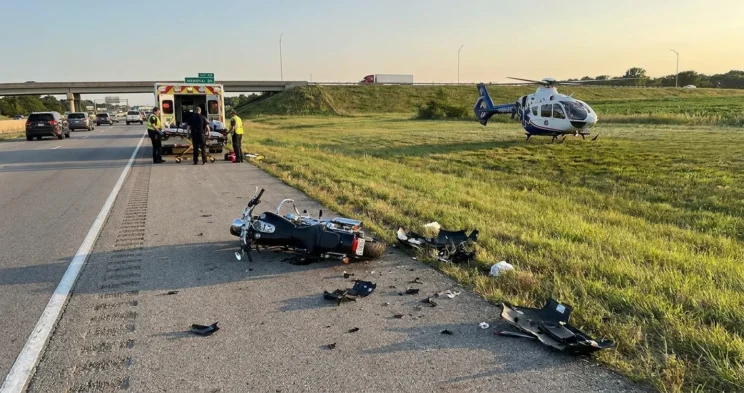
You were on the MoPac heading home from work when you heard the news: a rider went down on I-35 near Round Rock, traveling fast, and it was bad. You ride that same stretch every week. The question that stays with you is the one most people are too uncomfortable to ask directly: can you actually survive a motorcycle crash at high speed?
The answer is yes, sometimes. But the factors that determine whether you walk away, get carried away, or don’t come home at all are worth understanding clearly before the next ride.
Speed, Energy, & What Your Body Absorbs
The physics of a high-speed motorcycle crash come down to one principle: kinetic energy scales with the square of your speed. When your speed doubles, the energy your body must absorb quadruples.
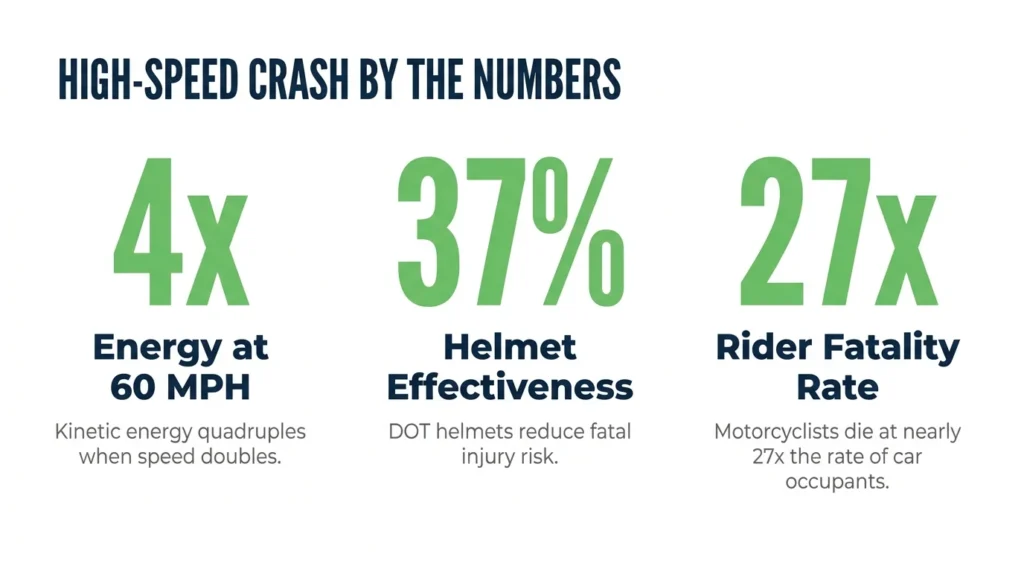
At 30 mph, a crash produces a survivable but serious amount of force for a geared rider. At 60 mph, that same scenario produces roughly four times the destructive energy. At 70 mph, the forces involved are so extreme that survival often depends as much on luck as on any preparation.
What makes a motorcycle crash different from a car crash is what’s missing. There is no crumple zone absorbing energy before it reaches you. There are no airbags. There is no metal cage redirecting force around your body. You are the first thing to contact whatever you hit.
According to NHTSA motorcycle safety data, motorcyclists are nearly 27 times more likely to die in a crash than passenger car occupants per mile traveled. That gap exists precisely because the physics of energy transfer are so unforgiving on two wheels.
Impact angle shapes outcomes significantly. A glancing slide across pavement distributes energy over time and distance. A direct frontal impact with a fixed object at high speed is a different situation entirely: all of that energy stops in fractions of a second, and your body absorbs the whole thing.
The road surface also plays a role. Asphalt and concrete are dense and high-friction. A slide on either will cause severe road rash at speed, but it can distribute impact over several feet rather than one instant. Striking a concrete barrier or a parked vehicle at the same speed removes that distribution entirely.
Gear Is Not Optional at Any Speed
Gear does not make you invincible at high speed, but it genuinely changes outcomes. The difference between a rider in full gear and a rider in shorts and a t-shirt at 50 mph is not a small one.
A DOT-compliant helmet is your most important piece of equipment. NHTSA data shows helmets are about 37 percent effective at preventing fatal injuries for riders. That number sounds modest until you understand what it means in absolute terms: thousands of riders are alive today because they wore one.
Abrasion-resistant materials protect your skin. Leather, Cordura, and Kevlar panels in a riding jacket can be the difference between road rash that heals and road rash that strips skin to bone and leads to sepsis, or a life-threatening infection. At highway speeds, unprotected skin does not survive contact with asphalt.
Jacket armor at the shoulders, elbows, and back absorbs impact forces that would otherwise go directly into your joints and spine. Gloves protect your hands and wrists, which are almost always the first point of contact when you go down. Boots protect ankles and feet, which can be severely crushed in a collision without protection.
Gear also matters for a reason many riders don’t think about: it creates a documented record.
Photos of a fully geared rider at the scene of a crash tell a very different story than photos of someone who was riding without protection. That documentation can shape how your injuries are interpreted and whether an insurer argues you contributed to your own harm.
What Else Determines Whether You Walk Away?
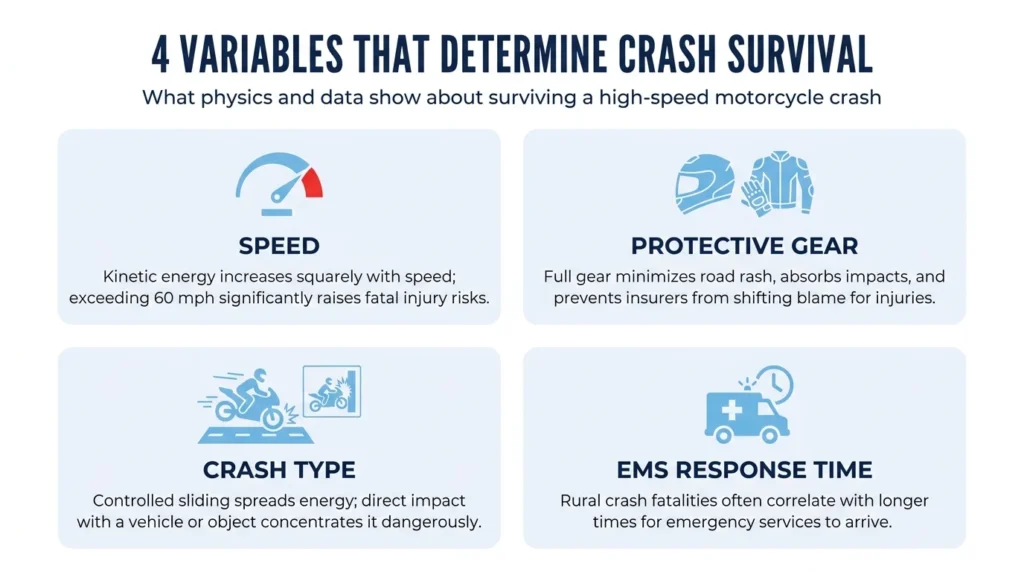
Speed and gear are the two variables you control before a crash. Several others determine what happens when physics takes over.
The type of crash matters more than most riders realize. A single-vehicle slide, where the bike goes down on pavement without hitting another object, produces a different injury profile than a multi-vehicle collision. When a car or truck becomes the striking object, the size mismatch alone dramatically increases the severity of the outcome.
A motorcycle hitting an SUV at 45 mph is absorbing an enormous amount of momentum from a vehicle many times heavier.
Emergency response time is a survival variable you cannot control but that Texas riders need to understand. Rural crashes are statistically more fatal partly because EMS cannot reach the scene as quickly. Getting to a trauma center fast matters for internal injuries, blood loss, and traumatic brain injury.
If you ride in remote areas, riding with someone, letting someone know your route, and carrying a means of communication are practical steps that could affect what happens after a crash.
Age and pre-existing health also factor in. The body’s ability to manage major trauma, survive surgery, and recover from blood loss varies significantly. Younger riders with no underlying conditions generally have higher survival rates from injuries that would be fatal in older riders with compromised health.
Data on how often these crashes turn fatal in Texas appears in a closer look at what percentage of motorcycle accidents are fatal.
How Speed Becomes a Legal Factor After a Crash
Surviving a crash is one problem. What happens next legally is a different one, and speed sits at the center of both.
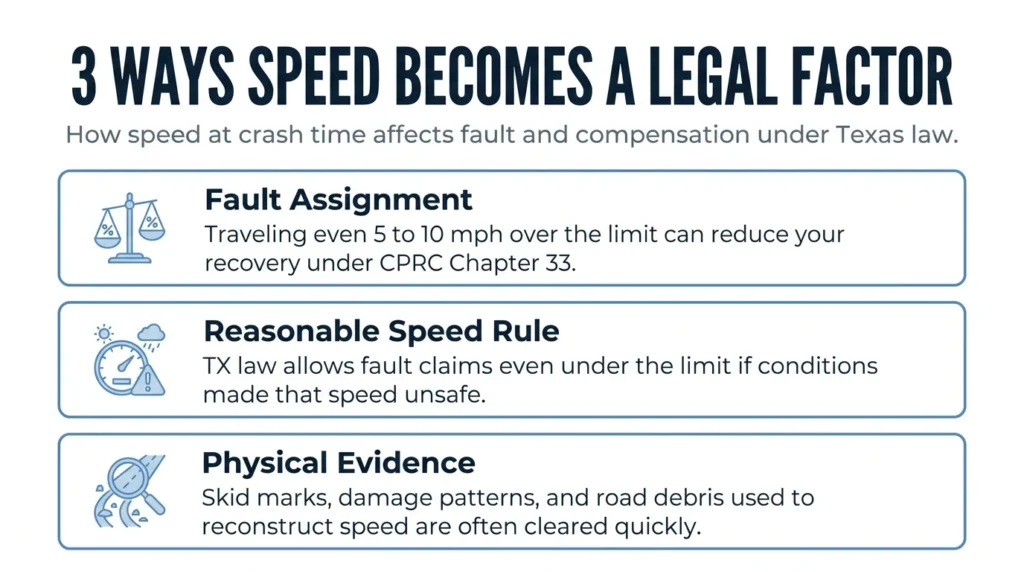
Texas uses a proportionate responsibility system under Texas Civil Practice and Remedies Code (CPRC) Chapter 33 to assign fault after a crash. If you are found more than 50 percent responsible for causing the accident, you cannot recover damages from the other party, even if they also acted negligently. If you are found 30 percent at fault, your recovery is reduced by 30 percent.
Speed is one of the first factors the opposing insurer’s team examines. Even traveling 5 to 10 mph over the posted limit at the time of a crash can be used to assign a percentage of fault to you. Texas Transportation Code § 545.351 requires all operators to drive at a speed reasonable and prudent under conditions then existing.
That “reasonable speed” standard gives adjusters and opposing counsel a basis to argue fault even when a rider was technically at or below the posted limit, if conditions at the time made that speed unsafe.
Crash reconstruction specialists gather evidence quickly. Skid marks, vehicle damage patterns, and roadway debris are often the primary sources used to calculate speed at the moment of impact. That evidence can degrade or be cleared from the scene fast.
Documented gear use works in your favor in two directions. First, it supports the argument that you were riding responsibly. Second, it limits claims that your injuries were worsened by your own recklessness.
Texas gives you two years from the date of the crash to file a personal injury lawsuit under CPRC § 16.003. Evidence of speed and the physical condition of your gear is among the first things to document. If a crash has already happened, the time to start protecting your position is now, not when that two-year window is closing.
The legal strategies available after a motorcycle accident in Texas walk through what protecting your rights actually looks like from the day after the crash forward.
Talk to an Attorney Before Speed Becomes the Story
When a rider survives a high-speed crash, the insurer’s next move is often to build a narrative around that speed. They want to argue the rider was at fault, that the injuries were self-inflicted through recklessness, and that the claim should be reduced or denied.
Angel Reyes & Associates has handled motorcycle injury claims across Texas for over 30 years. We work on a contingency basis, so there is no upfront cost and no fee unless we win. If speed or gear use is being used to shift fault onto you after a crash, we can review what the evidence actually shows and help you understand your options.
Reach out for a free consultation or review our case results to see how we have helped injury victims recover more than $1 billion in compensation.
Past results do not guarantee future outcomes.
High-Speed Motorcycle Crash FAQs
Can you survive a motorcycle crash at 100 mph?
Survival at 100 mph is possible in specific circumstances, such as a controlled slide onto an open road surface with full protective gear, but the odds of escaping without life-threatening injury are very low. At that speed, even a glancing contact with a fixed object or another vehicle typically produces forces the body cannot survive.
Does not wearing a helmet hurt your injury claim in Texas?
Texas does not require helmets for riders 21 and older who meet certain criteria, but if you were not wearing one and suffered head injuries, the other side’s insurer may argue you made your injuries worse and seek a reduction in your compensation under Texas’s proportionate responsibility rules. Helmet use typically has no effect on claims involving injuries unrelated to the head, such as broken bones or spinal damage.
Does the road surface I crash on affect my survival odds?
Yes. A controlled slide across smooth asphalt or concrete distributes energy over distance, which is generally more survivable than striking a fixed object, a raised curb edge, or a vehicle that stops your momentum instantly. Gravel and dirt can cause riders to lose directional control faster, but a long slide on either surface may dissipate energy more gradually than a hard stop.
What should I do in the first 24 hours after surviving a motorcycle crash?
Seek medical attention even if injuries seem minor, since adrenaline can mask symptoms of internal injury, concussion, and soft tissue damage that appear hours later. Document the scene with photos if you are physically able, note road conditions and any visible debris, and avoid giving recorded statements to any insurer before speaking with an attorney.
Can speed still be used against me if the other driver was mostly at fault?
Yes. Texas law allows fault to be split between multiple parties, so even if another driver ran a red light or failed to yield, evidence that you were traveling above the speed limit or at an unreasonable speed for conditions can still be used to assign a percentage of fault to you and reduce your compensation by that amount.
About the Authors

Alex Ivanov
Writer
Alex Ivanov is a personal injury attorney at Angel Reyes & Associates, focused on car, truck, and motorcycle accident cases. Licensed in Texas and multiple federal districts, Alex brings international legal experience and a global education to his practice. He earned his LL.M. from Texas A&M University School of Law after graduating from Belarussian State University in 2016. Alex is fluent in Russian, English, Ukrainian, and Belarussian, and is recognized by multiple national trial lawyer associations for his results and leadership under 40.

Kyle Nicolas
Editor
Kyle Nicolas is the Web Content & SEO Manager at Angel Reyes & Associates. He has more than 10 years of experience as a marketing co...

Angel Reyes
Reviewer
Angel L. Reyes, III is the Founder and Managing Partner of Angel Reyes & Associates. A nationally recognized trial attorney and business...