Can a Common-Law Spouse File a Wrongful Death Claim in Texas?


Every article on this site is researched by our internal team, reviewed for legal accuracy against current Texas law, and held to State Bar of Texas advertising standards before publication. We do not publish content that overstates outcomes or makes promises about results.
Learn more about our
editorial standards .
Key Takeaways
- A common-law spouse can file a Texas wrongful death claim only by proving informal marriage.
- Texas informal marriage requires agreement, living together, and holding out as married.
- You have two years from the date of death to file a wrongful death lawsuit in Texas.
Your partner left the house early, heading north on Loop 1604 toward a job site in Schertz. A driver ran a light, and the two of you never got the chance to say goodbye. Now, in the middle of grief, someone has told you something frightening. Because you never signed a marriage license, they say you may not even have the right to file a claim.
Do Common-Law Spouses Have Standing To Sue?
Yes. You can file a wrongful death claim as a common-law spouse, but only if your relationship meets Texas’s informal marriage test. Without it, you have no legal standing to sue.
The law narrows who can bring this kind of case. Under the Texas Civil Practice and Remedies Code (CPRC) § 71.004, only a surviving spouse, children, or parents may file.
That is why your marital status is the threshold question in any Texas wrongful death claim. It comes first, before any other question about the case.
If you want the full list of every family member who can file, it helps to know who can sue in a Texas wrongful death lawsuit.
Informal Marriage Requirements Under Texas Law
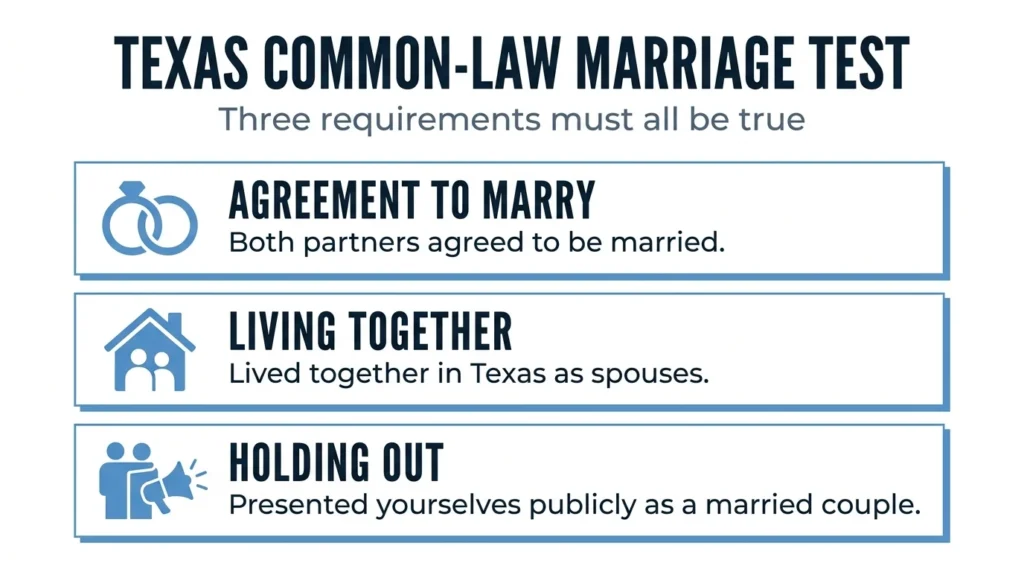
Texas will treat you as married if you meet a three-part test under the Texas Family Code § 2.401. You must have agreed to be married, lived together in Texas as spouses, and presented yourselves to others as a married couple.
The third criterion is the part people underestimate. It means you introduced each other as spouses, used the same last name, or told family and coworkers you were married.
All three parts must be true at the same time. Missing even one means you were not common-law married in Texas, no matter how many years you shared a home.
Some couples record the relationship by filing a Declaration of Informal Marriage with the county clerk under Family Code § 2.402. If you never filed one, your claim still stands. It simply means you have no ready-made record and must show the marriage another way.
How To Prove Common-Law Marriage After Death
Your partner can no longer confirm the agreement, so you have to rebuild the proof from the life you shared. Three kinds of evidence carry the most weight.
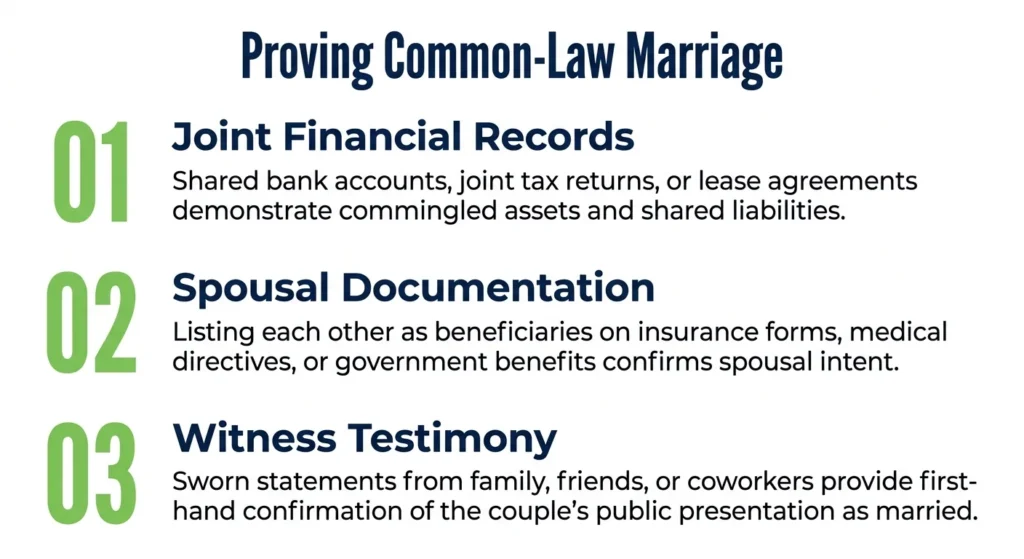
- Joint financial records: shared bank accounts, joint tax returns, or a lease or mortgage in both names
- Documents naming your partner as your spouse: insurance beneficiary forms, medical directives, or employment benefit paperwork
- Witness testimony: statements from family, friends, or coworkers who knew you as a married couple
The absence of a filed declaration does not end your case, but it does raise the bar on proving your common-law marriage. With no self-authenticating record, the court leans harder on the evidence you can gather. The strength of that documentation often shapes the outcome.
Once your standing is settled, knowing what damages a wrongful death claim can recover helps you weigh whether the effort is worth it.
Deadlines for Filing a Wrongful Death Claim
Texas gives you two years from the date of death to file a wrongful death lawsuit. That deadline comes from the Texas Civil Practice and Remedies Code § 16.003, and the clock does not pause while you gather proof of your marriage.
Waiting can cost you the case entirely. If the two years run out before you file, your right to sue is almost always gone, no matter how strong your proof of the marriage turns out to be.
Acting early also protects your evidence. Bank records, benefit forms, and the memories of witnesses all hold up better when you start gathering them soon after the loss.
The filing window has narrow exceptions in certain situations. Learning about the wrongful death statute of limitations in Texas helps you see when these exceptions apply and how they could affect your claim.
Understanding the typical wrongful death settlement value can also help you decide whether proving your eligibility is worth the time.
Work with an Experienced Wrongful Death Attorney
Proving an informal marriage while grieving is a heavy thing to carry alone. Angel Reyes & Associates has guided Texas families through wrongful death claims for over 30 years, and we serve families from our offices across Texas no matter where the death happened.
You can learn about our team and our history before you decide anything. We work on contingency, so there is no fee unless we win, and our work has meant more than $1 billion recovered for clients.
If you’re not sure whether your relationship qualifies, schedule a free consultation so we can review your situation and walk you through your options.
Past results do not guarantee future outcomes.
Wrongful Death Claim FAQs
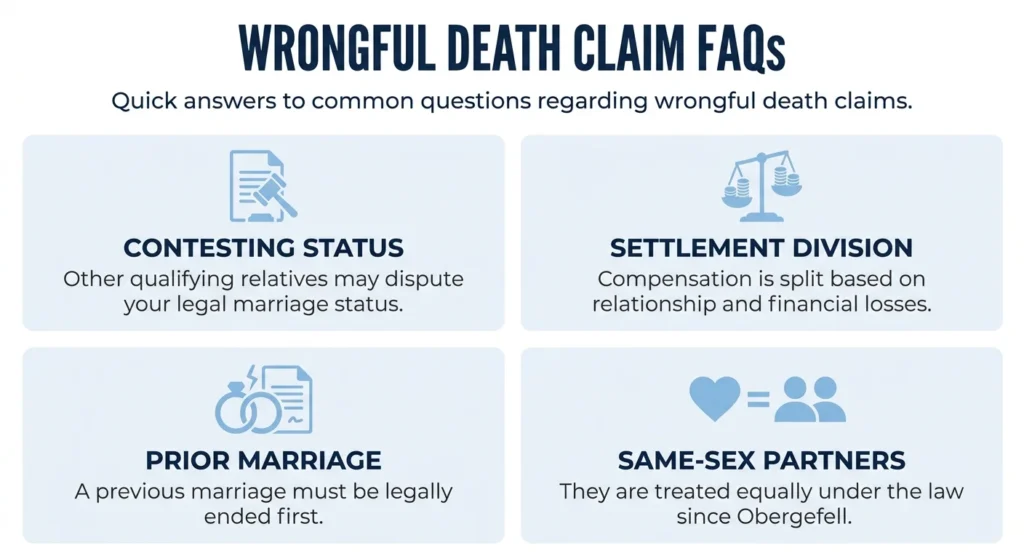
Can other family members contest my status as a common-law spouse?
Yes. Relatives who also qualify to file, like the decedent’s children or parents, can dispute your marriage status if they believe it affects their share of any recovery.
How does a wrongful death settlement get divided if a spouse, children, and parents all have claims?
A jury or settlement divides the money among the eligible claimants. The split is based on each person’s relationship to the deceased and the losses they suffered, not necessarily equal shares.
Does it matter if my partner was still legally married to someone else while we lived together?
Texas will not recognize an informal marriage if either partner was still legally married to someone else at the time. That earlier marriage must have ended in divorce or death before the informal marriage can count.
Can a same-sex partner qualify as a common-law spouse for a Texas wrongful death claim?
Yes. Since the 2015 Obergefell v. Hodges ruling, Texas treats same-sex couples the same as opposite-sex couples under the informal marriage test.
About the Authors

Angel Reyes
Writer
Angel L. Reyes, III is the Founder and Managing Partner of Angel Reyes & Associates. A nationally recognized trial attorney and business leader, Angel has helped over 70,000 injury victims recover more than $1 billion since founding the firm in 1993. Named to the Texas Super Lawyers list annually since 2008, Angel brings Wall Street experience, Ivy League education, and a deep commitment to client advocacy. He is a frequent legal commentator and published author with extensive contributions to legal scholarship, trial strategy, and consumer protection.

Kyle Nicolas
Editor
Kyle Nicolas is the Web Content & SEO Manager at Angel Reyes & Associates. He has more than 10 years of experience as a marketing co...

Spencer Browne
Reviewer
Spencer Browne is a partner at Angel Reyes & Associates and a Board Certified personal injury trial lawyer with nearly 100 jury trials a...