Does Suing for Less Money Make Your Case Go Faster?


Every article on this site is researched by our internal team, reviewed for legal accuracy against current Texas law, and held to State Bar of Texas advertising standards before publication. We do not publish content that overstates outcomes or makes promises about results.
Learn more about our
editorial standards .
Key Takeaways
- Pleading at or under the Texas threshold puts a suit on the expedited actions track.
- Level 1 allows 20 deposition hours per party and 15 interrogatories over 180 days.
- The judgment ceiling binds even if a jury awards more, so assess damages early.

You are a few months out from a wreck on I-35, treatment is done, and your lawyer asks something you did not expect. Do you want to ask for less money so the case moves faster?
Texas has a rule that makes that a real choice. Plead your damages at or under a set dollar figure, and the case lands on the fastest track the civil rules offer. The speed is genuine, and so is the price.
The Short Answer & What It Costs
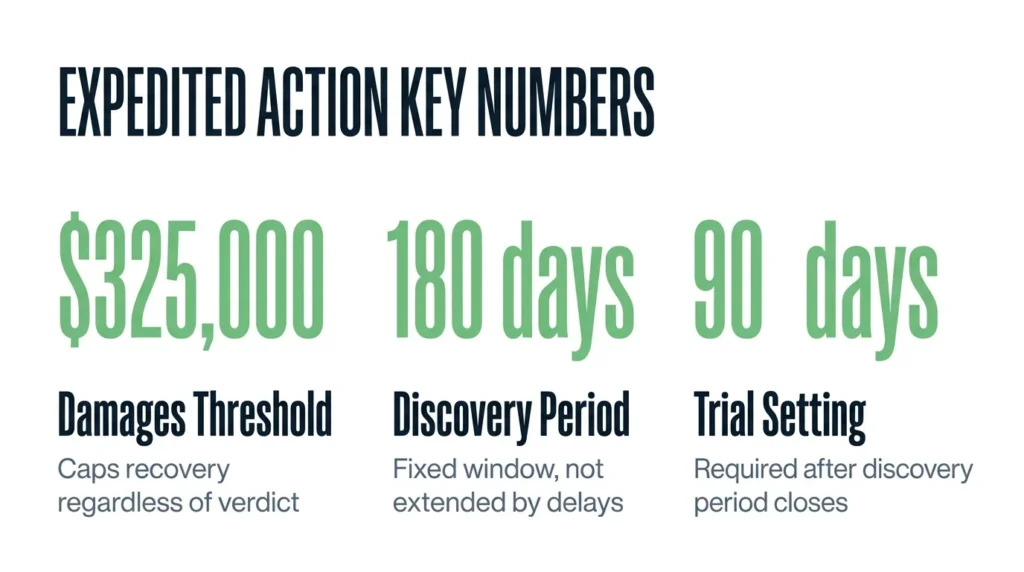
Yes, and it happens by rule rather than a judge’s discretion. Under Texas Rule of Civil Procedure 169, any case automatically enters the expedited actions process if every claimant asks only for monetary recovery of $325,000 or less. That threshold excludes interest, statutory or punitive damages, penalties, and attorney fees.
Nobody elects it. The pleading does it.
What an expedited action in Texas buys is concrete. On any party’s request, the court must set trial within 90 days after the discovery period closes. It may continue the case twice, for no more than 60 days total. Each side gets eight hours to try the case, extendable to twelve on good cause.
The cost is just as concrete. Discovery drops to the tightest control plan the rules allow, and a party prosecuting the suit cannot recover more than that same figure, whatever a jury awards.
How a Texas Case Lands on the Expedited Track
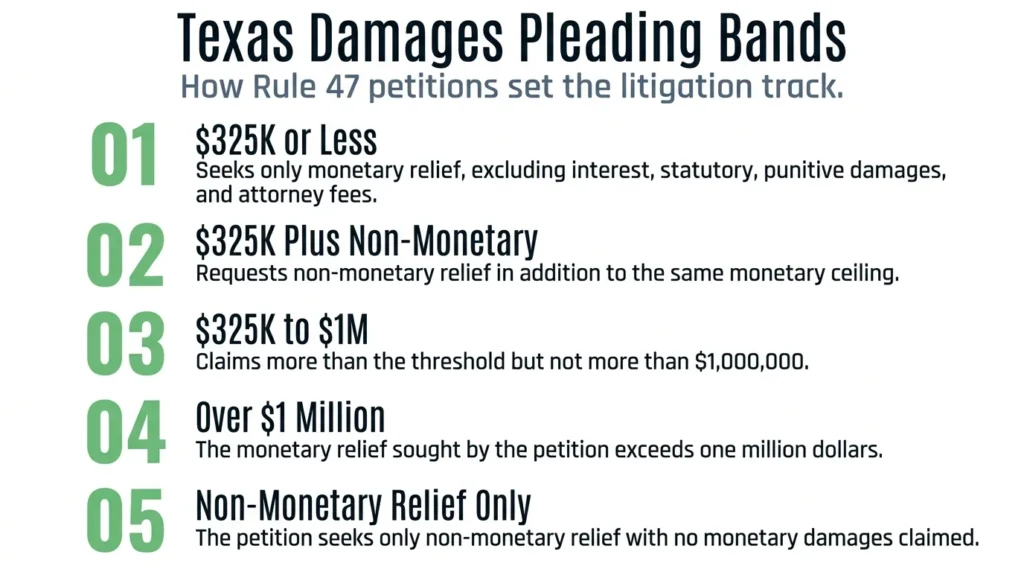
The petition decides whether a case lands on the expedited track, not the court. Rule 47 requires an original pleading to state which damages band the party seeks:
- Only monetary relief of $325,000 or less, with the exclusions named above
- That same amount or less, plus non-monetary relief
- More than that amount but not more than $1,000,000
- More than $1,000,000
- Only non-monetary relief
A petition carrying the first statement is governed by the expedited actions process. A party that fails to state a band may not conduct discovery until the pleading is amended to comply.
The plaintiff also alleges the intended discovery level in the first numbered paragraph of that petition. That allegation notifies the court and the other parties without binding them.
Two widespread beliefs need correcting:
- It applies to district courts: The process is not limited to county courts at law. Any district court suit pleaded at or under the ceiling goes on the expedited track as well.
- It applies to medical malpractice and special claims: Current Rule 169 carries no exemption for health care liability, family, property, or tax claims. That carve-out was deleted effective January 1, 2021, though older articles still repeat it. Today, medical malpractice claims are not automatically excluded; only suits specifically exempt by statute stay off the expedited track.
Suits filed before January 1, 2021 run on the prior rules, which is why a $100,000 figure and a six-hour deposition cap keep surfacing online. Justice court cases sit outside this framework. A truck accident claim rarely fits inside these limits, and the petition still sets the track.
Texas Discovery Levels: Level 1 vs. Level 2
Every Texas case runs under a discovery control plan. Texas discovery levels come in three:
- Level 1: Applies automatically to any suit governed by the expedited actions rule and imposes the most restrictive limits.
- Level 2: Serves as the default track for cases outside of Level 1 until the court orders a custom plan.
- Level 3: A court-ordered plan tailored specifically to the suit that can change any discovery limit in the rules.
The discovery clock starts when the first initial disclosures are due, which is 30 days after the first answer or general appearance. Inside a capped case, those disclosures carry heavy strategic weight.
Each party must produce its legal theories and factual bases, economic damages and how they were calculated, persons with knowledge, documents it may use, and insurance agreements. In an injury suit, that sweeps in all reasonably related medical records and bills.
Add up the pieces, and the rule’s standard schedule runs about ten months from the first answer. That breakdown includes roughly a month to initial disclosures, followed by the discovery period, and trial within 90 days of the close. This total is an estimate rather than a hard statutory deadline, and up to 60 days in continuances can extend that timeline.
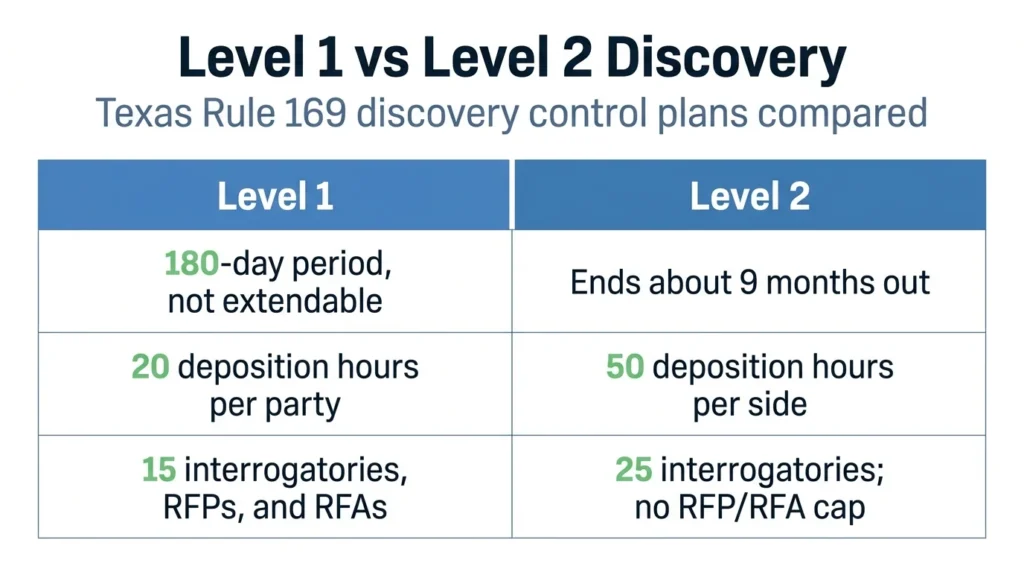
What Level 1 Allows
- A 180-day discovery period
- 20 hours of oral deposition time per party, total, for all witnesses
- 15 interrogatories, 15 requests for production, and 15 requests for admission
Discrete subparts count separately against each 15. The court may modify the deposition hours so no party gains an unfair advantage. The 2021 amendments raised the cap from six hours to 20 and removed the parties’ ability to agree past it on their own.
How Level 2 Compares
Level 2’s period ends on the earlier of 30 days before trial or nine months after the first initial disclosures are due. It allows 50 hours of deposition time per side, six more hours for each expert designated beyond two, and 25 interrogatories. It sets no numeric cap on requests for production or admission.
The units differ, and this is the easiest detail to get wrong. Level 1 measures deposition time per party. Level 2 measures it per side. The 20-hour figure is never a per-side number.
The Limits of the Early Close
Part of the Level 1 close is genuinely firm. The 180 days are fixed by rule and not measured from the trial date, meaning the discovery period never stretches just because a court docket is delayed. Additionally, the standard rule requiring a court to grant extra discovery after late pleadings or materially changed facts does not apply under Level 1.
However, other doors remain open. A court may modify a discovery control plan at any time and must do so when the interest of justice requires it. The parties may also agree to modify the plan, or a court may adjust it for good cause.
Finally, removing a case from the expedited track reopens discovery entirely. Anyone previously deposed can be redeposed, and the trial date can be continued. Ultimately, the Level 1 discovery window is best described as early, fixed, and not automatically extendable.
The Trade & the Evidence Spine That Makes It Survivable
The speed is real, and it is bought with evidence and with dollars.
Twenty hours per party is the entire deposition budget. A corporate representative, the defendant driver, two treating providers, and one expert consume most of it, and the parties can no longer stipulate past the cap.
Fifteen requests for production is a hard number in any claim that turns on documents:
- maintenance records
- driver qualification files
- electronic data
- internal policies.
Each discrete subpart counts.
Expert challenges move to the back of the case. Unless the sponsoring party asks otherwise, a party may challenge expert testimony only as an objection to summary judgment evidence or during trial on the merits.
There is no standalone pretrial reliability hearing. A claim resting on a contested engineering opinion gets that ruling mid-trial, inside an eight-hour clock. It cuts both ways, since the claimant also skips a pretrial gatekeeping fight. Premises liability claims built on a retained expert feel this most.
The exit window closes as well. A court must remove a suit on motion and a showing of good cause, or if a claimant pleads for relief beyond the monetary limit.
But that pleading cannot be filed without leave of court unless it comes before the earlier of 30 days after discovery closes or 30 days before trial, and leave requires good cause that outweighs the prejudice to an opposing party. If the damages assessment was wrong on the high side, the ceiling, not the jury, sets the recovery.
So the decision rests on two things before the petition is filed:
- A damages assessment solid enough to choose the track
- A discovery plan matched to what the claim will actually require
A soft tissue car accident claim with completed treatment and clean liability is a candidate. A case needing a corporate representative deposition, heavy document production, or a retained engineering expert usually is not.
Talk to an Injury Lawyer Before the Petition Is Filed
The pleading chooses the track, the exit window closes, and the ceiling binds. That makes this a decision to work through before filing, not after. Angel Reyes & Associates has guided injured Texans for over 30 years, recovering more than $1 billion for our clients through the work of over 700 dedicated professionals.
Our team is available 24/7 to help you navigate these critical early choices. With more than 30 offices across Texas, local expertise is always nearby, and we proudly serve clients in both English and Spanish.
Get a free consultation to have your damages assessed and your options laid out, completely risk-free with no fees unless we win.
Past results do not guarantee future outcomes.
Faster Trial FAQs
What happens if a Texas injury case is removed from the expedited actions process?
If a case is removed from the expedited track under Rule 169, the discovery period reopens, and the case generally proceeds under Level 2 or a court-ordered Level 3 discovery plan. A previously deposed witness may also be deposed again if the case is removed from the expedited process.
Does an expedited Texas lawsuit have to go to trial within 90 days?
Not necessarily; Rule 169 requires the court, on a party’s request, to set trial within 90 days after the discovery period ends, but the rule also permits limited continuances that can extend the timeline.
Can you amend a Texas injury lawsuit after choosing the expedited track?
Yes, but moving beyond the expedited monetary limit is subject to Rule 169’s timing and good-cause requirements, including restrictions based on how close the case is to the end of discovery or trial.
What types of personal injury cases may not be a good fit for Texas expedited actions?
Cases involving extensive corporate discovery, numerous depositions, complex expert testimony, or substantial document production may be difficult to develop within the limits of Level 1 discovery, even when the claimed damages fall below the applicable threshold.
About the Authors

Angel Reyes
Writer
Angel L. Reyes, III is the Founder and Managing Partner of Angel Reyes & Associates. A nationally recognized trial attorney and business leader, Angel has helped over 70,000 injury victims recover more than $1 billion since founding the firm in 1993. Named to the Texas Super Lawyers list annually since 2008, Angel brings Wall Street experience, Ivy League education, and a deep commitment to client advocacy. He is a frequent legal commentator and published author with extensive contributions to legal scholarship, trial strategy, and consumer protection.

Kyle Nicolas
Editor
Kyle Nicolas is the Web Content & SEO Manager at Angel Reyes & Associates. He has more than 10 years of experience as a marketing co...

Spencer Browne
Reviewer
Spencer Browne is a partner at Angel Reyes & Associates and a Board Certified personal injury trial lawyer with nearly 100 jury trials a...