Who Is at Fault in a Frontage Road Crash?


Every article on this site is researched by our internal team, reviewed for legal accuracy against current Texas law, and held to State Bar of Texas advertising standards before publication. We do not publish content that overstates outcomes or makes promises about results.
Learn more about our
editorial standards .
Key Takeaways
- Frontage road traffic must yield to vehicles entering or leaving the highway.
- Wrong-way entry on a signed one-way frontage road violates Texas law on its own.
- Texas bars recovery if you are more than 50 percent responsible for the crash.
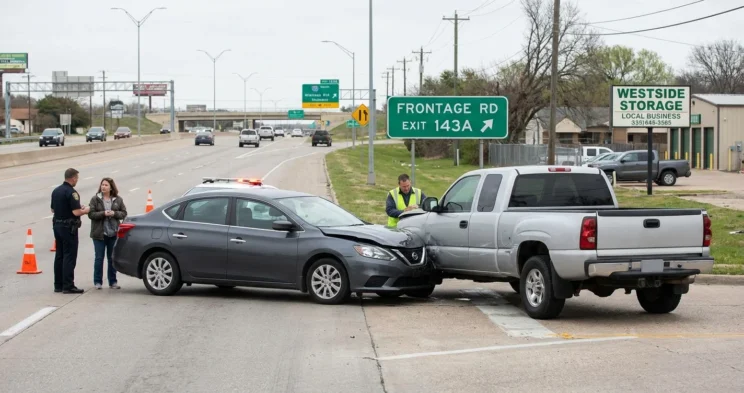
You were rolling down the feeder road, watching for your turn, and another vehicle came across the ramp gore before you could react. Now an adjuster is on the phone asking who had the right of way, and the honest answer is that you are not sure.
Fault in a frontage road accident is not a judgment call about who hit whom. In Texas it is decided by the right-of-way rules in Transportation Code Chapter 545, applied against the merge and exit geometry TxDOT built into that specific stretch of road.
That combination of statute and pavement design is what makes these crashes different from an ordinary fender bender on a city street.
How Fault Works on a Texas Frontage Road
On a Texas frontage road, the yield duty runs in one direction, and most drivers have it backward.
Frontage road traffic yields to vehicles entering or leaving the highway, not the other way around.
Texas Transportation Code § 545.154 puts it directly: an operator on an access or feeder road of a limited-access or controlled-access highway must yield the right-of-way to a vehicle entering or about to enter that road from the highway, or leaving or about to leave it to enter the highway.
Layered on top of that is Texas Transportation Code § 545.060, which requires every driver on a roadway with marked lanes to stay as nearly as practical within a single lane and to leave that lane only when the movement can be made safely. That duty applies to every merge on the corridor.
Signage does not change either rule. TxDOT’s Sign and Marking Manual guidance on frontage road and ramp intersection control explains that YIELD signs are recommended only where the geometry does not already give each movement a free, uncontested lane. Where a free lane exists, the design separates the traffic and neither driver has to yield.
So the absence of a yield sign is not permission. If the crash site had no free lane and no yield control, the statutory duty still governed, and proving that is part of building a Texas car accident case.
Wrong-Way Entry on a Converted One-Way Frontage Road
A driver who enters a one-way frontage road against the posted direction is violating a statute outright, separate from any other careless act, and that driver usually carries primary or sole fault.
Texas Transportation Code § 545.059 authorizes the Texas Transportation Commission to designate a roadway for one-way traffic and requires signs giving notice. Once that designation and signage are in place, an operator must drive only in the direction indicated.
Confusion about direction is common because Texas has been changing these roads for decades. TxDOT’s Roadway Design Manual chapter on frontage roads states that any new frontage road must be designed and constructed for one-way operation unless the Design Division approves an exception.
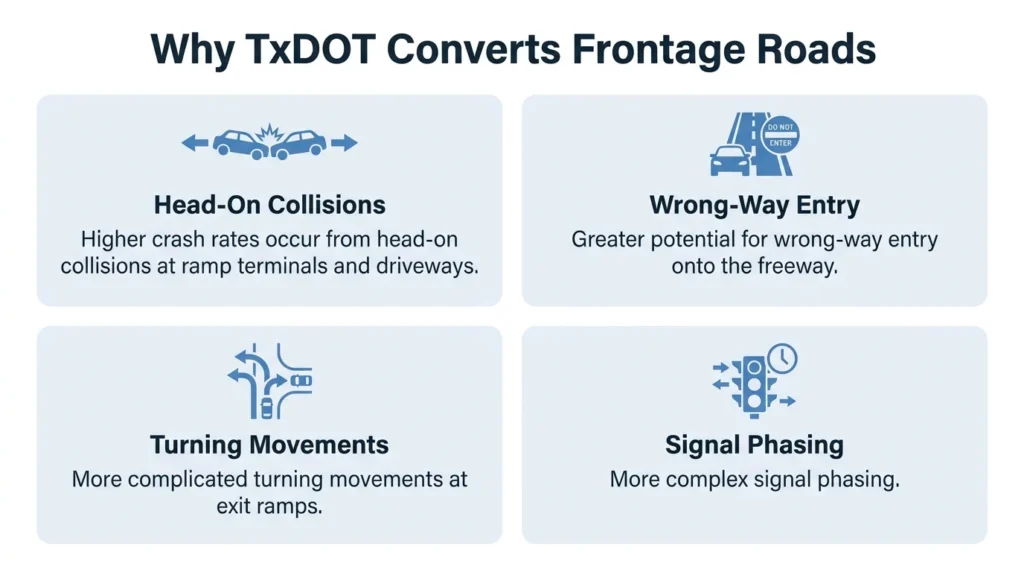
The manual is equally blunt about why. Two-way frontage roads carry higher crash rates from the risk of head-on collisions at ramp terminals and driveways, greater potential for wrong-way freeway entry, more complicated turning movements at exit ramps, and more complex signal phasing.
TxDOT’s stated reason for converting older roads is the same. A department public information officer told KSAT in March 2020 that two-way frontage roads were common in rural areas from the 1950s through the 1970s, and that 1990s growth brought a rise in head-on frontage road crashes.
The research behind that policy is state funded and peer reviewed. The Texas A&M Transportation Institute studied five Texas conversion sites and developed accident modification factors for converted segments and interchange intersections, giving TxDOT a measured safety basis for its one-way default.
Several real Texas locations carry frontage road and one-way conversion problems, and they show up among the most dangerous intersections in Texas.
Ramp Merge Crashes From Inadequate Acceleration Distance
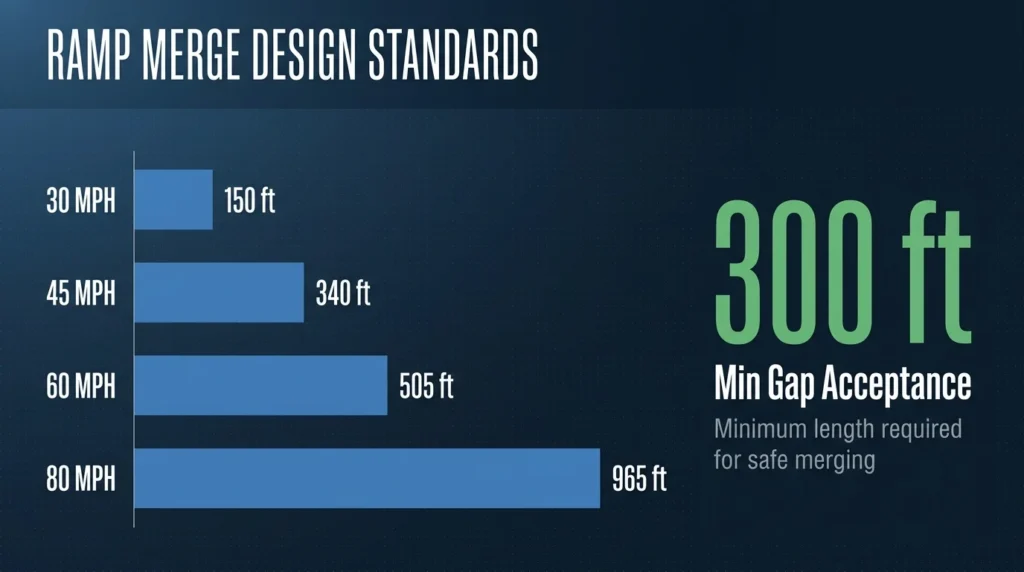
TxDOT sets minimum acceleration lane length, taper rate, and gap acceptance distance by design speed. When a ramp falls short of those standards, the geometry becomes a documented fact in the fault analysis alongside the merging driver’s own duty under § 545.060 to merge only when it is safe.
The published standards give investigators something concrete to measure against:
- Speed change lane lengths in the Roadway Design Manual chapter on speed change lanes scale with design speed. Deceleration lengths run 150 feet at 30 mph, 340 feet at 45 mph, 505 feet at 60 mph, and 965 feet at 80 mph, adjusted upward on upgrades steeper than 3 percent. Entrance and acceleration terminal lengths run roughly 550 to 720 feet for common highway and ramp speed pairings.
- Gap acceptance and taper standards appear in the chapter on ramp terminal design. The minimum gap acceptance length is 300 feet, the desirable taper rate is 50:1 to 70:1, and the minimum taper is 300 feet.
- Entrance curve geometry should provide at least a 1,000-foot radius with 200 feet of curve before the acceleration lane begins. TxDOT notes that a tighter radius causes drivers to drive directly onto the freeway without using the acceleration lane at all.
- High-volume ramps approaching 4,600 vehicles per hour call for roughly 1,200 feet of acceleration length plus taper. The design goal is for a merging driver to reach within 5 mph of the freeway’s operating speed by the point the acceleration lane joins the through lane.
Legacy ramps built to older, shorter standards still carry today’s traffic. That is why as-built ramp plans, signage plans, and TxDOT maintenance and traffic files matter as much as the police report in a service road crash in Texas, and why the same Chapter 545 framework governs unsafe lane changes and merges.
Turnaround Conflicts Under the Main Lanes
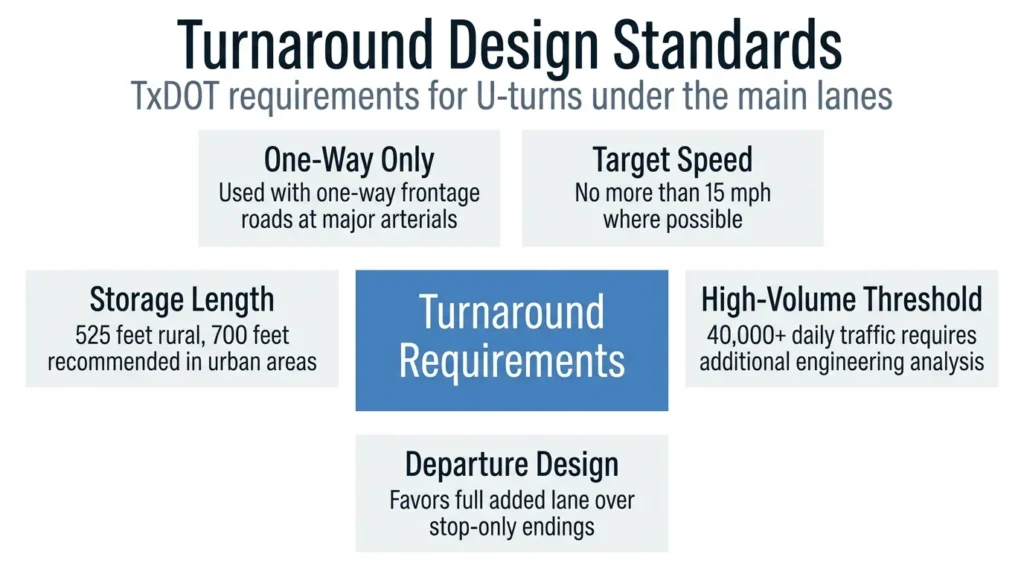
Turnarounds under the main lanes have their own design standards, and those standards frame whether the U-turning driver or a following or oncoming frontage lane driver bears the fault.
TxDOT’s chapter on frontage road turnarounds and intersection approaches sets out what a compliant turnaround looks like:
- Turnarounds are used only with one-way frontage roads, and they are prescribed at all interchanges with major arterials in urban and suburban areas.
- Target turnaround speed is no more than 15 mph where possible.
- Minimum storage and approach bay length is 525 feet in rural and suburban settings, with a recommended minimum of 700 feet in urban settings so the bay does not block adjacent queues.
- Locations with 40,000 or more average daily traffic, or level of service E or F, call for additional traffic engineering analysis.
- Where a turnaround sits under or near a bridge, TxDOT requires evaluation of sight lines for bridge rail and retaining wall obstructions.
- Departure design favors a full added lane, or at minimum a 100-foot acceleration lane with taper, over a stop, yield, or taper-only ending.
The statutes cover the driver’s side of the same movement. Under the turning rules in Subchapter C of Chapter 545, § 545.102 prohibits turning to move in the opposite direction where the vehicle is not visible to oncoming traffic within 500 feet on a curve or the crest of a grade, and § 545.103 requires a turn or lane change to be signaled and made only when it can be performed safely.
A serious investigation asks both questions. Did the turnaround meet the storage length, speed, and sight distance standards? And did the U-turning driver or the frontage lane driver breach the statute that applied to them?
How Fault Percentage Affects Your Recovery in Texas
Texas does not treat fault as all or nothing. Under Texas Civil Practice & Remedies Code § 33.001, a claimant whose percentage of responsibility is greater than 50 percent may not recover damages at all.
A claimant found 50 percent responsible or less can still recover, with the award reduced by their own assigned percentage. That is the practical stake in every argument about yield duties, merge distances, and sight lines.
Frontage road crashes frequently involve more than one driver who may share responsibility, and sometimes a roadway condition on top of that. The percentage a jury assigns to each of them is what turns the legal analysis above into an actual number on your claim.
Talk to an Experienced Lawyer Today
Frontage road fault turns on two things at once: the statute that applied to each driver, and the site-specific evidence showing how that piece of road was actually designed and signed. Design plans, conversion records, and intersection geometry are not documents most people can pull on their own while recovering from a crash.
Angel Reyes & Associates has guided injured Texans through the legal process for over 30 years, working with investigators and accident reconstruction specialists who know how to gather that record and apply it. The firm works on contingency, so there is no upfront cost to review your situation.
Contact Angel Reyes & Associates for a free consultation to understand your options.
Past results do not guarantee future outcomes.
Frontage Road Crash Fault FAQs
Who is at fault if you're hit while merging from a frontage road ramp onto the highway?
In many of these crashes, the frontage road driver you crossed owed you the yield duty. Under Transportation Code section 545.154, an operator on the frontage road must yield to a vehicle entering or leaving the highway at that ramp connection, not the other way around. That said, you still had to merge under section 545.060, moving into the travel lane only when it was safe to do so.
Can TxDOT or another governmental entity share liability for a frontage road design or signage defect?
Frontage road crashes are not always just about the two drivers. When a ramp, turnaround, or one-way conversion does not meet the engineering standards TxDOT sets for that type of roadway, the non-conforming design becomes part of the evidence a fault investigation should pull, alongside each driver’s own conduct under the statutes above. Claims involving a government entity’s design or signage decisions follow their own separate legal process, so whether one applies depends on the specific facts of the crash site.
What if the frontage road involved in the crash hadn't been converted to one-way operation yet?
If the frontage road had not yet been converted to one-way operation, the specific wrong-way violation under section 545.059 would not apply, since that statute only governs roads that are designated and signed for one-way traffic. Fault would instead turn on the general right-of-way and lane-discipline duties in sections 545.154 and 545.060.
What evidence should you gather right away after a ramp merge or turnaround crash?
Beyond the police report, the records that matter most are the site-specific ones: TxDOT’s as-built design plan for that ramp or turnaround, the signage plan for the location, and any conversion records if the frontage road was changed from two-way to one-way operation. Photos of the ramp gore, merge lane, or turnaround, taken as soon as it is safe, also help preserve the geometry as it actually existed at the time of the crash, before repairs or restriping can change it.
About the Authors

Spencer Browne
Writer
Spencer Browne is a partner at Angel Reyes & Associates and a Board Certified personal injury trial lawyer with nearly 100 jury trials across Texas. He focuses on car, truck, and wrongful death cases, with notable verdicts including a landmark win in the Choctaw Casino bus crash case. A recognized speaker and legal educator, Spencer is a member of the American Board of Trial Advocates and has been honored as a Texas Super Lawyer and one of D Magazine’s Best Lawyers in Dallas. He brings deep trial experience and relentless advocacy to every client he represents.

Kyle Nicolas
Editor
Kyle Nicolas is the Web Content & SEO Manager at Angel Reyes & Associates. He has more than 10 years of experience as a marketing co...

Angel Reyes
Reviewer
Angel L. Reyes, III is the Founder and Managing Partner of Angel Reyes & Associates. A nationally recognized trial attorney and business...