How Do Crumple Zones Protect You in a Crash?


Every article on this site is researched by our internal team, reviewed for legal accuracy against current Texas law, and held to State Bar of Texas advertising standards before publication. We do not publish content that overstates outcomes or makes promises about results.
Learn more about our
editorial standards .
Key Takeaways
- Crumple zones cut peak crash force by stretching how long deceleration takes.
- FMVSS 208 tests compliance up to 30 mph; NHTSA's NCAP rating test uses 35 mph.
- Texas law can add the vehicle maker as a defendant beside the at-fault driver.
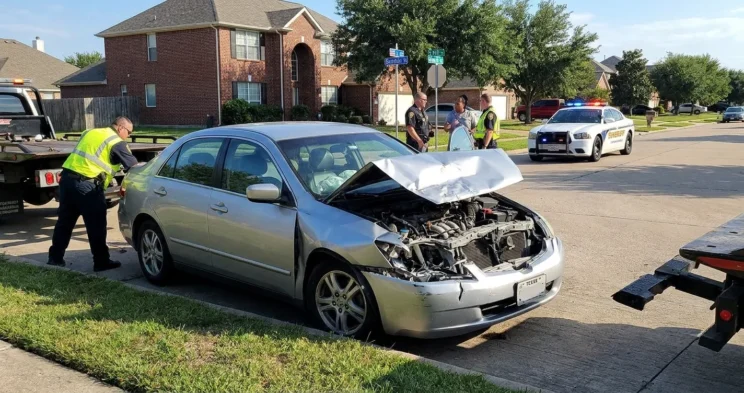
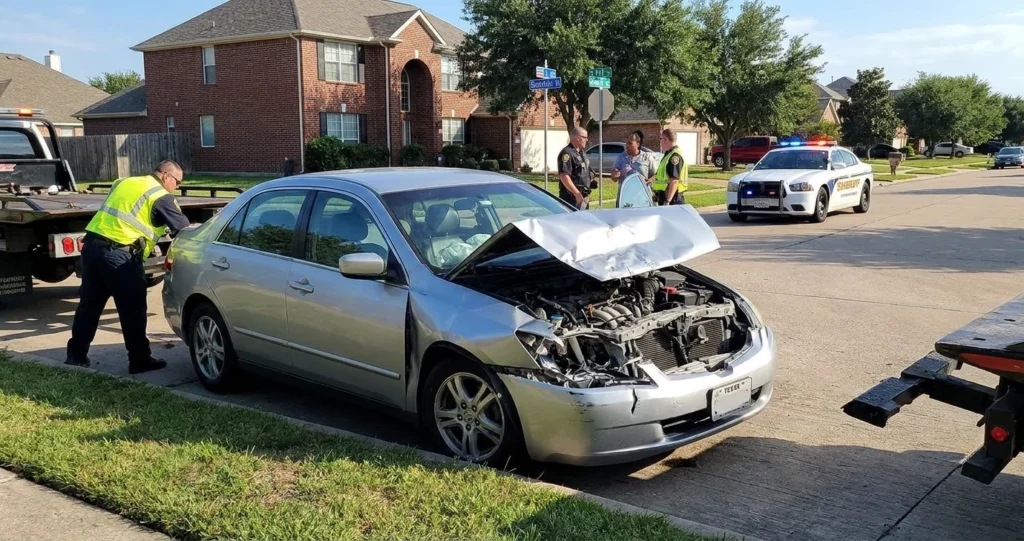
The front of your car collapsed into itself on I-35, and the tow truck driver told you it was totaled. That destruction is often the reason you walked away.
A crumple zone protects you by deforming in a controlled, engineered sequence, absorbing crash energy over a longer stretch of time so less force reaches your body. The ruined sheet metal did what it was built to do.
That same engineering explains something most injured drivers never consider. When a vehicle performs worse than its design should have allowed, the manufacturer can end up as a defendant alongside the driver who hit you.
What a Crumple Zone Is & How It Works
A crumple zone is a structural section of a vehicle, usually the front and rear, engineered to collapse in a predictable pattern during a collision. Rather than passing crash energy straight into the passenger compartment, that structure absorbs it through controlled plastic deformation, heat, and sound.
The reason this saves lives comes down to time. Average force depends on how quickly your speed changes, so stretching a crash into a longer, managed pulse lowers the peak force your body has to absorb.
Engineers build the vehicle around three functional zones. The passenger area is a rigid safety cell that resists intrusion and holds survival space around you. The front and rear sections are deliberately weaker, sacrificial structures meant to give way first.
None of this works alone. Crumple zones operate together with seat belts and airbags as a layered occupant-protection system, and no single element explains any one outcome.
The Federal Standard Behind Crumple Zone Design
Controlled deformation is not just an engineering preference. Federal law sets occupant-protection targets that only a deforming structure can realistically meet.
FMVSS 208, Occupant Crash Protection (49 CFR 571.208), requires manufacturers to design vehicle structure and restraint systems together so that forces and accelerations measured on instrumented crash-test dummies stay within specified injury limits at the head, neck, chest, and other body regions.
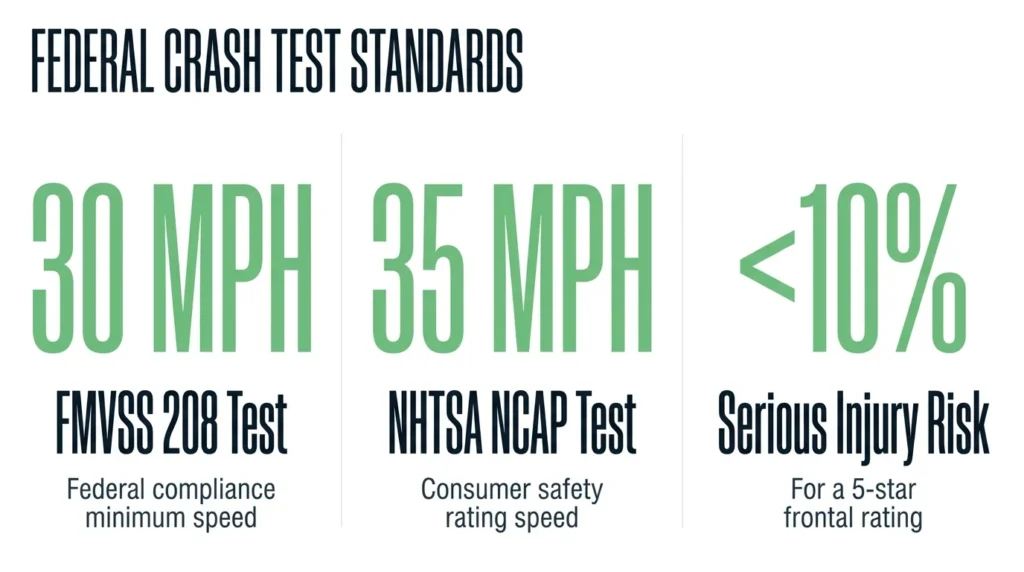
The FMVSS 208 compliance test is a perpendicular fixed-barrier impact at speeds up to 30 mph. That is the federal floor.
NHTSA’s 5-Star Safety Ratings are a separate, more demanding consumer-information program that crashes vehicles into a frontal barrier at 35 mph using dummies representing an average-size adult male and a smaller adult female. The two programs are different tests at different speeds, and the numbers should never be treated as interchangeable.
A five-star frontal rating reflects a statistical chance of serious injury under 10%. NHTSA cautions that frontal ratings should only be compared between vehicles within roughly 250 pounds of each other, because weight alone shifts occupant outcomes in a two-vehicle crash.
Unibody vs. Body-on-Frame Construction
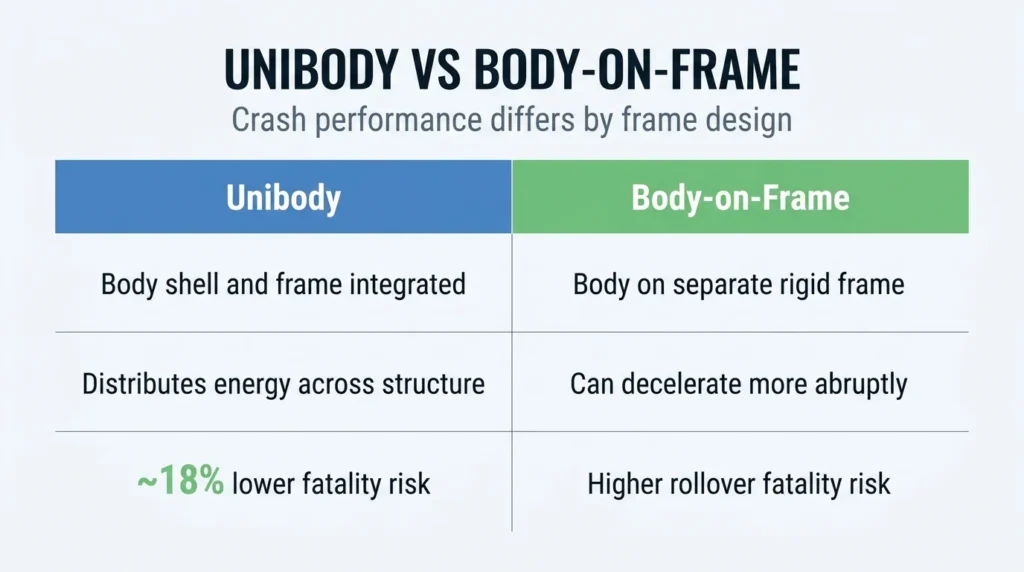
In unibody frame design, the body shell and the frame are one integrated structure. Engineers stiffen the passenger shell into a safety cell and design the front and rear sections of that same shell to fold along an engineered path, distributing crash energy across the whole structure.
Body-on-frame construction places the body on a separate rigid ladder frame that carries the primary structural loads. That rigidity helps with towing and payload, which is why it remains common on pickups and larger SUVs.
The trade-off appears in a severe crash. Without deformation elements deliberately engineered into the frame itself, a stiff ladder frame can decelerate more abruptly and transmit more force to the occupants.
Peer-reviewed research supports that point in a narrow setting. A 2014 case-control study in Accident Analysis & Prevention, Crash fatality risk and unibody versus body-on-frame structure in SUVs, found lower fatality risk for occupants of unibody compact SUVs than for occupants of comparably sized body-on-frame compact SUVs.
Occupants of vehicles crashing into a unibody SUV faced roughly 18% lower risk of death than those crashing into a body-on-frame SUV of the same class, and body-on-frame SUV design carried materially higher rollover fatality risk.
That study covers compact SUV models from 1996 through 2006 in two-vehicle crashes. It is meaningful evidence about engineered, controlled deformation, not a blanket rule that every unibody vehicle outperforms every body-on-frame vehicle.
When a Vehicle Performs Worse Than Its Design Should Have Allowed
When a vehicle fails to protect an occupant the way its design should have, the manufacturer can become a defendant alongside the driver who caused the wreck, not in place of that driver. Texas recognizes this as the crashworthiness doctrine.
A collision is not the intended use of a car, but manufacturers must reasonably anticipate that their vehicles will be in crashes. In Turner v. General Motors Corp., 584 S.W.2d 844 (Tex. 1979), the Texas Supreme Court applied strict products-liability principles to a design defect that did not cause the accident but failed to protect the occupant during it.
Responsibility can also be divided. In General Motors Corp. v. Sanchez, 997 S.W.2d 584 (Tex. 1999), the Texas Supreme Court held that comparative-responsibility principles apply in a strict-liability products case where there is evidence of driver or occupant negligence independent of merely failing to discover or guard against the defect.
That case involved a transmission and parking-mechanism defect rather than a crash-structure claim, but the principle it sets is general. A jury can apportion responsibility between a driver’s conduct and a manufacturer’s defective product in the same case.
Texas Civil Practice & Remedies Code Chapter 82 supplies the statutory framework, defining who counts as a manufacturer or a seller and what qualifies as a products liability action.
Practically, a crashworthiness claim turns on two questions. Was the vehicle’s design defective, and did that defect cause injuries beyond what a properly performing design would have produced in the same collision? That claim runs alongside the ordinary car accident claim against the at-fault driver rather than replacing it.
Building the Evidence for a Crashworthiness Case
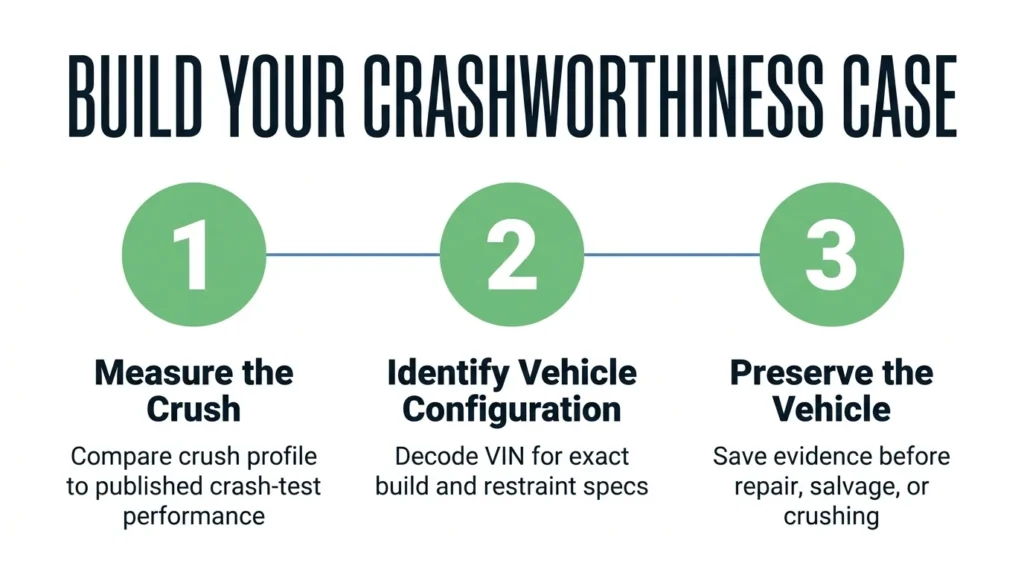
Three pieces of proof carry a crashworthiness claim, and each one depends on moving early:
- Measure the crush and compare it to published performance. Reconstruction methods such as those in SAE Technical Paper 980025 derive absorbed energy and speed change from a vehicle’s residual deformation profile. Those measurements can be compared against the vehicle’s own published crash-test results to assess whether it performed as its design should have allowed.
- Identify the exact vehicle configuration. The VIN, decoded through NHTSA’s public vPIC database, documents make, model, body style, restraint-system configuration, assembly plant, and production year. Manufacturer build records add the as-built detail for that specific vehicle.
- Preserve the vehicle itself. Texas law can impose a duty to preserve physical evidence once a party knows or reasonably should know that a claim is coming and that the evidence matters to it.
That last step carries real consequences. Under Brookshire Bros., Ltd. v. Aldridge, 438 S.W.3d 9 (Tex. 2014), a Texas court may give a spoliation instruction only where it finds intentional concealment of discoverable evidence or negligent destruction that irreparably deprived the other side of a meaningful ability to present its case.
Once a wrecked vehicle is repaired, sold for salvage, or crushed, the crush profile goes with it, and the claim can end before anyone measures it.
Talk to Angel Reyes & Associates About Your Crash
If you were hurt in a Texas crash and your injuries seem worse than the collision should have produced, that gap is worth investigating while the vehicle still exists.
Angel Reyes & Associates has guided injured Texans through crash claims for over 30 years, serving clients across the entire state. Initial consultations are free, so there is no cost to find out where you stand.
Contact Angel Reyes & Associates to have someone review what happened, look at the vehicle, and walk you through your options.
Past results do not guarantee future outcomes.
Crumple Zone FAQs
What speed are crumple zones actually tested at?
Crumple zone performance is tested under two different federal programs, not one. FMVSS 208’s compliance test is a barrier impact at speeds up to 30 mph, the federal minimum. NHTSA’s separate NCAP 5-Star rating program crashes vehicles into a frontal barrier at 35 mph. The two are different tests and should not be treated as the same number.
What's the difference between a crumple zone and the passenger safety cell?
A crumple zone and the passenger safety cell serve opposite structural roles. The crumple zone is the sacrificial structure engineered to collapse and absorb crash energy. The safety cell is the rigid passenger compartment engineered to resist intrusion and preserve survival space. Both work together in the same collision, not as alternatives to each other.
Does more visible crumple damage mean a crash was more dangerous?
Not necessarily. Extensive crumple damage often means the structure absorbs energy as designed, keeping force out of the passenger compartment. Crush damage should be read alongside occupant-loading and injury information, not alone. A lightly damaged vehicle is not automatically the safer outcome.
Can a manufacturer be held responsible for a crash it didn't cause?
Yes, under Texas’s crashworthiness doctrine. Manufacturers must anticipate that their vehicles will be in crashes, and a design defect that worsens injuries can support strict liability even without causing the crash. This claim adds the manufacturer as a defendant alongside the at-fault driver, not in place of it. Texas law also lets a jury divide responsibility between the two when there is evidence of independent negligence.
What happens to a crashworthiness claim if the vehicle is repaired or scrapped before it can be inspected?
Losing access to the vehicle can seriously damage the case. Texas law can require preserving a wrecked vehicle once a claim is reasonably anticipated, since the crush profile is often the core evidence in the claim. A court may allow a spoliation instruction only for intentional destruction or negligent destruction that irreparably harmed the case. Once the vehicle is repaired, salvaged, or crushed, that measurement usually cannot be recovered.
About the Authors

Spencer Browne
Writer
Spencer Browne is a partner at Angel Reyes & Associates and a Board Certified personal injury trial lawyer with nearly 100 jury trials across Texas. He focuses on car, truck, and wrongful death cases, with notable verdicts including a landmark win in the Choctaw Casino bus crash case. A recognized speaker and legal educator, Spencer is a member of the American Board of Trial Advocates and has been honored as a Texas Super Lawyer and one of D Magazine’s Best Lawyers in Dallas. He brings deep trial experience and relentless advocacy to every client he represents.

Kyle Nicolas
Editor
Kyle Nicolas is the Web Content & SEO Manager at Angel Reyes & Associates. He has more than 10 years of experience as a marketing co...

Angel Reyes
Reviewer
Angel L. Reyes, III is the Founder and Managing Partner of Angel Reyes & Associates. A nationally recognized trial attorney and business...