What Is New Car Replacement Coverage?


Every article on this site is researched by our internal team, reviewed for legal accuracy against current Texas law, and held to State Bar of Texas advertising standards before publication. We do not publish content that overstates outcomes or makes promises about results.
Learn more about our
editorial standards .
Key Takeaways
- Check your declarations page and full endorsement to confirm new car replacement coverage.
- Actual cash value pays your car's used value; the endorsement pays toward a new one.
- Coordinate both insurers' claims because your new-car benefit comes from your policy.
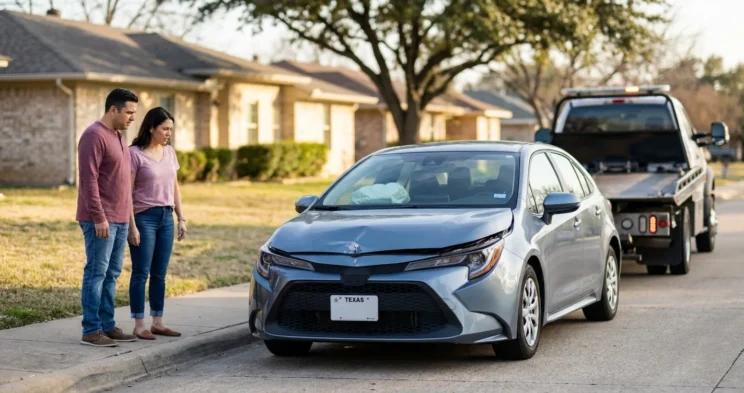
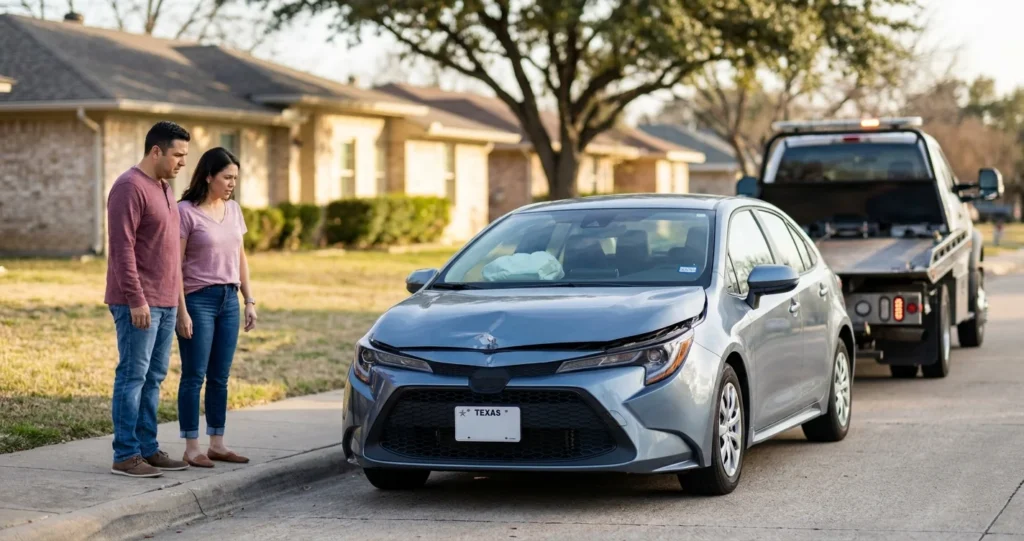
New car replacement coverage is an optional endorsement on your own auto policy that can pay based on a new vehicle of the same make and model after an eligible covered total loss, minus any applicable deductible. If your nearly new car is totaled, this benefit can address the difference between its depreciated value and the cost of a new replacement. The endorsement your insurer issued sets the exact terms.
What Does New Car Replacement Coverage Pay After a Total Loss?
New car replacement coverage bases an eligible payment on new-car cost. Travelers describes its new car replacement product as covering a new vehicle of the same make and model after a covered total loss, less applicable deductibles. Other insurers offer similar benefits under their own terms.
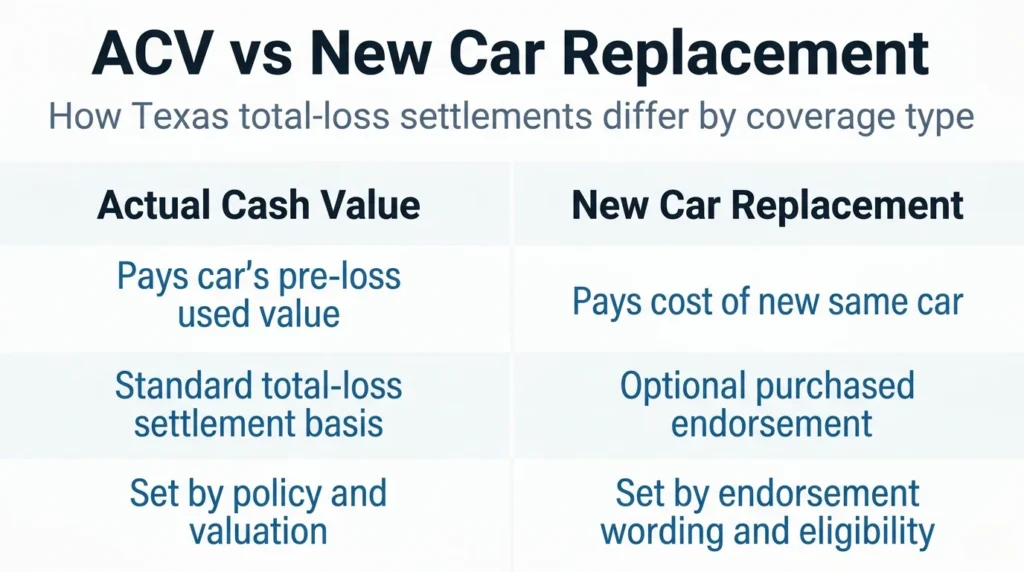
A standard policy settles differently. The Texas Department of Insurance explains that an ordinary settlement pays actual cash value, which is replacement cost minus depreciation. In plain terms, actual cash value is what your car was worth as a used vehicle right before the loss.
That distinction answers the replacement cost vs. actual cash value question for car owners:
| Settlement feature | Actual cash value | New car replacement |
|---|---|---|
| Payment basis | Your car’s pre-loss used value after depreciation | The cost of a new car of the same make and model |
| Coverage basis | Standard total-loss settlement | An optional endorsement you purchase |
| Controlling terms | Your policy and the vehicle valuation | The endorsement’s wording and eligibility terms |
The benefit is a payment based on new-car cost, not necessarily delivery of a new vehicle. Your issued endorsement determines what you receive.
How Can You Tell Whether Your Policy Includes It?
Start with the declarations page for the policy period covering your loss, then read the full endorsement. The Office of Public Insurance Counsel explains that this page summarizes vehicles, coverage, limits, deductibles, and endorsements. You need the complete policy and endorsement to confirm the terms.
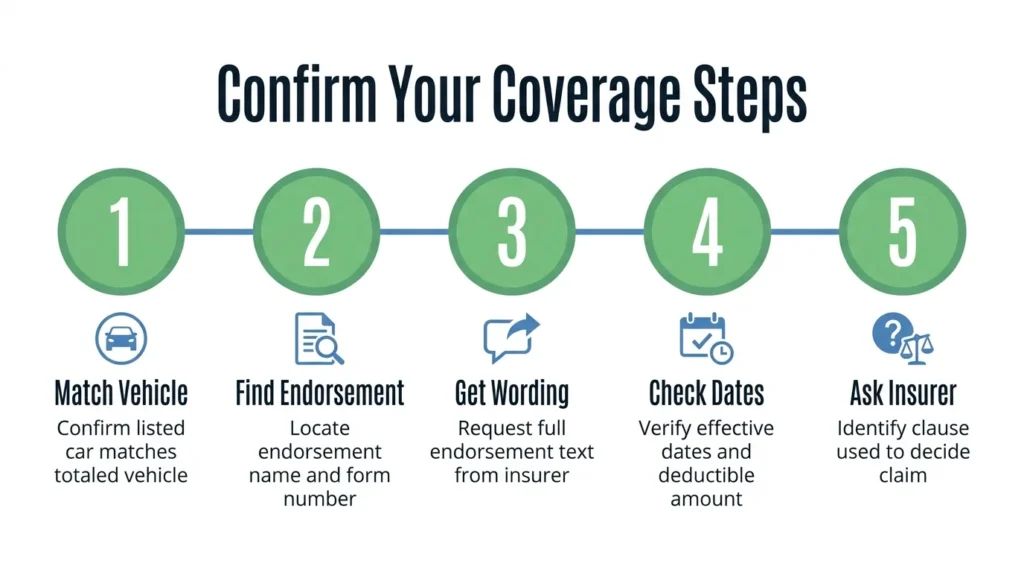
Comprehensive or collision coverage alone does not establish that you have new car replacement. Follow these steps:
- Confirm that the listed vehicle matches the car that was totaled.
- Find the endorsement or package name and its form number.
- Get the full endorsement wording from your agent or insurer.
- Check the effective dates and applicable deductible.
- Ask the insurer to identify the clause it used to decide your claim.
Eligibility rules vary. Travelers advertises replacement within the first five years of ownership and requires original ownership, a current or future model year when you add coverage, and both comprehensive and collision.
The Liberty Mutual customer disclaimer describes different terms: a car less than one year old, fewer than 15,000 miles, and no previous owner. Its terms exclude leased vehicles, as do Travelers’ new-car replacement terms. These are product examples, not Texas-wide rules or guarantees of availability.
Pay attention to how your form measures age and mileage. Purchase date, model year, and policy start date are not interchangeable.
Only covered losses qualify. The endorsement does not erase other exclusions or supply missing collision or comprehensive protection. Ask how the form handles a discontinued model, upgrades, accessories, replacement requirements, and any settlement cap.
Keep your purchase contract or invoice, purchase date, ownership records, and mileage evidence from around the loss. Compare these records with the endorsement’s definitions and the coverage effective on the loss date. Do not expect coverage added afterward to apply to a crash that already happened.
How Is New Car Replacement Different From Gap Coverage?
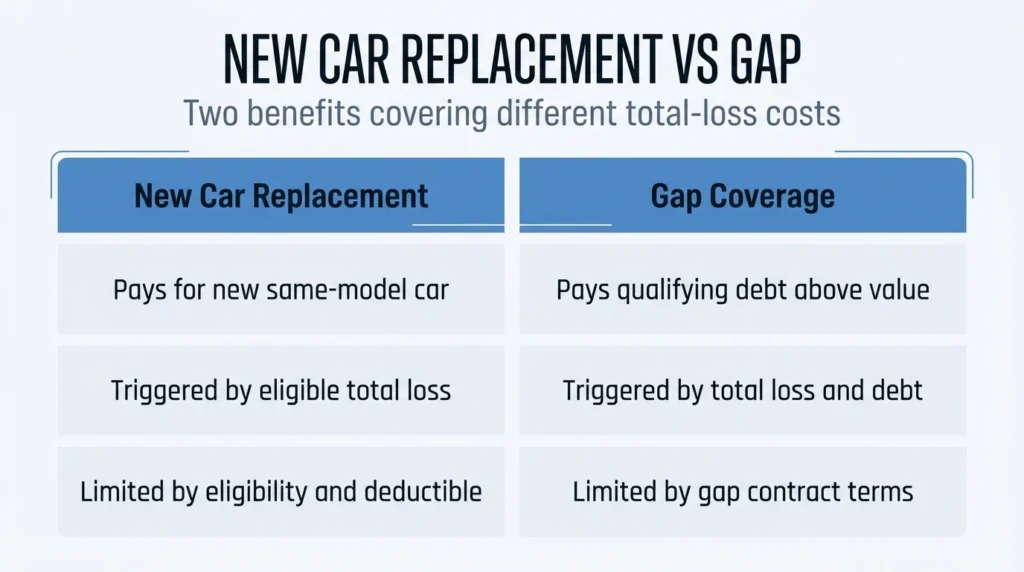
New car replacement addresses the cost of an eligible new vehicle. Gap may cover qualifying loan or lease debt above the totaled car’s value. Three separate amounts matter: the used car’s value, the new replacement’s cost, and the remaining loan balance:
| Coverage feature | New car replacement | Gap coverage |
|---|---|---|
| Payment purpose | A new car of the same make and model | Qualifying debt above the vehicle’s value |
| Trigger | An eligible covered total loss | A qualifying total loss and remaining loan or lease debt |
| Main restrictions | Endorsement eligibility, exclusions, and deductible | The gap contract’s limits and exclusions |
The Texas Department of Insurance explains that exclusions may reduce payment for overdue amounts, certain finance or warranty charges, deductibles, and previous damage. Gap products sold by a dealer or bank are not always insurance.
The benefits can coexist. Travelers bundles gap insurance with its replacement package, but that does not make leased cars eligible for its new-car benefit. Neither product automatically replaces the other, and the contracts determine how payments work together.
What If Another Driver Caused the Crash?
A total-loss claim against the at-fault driver’s insurer generally concerns your vehicle’s value, subject to liability, coverage, and policy limits. Your new-car replacement benefit comes from your own purchased endorsement. It does not increase what the other driver’s insurer must pay.
The Texas Department of Insurance explains that fault disputes, inadequate limits, or an uncooperative driver can delay or prevent payment. Ask for the insurer’s valuation and reasons for its offer so you can assess the amount.
Your own policy may provide another route. The Office of Public Insurance Counsel’s third-party claims information explains that a driver with collision coverage can claim under that policy and let their insurer seek recovery from the other company. A deductible may apply and might be recovered later, but reimbursement is not certain.
After a crash someone else caused:
- Report the crash to your own insurer, even if you plan to claim against the other driver.
- Ask whether your collision coverage and new car replacement endorsement apply.
- Tell both adjusters about the other claim so they can coordinate payments.
Do not expect two full vehicle payments for the same loss. Each insurer’s payment depends on its applicable obligations and coordination of the claims.
Which Documents Help You Review a Total-Loss Offer?
Your records help answer two separate questions: whether the insurer valued your car correctly and whether your endorsement applies. The Texas Department of Insurance totaled-car guidance explains that insurers may total a car when repairs approach or exceed its value, and sometimes at a lower repair cost. Ask which valuation source the insurer used.
Review the offer in this order:
- Request the written total-loss valuation and settlement calculation. Check the vehicle description, mileage, features, and options.
- Compare your declarations page and full endorsement with the purchase date, ownership records, mileage evidence, and loss details.
- Gather comparable local used-car listings and documentation of special features if the actual cash value seems low.
- Identify valuation errors separately from disagreements about endorsement eligibility.
Local market evidence can support a challenge to the actual cash value. The endorsement’s wording and your eligibility records address whether the new-car benefit applies.
Get Help Reviewing Your Coverage & Claim
A totaled car can leave you facing financial stress and unfamiliar paperwork. Before seeking help with a crash-related claim, gather your declarations page, full endorsement, purchase records, mileage evidence, and total-loss valuation.
Angel Reyes & Associates has guided injured Texans through crash claims for over 30 years. Contact Angel Reyes & Associates for a free consultation to review your options. Every case is different.
Past results do not guarantee future outcomes.
New Car Replacement Coverage FAQs
Does a used or leased vehicle qualify for new car replacement coverage?
Eligibility depends on your endorsement. The Travelers and Liberty Mutual products discussed above require original ownership and exclude leased vehicles, so check your own form before assuming you qualify.
Does new car replacement coverage apply if your car is stolen?
It may apply if your vehicle is stolen and not recovered, or if it is recovered with damage that qualifies as a covered total loss. The claim must meet the endorsement’s requirements, and comprehensive coverage is generally relevant to vehicle theft. Check your policy for the specific conditions and exclusions.
Is new car replacement coverage worth the extra cost?
It may be worthwhile if you own a recently purchased vehicle that could lose value quickly and want additional protection against depreciation after a total loss. Compare the endorsement’s premium, eligibility restrictions, deductible, and settlement terms with the potential financial difference between your car’s used value and a new replacement.
About the Authors

Spencer Browne
Writer
Spencer Browne is a partner at Angel Reyes & Associates and a Board Certified personal injury trial lawyer with nearly 100 jury trials across Texas. He focuses on car, truck, and wrongful death cases, with notable verdicts including a landmark win in the Choctaw Casino bus crash case. A recognized speaker and legal educator, Spencer is a member of the American Board of Trial Advocates and has been honored as a Texas Super Lawyer and one of D Magazine’s Best Lawyers in Dallas. He brings deep trial experience and relentless advocacy to every client he represents.

Kyle Nicolas
Editor
Kyle Nicolas is the Web Content & SEO Manager at Angel Reyes & Associates. He has more than 10 years of experience as a marketing co...

Angel Reyes
Reviewer
Angel L. Reyes, III is the Founder and Managing Partner of Angel Reyes & Associates. A nationally recognized trial attorney and business...