April Is National Alcohol Awareness Month


Every article on this site is researched by our internal team, reviewed for legal accuracy against current Texas law, and held to State Bar of Texas advertising standards before publication. We do not publish content that overstates outcomes or makes promises about results.
Learn more about our
editorial standards .
Key Takeaways
- Every April, the National Institute for Alcohol Abuse and Alcoholism, SAMHSA, MADD, and the Texas Department of Transportation combine their public awareness efforts by hosting National Alcohol Awareness Month.
- NHTSA data indicates intoxicated driving killed more than 12,000 people in 2023, and early projections for 2024 estimate over 11,000. Texas accounted for 1,699 of those 2023 deaths, more than any other state.
- Measurable impairment begins at 0.02 BAC, well below the 0.08 legal threshold, and crash risk at 0.15 BAC is at least 12 times higher than for a sober driver.
On February 6, 2025, an intoxicated driver going the wrong way down I-45 in Houston struck a jeep, killing its 58-year-old driver. This kind of crash is unfortunately far too common in Texas, and they are almost always the result of a driver who should never have been behind the wheel.
Texas loses more people to drunk driving than any other state in the country, and that unfortunate reputation is what makes National Alcohol Awareness Month such an important part of April every year. If you drive in this state, the sobering reality of intoxicated driving touches your life, whether you realize it yet or not.
What Is National Alcohol Awareness Month?
National Alcohol Awareness Month was established in April 1987 by the National Council on Alcoholism and Drug Dependence with a mission to reduce stigma around alcohol use disorder and promote education, prevention, and treatment.
Every April, the National Institute on Alcohol Abuse and Alcoholism (NIAAA), SAMHSA, MADD, and the Texas Department of Transportation all amplify awareness campaigns, prevention resources, and enforcement messaging. The month opens with Alcohol-Free Weekend on the first weekend of April, a 72-hour challenge to abstain from alcohol. Anyone who finds that more difficult than expected is encouraged to speak with a healthcare provider about treatment options.
MADD, which is headquartered in Irving, runs victim support services, court-monitoring programs, and prevention campaigns throughout Texas. TxDOT’s “Drive Sober. No Regrets.” campaign works alongside national NHTSA enforcement mobilizations to increase patrols and sobriety checkpoints on high-volume corridors across the state.
Why Drunk Driving Is So Dangerous
Alcohol is a central nervous system depressant that dismantles the exact abilities that safe driving requires: judgment, reaction time, coordination, vision, and the capacity to manage more than one thing at once.
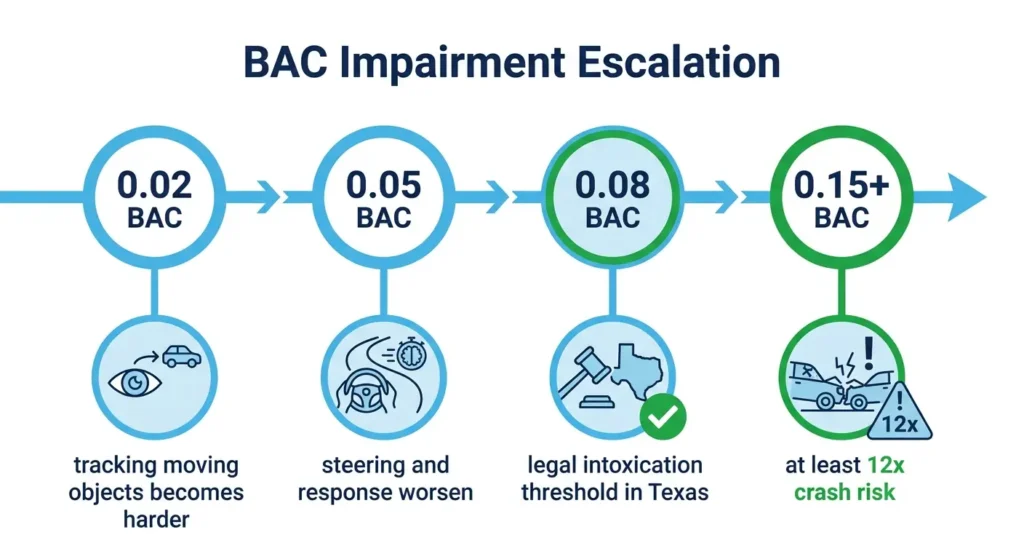
According to NHTSA, measurable impairment begins at just 0.02 BAC, where a driver loses the ability to track moving objects and divide attention. At 0.05 BAC, steering control and emergency response degrade noticeably. At 0.08 BAC, the legal limit under Texas Penal Code § 49.04, crash risk is roughly four times higher than for a sober driver. At 0.15 BAC — nearly twice the legal limit — crash risk jumps to at least 12 times that of a sober driver.
One of the most dangerous misconceptions about impaired driving is the belief that you would know if you were too impaired to drive. Research shows the opposite is true. The inability to recognize your own impairment is often itself a symptom of impairment. This is why Texas law defines intoxication as either reaching 0.08 BAC or losing the normal use of your mental or physical faculties, whichever comes first.
Texas Drunk Driving Statistics
Texas ranks first in the nation for alcohol-impaired driving deaths. According to the NHTSA’s data for 2023, 12,429 people were killed in alcohol-impaired driving crashes, accounting for 30% of all U.S. traffic fatalities that year. Texas was responsible for 1,699 of them, exceeding California by more than 340 and Florida by more than 850.
Early NHTSA projections for 2024 estimate that number declined further to approximately 11,904, which would be a third consecutive yearly improvement, but final 2024 figures have not yet been published.
The 2024 TxDOT crash data tell an equally grim story. Texas logged 22,737 alcohol-DUI crashes in 2024, killing 1,053 people and seriously injuring more than 2,200 others. That is roughly three deaths per day, every day, all year. Incredibly, 27% of those deaths involved a driver with a BAC of 0.15 or higher, the highest such share of any state in the country.
Texas DWI Laws & Penalties
Texas Penal Code Chapter 49 governs drunk driving offenses in Texas, and the penalties escalate quickly based on BAC level, prior convictions, and the circumstances of the crash.
A first DWI offense under § 49.04 is a Class B misdemeanor carrying a mandatory minimum 72 hours in jail, up to 180 days total, a fine of up to $2,000, plus a $3,000 state fine at sentencing under Transportation Code § 709.001, and a license suspension of 90 days to one year. If the driver’s BAC was 0.15 or higher, the charge escalates to a Class A misdemeanor, with higher fines and a mandatory ignition interlock requirement. A third or subsequent DWI is a third-degree felony carrying 2 to 10 years in prison. Texas has no lookback period, meaning prior convictions count forever.
Three aggravated offenses carry the most serious consequences. DWI with a child passenger under 15 (§ 49.045) is a state jail felony. Intoxication Assault (§ 49.07) carries 2 to 10 years. Intoxication Manslaughter (§ 49.08) is a second-degree felony carrying 2 to 20 years in prison, with no possibility of deferred adjudication.
Texas also runs “No Refusal” weekends around major holidays, during which judges are on call 24/7 to issue blood draw warrants for drivers who refuse breath tests. Under the state’s Implied Consent law, refusing a chemical test triggers an automatic 180-day license suspension, and the refusal itself can be used against you at trial.
What You Can Do This April (& Every Other Month)
Most drunk driving crashes are preventable. The most effective step anyone can take is the simplest: decide on a sober ride home before pouring your first drink.
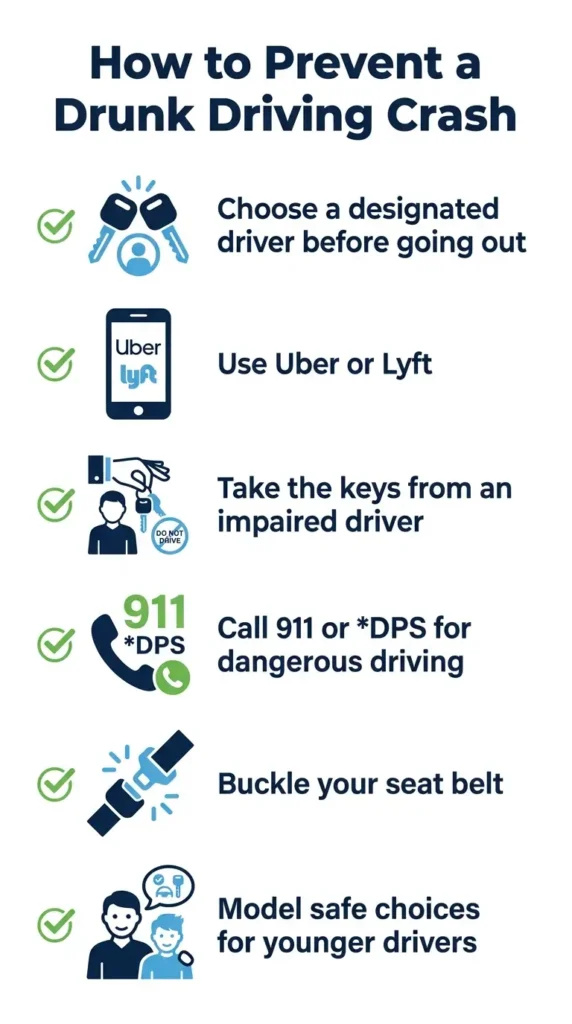
Here is what that looks like in practice:
- Designate a driver before you go out. Make the plan when everyone is sober, not at the end of the night.
- Use rideshare. Uber and Lyft are available in every major Texas market and most mid-size cities. Research from Harris County has linked rideshare availability to measurable reductions in both drunk driving convictions and trauma hospitalizations.
- Take the keys. If someone you know is about to drive drunk, intervene. Arrange a sober ride for them. Hosts bear responsibility for ensuring every guest has a safe way home.
- Call 911 for impaired drivers. If you observe a vehicle driving erratically, keep a safe distance and call 911. Texas DPS also accepts reports at *DPS (*377) with vehicle description, location, and direction of travel.
- Wear your seat belt. NHTSA identifies seat belts as your best protection against an impaired driver. This is especially true late at night, when drunk driving risk peaks.
- Model the behavior for younger drivers. Teen and young adult drivers are statistically among the most vulnerable groups. What adults do behind the wheel matters.
If a Drunk Driver Hurt You, We Can Help
National Alcohol Awareness Month is about prevention. But if you have already been hurt by someone who chose to drive drunk, the path forward starts with understanding your rights.
Texas victims of drunk driving have strong civil remedies, including the right to recover economic damages, non-economic damages, and exemplary (punitive) damages when gross negligence is proven by clear and convincing evidence. Drunk driving routinely meets that standard.
Those exemplary damages are subject to the statutory cap under Texas Civil Practice & Remedies Code § 41.008(b), but they represent a meaningful additional layer of accountability beyond the driver’s liability coverage. You may also have a claim against the bar or establishment that over-served the driver under the Texas Dram Shop Act.
At Angel Reyes & Associates, our attorneys have spent over 30 years representing Texans injured in drunk driving crashes and other serious car accidents across the state. We have recovered more than $1 billion for our clients, and we take every case on a no-fee-unless-we-win basis. If a drunk driver changed your life, contact us today to schedule a free consultation. We are available 24/7, handle cases remotely from anywhere in Texas, and offer service in Spanish as well.
About the Authors

Spencer Browne
Writer
Spencer Browne is a partner at Angel Reyes & Associates and a Board Certified personal injury trial lawyer with nearly 100 jury trials across Texas. He focuses on car, truck, and wrongful death cases, with notable verdicts including a landmark win in the Choctaw Casino bus crash case. A recognized speaker and legal educator, Spencer is a member of the American Board of Trial Advocates and has been honored as a Texas Super Lawyer and one of D Magazine’s Best Lawyers in Dallas. He brings deep trial experience and relentless advocacy to every client he represents.

Kyle Nicolas
Editor
Kyle Nicolas is the Web Content & SEO Manager at Angel Reyes & Associates. He has more than 10 years of experience as a marketing co...

Angel Reyes
Reviewer
Angel L. Reyes, III is the Founder and Managing Partner of Angel Reyes & Associates. A nationally recognized trial attorney and business...