Pursuing a Claim as a Drunk Driving Accident Victim


Every article on this site is researched by our internal team, reviewed for legal accuracy against current Texas law, and held to State Bar of Texas advertising standards before publication. We do not publish content that overstates outcomes or makes promises about results.
Learn more about our
editorial standards .
Key Takeaways
- Drunk driving victims in Texas can pursue exemplary (punitive) damages on top of compensation for their actual losses.
- Bars and restaurants that overserve alcohol may be held liable under Texas dram shop laws.
- The Texas Crime Victims' Compensation Fund provides up to $50,000 when drunk drivers lack adequate insurance.
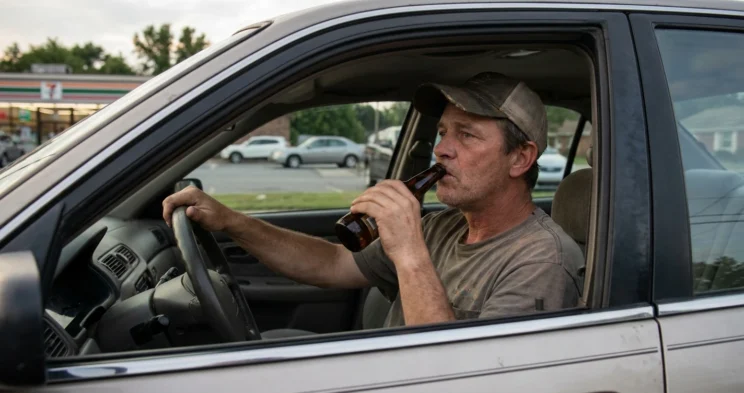
Texas Drunk Driving Victim Rights: Compensation Beyond the Obvious
A drunk driver just ran a red light on Westheimer Road and slammed into your car. Now you’re dealing with injuries, medical bills, and a wrecked vehicle. The other driver is facing criminal charges, but their penalties won’t pay for your recovery.
Texas law gives drunk driving accident victims powerful rights that go beyond filing a basic insurance claim. Plaintiffs in these cases often have access to multiple compensation sources that other accident victims don’t.
Why Drunk Driving Claims Are Worth More Than Regular Accidents
Drunk driving cases typically result in higher compensation than standard car accidents. The reason is straightforward: Texas law treats drunk driving as gross negligence, which opens the door to exemplary (punitive) damages.
Exemplary damages exist to punish defendants for especially reckless behavior and deter others from similar conduct. In a typical car accident, you can recover compensation for your actual losses. In a drunk driving case, you may also recover damages designed to punish the drunk driver’s decision to get behind the wheel.
Texas Civil Practice and Remedies Code § 41.008 caps exemplary damages at the greater of:
- Two times your economic damages plus up to $750,000 for non-economic damages, or
- $200,000
This means if you have $100,000 in medical bills and lost wages, you could potentially recover an additional $200,000 or more in exemplary damages on top of your compensation for pain and suffering.
Drunk driving cases also frequently involve multiple liable parties. When more than one defendant shares responsibility, your total compensation potential increases significantly.
Liable Parties Beyond the Drunk Driver
The drunk driver isn’t always the only party responsible for your injuries. Texas law allows you to pursue claims against others who contributed to the accident.
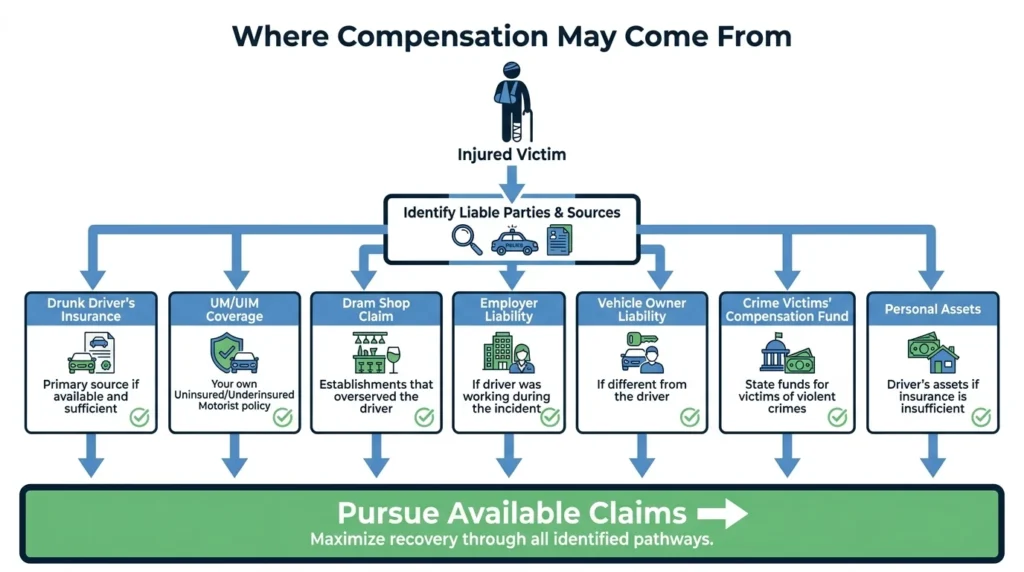
Bars and restaurants that overserve alcohol can be held liable under Texas dram shop laws. If an establishment served alcohol to someone who was obviously intoxicated, and that person then caused your accident, the business may share financial responsibility for your damages.
Vehicle owners may be liable when they knowingly lend their car to someone who is intoxicated or has a history of drunk driving. If the drunk driver borrowed a friend’s car after drinking at a party, the vehicle owner could face liability.
Employers can be held responsible when an employee causes a drunk driving accident while working or driving a company vehicle. This is particularly relevant in cases involving commercial drivers or employees traveling for business purposes.
When Bars & Restaurants Pay Under Dram Shop Laws
To hold a bar or restaurant liable under Texas Alcoholic Beverage Code § 2.02, you must prove the establishment served alcohol to someone who was obviously intoxicated to the point that they presented a clear danger to themselves and others.
Key evidence in dram shop cases includes:
- Witness statements from other patrons or staff
- Credit card receipts showing alcohol purchases
- Surveillance footage from the establishment
- Testimony about the drunk driver’s behavior before leaving
These cases require thorough investigation. Surveillance footage can be deleted quickly, and witness memories fade. Acting fast to preserve this evidence is critical.
Compensation When the Drunk Driver Has No Insurance
Many drunk drivers carry minimal insurance or none at all. When the at-fault driver can’t cover your damages, you still have options.
Your uninsured/underinsured motorist (UM/UIM) coverage is often your first line of defense. This coverage, which is part of your own auto policy, pays for your injuries when the other driver lacks adequate insurance. Texas law requires insurers to offer UM/UIM coverage, though you may have declined it when purchasing your policy.
The Texas Crime Victims’ Compensation Fund provides up to $50,000 for victims of violent crimes, including drunk driving accidents. This state program can cover medical expenses, lost wages, and other costs when other sources fall short.
Pursuing the drunk driver’s personal assets is another option. If the drunk driver owns property, has savings, or earns income, you may be able to collect a judgment against those assets. However, this does typically take a considerable amount of time.
How to Apply for Crime Victim Compensation
The Texas Crime Victims’ Compensation Program is administered by the Texas Attorney General’s Office. To qualify, you must:
- File an application within three years of the accident
- Report the crime to law enforcement within a reasonable time
- Cooperate with the investigation and prosecution
- Not have been engaged in criminal activity that contributed to the accident
Required documentation includes police reports, medical records, and proof of expenses. The fund covers medical treatment, counseling, lost wages, and funeral expenses in fatal cases.
Special Rights for Families Under Bentley’s Law
When a drunk driver kills a parent, Texas provides special protections for surviving children. Bentley’s Law, named after a child who lost both parents to a drunk driver, requires convicted drunk drivers to pay child support to the victim’s minor children.
The court orders support payments based on the drunk driver’s income and the children’s needs. If the convicted driver fails to pay, their driver’s license is automatically suspended until they meet their obligations.
This law applies in addition to any wrongful death claim the family may pursue. It ensures that children who lose a parent to drunk driving receive ongoing financial support, not just a one-time settlement.
Criminal Restitution vs Your Civil Claim
The criminal case against the drunk driver is separate from your civil claim. Understanding how these proceedings interact helps you maximize your recovery.
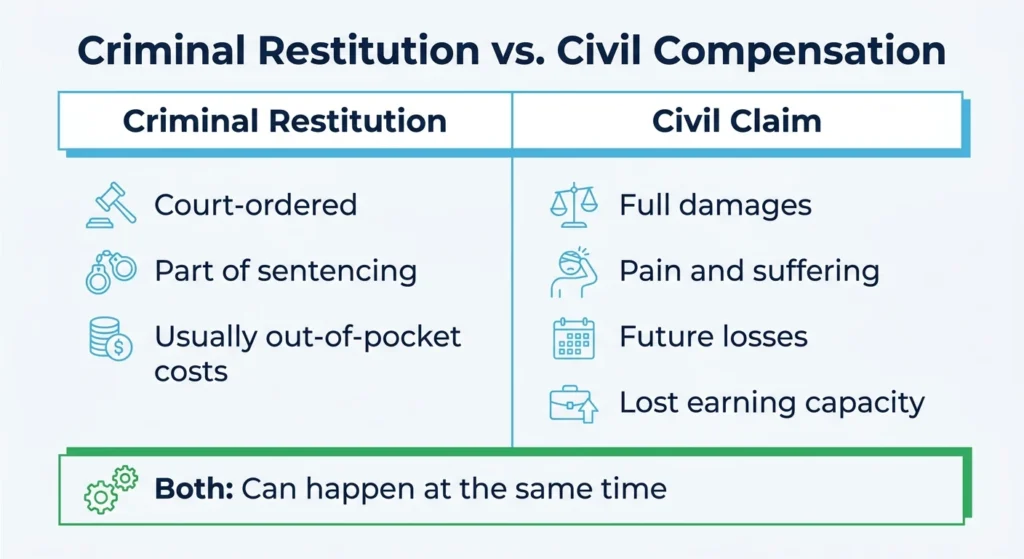
Criminal restitution is ordered by the court as part of the drunk driver’s sentence. It typically covers only out-of-pocket expenses like medical bills and property damage. Restitution does not include compensation for pain and suffering, future medical needs, or lost earning capacity.
Your civil claim allows you to pursue full compensation for all your damages. This includes current and future medical expenses, lost wages, reduced earning capacity, physical pain, emotional distress, and loss of enjoyment of life.
You can pursue both. Criminal restitution payments may be credited against your civil judgment to prevent double recovery, but the civil case allows you to seek damages the criminal court cannot award.
The criminal case can actually help your civil claim. A conviction or guilty plea establishes that the driver was intoxicated, which strengthens your negligence case. However, don’t wait for the criminal case to conclude before starting your civil claim. The two-year statute of limitations for personal injury cases runs regardless of criminal proceedings.
Essential Steps After a Drunk Driving Accident
The actions you take immediately after a drunk driving accident can significantly impact your claim.
Document signs of intoxication if you can safely do so. Note the other driver’s behavior, speech patterns, and any smell of alcohol. Take photos or video if possible. This evidence supports both the criminal case and your civil claim.
Request that police conduct field sobriety and chemical tests. Officers typically perform these tests when drunk driving is suspected, but you can ask them to do so if they haven’t. The results become part of the police report and provide powerful evidence for your case.
Preserve evidence of the drunk driver’s activities before the accident. If you learn the driver came from a bar or restaurant, that information is valuable for a potential dram shop claim. Credit card statements, social media posts, and witness accounts can establish where the driver was drinking.
Get medical attention immediately, even if your injuries seem minor. Some injuries don’t show symptoms right away, and prompt medical documentation connects your injuries to the accident.
Contact an experienced attorney as soon as possible. Drunk driving cases involve multiple potential defendants, complex insurance issues, and time-sensitive evidence. An attorney can begin investigating while evidence is fresh and ensure you don’t miss any compensation sources.
Get the Full Compensation You Deserve
Drunk driving accidents cause devastating injuries and financial hardship. You shouldn’t have to bear those costs because someone else chose to drive drunk.
Angel Reyes & Associates has helped drunk driving victims across Texas recover compensation from every available source. With over 30 years of experience and more than $1 billion recovered for clients, we know how to build strong cases that hold drunk drivers and other responsible parties accountable.
We handle drunk driving accident cases on a contingency basis, which means you pay nothing unless we win. Contact us today for a free consultation to discuss your options.
Drunk Driving Victim FAQs
Can I still file a civil claim if the drunk driver pleads not guilty?
Yes. Civil and criminal cases have different standards of proof. You can pursue compensation even if criminal charges are pending or dismissed.
What happens if the drunk driver files for bankruptcy after my accident?
Debts arising from drunk driving accidents typically cannot be discharged in bankruptcy under federal law. Your judgment may remain collectible despite the bankruptcy filing.
Does Texas require bars to check if customers drove to the establishment?
No. Texas dram shop liability focuses on whether the establishment served someone who was obviously intoxicated, not how they arrived or planned to leave.
Can I recover compensation if I was partially at fault for the accident?
Yes, under Texas proportionate responsibility law. Your compensation is reduced by your percentage of fault, but you can still recover if you’re less than 51% responsible.
How long do I have to apply for crime victim compensation after a drunk driving accident?
You must file your application within three years of the accident date. However, filing earlier ensures better access to records and witness testimony.
About the Authors

Spencer Browne
Writer
Spencer Browne is a partner at Angel Reyes & Associates and a Board Certified personal injury trial lawyer with nearly 100 jury trials across Texas. He focuses on car, truck, and wrongful death cases, with notable verdicts including a landmark win in the Choctaw Casino bus crash case. A recognized speaker and legal educator, Spencer is a member of the American Board of Trial Advocates and has been honored as a Texas Super Lawyer and one of D Magazine’s Best Lawyers in Dallas. He brings deep trial experience and relentless advocacy to every client he represents.

Kyle Nicolas
Editor
Kyle Nicolas is the Web Content & SEO Manager at Angel Reyes & Associates. He has more than 10 years of experience as a marketing co...

Angel Reyes
Reviewer
Angel L. Reyes, III is the Founder and Managing Partner of Angel Reyes & Associates. A nationally recognized trial attorney and business...