Can You File a Wrongful Death Claim After a Fatal Bicycle Accident in Texas?


Every article on this site is researched by our internal team, reviewed for legal accuracy against current Texas law, and held to State Bar of Texas advertising standards before publication. We do not publish content that overstates outcomes or makes promises about results.
Learn more about our
editorial standards .
Key Takeaways
- Texas law allows the spouse, children, or parents of the deceased to file a wrongful death claim.
- If the cyclist is found to be over 50% responsible for the crash under §33.001, their family recovers nothing.
- The cyclist's own UM/UIM coverage may pay damages if the driver did not have enough insurance to cover the loss.
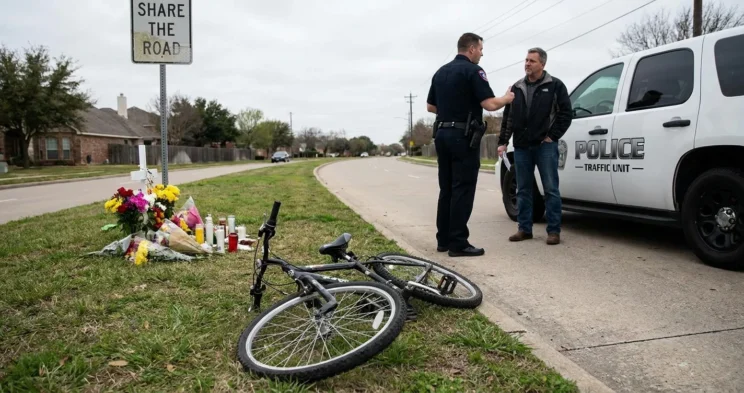
One moment, your husband was out on his usual Saturday bike ride. The next, you are standing in a hospital corridor, struggling to process what a Texas state trooper just told you. In an instant, an ordinary day became defined by an unimaginable loss.
When a driver’s negligence kills a cyclist in Texas, the rider’s surviving spouse, children, and parents can file a wrongful death claim, and the estate can file a separate survival claim for what the cyclist suffered before their death.
Families in this position usually have three questions:
- Who is allowed to file?
- Will the driver’s insurance actually pay?
- What happens if someone claims that the cyclist was partially at fault?
Texas law answers all three.
Who Can File a Wrongful Death Claim After a Fatal Bicycle Accident in Texas?
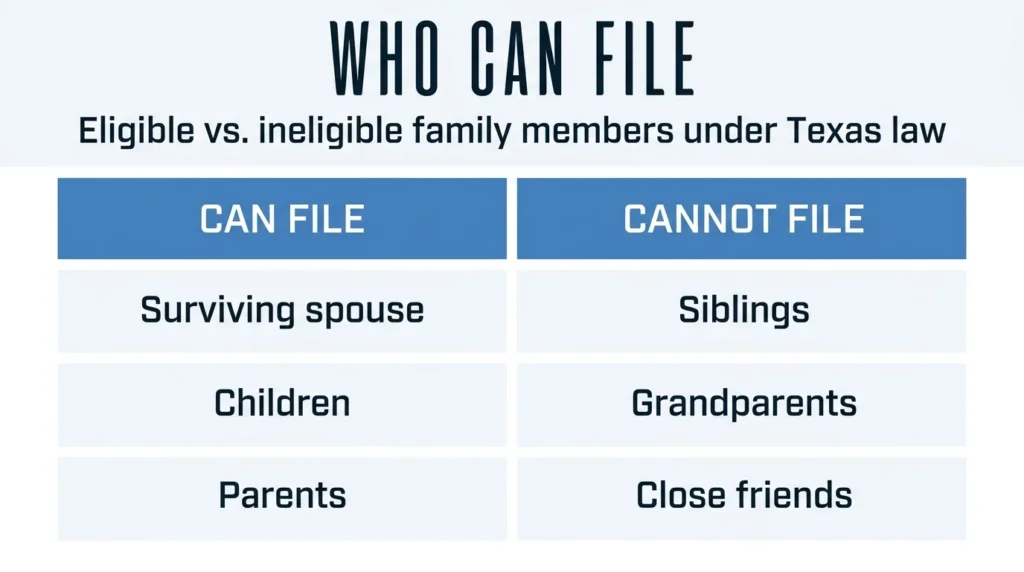
Texas Civil Practice & Remedies Code §71.004 makes a wrongful death action available “for the exclusive benefit of the surviving spouse, children, and parents of the deceased.” Any one of these family members may file a claim individually or on behalf of all of them.
Siblings, grandparents, and close friends cannot file a wrongful death claim under Texas law, no matter how close their relationship to the deceased was. This surprises many families, so it is one of the first things worth confirming in a wrongful death claim as early as possible.
There is also an important deadline that most people don’t know about. Under §71.004(c), if none of the eligible family members file a lawsuit within three calendar months of the death, then the executor or administrator of the estate must file the claim, unless all the eligible family members request that no lawsuit is filed.
A second claim known as a survival action may also be available. Under Texas Civil Practice & Remedies Code §71.021, a personal injury claim is not dismissed when the injured person dies. Instead, it transfers to the deceased’s estate (not the family members directly) and covers what the cyclist personally endured (including conscious pain and suffering) before their death, along with medical and funeral expenses.
These two claims provide compensation for different losses, although they are typically filed together:
- The wrongful death claim provides compensation for what the family of the deceased lost.
- The survival claim provides compensation for what the victim lost between the time of injury and time of death.
Proving the Driver’s Negligence in a Fatal Bicycle Collision
The family of the deceased has to prove that the driver had a duty to drive safely, failed to do so, and caused the death as a result. In a fatal bicycle collision, this is often shown with evidence that the driver violated a traffic law, rather than by arguing what a reasonable driver would have done in the same situation.
Texas recognizes negligence per se, which applies when a driver violates a safety law written to keep a protected class of people safe from the kind of harm that occurred. Roadway users (including cyclists) are part of that protected class. When negligence per se applies, violating the safety law establishes that the driver failed to meet their legal duty of care. This is when the focus of the case shifts to whether the violation caused the death, and what damages resulted from the death.
A violation of Transportation Code §545.053(a) is a common cause of death in these cases. This law states that a driver must pass on the left of the other vehicle at a safe distance and cannot return to the right lane until there is enough space to do so safely.
Improper use of the shoulder is also a common cause of death in these cases. Transportation Code §545.058 permits driving on an improved shoulder only for specific purposes, such as stopping, slowing down to make a turn, passing a stopped vehicle, or avoiding a collision. Outside of these specific purposes, a driver who drifts onto the shoulder where a cyclist is riding may have violated the law.
Other important traffic violations that disregard safety laws designed to protect people sharing the road include:
- Failure to yield
- Running a red light
- Speeding
- Making unsafe lane changes
- Distracted driving
Proving those violations occurred requires gathering physical evidence, including:
- Vehicle damage patterns
- Roadway measurements
- Camera footage
- Event data recorder downloads
The same evidence that supports [car accident claims](https://www.reyeslaw.com/car-accidents/) also supports fatal bicycle crash cases, and it must be gathered as early as possible because it can disappear quickly.
Cyclist Rights and Safe-Passing Laws
A cyclist in Texas has the same rights and duties as a driver, according to Transportation Code §551.101(a), which means a cyclist who is lawfully using a travel lane is not an obstacle or “in the way” of traffic.
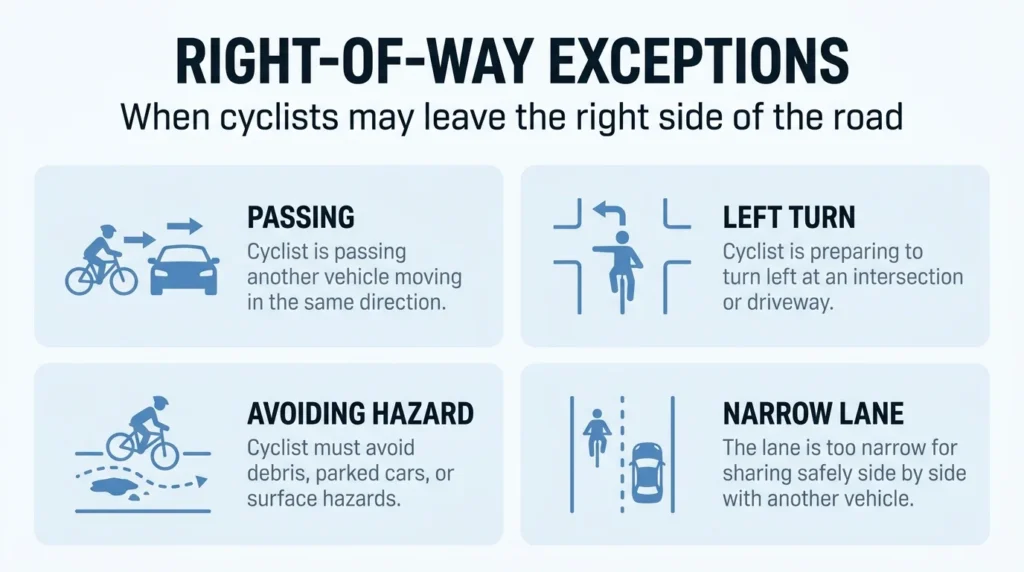
Section 551.103 does require a cyclist who is moving slower than traffic to ride as close as possible to the right side of the road. However, this law has important exceptions that become a key issue when defense lawyers argue that the cyclist was at fault. These exceptions include:
- When the cyclist is passing another vehicle moving in the same direction
- When the cyclist is preparing to make a left turn at an intersection or onto a private road or driveway
- When the cyclist needs to avoid an unsafe condition (including debris, parked cars, surface hazards, and fixed or moving objects)
- When the lane is too narrow for a bicycle and a vehicle to travel safely side by side, (including outside lanes narrower than 14 feet with no designated bike lane)
On a one-way street with two or more marked lanes, a cyclist may ride as close as possible to the left side of the road. Two cyclists may also ride side by side in a single lane, as long as they are not impeding traffic.
In Texas, passing distance is different because Texas has no statewide law that sets a specific numerical measurement for passing distance. The statewide standard requires drivers to pass at a general “safe distance” according to §545.053, but it does not define exactly how far away a “safe distance” is.
Texas does not put a specific number on safe passing distance because previous attempts to create one have never become law. The 2009 Safe Passage bill, Senate Bill 488 had broad bipartisan support but was vetoed by Governor Rick Perry. A later proposal in 2019, House Bill 962, would have required three feet of clearance for passenger vehicles and six feet of clearance for commercial vehicles, but the bill died in committee.
More than two dozen Texas cities have created their own local rules for specific passing distance. Therefore, whether your crash occurred because of unsafe passing distance depends on where the crash happened. This detail becomes important in a [wrongful death claim](https://www.reyeslaw.com/wrongful-death/) involving a passing distance violation.
How Comparative Fault Affects Recovery
Texas follows a modified comparative fault system with hard limits. Under Civil Practice & Remedies Code §33.001, a claimant may not recover damages if their percentage of responsibility is greater than 50%.
When applied to a fatal bicycle case, that means the jury weighs the cyclist’s share of responsibility against the driver’s. If the cyclist is assigned more than 50% of responsibility, then their family recovers nothing. If the cyclist is found to be 50% or less at fault, then their recovery is reduced according to their assigned percentage of responsibility. For example, if a cyclist is found to be 20% responsible for the crash, then their award is reduced by 20%.
Section 33.003(a) requires the jury or judge to assign a percentage of fault to each involved party (including the claimants, defendants, and other responsible third parties). In bicycle cases, defense lawyers use this rule aggressively to argue that the cyclist did not have lights on their bike, they ran a stop sign, or they were not riding far enough to the right.
Section 33.003(b) protects the cyclist’s family from this tactic. A jury cannot consider whether the cyclist was partially responsible for the crash unless there is sufficient evidence to support the argument. This means the defendant must prove that the cyclist was at fault with hard evidence, rather than simply make an accusation.
This is why Texas road-use laws are so important. For example, a cyclist who moved to the left to avoid a pothole was following §551.103, not violating it. Documenting that fact protects the family’s share of recovery.
UM/UIM Coverage for Cyclists
The at-fault driver’s insurance policy is the first source of payment, but it is frequently not enough to cover a wrongful death claim. For this reason, Texas provides additional options.
Insurance Code §1952.101 requires every auto insurance company in Texas to include uninsured and underinsured motorist coverage with every policy unless the policyholder rejects it in writing, according to the Texas Office of Public Insurance Counsel.
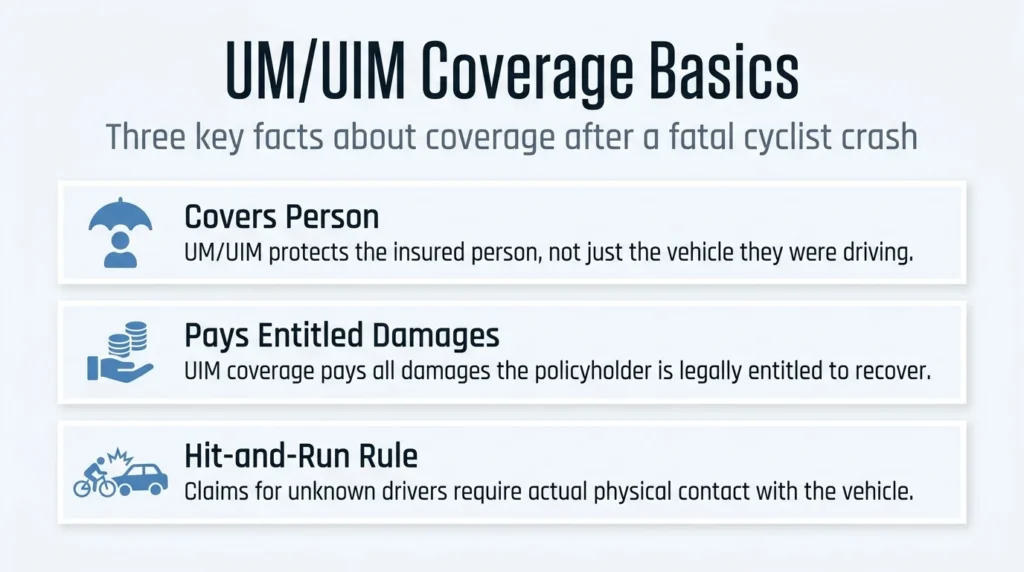
Three key points determine how this coverage works after a fatal bicycle collision:
- UM/UIM covers the insured person, not the vehicle. The deceased cyclist’s own auto policy (or a policy held by a family member living in the same household) may provide coverage even if the deceased was on a bicycle at the time of the crash because the injury still involved a motor vehicle. Whether the policy will actually pay damages for this situation depends on the specific policy language.
- UIM coverage pays what the policyholder is legally entitled to recover. Section 1952.106 requires UIM coverage to pay for all damages the policyholder is legally entitled to recover, up to the policy limits.
- Hit-and-run claims require physical contact. Under §1952.104(3), a claim involving an unknown driver requires actual physical contact between the driver’s vehicle and the policyholder or their property. If a driver forces a cyclist off the road without making contact with them, this makes proving the claim much more difficult. In this case, independent witness testimony becomes essential.
Checking every available policy is worth the effort before accepting any settlement offer. Families often assume that the at-fault driver’s minimum coverage is the only source of compensation that exists, but that assumption can cause them to miss out on additional coverage that may already be available to them.
Talk to An Attorney About Bicycle Wrongful Death Claims in Texas
In a bicycle wrongful death claim, the specific facts of the crash mean everything. This includes where each party was on the road, what the driver was doing, what the road conditions were, and what insurance coverage was available at the time of the crash. The answers are not always clear in the first weeks after a death, and important evidence can disappear if it is not preserved quickly.
Angel Reyes & Associates has guided Texas families through situations like this for over 30 years, and we have recovered more than $1 billion for our clients. Our team of personal injury attorneys, investigators, and accident reconstruction specialists can document a collision scene before it changes.
Contact Angel Reyes & Associates for a free consultation to review who can file a wrongful death claim, how comparative fault may affect the claim, and what insurance coverage may apply. We are available 24/7 and we work on contingency, which means you pay no fee unless we win your case.
Past results do not guarantee future outcomes.
Bicycle Accident Wrongful Death FAQs
Can you still file a wrongful death claim in Texas if the deceased was not wearing a bicycle helmet at the time of the accident?
Yes. Texas has no statewide helmet requirement for adult cyclists. Although local laws may apply, the defense must still connect the lack of a helmet to the death before it can affect damages.
Can a trucking or delivery company be liable for a fatal bicycle accident?
Sometimes. An employer may be responsible if their driver caused the collision while performing their job duties. Separate claims may also arise from negligent hiring, training, supervision, or vehicle maintenance.
What happens if a dangerous road condition contributes to a cyclist's death?
A government entity, contractor, or other responsible party may share liability if road hazards (such as defective signals, unsafe construction zones, or poorly maintained roads) contributed to the crash. Be aware that claims involving a government entity may have shorter notice requirements and special immunity rules.
Can defective bicycle equipment support a separate wrongful death claim?
Yes. A manufacturer, distributor, or seller may be liable if a defective brake, wheel, frame, helmet, or other component contributed to the fatal accident. However, the family must preserve the bicycle and damaged equipment for inspection to prove the equipment was faulty.
Does a criminal case against the driver negate a wrongful death lawsuit?
No. Criminal prosecution is pursued by the government to determine criminal responsibility, but a wrongful death lawsuit is a separate civil case that seeks compensation for the family’s losses.
About the Authors

Angel Reyes
Writer
Angel L. Reyes, III is the Founder and Managing Partner of Angel Reyes & Associates. A nationally recognized trial attorney and business leader, Angel has helped over 70,000 injury victims recover more than $1 billion since founding the firm in 1993. Named to the Texas Super Lawyers list annually since 2008, Angel brings Wall Street experience, Ivy League education, and a deep commitment to client advocacy. He is a frequent legal commentator and published author with extensive contributions to legal scholarship, trial strategy, and consumer protection.

Kyle Nicolas
Editor
Kyle Nicolas is the Web Content & SEO Manager at Angel Reyes & Associates. He has more than 10 years of experience as a marketing co...

Angel Reyes
Reviewer
Angel L. Reyes, III is the Founder and Managing Partner of Angel Reyes & Associates. A nationally recognized trial attorney and business...