Does Life Insurance Reduce a Wrongful Death Settlement?


Every article on this site is researched by our internal team, reviewed for legal accuracy against current Texas law, and held to State Bar of Texas advertising standards before publication. We do not publish content that overstates outcomes or makes promises about results.
Learn more about our
editorial standards .
Key Takeaways
- Independent life insurance generally does not reduce what the at-fault party owes.
- Coverage the defendant funded and policy reimbursement terms need separate review.
- After a fatal crash, gather every policy, beneficiary form, payment record, and release.

Generally, no. In Texas, an independent life insurance payout usually does not reduce the wrongful death damages the at-fault party owes. This protection comes from the collateral source rule.
Who paid for the coverage, the policy terms, and applicable law can affect how a payment is treated. The rule does not guarantee a settlement amount or resolve every reimbursement claim.
Does Life Insurance Affect a Texas Wrongful Death Settlement?
In most cases, an independent life insurance payout does not reduce the damages the at-fault party owes in a Texas wrongful death case. In Sky View at Las Palmas, LLC v. Mendez, the Texas Supreme Court restated that a wrongdoer does not get a liability reduction because the injured party had insurance from an independent source.
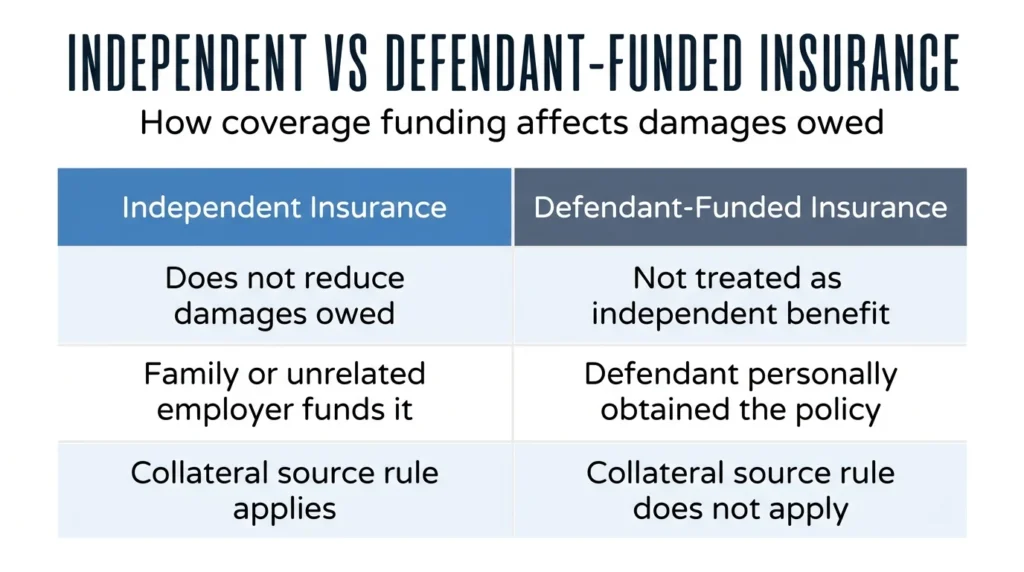
When your loved one or an unrelated employer obtained the coverage independently of the defendant, the benefit comes from that separate insurance contract. The person who caused the death generally does not get to treat it as a discount.
In Sky View, the defendant had obtained the insurance, so the court did not treat the payment as an independent benefit. Who provided the coverage can affect whether it reduces what the defendant owes.
Damages are what the law says the defendant owes. A settlement is a negotiated amount shaped by those damages rules. Your family’s net recovery is what remains after you resolve any valid obligations, such as an enforceable reimbursement claim.
The collateral source rule generally prevents independent insurance benefits from reducing those damages. It does not promise a particular settlement figure or erase enforceable reimbursement obligations under a policy.
Personal Life Insurance & Employer Group Life Benefits
Personal life insurance and employer group life coverage unrelated to the defendant generally pay benefits under a separate insurance contract. Those independent payments generally do not reduce what the defendant owes in a wrongful death case.
The Texas Department of Insurance explains that life insurance pays the beneficiary named in the policy and that employers may offer group life coverage.
If the employer is also a defendant or funded a benefit connected to the liability claim, the court must separately review the payment to determine whether it affects the damages owed.
The person named on a life insurance policy may be different from those entitled to bring a wrongful death claim. Under Texas Civil Practice and Remedies Code Chapter 71, the surviving spouse, children, and parents are the wrongful death beneficiaries. Someone may qualify for one type of payment without qualifying for the other.
Accidental Death Benefits After a Fatal Crash
An independently provided accidental death benefit, including one under an auto policy, generally does not automatically reduce what the at-fault party owes. How a payment is treated depends on who provided the coverage, what it pays for, and the full policy terms. The policy and applicable law also determine whether the insurer can seek repayment.
TDI notes that an accidental death rider, an addition to a policy, can provide an extra payment when the insured dies because of an accident. Liability coverage pays on behalf of a driver who caused harm.
Accidental death, personal injury protection, medical payments, uninsured/underinsured motorist, and liability coverage each have their own conditions and repayment rules, even when they appear on the same auto policy.
How a Texas Court Treated Accidental Death Payments
In Sweep v. Lear Jet Corp., the Fifth Circuit applied Texas law to wrongful death claims after a fatal aircraft crash. Another party’s insurer had paid accidental death benefits regardless of who was at fault. The court reversed a decision that allowed those payments to reduce the aircraft manufacturer’s potential liability.
The federal court was predicting how Texas law would apply. Its decision does not resolve how every modern auto policy treats these benefits.
The payments had not settled an injury claim against the policyholder, and no court had found the policyholder partly responsible for the crash. The court left open the possibility of a credit if later findings supported one.
Why You Need the Complete Auto Policy
A published Texas personal auto policy illustrates how several policy sections can affect a benefit. Its optional accidental death coverage depends on the declarations page and endorsement. Other sections address additional insurance and the insurer’s rights to recover payments.
This example does not establish what every policy covers or whether a repayment clause is enforceable. Read the declarations page, endorsement, and general provisions together.
A benefit may leave the defendant’s debt unchanged, while an enforceable repayment requirement reduces what the family keeps.
Can a Health Plan Seek Repayment From the Recovery?
The collateral source rule addresses whether an insurance payment reduces what the defendant owes. A health plan may also have a right to recover medical expenses it paid, which can reduce what the family ultimately keeps.
Texas Civil Practice and Remedies Code Chapter 140 allows certain covered benefit plans to seek contractual reimbursement, subject to statutory limits. It excludes some systems, including Medicare, Medicaid, workers’ compensation, and self-funded ERISA plans. Other rules govern those plans’ recovery rights.
Family members may bring wrongful death claims, while Chapter 71 separately preserves the estate’s survival claim. To evaluate a repayment demand, identify the plan, the expenses it paid, whose claim is involved, and which part of the recovery the plan seeks.
What Documents Show Whether a Benefit Affects the Recovery?
Policy and payment records can show who provided each benefit, who received it, and what it covered. Also check the full policy for repayment terms.
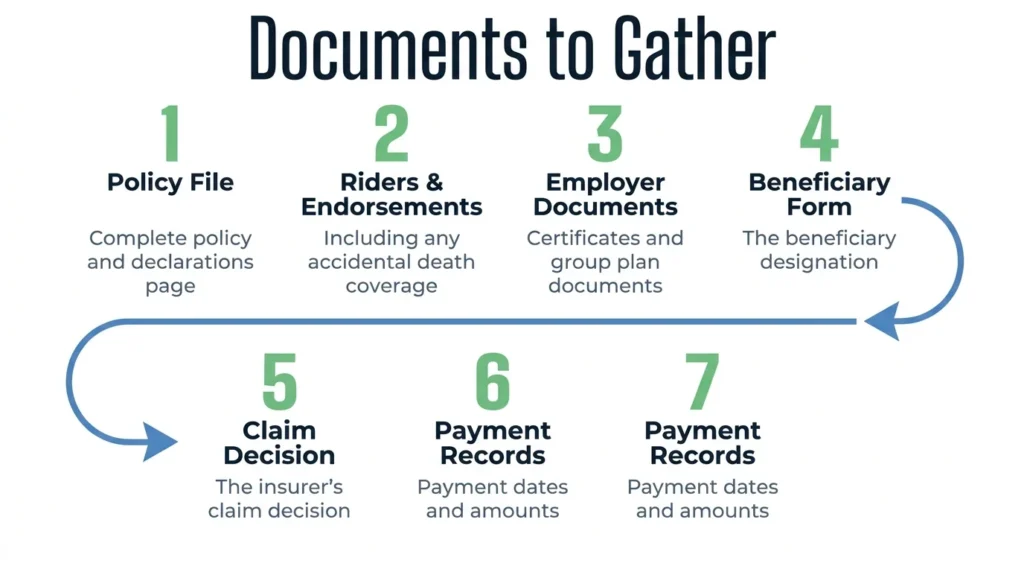
Start by gathering these documents for every policy that paid or may pay:
- The complete policy and declarations page
- All riders and endorsements, including any accidental death coverage
- Employer certificates and group plan documents
- The beneficiary designation
- The insurer’s claim decision
- Payment dates and amounts
- Any release you were asked to sign
Next, identify who purchased or funded each coverage. Note whether that payer has any connection to a defendant, because defendant-funded coverage can fall outside the collateral source rule.
Review each document for provisions on reimbursement, subrogation, other insurance, offsets, and assignment. The policy language and applicable law determine whether a repayment requirement applies.
Keep a record of each payment’s source, recipient, benefit type, date, and amount to help your attorney identify any repayment issues.
Talk With Angel Reyes & Associates About Your Claim
Sorting out life insurance, accidental death benefits, and health plan claims while grieving is a heavy load. You do not have to work through these policies alone.
Angel Reyes & Associates can review your policies, payment records, and the facts of the crash to explain how each benefit fits with your Texas wrongful death claim. Contact us for a free consultation.
Past results do not guarantee future outcomes.
Life Insurance & Wrongful Death FAQs
Are wrongful death settlements taxable in Texas?
Wrongful death compensation for physical injury or death is generally excluded from federal income tax under Internal Revenue Code Section 104(a)(2). Punitive damages and certain interest payments may be taxable, depending on the circumstances.
Can you receive life insurance benefits before a wrongful death lawsuit is settled?
Yes. Life insurance claims generally proceed separately from wrongful death lawsuits, so beneficiaries may receive policy benefits while litigation is pending. Payment depends on the insurer’s review of the claim and the policy’s requirements.
What happens if the deceased person had no life insurance?
A family may still pursue a Texas wrongful death claim even if the deceased had no life insurance coverage. Eligibility depends on the family relationship and whether the death resulted from another party’s legally actionable conduct.
Can a life insurance company deny benefits after a fatal car accident?
Yes. An insurer may deny a claim if a valid policy exclusion applies or the claim does not meet the policy’s requirements. The reason for denial and the policy language determine whether you can challenge the decision.
Does a wrongful death settlement affect Social Security survivor benefits?
A wrongful death settlement generally does not reduce Social Security survivor benefits based on the deceased person’s earnings record. However, settlement proceeds may affect eligibility for needs-based programs such as Supplemental Security Income (SSI).
About the Authors

Angel Reyes
Writer
Angel L. Reyes, III is the Founder and Managing Partner of Angel Reyes & Associates. A nationally recognized trial attorney and business leader, Angel founded the firm in 1993, which has gone on to help over 70,000 injury victims recover more than $1 billion. Named to the Texas Super Lawyers list annually since 2008, Angel brings Wall Street experience, Ivy League education, and a deep commitment to client advocacy. He is a frequent legal commentator and published author with extensive contributions to legal scholarship, trial strategy, and consumer protection.

Kyle Nicolas
Editor
Kyle Nicolas is the Web Content & SEO Manager at Angel Reyes & Associates. He has more than 10 years of experience as a marketing co...

Angel Reyes
Reviewer
Angel L. Reyes, III is the Founder and Managing Partner of Angel Reyes & Associates. A nationally recognized trial attorney and business...