What Is a Survival Action & Who Brings It?


Every article on this site is researched by our internal team, reviewed for legal accuracy against current Texas law, and held to State Bar of Texas advertising standards before publication. We do not publish content that overstates outcomes or makes promises about results.
Learn more about our
editorial standards .
Key Takeaways
- A survival action belongs to the decedent's estate, not to the surviving family.
- It recovers pain, medical bills, and funeral costs incurred before the death.
- The survival deadline runs on your loved one's injury clock, not the date of death.

Families who lose someone in a Texas crash hear about wrongful death claims. A second claim often goes unmentioned. A survival action is the injured person’s own personal injury claim, and Texas law keeps it alive after they are gone.
It belongs to the estate, not to the family, and it recovers only what your loved one personally lost before death. Ordinarily the estate’s personal representative brings it.
How Texas Section 71.021 Keeps an Injury Claim Alive
At common law, a personal injury claim died with the injured person. Texas Civil Practice and Remedies Code § 71.021 ended that rule.

This means a personal injury action survives to and in favor of the heirs, legal representatives, and estate of the injured person.
The survival statute does not hand the family a new claim. It preserves the claim your loved one already had against the person who hurt them.
That distinction drives everything else. In Russell v. Ingersoll-Rand Co., the Texas Supreme Court called the survival action wholly derivative of the decedent’s rights. The wrong being sued is the wrong your loved one suffered before death, and any defense the at-fault driver could have raised while your loved one was alive can still be raised against the estate.
After a fatal crash, families usually see both claims filed together in one lawsuit. They stay separate causes of action, valued separately and distributed differently.
Damages the Estate Recovers & Damages It Does Not
A survival action recovers what your loved one personally sustained while alive. It does not recover what the family lost when they died.
Losses the Estate Can Claim
The estate’s list is limited to harm your loved one absorbed between the injury and death:
- Conscious physical pain and mental anguish suffered before death
- Medical expenses incurred before death
- Reasonable funeral and burial expenses
Pain damages depend on proof. These are losses the decedent sustained, so there must be evidence of conscious suffering between the crash and the death. Where death was instantaneous, that element may not be available, even though medical and funeral costs can still be estate items.
The estate can also pursue exemplary damages on top of those losses. Death of the injured party does not bar them, as the Texas Supreme Court held in Hofer v. Lavender.
Modern Texas law sets a high bar. Texas Civil Practice and Remedies Code Chapter 41 requires gross negligence, malice, or fraud proven by clear and convincing evidence, and it limits exemplary damages. How that limit applies depends on the facts and on who brings the claim.
Losses That Belong to the Family Instead
The survivors’ own losses sit on the other side of the case. Loss of companionship and society, the family’s mental anguish, loss of inheritance, and lost household services belong to wrongful death claims rather than to the estate.
Funeral Costs Recovered Once, Not Twice
Funeral and burial expenses can be recovered in either claim, but only once. The defendant cannot be made to pay for the same funeral twice, a limit Russell restates under the current code.
Who actually paid decides which side the expense belongs on. Beneficiaries who paid the funeral or became legally responsible for it may recover it in the wrongful death claim. If the estate bore the cost, it goes in the survival claim.
Who Is Legally Authorized to File the Survival Claim?

The estate owns the survival claim. Ordinarily only the estate’s personal representative, an executor or an administrator, can file it.
The Personal Representative Default
The survival claim is estate property, and the personal representative is normally the only person authorized to sue for property belonging to the estate. Frazier v. Wynn states that default, and Austin Nursing Center v. Lovato confirms it.
Lovato also settled a point most sources get wrong. The estate itself holds the legal right to recover. Who may file on its behalf is a separate question, and a defect there can often be fixed. A plaintiff who filed for the estate before the deadline and was appointed administrator only afterward had that appointment relate back to the original petition.
Do not treat that as a safety net. A petition filed in the name of someone already dead, with nothing to show the death, may not invoke the court’s jurisdiction at all.
When Heirs Can Sue Without an Administration
Sometimes the heirs can bring the claim themselves. Under Shepherd v. Ledford, heirs at law may maintain a survival suit during the four-year window Texas allows for opening an administration, but only if they allege and prove that no administration is pending and none is necessary. The Texas Estates Code sets that current four-year deadline for applying for letters testamentary or letters of administration.
In Shepherd, the showing included:
- No real property in the estate
- A personal estate passing to the surviving spouse
- Debts already paid
- A family in agreement on distribution
A family settlement agreement is a recognized alternative to administration in Texas.
Unpaid estate debts defeat the route. In Frazier, the plaintiff proved no administration existed, but debts were still owed at trial, so an administration was necessary. Treat this path as sometimes possible on a specific showing, never as a way around probate.
Who may file the wrongful death claim, and how those proceeds get divided, are separate questions.
Deadlines That Apply to Each Claim
Texas normally gives you two years after a fatal crash. The two claims do not measure those two years the same way.
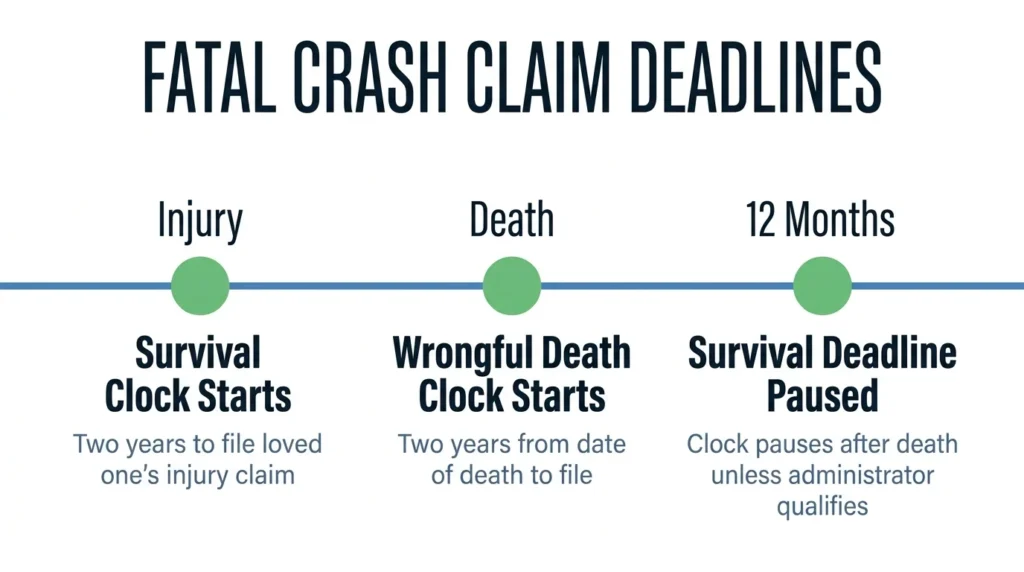
The wrongful death claim runs two years from the date of death. Texas Civil Practice and Remedies Code § 16.003(b) sets that period.
The survival claim runs on the deadline that applied to your loved one’s own injury claim. That is usually two years from the date of the injury, not from the date of death. If that deadline had already run out before your loved one died, the survival claim is barred. The Texas Supreme Court said exactly that in Russell.
The same principle reaches the wrongful death claim. Russell holds that action is derivative too. If your loved one could no longer have sued for the injury on the day they died, the family’s wrongful death claim is barred as well.
A death does pause the clock. Texas suspends the deadline for 12 months after the death. That pause can end sooner if an executor or administrator qualifies during those 12 months. Section 16.062 sets both rules.
In most fatal crash cases the injury and the death happen on the same day, so both deadlines land in the same place. When someone survives the crash for months or years, they do not. Assume the earliest date and have a lawyer confirm it now.
Proving the Claim & Where the Money Goes
An estate claim rests on paperwork showing who may act for the estate and records proving what your loved one lost.
Documents That Support an Estate Claim
- Letters testamentary or letters of administration, or a court proceeding to declare heirship where there is no will and no administration
- Medical records covering the period between the injury and death
- Funeral and burial expense documentation, with a clear record of who actually paid
Two Recoveries, Two Destinations
The two recoveries do not land in the same place. Section 71.011 says damages recovered in a wrongful death action are not subject to the debts of the deceased.
Survival money works differently. The claim belongs to the estate, so the recovery is an estate asset. It passes by will or by intestacy, and the estate’s creditors can reach it.
Talk With an Attorney About Your Case
Two parts of an estate claim are easy to get wrong and costly to get wrong. The filing deadline is not one fixed date, and the person authorized to file may need a probate step first.
Angel Reyes & Associates has guided Texas families through situations like this for over 30 years.
Request a free consultation to review your options.
Past results do not guarantee future outcomes.
Survival Action FAQs
What happens to the survival claim if the driver who caused the crash also died?
The claim survives against that driver’s estate. Texas survival law runs in both directions, so the action does not end because the liable person died, and the suit proceeds as if that person were still alive. Exemplary damages have also been allowed against a deceased wrongdoer’s estate, though availability always depends on the proof.
What is an heirship determination and when is one needed?
It is a court proceeding that establishes who a person’s heirs are. Texas law authorizes one when someone dies without a will and no administration has been opened in Texas. The Estates Code sets who may apply and what the application must contain. Families use it when authority to act for the estate still has to be documented.
Can a later appointment as administrator save a case already on file?
It can. The Texas Supreme Court has held that where the suit was filed for the estate before the deadline and the person who filed was appointed administrator only afterward, the later appointment related back to the original petition. That is a repair, not a plan. Sort out who is authorized to file before the petition goes in whenever the timeline allows.
About the Authors

Angel Reyes
Writer
Angel L. Reyes, III is the Founder and Managing Partner of Angel Reyes & Associates. A nationally recognized trial attorney and business leader, Angel has helped over 70,000 injury victims recover more than $1 billion since founding the firm in 1993. Named to the Texas Super Lawyers list annually since 2008, Angel brings Wall Street experience, Ivy League education, and a deep commitment to client advocacy. He is a frequent legal commentator and published author with extensive contributions to legal scholarship, trial strategy, and consumer protection.

Kyle Nicolas
Editor
Kyle Nicolas is the Web Content & SEO Manager at Angel Reyes & Associates. He has more than 10 years of experience as a marketing co...

Angel Reyes
Reviewer
Angel L. Reyes, III is the Founder and Managing Partner of Angel Reyes & Associates. A nationally recognized trial attorney and business...