eVTOL Battery Fires & Air Taxi Safety Risks


Every article on this site is researched by our internal team, reviewed for legal accuracy against current Texas law, and held to State Bar of Texas advertising standards before publication. We do not publish content that overstates outcomes or makes promises about results.
Learn more about our
editorial standards .
Key Takeaways
- eVTOL battery failures can cause fire, toxic smoke, and dangerous reignition after flames go out.
- Manufacturers, operators, and maintenance providers may all share liability in a battery incident.
- Texas generally gives you two years to file a claim, but critical evidence can be lost in days.
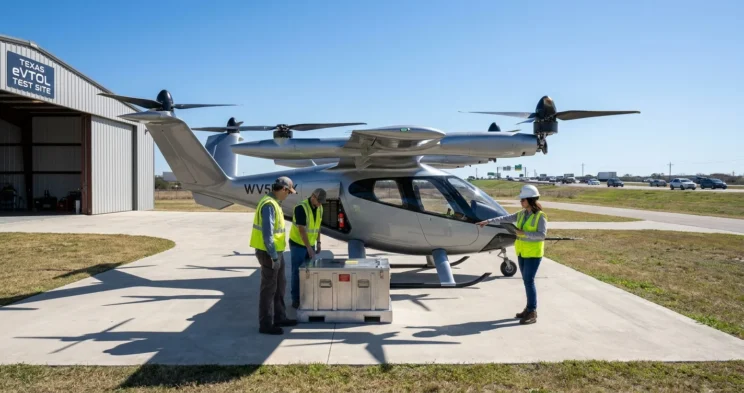
You’re driving down I-10 through Houston when something that looks like a large drone carrying passengers glides overhead toward downtown.
That’s not science fiction. Electric air taxis are being tested across the country right now, and Texas is on the short list for early deployment. The FAA is working through the final approval steps, and several companies are already running test flights. Commercial service could start within a few years.
Before these aircraft become a regular part of the Texas skyline, it’s worth understanding a risk that comes with the technology: high-energy battery systems that can fail in ways traditional aircraft never could. If you or someone you love is hurt in an eVTOL incident involving fire, smoke, or a battery failure, knowing your legal options before that day comes is the kind of preparation that matters.
Why eVTOL Battery Incidents Are Different From Traditional Aircraft Emergencies
Electric vertical takeoff and landing aircraft (eVTOLs) represent a new category the FAA calls “powered-lift.” Unlike traditional helicopters or planes, these air taxis run entirely on high-energy lithium-ion battery packs with no backup engine.
That changes the risk profile. Lithium-ion cells pack enormous energy into compact spaces. When something goes wrong, the failure can be sudden, intense, and difficult to stop.
The FAA recently finalized rules for integrating powered-lift aircraft into the national airspace system. These rules establish training standards and operational requirements. They also acknowledge that this technology brings unique safety considerations that pilots, operators, and regulators are still working through.
What Thermal Runaway Is & Why It’s Dangerous in an Air Taxi
Thermal runaway is a battery failure where heat triggers a self-accelerating chain reaction. One cell overheats. That heat spreads to neighboring cells. The reaction cascades through the battery pack.
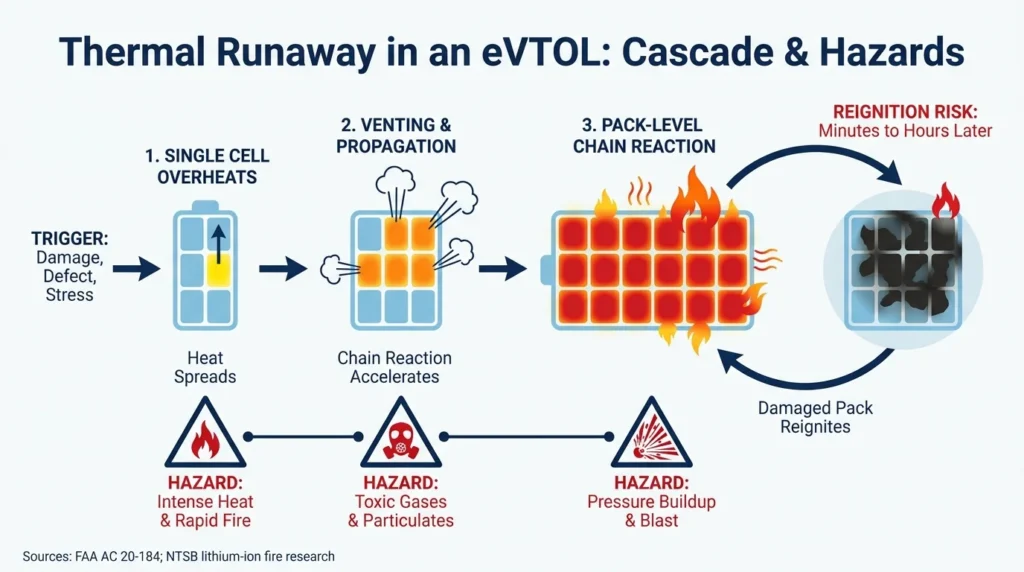
According to FAA Advisory Circular 20-184, thermal runaway can produce:
- Intense heat and fire that spreads rapidly
- Toxic vent gases released as cells fail
- Explosive pressure buildup in confined spaces
The danger doesn’t end when flames disappear. The NTSB’s safety research on lithium-ion battery fires highlights a risk called reignition: damaged battery packs can hold onto enough energy to flare up again minutes or hours after the initial fire appears controlled.
How Thermal Runaway Can Harm People
Battery failures in an eVTOL could injure people in several ways:
- Burns and blast trauma during the initial event or emergency evacuation
- Smoke inhalation and toxic exposure from vent gases and particulates
- Secondary injuries from falls during evacuation, vehicle collisions near landing zones, or responder injuries at the scene
Ground workers at vertiports, bystanders near emergency landing sites, and first responders could face exposure risks even if they weren’t passengers.
Where Thermal Runaway Risk Shows Up
When and where a battery failure happens will often determine who gets hurt and who may be responsible.
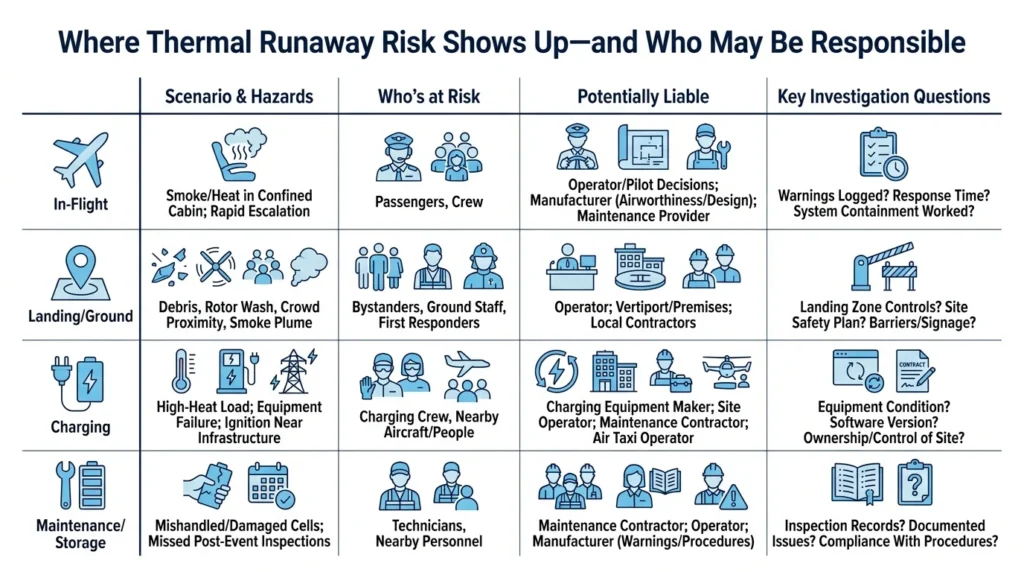
In-flight risk: A confined cabin means smoke and heat can become life-threatening within seconds. Even if the pilot executes a perfect emergency landing, passengers may suffer exposure during descent.
Landing and ground risk: Emergency landings near busy areas like the Medical Center in San Antonio or Downtown Austin could create hazards for people on the ground. Rotor wash, debris, and crowd proximity compound the danger.
Charging risk: High-power charging generates heat. A thermal event at a vertiport charging station could injure ground crews and damage nearby aircraft.
Maintenance and storage risk: Improperly handled cells, inadequate inspection after a hard landing, or ignored warning signs can set the stage for failure. The FAA’s guidance emphasizes that maintenance programs are central to managing battery risks.
Post-Incident Reignition: What Bystanders Should Know
If you witness or are near an eVTOL battery incident, understand that the scene may still be dangerous after visible flames are out.
The NTSB research documents cases where lithium-ion batteries reignited after initial suppression. Practical safety steps include:
- Maintain distance from the aircraft
- Stay upwind to avoid smoke exposure
- Avoid enclosed spaces where gases may accumulate
- Wait for trained responders before approaching
Don’t handle debris or damaged battery components. This protects your safety and preserves evidence that investigators will need.
Are Air Taxis Safe? What Testing Prevents & What It Can’t Eliminate
People asking “are air taxis safe?” deserve a straight answer.
Aviation battery safety standards exist specifically to prevent catastrophic outcomes from thermal runaway. The FAA’s AC 20-184 establishes testing and installation requirements designed to contain failures and protect occupants.
European regulators have developed similar frameworks. EASA requires VTOL manufacturers to show their aircraft can contain a battery failure before it reaches passengers.
These standards reduce risk. They don’t eliminate it.
Redundancy, training, and safety systems make incidents less likely. When incidents do occur, the legal question often becomes whether someone failed to meet their safety obligations through defective design, inadequate maintenance, or poor operational decisions.
What to Do After an eVTOL Battery Fire or Smoke Incident in Texas
Actions taken in the first hours after an incident can affect both your health and your ability to prove what happened.
Seek medical evaluation immediately. Burns and smoke inhalation symptoms can worsen over time. Document everything medical providers tell you. If you’re unsure what steps to take after an accident, prioritize your health first.
Report and document. Obtain incident reports where possible. Preserve booking confirmations, ride receipts, and any communications with the operator.
Don’t handle debris. Reignition risk means damaged batteries should only be handled by trained personnel.
Photograph safely. Capture warning screens, signage, charging station labels, visible damage, and your injuries. If a vehicle collision occurred near the landing site, understanding what evidence matters can make a difference.
Identify witnesses. Get contact information from anyone who saw what happened.
Who May Be Liable in Texas After an eVTOL Thermal Runaway Incident
Battery failure cases can involve more than one responsible party. Fault may be shared depending on what caused the failure and when it happened.
Product liability: The aircraft manufacturer, battery supplier, or charging equipment maker may be liable if a defect in design, manufacturing, or product warnings contributed to the incident.
Operator negligence: The air taxi company may bear responsibility for ignored alerts, poor maintenance scheduling, inadequate crew training, or bad decisions in the air.
Premises and maintenance failures: Vertiport operators, charging station owners, and maintenance contractors may be liable if unsafe conditions or sloppy workmanship played a role.
How Timing Affects Who’s Responsible
Timing matters for legal liability. The same battery failure raises different questions depending on when it happened:
- During flight: How the pilot responded and whether the aircraft was airworthy become the central questions
- During charging: The condition of the charging equipment and who controlled the site matter most
- During maintenance: Whether inspections were done correctly and whether problems were documented become key
An experienced personal injury firm can help identify which theories apply to your situation.
Evidence That Often Matters & How It Can Disappear
Battery events can destroy physical evidence. Digital logs get overwritten. Surveillance footage has retention limits. Early preservation matters.
Flight logs and maintenance records: Onboard data may show whether warning signs were present before the incident and how the crew responded.
Battery and charging artifacts: Pack remnants, charging station identifiers, and software versions can reveal defects. These should be preserved by professionals.
Scene and witness evidence: Vertiport surveillance, nearby business cameras, 911 dispatch audio, and social media videos with timestamps can all support your case.
Medical and damages evidence: ER records, follow-up care documentation, lost wages, and symptom journals help establish the full impact of your injuries.
Texas Deadline Basics: The 2-Year Personal Injury Filing Baseline
Texas law generally provides a two-year limitations period for personal injury claims. Texas Civil Practice and Remedies Code § 16.003 establishes this baseline.
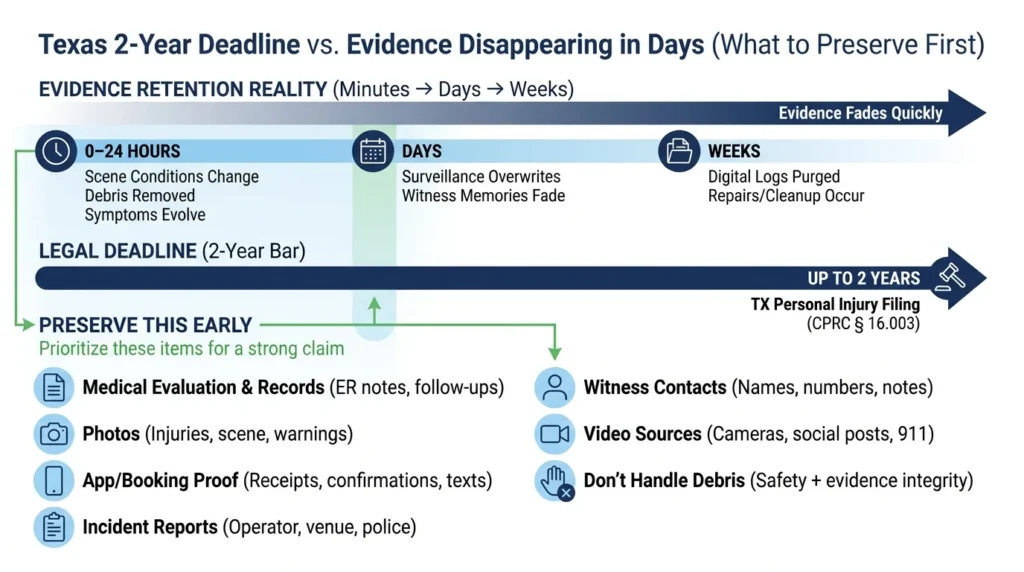
The clock typically starts on the date of the incident. While exceptions may exist in specific circumstances, you should never assume you have extra time. Understanding how personal injury claims work in Texas helps you protect your rights.
The practical risk goes beyond the legal deadline. Waiting can mean lost evidence. Surveillance systems overwrite footage. Digital logs get purged. Witnesses forget details. Even if you’re within the two-year window, delay can weaken your case.
How Angel Reyes & Associates Can Help
If you or someone you love is injured in an eVTOL incident involving fire, smoke, or a battery failure, you’ll be dealing with a new area of law where multiple parties may share responsibility.
Angel Reyes & Associates has over 30 years of experience handling serious injury cases across Texas. We’ve recovered more than $1 billion for our clients. We work on contingency, which means no fee unless we win. Our team offers free consultations and can communicate in Spanish.
We have more than 20 locations across Texas and can handle most of your case remotely. Our investigators and reconstruction specialists know how to preserve critical evidence before it disappears.
Contact us today to discuss your situation and understand your options before the deadline passes.
Past results do not guarantee future outcomes.
eVTOL Accident & Failure FAQs
Can smoke inhalation symptoms show up hours after an eVTOL battery incident?
Yes. Coughing, throat irritation, shortness of breath, headaches, and chest tightness may worsen after the event, so delayed symptoms still deserve medical attention and documentation.
What if the air taxi was charging or being serviced when the battery fire happened?
A ground incident may involve different responsible parties than an in-flight event, such as a charging equipment provider, maintenance contractor, property operator, or aircraft operator. The location and activity at the time of the fire often shape the investigation.
Do I need to keep my app receipts or ride confirmation after an air taxi incident?
Yes. Booking records, payment receipts, emails, texts, and app screenshots can help confirm who operated the flight, when it happened, and what services were involved.
Can surveillance video from a vertiport or nearby business be lost quickly?
Yes. Many camera systems overwrite footage on a short cycle, so video from vertiports, parking areas, and nearby businesses may disappear if it is not requested or preserved promptly.
Will a government investigation automatically protect my injury claim?
Not necessarily. Safety investigations and civil injury claims are different processes, and an official report may take time while evidence and filing deadlines keep moving.
About the Authors

Angel Reyes
Writer
Angel L. Reyes, III is the Founder and Managing Partner of Angel Reyes & Associates. A nationally recognized trial attorney and business leader, Angel has helped over 70,000 injury victims recover more than $1 billion since founding the firm in 1993. Named to the Texas Super Lawyers list annually since 2008, Angel brings Wall Street experience, Ivy League education, and a deep commitment to client advocacy. He is a frequent legal commentator and published author with extensive contributions to legal scholarship, trial strategy, and consumer protection.

Graham Griffin
Editor
Graham Griffin is the Web & Content Manager at Angel Reyes & Associates, where he oversees content strategy, AI-powered workflows, a...

Angel Reyes
Reviewer
Angel L. Reyes, III is the Founder and Managing Partner of Angel Reyes & Associates. A nationally recognized trial attorney and business...