FAA Rules for eVTOL Air Taxis in Texas


Every article on this site is researched by our internal team, reviewed for legal accuracy against current Texas law, and held to State Bar of Texas advertising standards before publication. We do not publish content that overstates outcomes or makes promises about results.
Learn more about our
editorial standards .
Key Takeaways
- Before boarding any eVTOL flight, the aircraft, the pilot, and the operator must each have separate FAA approval.
- Texas cities control where takeoff sites can be built independently of any FAA approval the operator holds.
- Texas injury law applies to eVTOL passengers and bystanders the same way it applies to any vehicle crash.
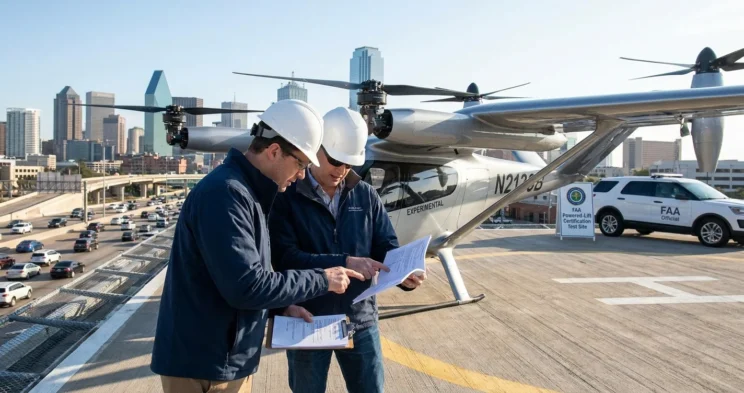
You’ve seen the headlines about air taxis coming to Texas cities. Within the next year or two, powered aircraft could be lifting off from rooftops in Dallas, Houston, and Austin and flying over the same roads you drive every day. These aircraft aren’t in commercial service yet, but when one malfunctions over a Texas highway, personal injury law applies the same day it happens.
What “Powered-Lift” Means & Why the FAA Label Matters
The FAA classifies eVTOL aircraft as “powered-lift” because they use engine-driven lift to take off and land vertically, then transition to wing-borne flight. That label determines which safety standards the aircraft must meet, which pilot credentials are required, and which operating rules govern commercial service.
One distinction worth knowing: some FAA documents, like the Code of Federal Regulations and Special Federal Aviation Regulations, are actual enforceable rules. Others, like Advisory Circulars and online FAQs, explain how the FAA interprets those rules but carry no legal force on their own. That distinction matters when evaluating whether an operator running flights near you has actually met its legal obligations.
Three FAA Approvals Required Before Passengers Board
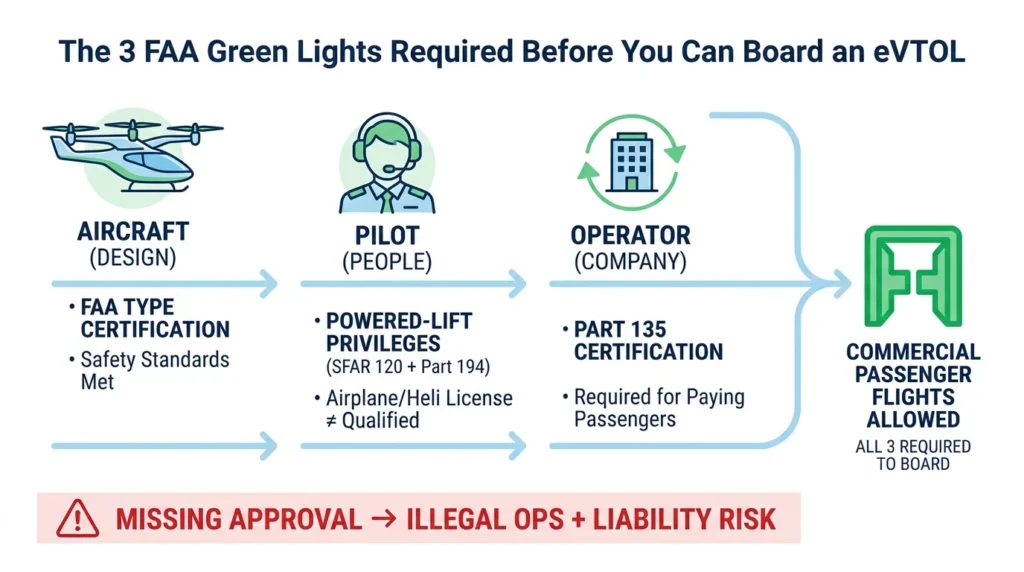
No single approval unlocks commercial passenger service. Three separate tracks must all be complete before anyone boards:
- The aircraft must pass an FAA safety review confirming the design meets applicable standards, under the FAA’s type certification rules
- Pilots must hold a specific FAA license for this category of aircraft, separate from a standard airplane or helicopter license
- The company carrying passengers must obtain separate FAA authority to conduct commercial flights
A safety-approved aircraft does not automatically mean the company operating it is cleared to carry you. If an operator skips any of these tracks and someone is hurt, that gap is directly relevant to a negligence claim under Texas law.
Pilot Licensing Rules for eVTOL Aircraft
The FAA established specific licensing rules for powered-lift pilots through SFAR 120 and Part 194, a framework that sets out what training, experience, and credentials pilots need before they can legally carry passengers in this aircraft category. A standard airplane or helicopter license does not transfer. Pilots must meet separate requirements specific to powered-lift aircraft.
As a passenger, you have the right to expect that any pilot operating a commercial eVTOL flight holds the correct credentials for that specific aircraft. An operator that puts an underqualified pilot in the cockpit and causes an injury is in a weaker legal position because of it.
What a Company Must Show the FAA Before Carrying Paying Passengers
Before an eVTOL company can legally carry paying passengers, it must obtain Part 135 air carrier certification, the FAA’s formal approval process for commercial passenger operations. This is separate from getting the aircraft certified and the pilots licensed, and it involves a lengthy review of the company’s safety procedures, leadership, and training programs before approval is granted.
The FAA updated how it defines commercial air operations in July 2023, which affects how certain services are categorized. What a company calls its service in its marketing may be classified differently under federal rules. That gap can become significant in a legal claim after an incident.
What the MOSAIC Rule Does (& Doesn’t) Cover
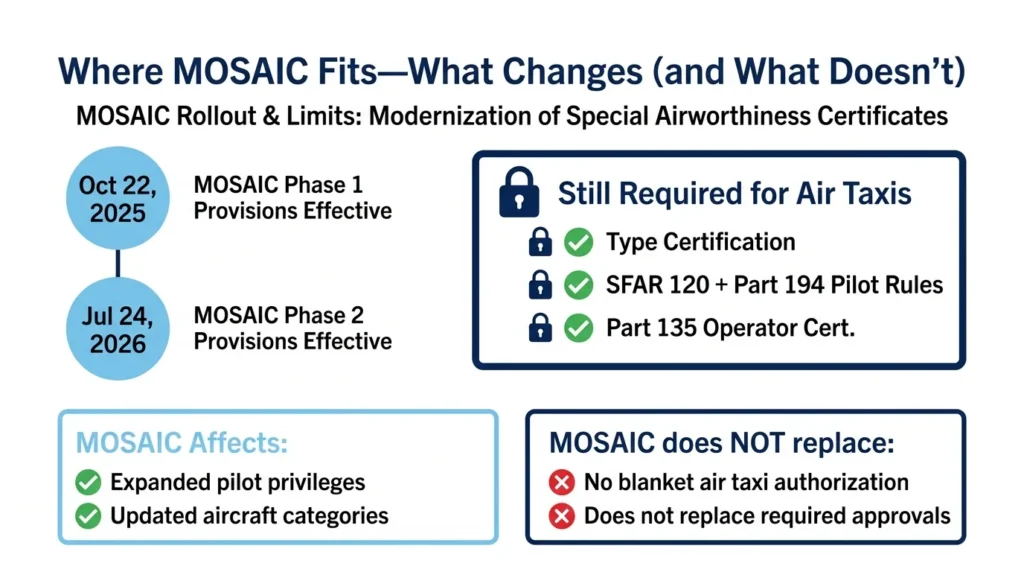
In 2024 the FAA finalized the MOSAIC rule (Modernization of Special Airworthiness Certificates), which expanded certain pilot privileges and updated certification categories for smaller aircraft. Two provisions take effect on October 22, 2025 and July 24, 2026 respectively.
MOSAIC does not replace the aircraft safety review, the SFAR 120/Part 194 pilot licensing requirements, or the Part 135 commercial operator approval process. It is not a blanket authorization for air taxi launches. If a company suggests the approval process is simpler than three separate steps, that claim warrants a closer look before you board.
The Federal Air Taxi Coordination Program
The federal government established a program called eIPP (eVTOL & AAM Integration Pilot Program) to help cities, states, and private companies work together on bringing air taxis into service. It supports coordination on things like community engagement, noise management, and emergency response planning.
It is not a certification process and does not give any company permission to carry passengers.
For Texans near proposed takeoff sites in Dallas County, Harris County, or Travis County, eIPP is where local governments work with developers to plan for the future. They discuss flight paths, noise concerns, and emergency response before any operations begin. It does not reduce any legal responsibility if something goes wrong with one of these aircraft.
Texas Local Approvals: What FAA Clearance Doesn’t Cover
FAA approval covers aircraft, pilots, and operators. It does not cover the physical sites where these aircraft land and board passengers in Texas. Cities and counties control takeoff site placement through zoning, building permits, and local code. A fully FAA-approved operation still cannot launch if the takeoff site lacks local permits.
For Texans near proposed sites in the DFW Metroplex, Houston, or Austin, local approval processes are where community input happens. Noise concerns, flight paths over residential corridors, and emergency response coordination all run through municipal channels, not the FAA.
If a local approval was improperly granted or safety concerns were ignored during that process, it can become relevant to an injury claim.
How Angel Reyes & Associates Can Help
At Angel Reyes & Associates, we have represented injured Texans for over 30 years in cases involving cars, commercial vehicles, defective products, and complex multi-party liability.
The legal principles that apply when a commercial vehicle causes a crash, when a defective product injures someone, or when a property owner fails to maintain a safe site are the same ones that will govern eVTOL injury claims in Texas. We are building that expertise now so our clients are never behind.
Our firm has recovered more than $1 billion for clients across Texas. Past results do not guarantee future outcomes. We offer free consultations, maintain more than 20 locations across the state, and are available 24/7. If you or someone you know is hurt in an incident involving one of these aircraft, reach out to us today before speaking with the operator or their insurer.
eVTOL Rules FAQs
Can I file a personal injury claim if I'm a paying passenger on an eVTOL that crashes?
Yes. Passengers injured due to operator negligence, an unqualified pilot, or a defective aircraft can pursue claims against the operator, the manufacturer, or both depending on what caused the crash.
Does it matter if the eVTOL company was missing required FAA approvals at the time of the incident?
It can strengthen your claim significantly. A company conducting commercial flights without required approvals is already in violation of federal safety standards, which is directly relevant to establishing negligence.
Can a Texas city block a takeoff site site that already has FAA approval?
Yes. FAA approval covers aviation safety and operations, while cities and counties control zoning, land use, and building permits independently of the FAA.
What if the eVTOL company is headquartered outside Texas?
Texas courts can hear cases against out-of-state companies that operate or cause harm within the state. Where a company is based does not shield it from Texas personal injury claims.
How do I know which party to file a claim against after an eVTOL incident?
You may not know immediately, and you don’t need to before contacting an attorney. An attorney investigates the cause, identifies every potentially responsible party, and builds the claim accordingly.
About the Authors

Angel Reyes
Writer
Angel L. Reyes, III is the Founder and Managing Partner of Angel Reyes & Associates. A nationally recognized trial attorney and business leader, Angel has helped over 70,000 injury victims recover more than $1 billion since founding the firm in 1993. Named to the Texas Super Lawyers list annually since 2008, Angel brings Wall Street experience, Ivy League education, and a deep commitment to client advocacy. He is a frequent legal commentator and published author with extensive contributions to legal scholarship, trial strategy, and consumer protection.

Graham Griffin
Editor
Graham Griffin is the Web & Content Manager at Angel Reyes & Associates, where he oversees content strategy, AI-powered workflows, a...

Angel Reyes
Reviewer
Angel L. Reyes, III is the Founder and Managing Partner of Angel Reyes & Associates. A nationally recognized trial attorney and business...