How Many Self-Driving Car Accidents Have There Been? A Data Overview


Every article on this site is researched by our internal team, reviewed for legal accuracy against current Texas law, and held to State Bar of Texas advertising standards before publication. We do not publish content that overstates outcomes or makes promises about results.
Learn more about our
editorial standards .
Key Takeaways
- Level 2 ADAS requires human supervision while ADS performs the driving task, and this distinction directly affects who is assigned fault in Texas crashes.
- Neither NHTSA's Standing General Order nor Texas CR-3 data can prove whether self-driving technology is "safer" without exposure metrics (such as miles driven).
- Preserving vehicle data, photos of dashboard indicators, and witness statements quickly is critical because evidence in AV/ADAS crashes can disappear within days after the crash.
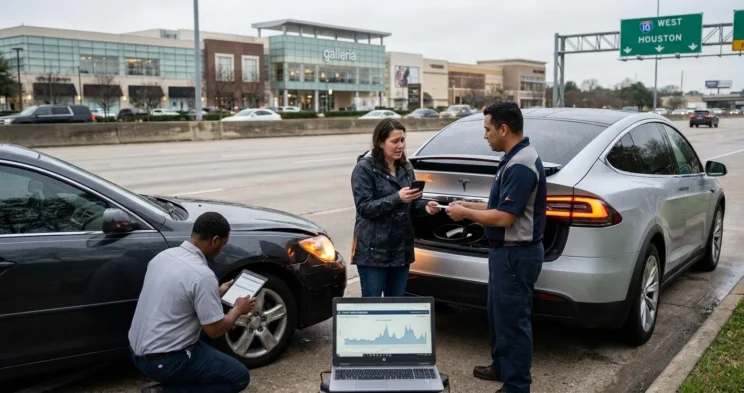
You were rear-ended on I-10 near the Galleria while stopped in traffic. The other driver mentioned something about their car’s “Autopilot” before the insurance calls started. Now, you’re wondering: does that change who’s responsible? And what does “self-driving” even mean when it comes to proving fault in Texas?
The answer depends on two very different technologies that often get lumped together, as well as what crash data can actually prove.
Why “Self-Driving Crash Data” Is Confusing in Texas
News stories about autonomous vehicle crashes rarely distinguish between true self-driving technology and driver-assistance features. Texas crash and federal reporting use specific definitions that change what the statistics mean.
The total number of crashes doesn’t reflect how safe a system is overall. A system with 100 reported crashes might be safer or more dangerous than one with 10 crashes. Without knowing how many miles each system drove, and under what conditions, the numbers tell an incomplete story.
Two key data sources track these crashes differently. The NHTSA Standing General Order collects reports from manufacturers and operators nationwide. Texas uses CR-3 crash report forms that feed into the TxDOT Crash Records Information System (CRIS).
However, neither source was designed to answer the question most people ask: “Is this technology safe?”
ADAS vs ADS: The Definitions Control What Gets Reported
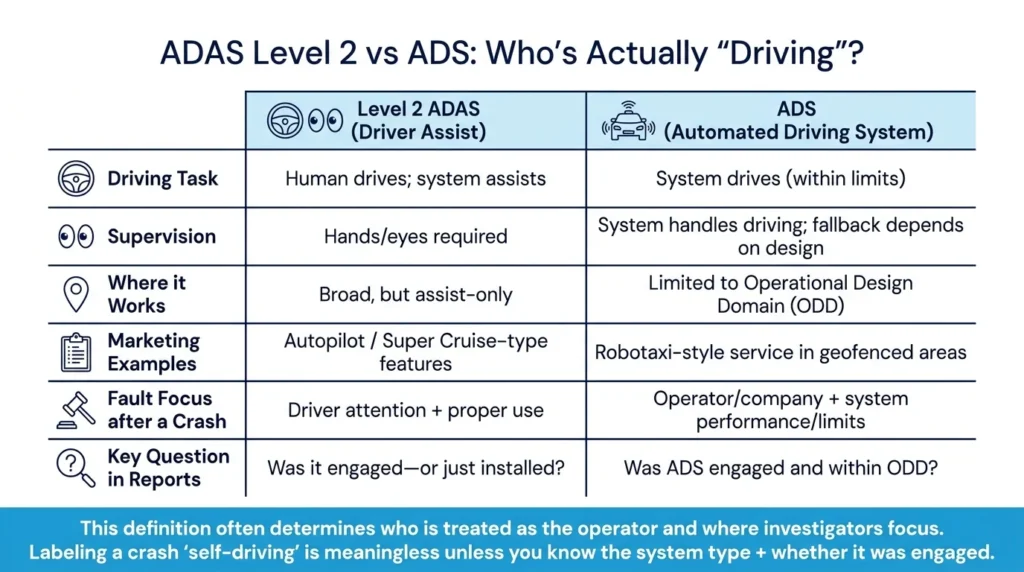
Before looking at the data, let’s discuss the distinction between these two categories in simple terms:
Level 2 ADAS (Advanced Driver Assistance Systems) includes features like adaptive cruise control, lane-keeping assistance, and systems marketed as “Autopilot” or “Super Cruise.” The driver must still keep their hands on the wheel and eyes on the road. With these systems, a human is always responsible for the actual task of driving.
ADS (Automated Driving Systems) refers to technology designed to handle the entire driving experience within specific conditions. When engaged, the system drives itself. Some robotaxi services operate this way in limited areas.
The distinction is important when determining who’s at fault. If a crash happens while Level 2 ADAS is active, the human driver was still supposed to be supervising. If true ADS was engaged, the focus changes to the system operator, the company, or the technology itself.
A crash “in an ADAS vehicle” does not mean ADAS caused the crash. The feature might not have been active at the time of the crash, or the crash might have happened for reasons unrelated to the technology. This is why “engaged” vs “installed” matters in every car accident investigation.
What NHTSA’s Standing General Order Does & Doesn’t Tell You
The Standing General Order (SGO) is the main national hub for reported ADS and Level 2 ADAS crashes. NHTSA requires manufacturers and operators to report certain crashes involving these systems.
You can access the NHTSA dashboard and download data showing crashes by state, system type, and reporting entity. Texas entries appear in this dataset.
The SGO explicitly states its limitations as follows:
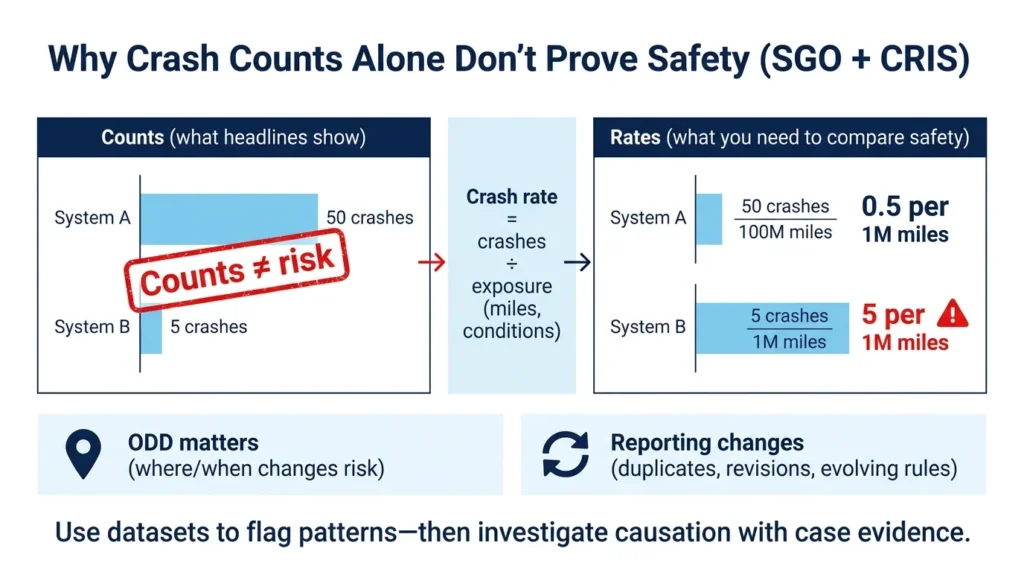
- No normalization by miles driven. This means you cannot compare crash counts without knowing exposure.
- No normalization by Operational Design Domain (ODD). This means systems that only operate in good weather on highways face different risks than those operating in dense urban traffic.
- Duplicates and revisions. This means reports can get updated, corrected, or duplicated.
- Evolving requirements. This means the reporting requirements change over time.
Can SGO Data Prove That Self-Driving Cars Are Safer Than Human Drivers?
Generally, no. To calculate crash risk with human drivers, you need exposure data, not just total crash counts.
Consider two systems: one with 50 crashes over 100 million miles, another with 5 crashes over 1 million miles. The first has more crashes, but a lower crash rate. As you can see, without miles and conditions, the comparison is meaningless.
Where and when these systems drive is also important. A system that only operates on sunny California highways faces different challenges than a system operating in Houston rush hour in the middle of a thunderstorm.
What the data can do is flag patterns worth investigating. If a particular system shows recurring crash types, that warrants attention, but patterns alone are not proof of causation.
Texas Crash Reporting: CR-3 Forms & the “Autonomous Unit” Fields
Texas crash data comes from what officers capture on CR-3 and CR-100 forms. These reports flow into CRIS, which shapes what researchers and attorneys can measure.
The CR-3 includes fields for “Autonomous Unit” and automation level engaged. In theory, this captures whether a vehicle had self-driving capability, and whether it was active at the time of the crash.
Often, these fields are incomplete or inconsistent. The officer records what they observed or were told at the scene, which may not match vehicle logs or manufacturer definitions. A driver might say “it was on Autopilot” without understanding what that means in a technical sense.
How to Get the Texas Crash Report & Why It’s Important
Obtaining your CR-3 early is crucial for several reasons: you can review it for errors, see what the responding officer wrote about automation, and identify any gaps that need additional evidence.
Beyond the autonomous unit fields, you should also check:
- Contributing factors listed
- The narrative section
- Unit descriptions
- Any citations issued
If the report seems incorrect about automation status or who was driving, document what you observed and speak with an attorney about preserving evidence before it disappears.
What the Data Can’t Prove & What Evidence Actually Does
Public datasets like the SGO and CRIS may be incomplete or non-standardized. Proving automation status in a specific Texas crash comes down to case-specific evidence.
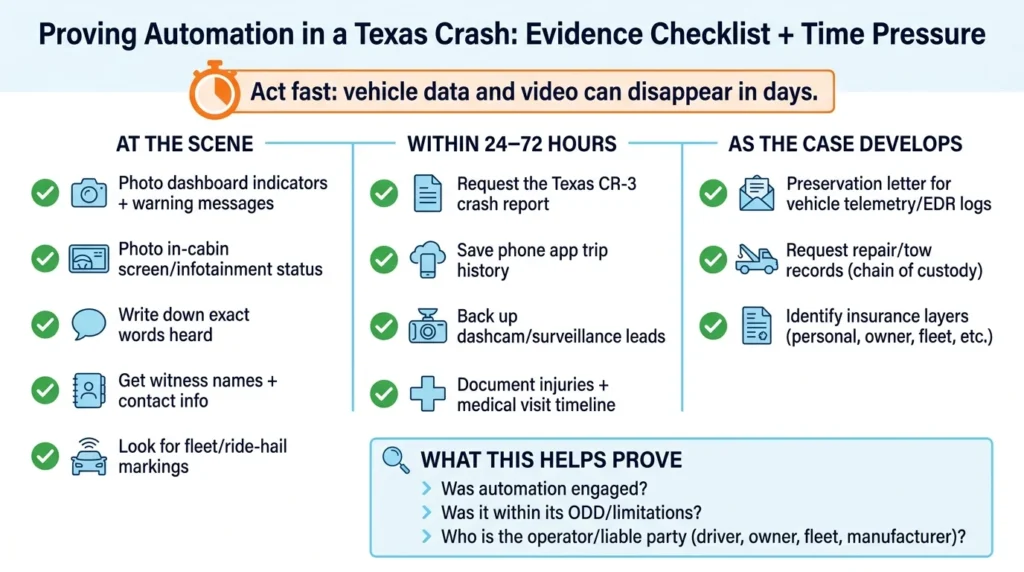
Sources of proof include:
- Vehicle telemetry and event data recorder information
- In-car alerts and infotainment screenshots
- Phone app trip history (for ride-hail or fleet vehicles)
- Dashcam or surveillance footage
- Witness statements detailing what the driver said at the time of the crash
Preservation is urgent. Vehicles may get repaired, data may get overwritten, and fleet vehicles may be returned to service. A delay of even a few days can erase critical logs. However, an attorney can send a preservation letter demanding that evidence be retained.
At the scene, make sure to take pictures of dashboard indicators, in-cabin screens, and any warning messages. Note what the driver says about “Autopilot” or “self-driving.” Identify any fleet markings or ride-hail company involvement.
Above all, make sure to get medical attention first if you’re injured.
Texas Liability Basics Regarding Automation
Whether an ADS is involved or not, Texas law still hinges on negligence, causation, and damages. Automation changes the facts, not the fundamentals.
Texas uses proportionate responsibility. If you’re found 51% or more at fault, you recover nothing. If you’re 20% at fault, your recovery is reduced by 20%. “Who had control” of the vehicle affects how fault percentages get assigned.
Texas Transportation Code addresses automated motor vehicles. When an ADS is engaged, the system is treated as the vehicle “operator” for traffic-law compliance purposes. This framing is important, but it doesn’t automatically resolve civil liability questions.
Potentially liable parties depend on the situation and may include:
- The human driver (especially with Level 2 ADAS)
- The vehicle owner
- An employer or fleet operator
- The car manufacturer or software developer
- Maintenance contractors
A Level 2 ADAS crash in which the driver wasn’t paying attention typically involves standard negligence analysis because the driver was supposed to supervise the system. An ADS fleet vehicle crash might involve company policies, remote monitoring failures, or system limitations.
Insurance & Compensation After an AV/ADAS Crash
Most victims are paid through insurance first. AV/ADAS involvement makes it harder to determine whose insurance policy applies.
Coverage layers may include:
- At-fault driver’s liability policy
- Vehicle owner’s policy (if different from driver)
- Commercial or fleet policies
- Your own UM/UIM coverage
- PIP or MedPay
Insurers in AV/ADAS cases often argue “driver error,” “feature misuse,” “system limitation,” or “no proof that it was engaged.” However, strong documentation counters these arguments.
Damages include medical bills, lost wages, and pain and suffering. Early documentation is critical regardless of whether automation was involved. Our case results show what thorough preparation can achieve.
When to Talk to a Texas Attorney After an AV/ADAS Crash
Evidence preservation and multi-party liability questions are time-sensitive. Getting legal representation early on can help ensure that important evidence isn’t lost.
Consider immediate legal action if:
- You suffered severe injuries
- A commercial or fleet vehicle was involved
- Fault is being disputed
- The vehicle is being towed, repaired, or returned to a fleet quickly
An attorney can send preservation letters, coordinate with investigators, review your crash report for errors, and handle insurance communication so that you don’t say something that accidentally hurts your claim.
At Angel Reyes & Associates, we’ve spent over 30 years helping Texas families after serious crashes. We offer free consultations, and we charge no fee unless we win. We can handle the majority of your case remotely, and we serve clients across our more than 20 Texas locations.
If a crash involving driver-assist or self-driving technology left you injured, contact us to discuss your options.
Past results do not guarantee future outcomes.
Self-Driving Accident FAQs
Can you sue a car manufacturer after a self-driving or driver-assist crash in Texas?
Possibly, but only if the facts support a product-related claim (such as a design defect, manufacturing defect, or inadequate warning system). These cases are often more complex than ordinary car crash claims because they may require technical evidence about how the system was designed and how it performed.
What if the other driver says the car was driving itself, but the police report is unclear?
A police report is important, but it is not the final word on what happened. Video footage, vehicle data, app records, witness statements, and repair or fleet records may help clarify whether an automated feature was actually active at the time of the crash.
Do black boxes record whether driver-assistance features were turned on?
Sometimes, but not every vehicle stores the same kind of data or keeps it for the same length of time. The available information can depend on the make, model, software, and whether the vehicle or company still has access to the logs.
Are robotaxis or company-owned self-driving vehicles insured differently than private cars?
Often, yes. A fleet-operated vehicle may have commercial coverage or layered policies that differ from a personal auto policy, which can affect how a claim is investigated and paid.
Does a software update have any affect on a claim after an autonomous vehicle crash?
Yes, it can, because the update history may help show what the system was supposed to do, whether known issues were addressed, and whether the vehicle was operating with the latest version. This does not automatically prove fault, but it can become an important part of the evidence.
About the Authors

Angel Reyes
Writer
Angel L. Reyes, III is the Founder and Managing Partner of Angel Reyes & Associates. A nationally recognized trial attorney and business leader, Angel has helped over 70,000 injury victims recover more than $1 billion since founding the firm in 1993. Named to the Texas Super Lawyers list annually since 2008, Angel brings Wall Street experience, Ivy League education, and a deep commitment to client advocacy. He is a frequent legal commentator and published author with extensive contributions to legal scholarship, trial strategy, and consumer protection.

Kyle Nicolas
Editor
Kyle Nicolas is the Web Content & SEO Manager at Angel Reyes & Associates. He has more than 10 years of experience as a marketing co...

Angel Reyes
Reviewer
Angel L. Reyes, III is the Founder and Managing Partner of Angel Reyes & Associates. A nationally recognized trial attorney and business...