May Is Motorcycle Safety Awareness Month: Stay Alert & Save a Life!


Every article on this site is researched by our internal team, reviewed for legal accuracy against current Texas law, and held to State Bar of Texas advertising standards before publication. We do not publish content that overstates outcomes or makes promises about results.
Learn more about our
editorial standards .
Key Takeaways
- Motorcyclists are significantly overrepresented in Texas traffic fatalities, making up over 14 percent of all 2025 deaths despite being less than 2 percent of registered vehicles.
- Motorcyclists are typically not at fault for accidents. The most common cause of crashes is another driver failing to see the motorcycle before turning or merging.
- Texas’s two-year statute of limitations means injured motorcyclists must act promptly or risk losing the right to seek compensation entirely.
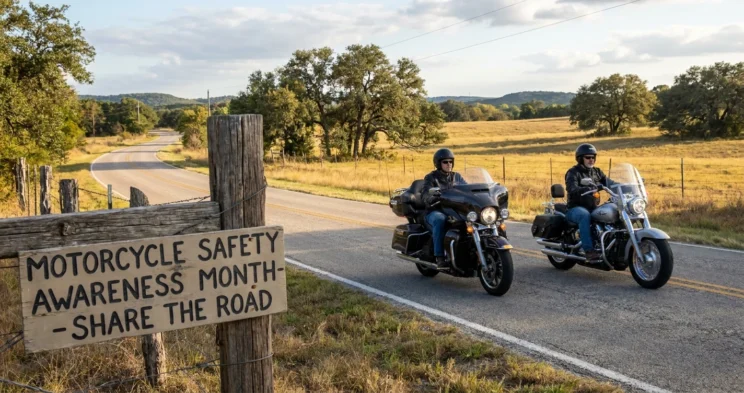
Every year, Texas loses hundreds of motorcyclists to crashes on its roads. If you’ve ever driven on I-35, navigated the Dallas North Tollway through Addison, or merged onto a busy street during rush hour, you have shared the road with riders whose survival depends, in part, on decisions you make behind the wheel.
Studies consistently show that when a motorcycle and another vehicle collide, the other driver is at fault more often than the rider. May is Motorcycle Safety Awareness Month, and it exists as much for drivers as it does for riders.
What Is Motorcycle Safety Awareness Month?
Every May, federal and state safety agencies focus their efforts on reducing deaths and injuries involving motorcyclists. The National Highway Traffic Safety Administration (NHTSA) leads a national push to raise awareness and change driving behavior, not just increase knowledge.
In Texas, TxDOT runs its Look Twice for Motorcycles campaign each spring. The premise is direct: motorcycles are harder to spot in traffic, and that difficulty costs riders their lives. The campaign urges drivers to take a second, deliberate look before changing lanes, making turns, or pulling into traffic.
Why Motorcyclists Face Greater Risk on Texas Roads
A motorcycle offers no structural protection around the rider. There are no airbags, no crumple zones, and no door panels to absorb an impact. When a collision happens, the rider absorbs the full force of it.
Motorcycle crash injuries tend to be severe precisely because riders have no barrier between their bodies and the road, which also contributes to an increased fatality rate.
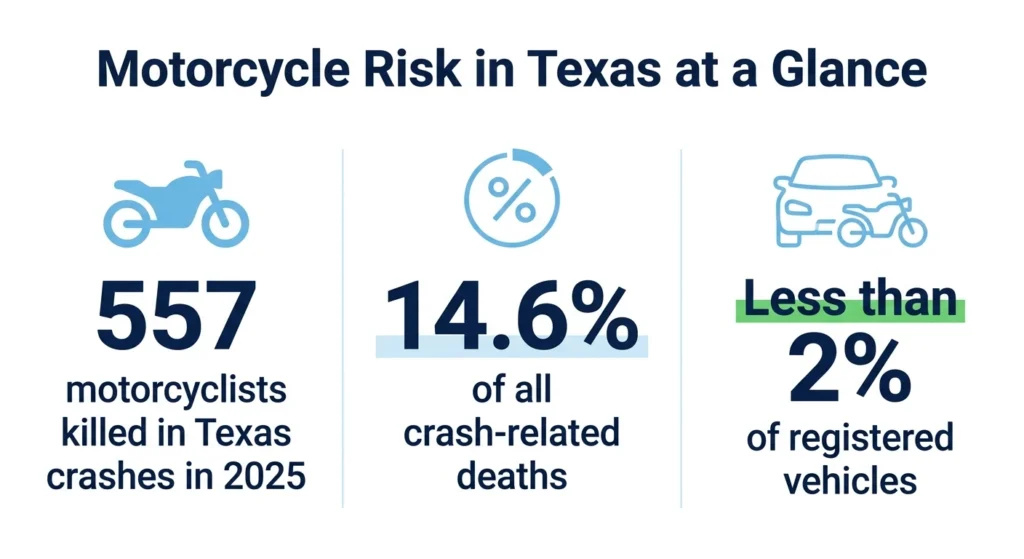
Motorcyclists are significantly overrepresented in Texas traffic fatalities relative to how many miles they travel. According to TxDOT, 557 riders lost their lives in motorcycle accidents in 2025, accounting for 14.6 percent of all crash-related deaths. This is despite motorcycles making up an estimated less than two percent of all registered vehicles in the state.
The most common cause of motorcycle crashes is not rider error. Studies consistently show that the other driver is often at fault, typically because they failed to see the motorcycle before turning, merging, or pulling out of a side road. Speed perception is another major factor: drivers frequently misjudge how quickly a motorcycle is approaching, leaving no time to correct a mistake.
What Texas Law Requires for Motorcycle Riders
Texas requires helmets for some riders, but not all. Under Texas Transportation Code § 661.003, a helmet is legally required for:
- All riders under 21 years of age, regardless of training or experience
- Riders 21 or older who have not completed an approved motorcycle operator safety course
- Riders 21 or older who do not carry at least $10,000 in qualifying medical benefits coverage
If you are 21 or older and meet one of the two exemptions above, Texas law permits riding without a helmet. But that legal permission does not make it safe. Helmets remain one of the most effective protections against fatal head injuries in a crash.
Texas law also requires motorcycle headlamps to remain on at all times during operation. This requirement helps increase a rider’s visibility in traffic, particularly in the glare-heavy conditions common along Texas highways.
How Drivers Can Help Prevent Motorcycle Crashes
Motorcycle Safety Awareness Month is as much a message for car and truck drivers as it is for riders. Many motorcycle crashes are entirely preventable when drivers adopt a few deliberate habits.
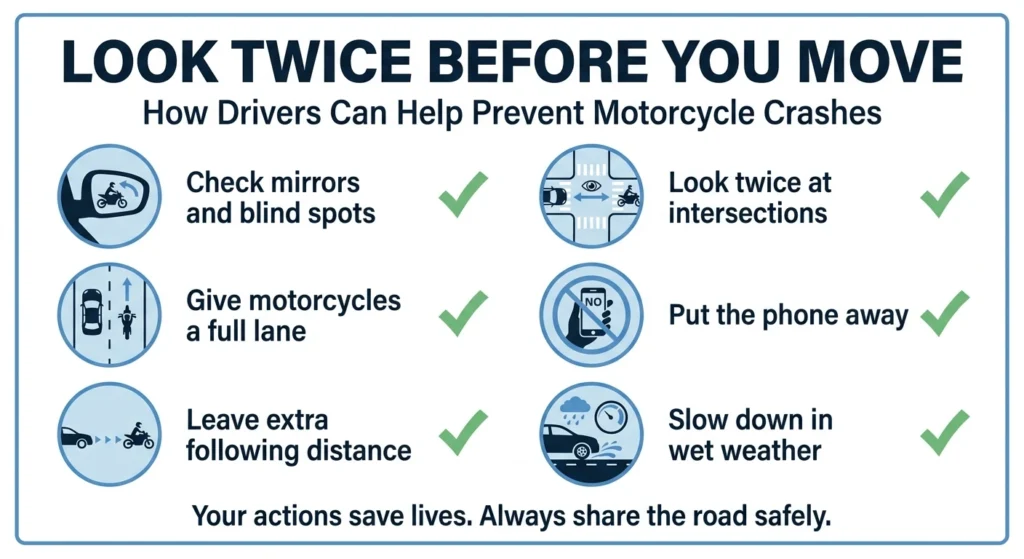
Steps every driver can take to protect motorcyclists:
- Look twice before changing lanes. Mirrors have blind spots. Turn and look.
- Give motorcycles a full lane. Motorcycles are entitled to the full lane width, and lane splitting is illegal in Texas. Do not share or squeeze past them.
- Leave extra following distance. Motorcycles can stop faster than most passenger vehicles.
- Look specifically for motorcycles at intersections. Small profiles are easy to miss, so check twice before turning across oncoming traffic.
- Put the phone away. Distracted driving is one of the leading causes of crashes involving vulnerable road users.
- Slow down in wet weather. Rain and painted road markings create additional hazards for riders. Give them more space.
These aren’t complicated changes. Each one takes less than a second and can mean the difference between a close call and a life-altering crash.
What to Do After a Motorcycle Crash in Texas
The steps you take immediately after a motorcycle crash can significantly affect your ability to recover compensation.
First, seek medical attention right away, even if your injuries seem minor. Adrenaline can mask pain, and some injuries, including internal bleeding and traumatic brain injuries, do not show symptoms immediately. A medical record tied to the date of the crash becomes critical evidence in any claim.
Second, document the scene if you are physically able. Photograph vehicle positions, road conditions, any visible traffic controls, and your injuries. Collect the other driver’s contact and insurance information and get names and contact details from any witnesses.
Third, be careful about recorded statements to insurance adjusters. Insurance companies are businesses, and their goal is to resolve claims for the lowest possible payout. A recorded statement taken in the days after a crash can be used against you. Speak with an attorney before giving one.
Texas’s statute of limitations for personal injury claims is two years from the date of the crash under Texas Civil Practice and Remedies Code § 16.003. Missing that deadline typically means losing the right to seek compensation entirely.
If a Motorcycle Crash Changed Your Life, We Can Help
Motorcycle crashes often produce some of the most serious injuries a person can survive: spinal damage, amputations, traumatic brain injuries, and wrongful death. The road to physical recovery is hard enough without also fighting an insurance company for fair compensation.
At Angel Reyes & Associates, we have spent over 30 years representing Texans injured in motorcycle crashes and other serious collisions. We have recovered more than $1 billion for clients across the state in cases ranging from minor accidents to catastrophic crash injuries. We offer free initial consultations and represent clients on a no-fee-unless-we-win basis.
Our attorneys can handle your case remotely from anywhere in Texas, and we offer service in Spanish as well. Reach out to us today to talk through your options. You deserve someone in your corner.
About the Authors

Spencer Browne
Writer
Spencer Browne is a partner at Angel Reyes & Associates and a Board Certified personal injury trial lawyer with nearly 100 jury trials across Texas. He focuses on car, truck, and wrongful death cases, with notable verdicts including a landmark win in the Choctaw Casino bus crash case. A recognized speaker and legal educator, Spencer is a member of the American Board of Trial Advocates and has been honored as a Texas Super Lawyer and one of D Magazine’s Best Lawyers in Dallas. He brings deep trial experience and relentless advocacy to every client he represents.

Kyle Nicolas
Editor
Kyle Nicolas is the Web Content & SEO Manager at Angel Reyes & Associates. He has more than 10 years of experience as a marketing co...

Angel Reyes
Reviewer
Angel L. Reyes, III is the Founder and Managing Partner of Angel Reyes & Associates. A nationally recognized trial attorney and business...