Rideshare Accidents with Child Passengers in Texas


Every article on this site is researched by our internal team, reviewed for legal accuracy against current Texas law, and held to State Bar of Texas advertising standards before publication. We do not publish content that overstates outcomes or makes promises about results.
Learn more about our
editorial standards .
Key Takeaways
- Texas law exempts Uber and Lyft drivers from child safety seat requirements under Transportation Code § 545.412.
- When a child is injured during an active rideshare trip, up to $1 million in liability coverage applies under Texas Insurance Code Chapter 1954.
- Texas tolls the statute of limitations for minors, giving parents time to file but not a reason to wait.
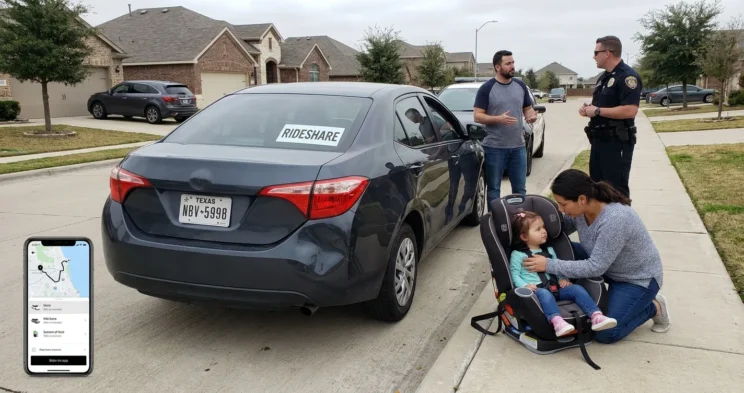
You booked an Uber for a quick trip across Austin with your seven-year-old riding beside you. As you crossed South Congress Avenue, another driver ran a red light and slammed into the vehicle. Your child was hurt. Now you’re dealing with medical appointments, insurance adjusters, and questions about who is liable for your child’s injuries.
Texas Car Seat Law Does Not Cover Rideshares
Texas generally requires children under 8 years old and shorter than 4 feet 9 inches to ride in an approved child safety seat. However, Texas Transportation Code § 545.412 creates an exception for drivers who transport passengers for hire. Uber and Lyft drivers, along with taxis, are not required by law to have a car seat in the vehicle or to enforce its use.
The Texas Department of State Health Services confirms that rideshare drivers fall within this exception. The driver faces no statutory penalty for picking up your child without a seat installed. There is also no explicit Texas car seat law that sets a specific age when a child can legally sit in the front seat.
The exemption does not mean you lose the right to pursue a claim if your child is injured in a rideshare crash. It means that liability is usually determined by other factors, like who caused the collision, whether the driver acted negligently, and what insurance coverage applied at the time of the crash.
Who Is Liable When a Child Is Hurt in a Rideshare?
Liability in a rideshare crash depends on who caused the accident and what the driver was doing at the time of impact. Uber and Lyft classify their drivers as independent contractors, which limits direct employer liability. However, the companies’ commercial insurance policies apply regardless of that classification.
Knowing how Uber and Lyft insurance coverage periods work is your starting point for any claim involving a child passenger.
Rideshare Insurance Coverage Periods
The amount of coverage available shifts dramatically depending on the driver’s app status at the moment of the crash. Texas Insurance Code Chapter 1954 establishes different coverage requirements based on the driver’s status at the time of the crash.
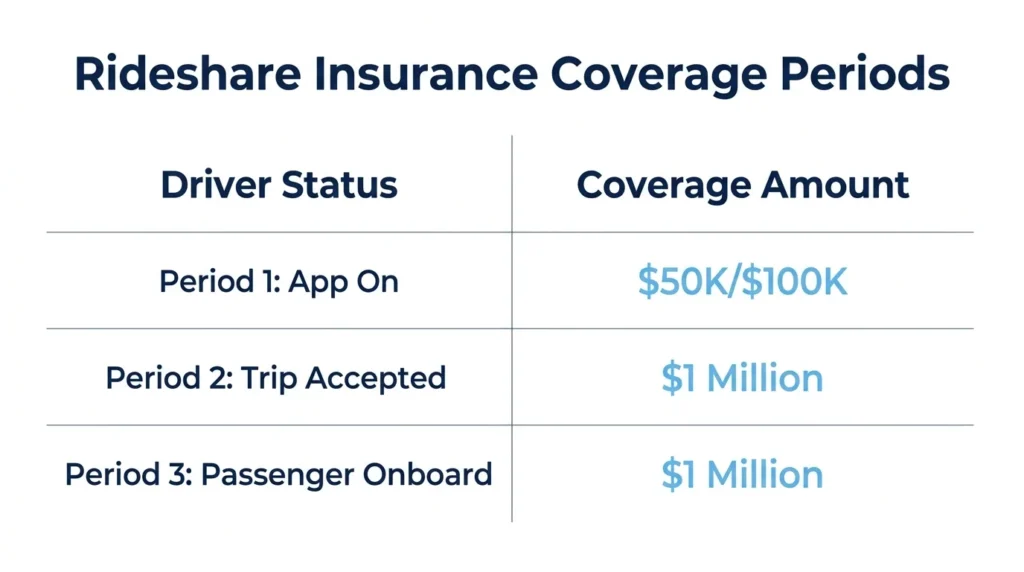
When a driver has accepted a ride request or is actively transporting a passenger (Periods 2 and 3), Uber and Lyft provide up to $1 million in liability coverage. If your child was injured while riding in the vehicle, this is usually the coverage that applies.
Coverage is lower during Period 1, when the driver is logged into the app but has not yet accepted a ride request. During that stage, Texas law requires at least $50,000 in bodily injury coverage per person and $100,000 per accident.
Other Parties Who May Share Liability
The rideshare driver is not the only party that may bear responsibility. If another driver caused the crash, their insurer becomes a primary recovery source for your child’s injuries.
You can also pursue a direct negligence claim against Uber or Lyft if the driver had a known history that the platform failed to screen adequately. That theory bypasses the independent contractor argument. Texas uses a modified comparative fault system, which means fault can be split across parties. A child passenger is rarely at fault.
Special Rules for Child Injury Claims in Texas
When the injured person is a minor, Texas law provides specific protections that do not apply to adult rideshare accident claims.
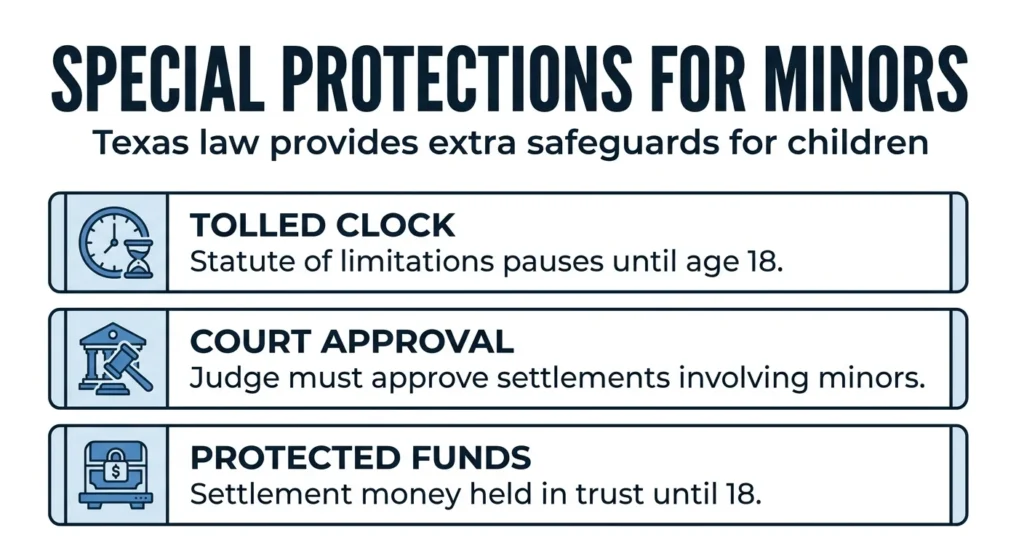
Texas Civil Practice and Remedies Code (CPRC) § 16.001 often tolls the two-year statute of limitations for minors. The filing clock does not start until the child turns 18.
That means your child may technically have until their twentieth birthday to file a personal injury lawsuit. However, parents and legal guardians can bring a claim on a child’s behalf much sooner, and waiting is rarely beneficial. Evidence disappears, witnesses move, and memories become less reliable over time.
Texas courts also require judicial approval before a settlement involving a minor becomes final. A judge must determine that the settlement serves the child’s best interests before it can be approved.
Those protections exist because childhood injuries can have consequences that are difficult to measure immediately. Developmental delays, learning difficulties, future medical needs, and lasting physical limitations may not become fully apparent until months or years after the crash.
Why Child Injury Claims Can Be Worth More Than Expected
A child’s injury claim often involves more than the medical bills generated immediately after the crash. Some injuries require ongoing treatment, therapy, educational accommodations, or future medical care that extends well beyond the initial recovery period.
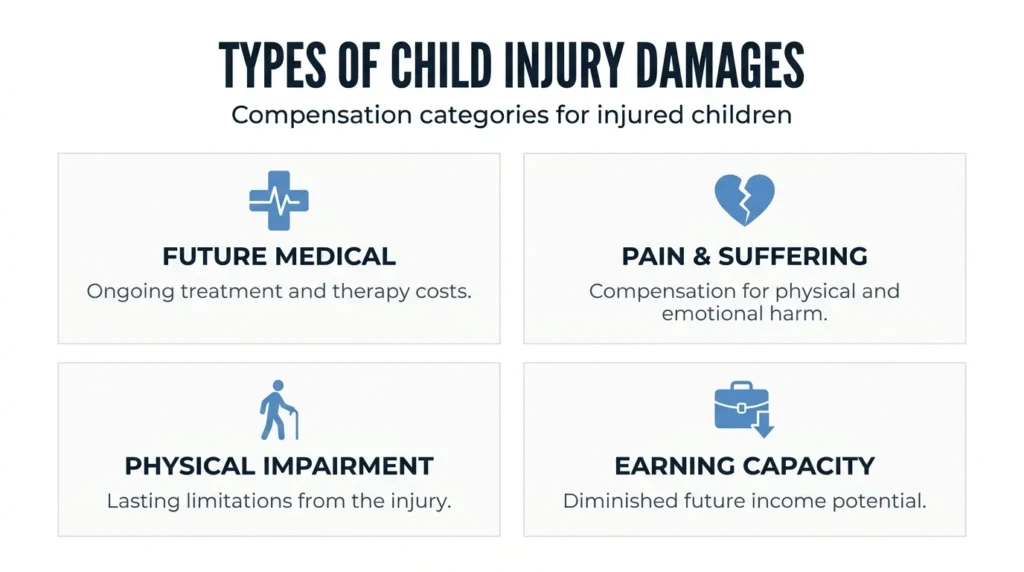
Because children have many years ahead of them, Texas law allows claims to account for losses that may affect them long into the future. Depending on the injury, damages may include future medical expenses, pain and suffering, physical impairment, and diminished earning capacity later in life.
In some cases, Texas law also allows exemplary damages. Texas Civil Practice and Remedies Code Chapter 41 requires clear and convincing evidence that the defendant acted with gross negligence, fraud, or malice. Ordinary negligence is not enough.
In Uber accident claims, gross negligence arguments tend to center on the platform rather than the individual driver. If Uber or Lyft retained a driver with a known history of dangerous behavior, or if screening processes broke down in a way that put a foreseeable danger behind the wheel, that conduct could support the argument.
While exemplary damages are uncommon, the long-term effects of a serious childhood injury can still result in significant compensatory damages. The focus is often on understanding not just the harm your child has suffered today, but the challenges they may face years into the future.
Even without exemplary damages, a child’s compensatory claim can be large. Future medical care, lost earning capacity over a lifetime, and pain and suffering calculated across decades all factor into what a serious child injury claim is worth.
Work with an Injury Attorney
A rideshare accident involving a child raises legal issues that do not exist in most car accident claims. Questions about insurance coverage, liability, court approval of settlements involving minors, and the impact of a child’s injuries can all affect the outcome. If you’re unsure what to do after a rideshare accident when your child is involved, acting early can help.
Angel Reyes & Associates has handled rideshare accident cases and personal injury claims for Texans for over 30 years. Our case results show examples of prior recoveries for injured Texans. Our team can review your situation, assess which parties may be liable, and help build the documentation your child’s claim requires.
Reach out to us for a free consultation.
Past results do not guarantee future outcomes.
Child Rideshare Accident FAQs
What happens to a child's settlement money after a Texas court approves it?
When a judge approves a minor’s personal injury settlement, the child’s funds go into a restricted trust or a court-controlled account, not directly to the parent. The child can access the money when they turn 18, and a parent or guardian can petition for early withdrawal only if the funds will be used for the child’s direct benefit, such as medical care or therapy.
Does bringing your own car seat to an Uber change your legal position if there is a crash?
Bringing and properly securing your own car seat is the safer choice for your child, but it does not eliminate your right to pursue a claim if the driver caused the crash. Your ability to recover compensation for your child’s injuries depends on who caused the accident and what the driver’s app status was at the time, not on whether a car seat was present.
What if the Uber driver's app was off when the crash happened?
If the driver was not logged into the Uber app at the time of the crash, Uber’s commercial insurance policy does not apply. Your recovery would depend on the driver’s personal auto insurance policy, which may have lower limits or exclude rideshare-related activities depending on its terms.
Can a parent recover compensation for their own injuries in the same claim as their child's?
Yes. A parent who was also injured in the same rideshare crash can pursue their own personal injury claim alongside the one filed on the child’s behalf. The two claims are legally separate, and each is evaluated based on the individual’s injuries, medical costs, and other losses.
Does Uber offer a car seat option in Texas?
Uber Car Seat is a service that provides a vehicle with a car seat installed. Still, it is only available in select cities, including New York City, Washington DC, Philadelphia, and a few others. Texas cities are not included, which means parents in Texas must bring their own seat when traveling by rideshare with a young child.
About the Authors

Angel Reyes
Writer
Angel L. Reyes, III is the Founder and Managing Partner of Angel Reyes & Associates. A nationally recognized trial attorney and business leader, Angel has helped over 70,000 injury victims recover more than $1 billion since founding the firm in 1993. Named to the Texas Super Lawyers list annually since 2008, Angel brings Wall Street experience, Ivy League education, and a deep commitment to client advocacy. He is a frequent legal commentator and published author with extensive contributions to legal scholarship, trial strategy, and consumer protection.

Graham Griffin
Editor
Graham Griffin is the Web & Content Manager at Angel Reyes & Associates, where he oversees content strategy, AI-powered workflows, a...

Angel Reyes
Reviewer
Angel L. Reyes, III is the Founder and Managing Partner of Angel Reyes & Associates. A nationally recognized trial attorney and business...