What Happens If Your Uber Gets in an Accident?


Every article on this site is researched by our internal team, reviewed for legal accuracy against current Texas law, and held to State Bar of Texas advertising standards before publication. We do not publish content that overstates outcomes or makes promises about results.
Learn more about our
editorial standards .
Key Takeaways
- Uber's $1 million liability policy covers injured passengers during an active Period 3 trip in Texas.
- Texas gives injured Uber passengers two years from the crash date to file a personal injury suit.
- Don’t give recorded statements to Uber's adjusters, and document every detail at the scene before leaving.
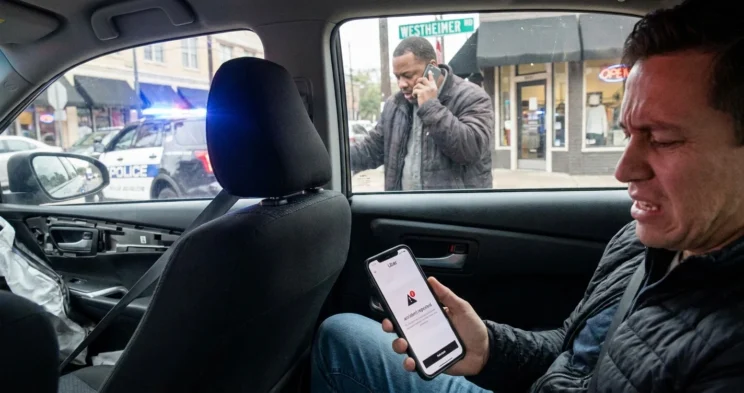
You were heading to a meeting in Uptown Houston when your Uber driver got T-boned at a light near Westheimer Road. The airbags fired, your phone slid under the seat, and the trip in the app just ended. Now your neck hurts, the driver is on the phone with someone, and no one has told you who pays for what.
What Happens Right After an Uber Crash
The trip effectively ends at the point of impact. Your driver must stop, check on you, and call 911 if anyone is hurt. Stay at the scene until police arrive and file their report on the accident.
Leaving early weakens any injury claim you may need to make later. The first 30 minutes set the foundation for everything that follows, so it’s important to know what to do after a rideshare accident in Texas.
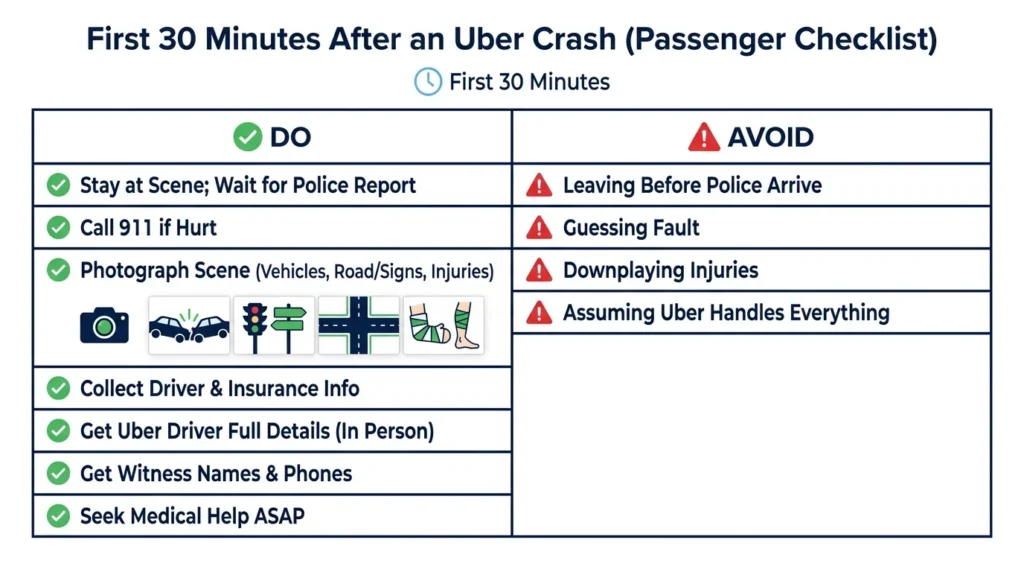
Take photos of both vehicles, the surrounding road, any signage, and any visible injuries. Get the other driver’s name, license plate, and insurance information directly from them. The Uber app shows your driver’s first name only, so collect full details in person.
Ask any witnesses for their names and phone numbers before they leave. Witness contact information is rarely available later.
Get checked out by a doctor even if you feel fine. Soft tissue injuries and concussions often surface hours or days after a crash. If you don’t see a doctor right away, that gap in treatment gives insurers an opening to argue your injuries came from something else.
How Uber’s Insurance Coverage Periods Work
Uber’s two coverage periods decide which policy pays your medical bills. The period depends on what the driver was doing in the app at the moment of the crash.
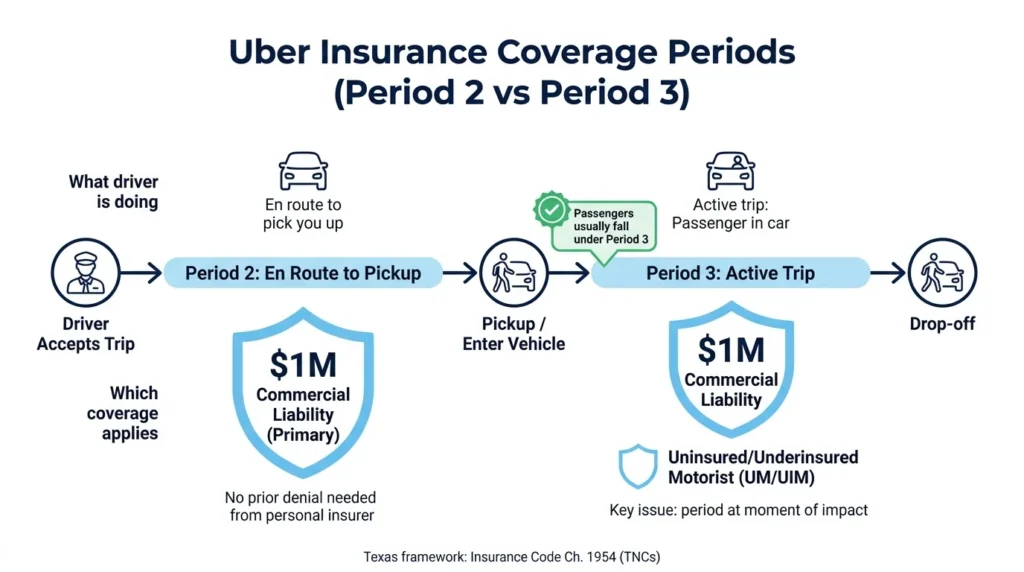
As an active passenger, you are almost always covered under the highest tier of Uber’s insurance, but knowing the structure helps you push back if an adjuster tries to apply the wrong policy.
Period 2 Coverage: Driver En Route to Pick You Up
Period 2 runs from the moment your driver accepts the trip until you get in the car. Uber’s commercial policy is active during this window but at lower limits than the on-trip policy.
Uber’s $1 million commercial liability policy is the primary coverage during Period 2 and does not require a prior denial from the driver’s personal insurer.
Period 3 Coverage: During Your Active Trip
Period 3 runs from the moment you enter the vehicle through drop-off. Uber’s $1 million commercial liability policy is still active in period 3. Most injured passengers are riding under this layer at the time of the crash.
Uninsured and underinsured motorist coverage also applies during Period 3. That matters when the at-fault driver carries no insurance or their coverage limits are too low to cover your injuries. The Texas Insurance Code Chapter 1954 sets the statutory insurance framework for transportation network companies operating in Texas.
Many Texas rideshare accident claims depend on which period applied at the moment of impact.
How to Report the Crash Through Uber’s App
Uber’s Safety Toolkit lets you report a crash inside the app. The report triggers an internal review and may prompt Uber’s claims team to contact you. File the report promptly, but keep it factual, reporting the:
- Date
- Time
- Location
- Crash occurred
Do not characterize your injuries or accept any version of fault.
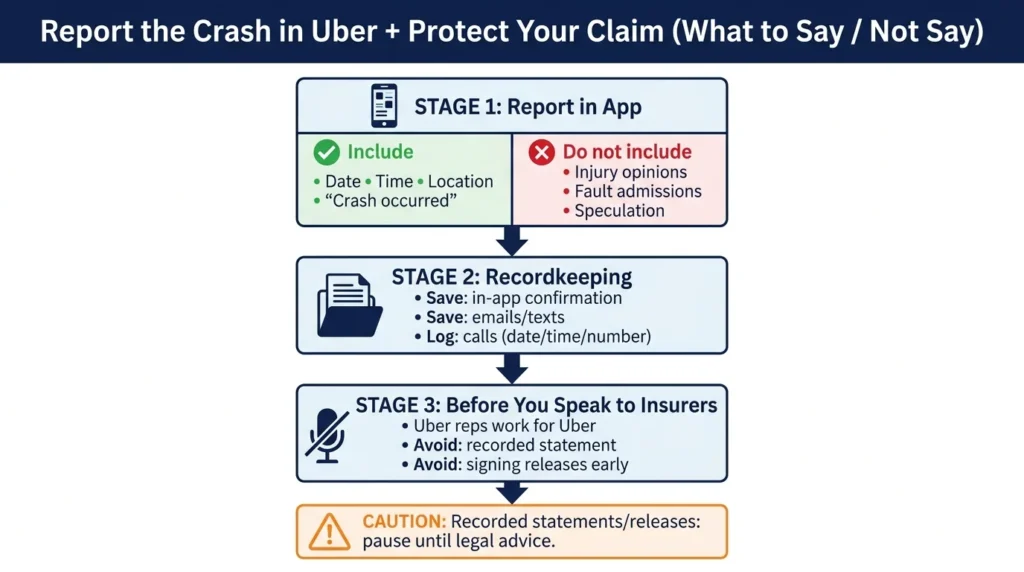
Save the in-app confirmation. Save every email, text, or call log from Uber and any insurer. These records often matter later if adjusters dispute the timeline.
Uber’s claims representatives work for Uber, not for you. Avoid giving a recorded statement or signing any release before talking to an attorney. Insurers could use your early statements to minimize what your claim is worth and give you a lowball offer under the average settlement for an Uber accident in Texas. Your settlement depends heavily on how cleanly the early record was preserved.
Uber’s official guidance on what to do after a crash describes the in-app reporting flow in more detail.
Filing Deadlines for Texas Rideshare Injury Claims
Texas gives most injured passengers two years from the crash date to file a personal injury lawsuit. The rule comes from the Texas Civil Practice and Remedies Code (CPRC) § 16.003. Miss that window and your right to recover compensation is almost always gone, no matter how strong the case is.
The clock starts on the date of the crash. It does not start on the date a doctor diagnoses your injury or the date you send a demand letter. Settlement talks with Uber’s insurer don’t pause the deadline either.
There are a few narrow exceptions for claims involving minors and certain delayed-discovery situations. But don’t rely on these without specific legal advice. The safe assumption is that you have a firm two-year window from the day of the crash.
Two years can feel like plenty of time, but medical treatment, insurer negotiations, and evidence gathering eat through it quickly. Speaking with a Texas attorney who handles car accident claims early gives you room to build your case without racing the calendar.
Talk to a Texas Rideshare Accident Attorney
Angel Reyes & Associates handles rideshare injury claims across Texas. With over 30 years of experience and more than $1 billion recovered for clients, our attorneys know how Uber’s insurance layers work and how to push back when adjusters try to underpay. Past results do not guarantee future outcomes.
We offer free consultations and work on contingency, meaning no fee unless we win. You can review our verdicts and settlements to see the kinds of outcomes we have secured for injured Texans. We can handle most of your case remotely, and our team is available 24/7. Contact us today to talk through what happened and what your next step looks like.
Uber Accident FAQs
Can I use my own health insurance to pay for medical care after an Uber crash?
Yes, your personal health insurance can cover treatment costs while your injury claim is still being worked out. You or your attorney can later seek reimbursement of those costs from the at-fault party’s insurer through a process called subrogation.
Does Uber's insurance cover a passenger if the Uber driver was at fault for the crash?
Yes. Uber’s Period 3 commercial liability policy covers passengers regardless of which driver caused the crash. The policy follows the trip, not the question of fault.
Can I still recover compensation if I was not wearing a seatbelt during the Uber crash?
Texas follows a proportionate responsibility system, so not wearing a seatbelt can reduce your recovery if it is found to have contributed to your injuries. However, it does not automatically bar you from recovering compensation if another party was primarily at fault.
What if the Uber driver had a suspended license at the time of the crash?
Uber’s commercial insurance policy generally remains in effect for passengers during an active trip even if the driver had a suspended license, because coverage follows the transportation network company (in this case, Uber’s) platform period rather than the driver’s licensure status. The driver’s personal insurer, however, would likely deny any claim based on that violation.
Does reporting a crash through the Uber app start a formal insurance claim?
Filing an in-app crash report opens an internal Uber safety review but does not, by itself, file an insurance claim with Uber’s commercial insurer. You typically need to file a separate claim directly with the insurer, which is why saving all app confirmations and communication from Uber matters from the start.
About the Authors

Angel Reyes
Writer
Angel L. Reyes, III is the Founder and Managing Partner of Angel Reyes & Associates. A nationally recognized trial attorney and business leader, Angel has helped over 70,000 injury victims recover more than $1 billion since founding the firm in 1993. Named to the Texas Super Lawyers list annually since 2008, Angel brings Wall Street experience, Ivy League education, and a deep commitment to client advocacy. He is a frequent legal commentator and published author with extensive contributions to legal scholarship, trial strategy, and consumer protection.

Kyle Nicolas
Editor
Kyle Nicolas is the Web Content & SEO Manager at Angel Reyes & Associates. He has more than 10 years of experience as a marketing co...

Angel Reyes
Reviewer
Angel L. Reyes, III is the Founder and Managing Partner of Angel Reyes & Associates. A nationally recognized trial attorney and business...