Tesla Robotaxi Safety in Austin: What Texas Crash Victims Need to Know About SB 2807 & Liability


Every article on this site is researched by our internal team, reviewed for legal accuracy against current Texas law, and held to State Bar of Texas advertising standards before publication. We do not publish content that overstates outcomes or makes promises about results.
Learn more about our
editorial standards .
Key Takeaways
- NHTSA contacted Tesla after Austin Robotaxi videos showed erratic driving behavior, documenting federal safety scrutiny that may support crash victims' claims.
- Texas SB 2807 creates an authorization framework for commercial automated vehicles that becomes fully enforceable May 28, 2026, affecting liability and insurance analysis.
- Robotaxi crashes may involve multiple liable parties, and preserving digital evidence quickly is critical because vehicle data and footage can overwrite within days.
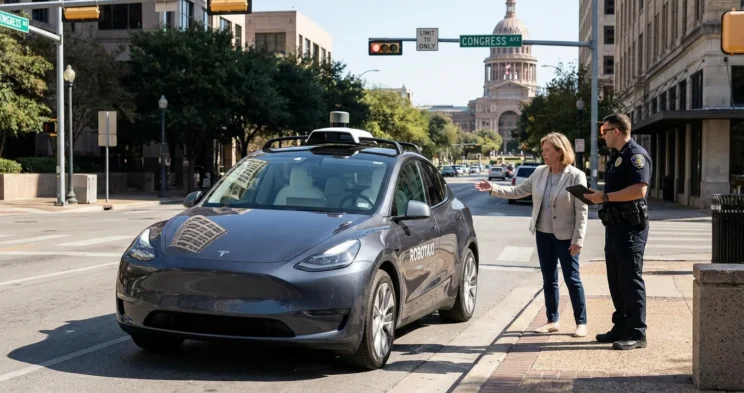
You’ve probably seen the news about Tesla’s driverless Robotaxis running in Austin with no one behind the wheel. Whether you’ve been hurt, you’re wondering about your rights, or you’re trying to understand how Texas law handles this, here’s what you need to know.
Tesla’s Robotaxi pilot program launched in Austin in mid-2025. Videos of erratic driving behavior quickly drew federal attention. Meanwhile, Texas passed SB 2807, creating a new authorization framework for commercial automated vehicles that becomes fully enforceable on May 28, 2026.
If you’ve been injured in a crash involving a Robotaxi in Austin, understanding both the safety concerns and the evolving legal landscape can help you protect your claim.
Austin Robotaxi Rollout Timeline & Safety Concerns
Tesla’s Austin operations progressed through several phases. The pilot launched in June 2025 with safety monitors present in vehicles. By December 2025, Tesla began testing without onboard safety monitors. In January 2026, Tesla expanded operations without onboard monitors.
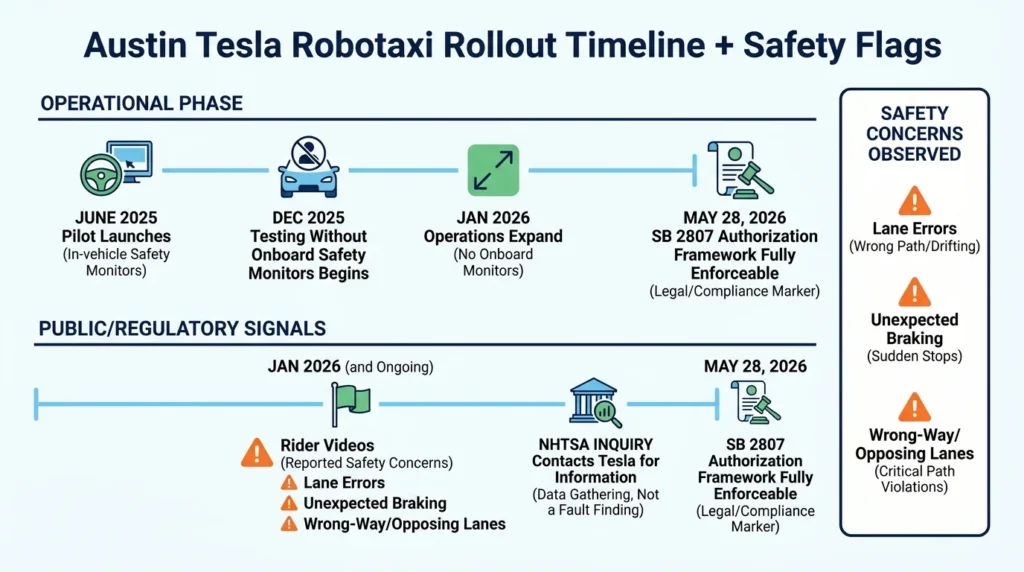
Early rider videos captured concerning behavior: lane selection errors, unexpected braking, and instances where vehicles appeared to travel in opposing lanes. These weren’t isolated clips. The pattern prompted the National Highway Traffic Safety Administration to contact Tesla seeking additional information.
NHTSA contact is not a finding of fault. It signals the agency is gathering data. For crash victims, this federal scrutiny matters because it documents that safety questions existed before your incident occurred. That timeline can support arguments that the company knew or should have known about the risk.
These behavior patterns are worth knowing whether you’ve already been in a crash or you’re deciding whether to use the service. The distinction between “safety driver,” “safety monitor,” and “fully driverless” operation affects liability analysis. When a human is present and expected to intervene, their actions (or failures) become relevant. When no human is onboard, the focus shifts entirely to the company’s systems, remote oversight, and corporate decision-making.
Are Self-Driving Cars Legal in Texas?
Yes. Texas permits automated vehicle operation under state law. Cities like Austin have limited ability to regulate core AV operations because Texas maintains a state-level framework.
SB 2807 creates a statewide authorization regime for commercial automated vehicle operations. The TxDMV Automated Vehicles Regulatory Program administers this framework. The authorization requirements become fully enforceable on May 28, 2026.
The enrolled SB 2807 bill text establishes what commercial AV operators must do to receive authorization. This includes safety and insurance compliance requirements.
For crash victims, the key question after May 28, 2026 becomes: was the robotaxi service properly authorized under Texas law at the time of your crash? Authorization status can affect available defenses and insurance coverage.
Texas traffic rules still apply to automated vehicles. The Texas Transportation Code Chapter 545 governs vehicle operation, and Subchapter J addresses automated vehicles specifically. A robotaxi that runs a red light, fails to yield, or drives unsafely violates the same rules that apply to human drivers. These violations can support negligence claims.
Who Is Liable When a Robotaxi Crashes in Texas?
This is the question that makes autonomous vehicle crashes legally complex. Multiple parties may share responsibility:
- The fleet operator or service provider running the robotaxi program
- The vehicle manufacturer if a design or manufacturing defect contributed
- The software developer if the autonomous driving system failed
- Remote assistance operators if human oversight failed
- Third-party drivers if another vehicle caused or contributed to the crash
- Maintenance providers if improper servicing played a role
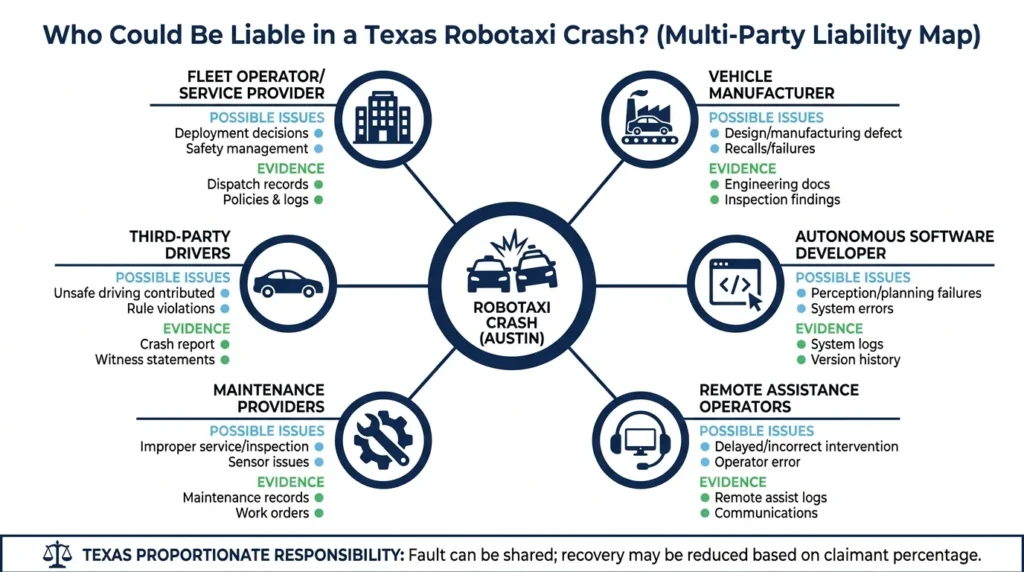
Texas uses proportionate responsibility rules. Multiple parties can share fault, and your recovery may be reduced by any percentage of fault assigned to you. Insurance companies and corporate defendants often try to shift blame early. Avoid giving recorded statements before speaking with an attorney.
When there’s no safety monitor onboard, fewer human witnesses exist to describe what happened. Claims become more dependent on digital evidence: vehicle telemetry, camera footage, remote assistance logs, and dispatch records. Preserving this evidence quickly is critical because some data may overwrite.
Our firm has experience handling complex vehicle accident cases. Past results do not guarantee future outcomes. We understand how to identify all potentially liable parties and pursue appropriate coverage.
Insurance Coverage After a Robotaxi Crash
Several insurance sources may apply to your claim:
- The robotaxi operator’s commercial liability policy
- Another driver’s liability coverage (if a third party contributed)
- Your own uninsured/underinsured motorist (UM/UIM) coverage
- Medical payments coverage or PIP (if applicable)
- Health insurance (with potential subrogation)
SB 2807 connects commercial automated vehicle operations to insurance requirements similar to those for transportation network companies. Texas Insurance Code Chapter 1954 addresses TNC insurance requirements and becomes relevant because the authorization framework incorporates these concepts.
If you were a passenger in a robotaxi, your claim process resembles a rideshare accident claim. Document your ride status, preserve app receipts, and screenshot any trip confirmations.
Insurance companies are businesses. Their goal is resolving claims for the lowest possible payout. Adjusters may pressure you for quick recorded statements or offer settlements before you understand your injuries’ full extent. They may also try to blame “software” or “technology” to complicate responsibility.
What to Do After a Robotaxi Crash in Austin
If a crash does happen, these steps protect your claim from the start.
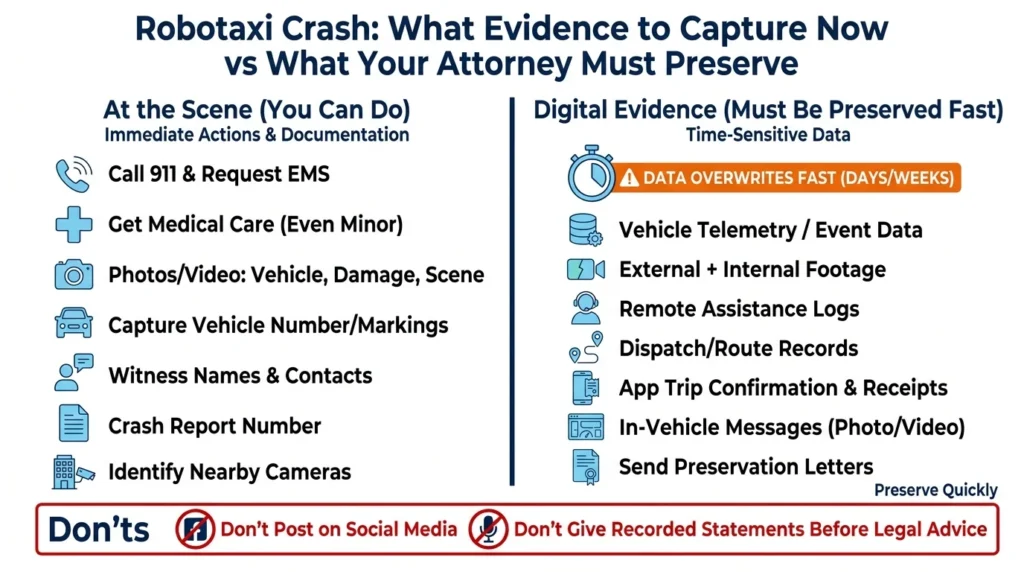
Immediate steps:
- Call 911 and request emergency medical services
- Get medical attention even if injuries seem minor
- Document the scene with photos and video
- Capture the robotaxi’s vehicle number and any visible markings
- Get contact information from witnesses
- Request the crash report number from responding officers
Evidence unique to robotaxi cases:
- Screenshot any ride app information or trip receipts
- Record video of traffic signals, lane markings, and signage at the scene
- Note any on-screen messages displayed in the vehicle
- Identify nearby businesses or residences that may have surveillance cameras
Preserve digital evidence quickly. An attorney can send preservation letters to relevant parties demanding retention of video footage, telemetry data, remote assistance logs, and dispatch records. Some of this data may overwrite within days or weeks.
If you were a passenger in the robotaxi, your documentation should include proof you were an authorized rider. If you were a pedestrian, cyclist, or driver of another vehicle, focus on scene evidence and identifying all possible camera sources.
Do not post about the crash on social media. Insurance defense teams monitor online activity. Statements about fault, your activities, or even your mood can be used against your claim. Protect yourself by staying offline until your case resolves.
How SB 2807 May Affect Your Claim Strategy
For crashes occurring after May 28, 2026, the SB 2807 authorization framework becomes fully enforceable and creates new avenues for investigating operator compliance. Whether the robotaxi service held a valid Texas authorization at the time of your crash is one of the first things your attorney should confirm.
Key questions to investigate through your attorney:
- Was the robotaxi service properly authorized under the Texas program?
- Did the operator comply with required safety management processes?
- Were incident response procedures followed?
- Does the operator maintain required insurance coverage?
Authorization status and compliance failures could strengthen liability arguments. The law continues to evolve. Rules applicable to your crash depend on when the incident occurred and what requirements were in effect at that time.
For crashes occurring before full enforcement, the analysis focuses more heavily on general negligence principles, product liability theories, and existing traffic law violations.
Talk to an Attorney Who Understands Complex Vehicle Cases
Robotaxi crashes involve corporate defendants, multiple insurance layers, and evidence that exists primarily in digital form controlled by the companies involved. These cases require prompt action and experience navigating commercial vehicle claims.
Angel Reyes & Associates has guided Texas injury victims for over 30 years. We’ve recovered more than $1 billion for our clients. We offer free consultations and work on contingency, meaning you pay no fee unless we win.
If you’ve been injured in a crash involving a Tesla Robotaxi or any autonomous vehicle in Austin or elsewhere in Texas, contact us today to discuss your options. We can help you understand your rights, identify all responsible parties, and pursue the compensation you deserve.
Past results do not guarantee future outcomes.
Tesla Robotoxi FAQs
Can I request records from Tesla or the robotaxi company after a crash?
You generally can ask for records through an insurance claim or legal process, but companies do not have to hand everything over informally. In cases involving serious injuries or disputed fault, formal evidence requests are often needed to seek logs, video, and system data.
Does Texas law treat an automated vehicle like a human driver for traffic-law purposes?
In many situations, yes, and the vehicle still has to follow ordinary traffic rules like lane use, yielding, and signaling. That matters because a crash can still be analyzed using familiar traffic-violation and negligence principles.
Will a federal investigation automatically help my injury claim?
Not by itself. A NHTSA inquiry may show regulators are looking at a safety issue, but your claim still depends on the facts of your own crash, your injuries, and the available evidence.
If I was not a passenger, can I still bring a claim after a robotaxi crash?
Yes. Pedestrians, cyclists, occupants of other vehicles, and sometimes property owners may have claims if an automated vehicle caused harm, though the proof needed will depend on how the incident happened.
What if the robotaxi company says the crash was caused by road construction or bad lane markings?
That does not automatically end your claim. In Texas, fault can be shared among multiple parties, so the evidence may need to address both the vehicle’s behavior and whether road conditions or another party also contributed.
About the Authors

Angel Reyes
Writer
Angel L. Reyes, III is the Founder and Managing Partner of Angel Reyes & Associates. A nationally recognized trial attorney and business leader, Angel has helped over 70,000 injury victims recover more than $1 billion since founding the firm in 1993. Named to the Texas Super Lawyers list annually since 2008, Angel brings Wall Street experience, Ivy League education, and a deep commitment to client advocacy. He is a frequent legal commentator and published author with extensive contributions to legal scholarship, trial strategy, and consumer protection.

Graham Griffin
Editor
Graham Griffin is the Web & Content Manager at Angel Reyes & Associates, where he oversees content strategy, AI-powered workflows, a...

Angel Reyes
Reviewer
Angel L. Reyes, III is the Founder and Managing Partner of Angel Reyes & Associates. A nationally recognized trial attorney and business...