Who’s Liable After a Texas Air Taxi (Part 135) Crash?


Every article on this site is researched by our internal team, reviewed for legal accuracy against current Texas law, and held to State Bar of Texas advertising standards before publication. We do not publish content that overstates outcomes or makes promises about results.
Learn more about our
editorial standards .
Key Takeaways
- Air taxi crashes typically involve multiple defendants: the operator, pilot, and maintenance firms.
- Texas bars recovery if you are found more than 50% at fault, making full identification critical.
- Finding the actual Part 135 certificate holder and preserving records are your two earliest steps.
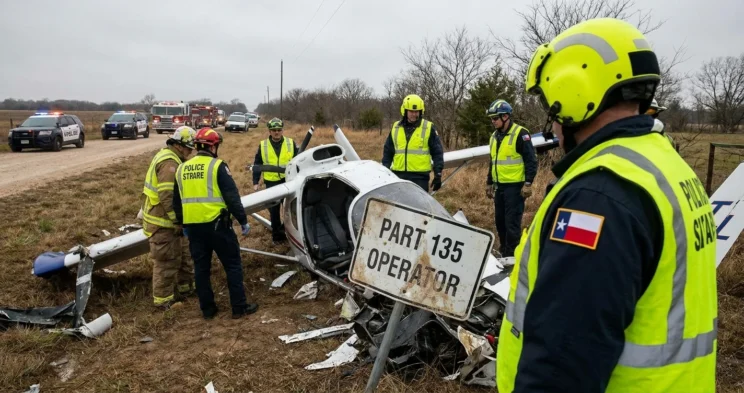
You’ve seen the headlines about air taxis coming to Texas cities. Maybe you spotted a test aircraft near one of the Houston-area airports or read about planned routes in the DFW corridor. Before these flights carry paying passengers, it’s worth understanding who is legally responsible when something goes wrong.
Air taxi operations will involve a web of overlapping parties: operators, pilots, brokers, maintenance providers, and sometimes government entities. Texas law already has a framework for sorting out fault among them.
What “Air Taxi” Means & Why Part 135 Status Matters for Liability
Most on-demand charter flights are expected to operate under FAA Part 135 certification. This federal designation requires operators to meet specific safety, maintenance, and training standards. The certificate holder is the entity legally responsible for the flight’s operation.
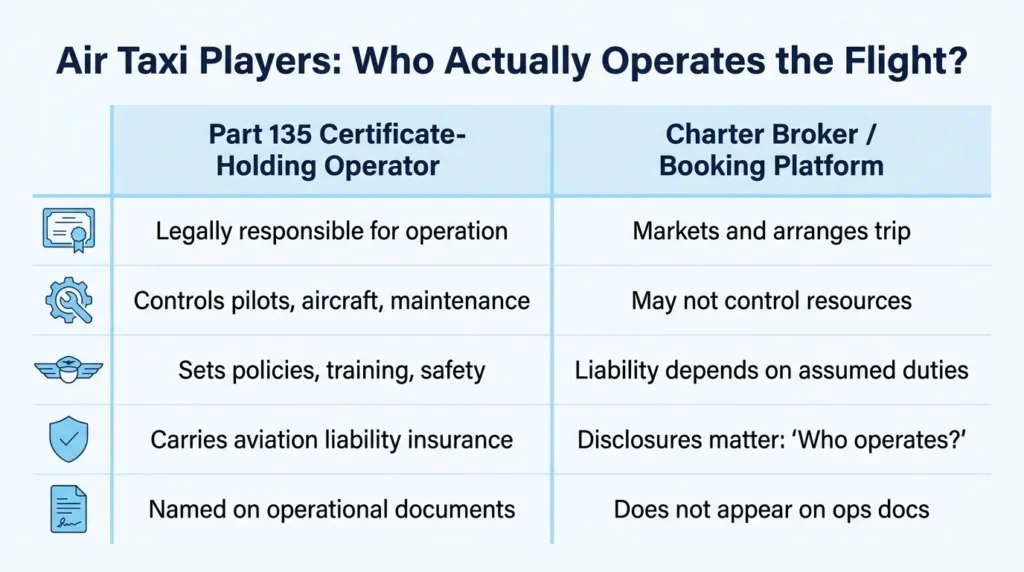
The company marketing a flight may not be the actual operator. Charter brokers and booking platforms often market flights without holding Part 135 certificates themselves. They connect passengers with operators but don’t control the aircraft, pilots, or maintenance. The FAA’s consumer guidance on chartering aircraft explains how to verify who actually holds the operating certificate.
This distinction drives liability claims. The certificate-holding operator typically carries the aviation liability insurance and bears legal responsibility for operational decisions. A broker’s role is different, and so is the broker’s potential liability. A broker may still face liability based on representations it made or duties it assumed toward the passenger. Federal regulators have proposed rules requiring clearer disclosures about who the actual operator is, precisely because this confusion creates problems for consumers.
How Liability Is Determined After an Aviation Crash in Texas
Aviation crashes rarely have a single cause. Weather, mechanical issues, pilot decisions, maintenance oversights, and air traffic control communications can all play a role. Determining liability means identifying who had a duty to act safely, how they failed that duty, and whether that failure contributed to the crash.
Texas aviation accident cases often involve both private defendants and government entities. The legal path differs significantly depending on who you’re pursuing. Claims against private companies follow standard civil procedures. Claims involving government entities, like air traffic control services, require different procedures and timelines.
Families should focus on two priorities in the early days: preserving evidence and identifying all potentially responsible parties. Flight records, maintenance logs, booking confirmations, and communications can disappear or become harder to obtain as time passes. An experienced legal team can send preservation letters to ensure critical evidence isn’t lost.
Texas Proportionate Responsibility: How Fault Gets Split
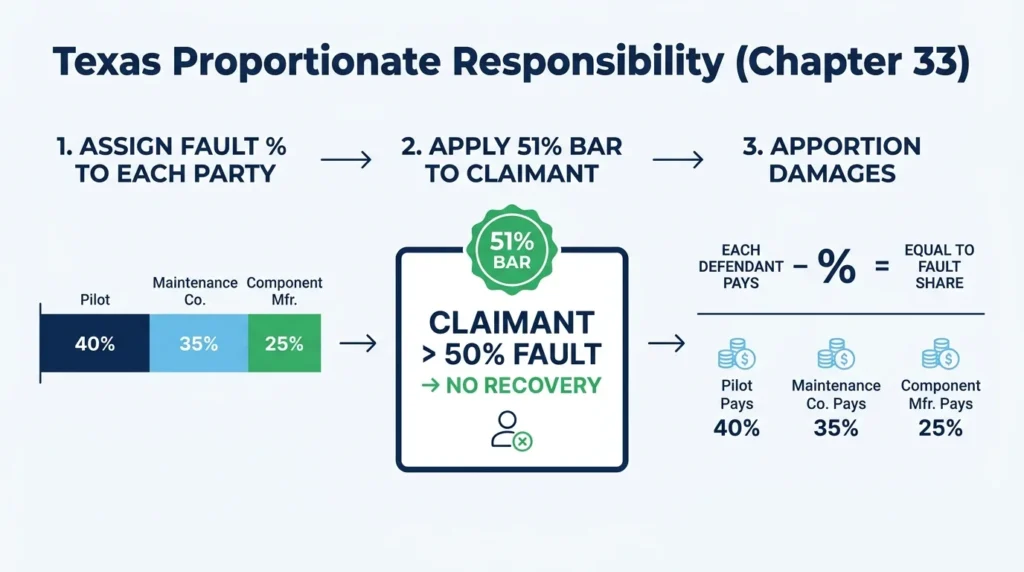
Texas Civil Practice and Remedies Code Chapter 33 governs how fault is allocated among multiple parties. Rather than holding one defendant entirely responsible, Texas law assigns each party a percentage of fault based on their contribution to the harm.
If a claimant is found more than 50% responsible for their own injuries, they cannot recover anything. Defense teams in aviation cases often try to shift blame onto the deceased pilot, the passenger, or other parties to reduce their client’s percentage.
This system makes identifying every potentially responsible party essential. If the pilot was 40% at fault, the maintenance company 35% at fault, and a component manufacturer 25% at fault, each defendant’s share of damages corresponds to their percentage (assuming the claimant bears no share of fault). Missing a responsible party can distort the allocation and reduce what families ultimately recover.
Most Common Defendants After a Texas Air Taxi Crash
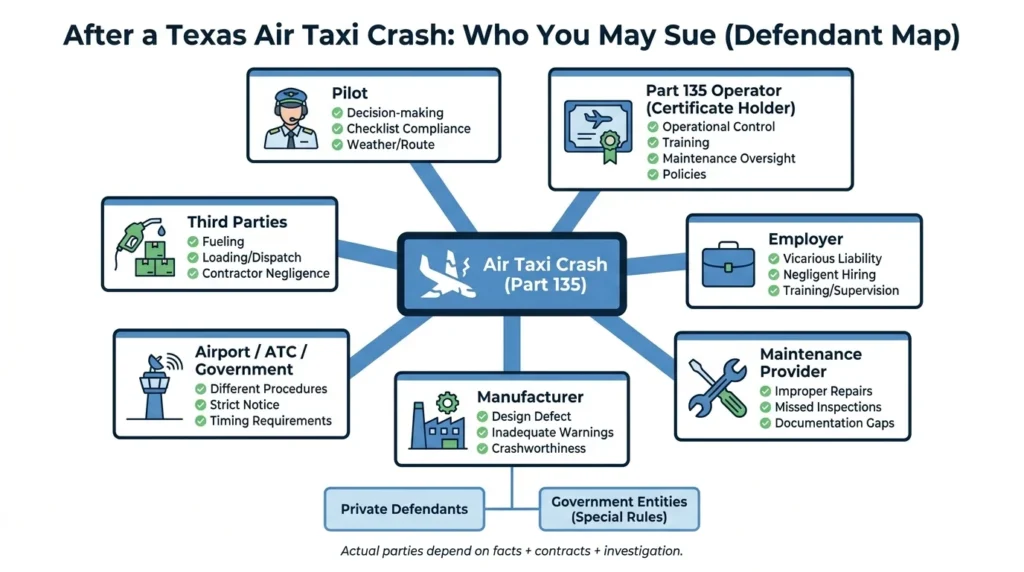
Air taxi crashes could involve overlapping responsibilities across multiple parties. Each defendant’s potential liability depends on what role they played and what went wrong.
Pilot Liability
The pilot may be liable when their actions or omissions fall below the required standard of care. Common areas of scrutiny include:
- Preflight planning and weather assessment
- Route and altitude decisions
- Checklist compliance
- Approach and landing execution
- Risk management and go/no-go decisions
Pilot decisions are never evaluated in isolation. If inadequate training or pressure from the operator contributed to poor judgment, liability may extend beyond the individual pilot.
Part 135 Operator Liability
The certificate-holding operator would likely become the central defendant because they control operational systems, policies, and compliance. Under FAA Part 135 requirements, operators must maintain aircraft airworthiness, ensure pilot qualifications, and establish safety procedures.
When consumers book through brokers or apps, identifying the actual operator requires reviewing the paperwork carefully. The FAA’s charter verification guidance can help clarify who held operational responsibility. This identification also determines which insurance policies apply to the claim.
Employer Liability
If the pilot was acting within the course and scope of employment, the employer may be responsible for the pilot’s negligence under vicarious liability principles. Employers can also face direct claims for negligent hiring, training, or supervision if they failed to properly vet or prepare their pilots.
Maintenance Providers
Maintenance errors or missed inspections could create liability for the repair facility and sometimes for the operator responsible for maintenance oversight. If maintenance work fell below reasonable standards or required practices, and that failure contributed to the crash, the maintenance provider becomes a defendant.
Manufacturers
When a defect in the aircraft, engine, or component contributes to the accident, the manufacturer may face product liability claims. These claims can involve design defects, manufacturing defects, or inadequate warnings. Manufacturers could become part of multi-party cases when component failures or crashworthiness issues are identified.
Airport, ATC & Government Entities
Claims involving air traffic control or government-owned airport facilities follow different rules. Timing and notice requirements can be critical. Identifying whether ATC services were federal and what role they played requires careful investigation. Understanding how to pursue claims against government entities is essential when these parties may share responsibility.
Third Parties
Ground operations and third-party conduct can also contribute to crashes. Fueling errors, improper loading, dispatch failures, and contractor negligence may all be assigned a percentage of fault under Texas proportionate responsibility rules.
Who Investigates an Aircraft Crash & What That Means for a Lawsuit
The NTSB investigates civil aviation crashes to determine causes and improve safety. These investigations can produce factual materials useful in civil claims, but an investigation is not a lawsuit. The two processes have different purposes and timelines.
Investigation reports may take months or even years to finalize. Families cannot afford to wait for final reports before taking action. Evidence preservation must begin immediately. Aircraft records, operator documents, maintenance logs, communications, and booking records need to be secured before they’re lost or destroyed.
Liability can be proven through multiple sources even while investigations continue. Witness statements, expert analysis, and documentary evidence all contribute to building a civil case. Early legal involvement helps ensure nothing critical is lost.
Wrongful Death & Survival Claims in Texas
After a fatal air taxi crash, Texas Civil Practice and Remedies Code Chapter 71 provides the framework for compensation claims. The law separates claims into two categories.
Wrongful death claims compensate surviving family members for their own losses: lost financial support, lost companionship, mental anguish, and similar harms. Under Texas law, the surviving spouse, children, and parents of the deceased may bring wrongful death claims.
Survival claims allow the estate to pursue compensation the deceased person could have sought if they had survived: pain and suffering before death, medical expenses, and similar damages.
Families would need to coordinate estate representation and gather extensive documentation. Medical records, financial records, and evidence of family relationships all become relevant. A wrongful death case requires careful attention to both legal requirements and practical logistics.
What Victims & Families Should Know Now
Understanding your rights before an incident occurs is the best position to be in. If a crash does happen, these steps help protect a potential claim:
- Document everything. Medical records, photos, names of witnesses, and all communications related to the flight.
- Preserve booking records. Confirmations, invoices, emails, texts, and any marketing materials. Note the aircraft tail number if you have it.
- Identify the actual operator. The FAA’s charter verification resources can help distinguish between brokers and certificate holders.
- Be cautious with insurers. It’s reasonable to consult with an attorney before giving recorded statements or signing any releases.
- Contact a lawyer early. Multi-party identification, preservation letters, expert coordination, and government-entity procedures all benefit from early legal involvement.
How Angel Reyes & Associates Can Help
Aviation cases involving multiple defendants require experienced legal guidance. Identifying all responsible parties, preserving critical evidence, and navigating Texas proportionate responsibility rules takes resources and knowledge that most families don’t have on their own.
Our legal team has guided Texas families through complex multi-party litigation for over 30 years, recovering more than $1 billion for clients across the state. We offer free initial consultations and work on contingency, meaning no fee unless we win. Our firm serves clients across more than 20 Texas office locations, and we can handle most aspects of your case remotely.
If your family is facing the aftermath of an air taxi crash, contact us today to discuss your situation and learn how we can help protect your rights.
Past results do not guarantee future outcomes.
Air Taxi Crash Liability FAQs
Can a passenger be blamed for an air taxi crash in Texas?
Passengers are generally not responsible for how a charter flight is operated, but a defendant may argue a passenger contributed in some way based on the specific facts. Whether that affects recovery depends on the evidence and how fault is allocated under Texas law.
Who can file a wrongful death claim after a fatal Texas air taxi crash?
In Texas, the surviving spouse, children, and parents are generally the family members who may bring a wrongful death claim. A separate survival claim may belong to the estate for losses the deceased could have pursued if they had lived.
Does the aircraft owner automatically have liability if they were not operating the flight?
Not always. An aircraft owner may be a defendant if ownership, leasing arrangements, maintenance responsibilities, or control over the aircraft played a role, but ownership alone does not automatically decide liability.
Can a charter broker be sued if the broker did not operate the plane?
Sometimes, but it depends on what the broker actually did and what representations it made. In many charter cases, the operator is the main focus, while a broker’s liability usually turns on its own conduct rather than flight operations it did not control.
How long does an aviation crash investigation usually take?
Aviation investigations often take many months and sometimes longer, especially in complex crashes. That is one reason civil claims and evidence preservation often need to move forward before a final public report is issued.
About the Authors

Angel Reyes
Writer
Angel L. Reyes, III is the Founder and Managing Partner of Angel Reyes & Associates. A nationally recognized trial attorney and business leader, Angel has helped over 70,000 injury victims recover more than $1 billion since founding the firm in 1993. Named to the Texas Super Lawyers list annually since 2008, Angel brings Wall Street experience, Ivy League education, and a deep commitment to client advocacy. He is a frequent legal commentator and published author with extensive contributions to legal scholarship, trial strategy, and consumer protection.

Graham Griffin
Editor
Graham Griffin is the Web & Content Manager at Angel Reyes & Associates, where he oversees content strategy, AI-powered workflows, a...

Angel Reyes
Reviewer
Angel L. Reyes, III is the Founder and Managing Partner of Angel Reyes & Associates. A nationally recognized trial attorney and business...