What Happens When an Uber or Lyft Hits a Motorcycle in Texas?


Every article on this site is researched by our internal team, reviewed for legal accuracy against current Texas law, and held to State Bar of Texas advertising standards before publication. We do not publish content that overstates outcomes or makes promises about results.
Learn more about our
editorial standards .
Key Takeaways
- Periods 2 and 3 unlock a $1 million rideshare policy; Period 1 limits are far lower.
- Being more than 50% at fault under Texas law bars your motorcycle injury recovery.
- You have two years from the crash date to file your Texas injury claim.
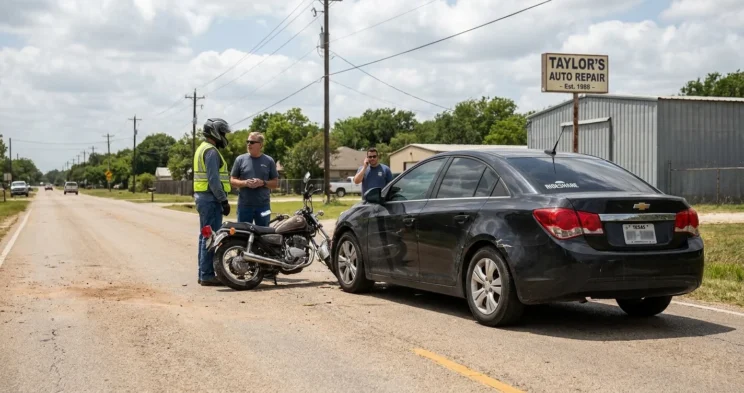
You were riding home on Westheimer Road when an Uber driver swung into your lane and clipped your bike. Now your leg is throbbing, your motorcycle is on its side, and the driver is telling you to call Uber, not him.
Whose insurance pays for this? You are not sure who to call first, and you are worried your own policy will leave you holding the bill.
Which Insurance Period Covers Your Crash
The insurance that pays depends on what the rideshare driver was doing the moment they hit you. Uber and Lyft drivers move through three coverage periods, and each one triggers a different policy.
When the app is off, the driver is just a regular motorist. Their personal auto policy is the only coverage in play, the same as any other crash.
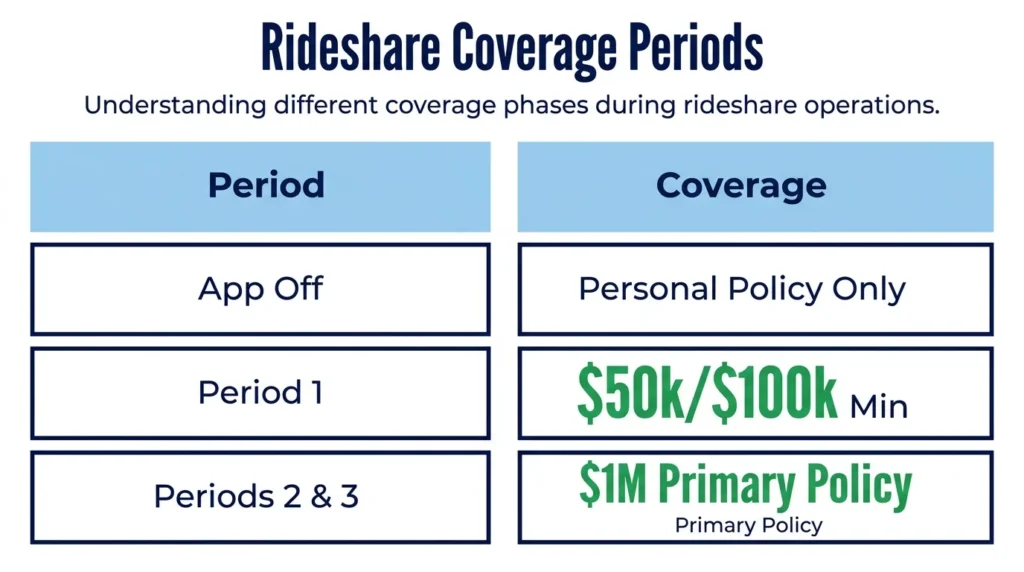
When the app is on but the driver has not yet accepted a ride, you are in Period 1. Here the company provides contingent coverage. Under the Texas Insurance Code § 1954.052, the required minimums are $50,000 per person and $100,000 per accident for bodily injury, plus $25,000 for property damage.
These Period 1 limits are lower than most riders expect. If the driver’s personal policy excludes rideshare use, this contingent coverage fills the gap, but only up to those reduced amounts.
Once the driver accepts your ride request or has a passenger in the car, the picture changes completely. During Periods 2 and 3, the Texas Insurance Code § 1954.053 requires $1,000,000 in primary liability coverage. Primary means the commercial policy responds first, not your own insurer.
That $1 million policy is the difference between a claim that covers your surgery and one that does not. The catch is proving which period was active.
Most riders have no way of knowing the driver’s app status at the moment of impact. The timestamp records on Uber and Lyft’s platforms are the key evidence, and getting them often takes legal pressure. If you want to understand how these periods break down in more detail, an attorney can walk you through each one.
Who Is Liable When a TNC Driver Hits a Motorcyclist
Liability usually starts with the rideshare driver who hit you, but the commercial insurance obligation reaches further than that. Uber and Lyft classify their drivers as independent contractors, not employees, and they routinely dispute direct employer liability. The coverage duty under Chapter 1954 attaches anyway, no matter how the driver is classified.
Your own conduct can also change what you recover. Texas follows a fault-sharing rule, and it can reduce your compensation or wipe it out entirely.
Under the Texas Civil Practice and Remedies Code Chapter 33, you cannot recover anything if you are found more than 50% at fault. Below that line, your damages drop by your share of the blame. A rider judged 20% responsible recovers 80% of their losses.
This is exactly why insurers work so hard to pin blame on motorcyclists.
Expect the adjuster to raise familiar arguments. They may claim you were lane splitting, which Texas prohibits under the Texas Transportation Code § 545.0605, or that you were speeding or failed to hold your lane.
These arguments are a business tactic. The adjuster’s job is to lower the payout, and shifting fault onto you is the easiest way to do it.
You can, and should, push back. Rideshare companies must meet licensing and insurance rules tracked by the Texas Department of Licensing and Regulation, which helps confirm what coverage the driver should have carried at the time. For a fuller look at how these claims work, speak to an attorney who specializes in rideshare accident claims.
Talking with an attorney before you give a recorded statement protects you from saying something an insurer can twist into a fault admission.
Steps to Take After a TNC Motorcycle Crash in Texas
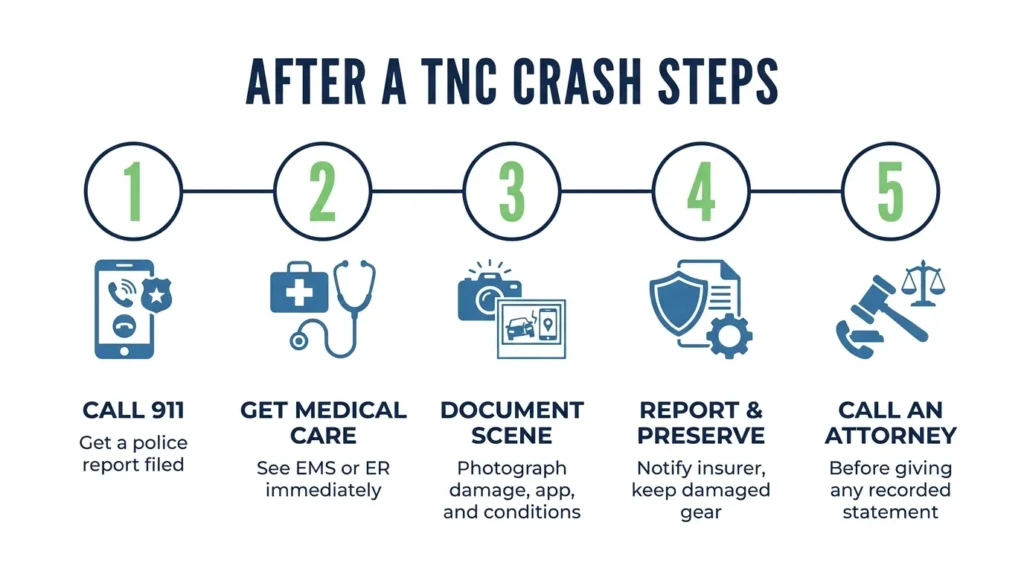
What you do in the first hours after the crash shapes your entire claim. Follow these steps to protect your health and your case.
- Step 1: Call 911. A police report that records the Uber or Lyft plate, the driver’s identity, and the app status becomes core evidence later.
- Step 2: Get medical care right away. Request EMS at the scene or go straight to the ER. Adrenaline masks injuries, and what feels minor can worsen within 24 to 72 hours.
- Step 3: Photograph everything. Capture the driver’s app screen if you can see it, your motorcycle’s resting position, all damage, road conditions, posted speed limits, and traffic signals.
- Step 4: Capture the driver’s rideshare details. Ask for the Uber or Lyft driver ID and screenshot the app showing the active trip if possible.
- Step 5: Report the crash and preserve your gear. Notify the rideshare app and your own motorcycle insurer, who may later seek repayment from the commercial policy. Keep your damaged helmet, jacket, and gloves, since they document the force of impact.
- Step 6: Talk to an attorney before the rideshare insurer. A recorded statement given without counsel can be used to shrink your claim.
For more detail on these early moves, our guide on what to do after a rideshare accident covers the full sequence. You can also learn how we handle motorcycle injury cases across the state.
Damages & the Two-Year Filing Deadline
You can pursue compensation for far more than your hospital bill. Recoverable damages include emergency and surgical care, rehabilitation, lost wages, reduced earning capacity, motorcycle repair or replacement, pain and suffering, and disfigurement.

Motorcyclists carry far more risk on the road than drivers wrapped in steel. National crash data from the NHTSA crash statistics database confirms that riders face higher injury and fatality rates than passenger vehicle occupants. That severity often drives medical costs well past the lower Period 1 limits.
You do not have unlimited time to act. The Texas Civil Practice and Remedies Code § 16.003 gives you two years from the date of the crash to file. Miss that window and your claim is almost always gone for good.
Your settlement value turns on two things: which coverage period was active and how fault gets divided. A rider with solid proof of Periods 2 or 3 can reach the $1 million policy instead of the contingent minimums.
A low early offer rarely reflects the full cost of a serious motorcycle injury. Our breakdown of how motorcycle accident settlements work explains what shapes a fair number.
Injured in a Texas TNC Motorcycle Crash? Contact Angel Reyes & Associates
A rideshare crash on a motorcycle leaves you facing layered insurance, aggressive adjusters, and a hard deadline all at once. You do not have to sort it out alone.
Angel Reyes & Associates has handled complex rideshare and motorcycle accident claims across Texas for more than 30 years. We offer free initial consultations, we charge no fee unless we win, and we have more than $1 billion recovered for clients.
You can read what our clients say about us or meet the attorneys who handle these cases. When you are ready, schedule a free consultation and we will review your options.
Past results do not guarantee future outcomes.
Rideshare Motorcycle Accident FAQs
Can I use my own motorcycle insurance to cover a crash caused by an Uber or Lyft driver?
Your own policy may pay out initially, but your insurer can then seek repayment from the at-fault rideshare driver’s commercial coverage. This is called subrogation, and it means you are not stuck carrying the cost of someone else’s mistake long-term.
What happens if the Uber or Lyft driver had no active insurance when they hit me?
Texas Insurance Code Chapter 1954 requires TNC commercial coverage to include uninsured and underinsured motorist protection during Periods 2 and 3. If the driver lacked personal coverage during Period 1, the contingent TNC policy still fills the gap up to the statutory minimums.
Does the type of motorcycle I ride affect my claim against a rideshare driver?
The type of motorcycle does not change who is liable or which insurance period applies. It may factor into your property damage calculation, since replacement cost varies by make, model, and condition.
How do I find out which coverage period was active when the Uber or Lyft driver hit me?
Request your trip record through the rideshare app and ask for the driver’s app status at the time of the crash. If the company does not respond, an attorney can subpoena the platform’s timestamp logs through litigation.
Can I recover damages for my riding gear if it was destroyed in the crash?
Yes, damaged safety gear such as a helmet, jacket, or gloves is treated as personal property in your damages claim. Keep all damaged items rather than replacing them, since the physical condition of the gear documents the severity of the impact.
About the Authors

Angel Reyes
Writer
Angel L. Reyes, III is the Founder and Managing Partner of Angel Reyes & Associates. A nationally recognized trial attorney and business leader, Angel has helped over 70,000 injury victims recover more than $1 billion since founding the firm in 1993. Named to the Texas Super Lawyers list annually since 2008, Angel brings Wall Street experience, Ivy League education, and a deep commitment to client advocacy. He is a frequent legal commentator and published author with extensive contributions to legal scholarship, trial strategy, and consumer protection.

Kyle Nicolas
Editor
Kyle Nicolas is the Web Content & SEO Manager at Angel Reyes & Associates. He has more than 10 years of experience as a marketing co...

Angel Reyes
Reviewer
Angel L. Reyes, III is the Founder and Managing Partner of Angel Reyes & Associates. A nationally recognized trial attorney and business...