Waymo vs Human Drivers: Robotaxi Crash Rates & What Texas Riders Should Know


Every article on this site is researched by our internal team, reviewed for legal accuracy against current Texas law, and held to State Bar of Texas advertising standards before publication. We do not publish content that overstates outcomes or makes promises about results.
Learn more about our
editorial standards .
Key Takeaways
- Waymo's published crash-rate comparisons show favorable outcomes vs human baselines, but results depend on definitions, operating areas, and benchmark design.
- "Regardless of fault" safety statistics do not determine legal liability in individual Texas crash cases.
- If you were injured in a robotaxi collision, preserve evidence, document the operator's information, and consider legal advice before providing statements to insurers.
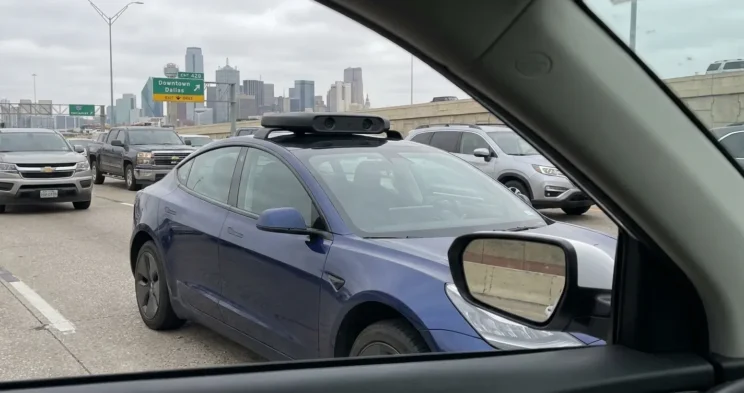
You were sitting in traffic on I-35E near Downtown Dallas when a Waymo robotaxi pulled up beside you. There was no driver behind the wheel, just sensors, cameras, and software making decisions at 45 miles per hour.
With Waymo’s announced expansion into Dallas, these encounters will become more common. The question everyone asks is simple: are these vehicles safer than human drivers?
The answer is more complicated than a yes or no. It depends on how you define “safer,” what data you trust, and where these vehicles operate. Understanding the real numbers can help you make informed decisions about sharing the road with robotaxis and empower you to know your rights if something goes wrong.
What “Crash Rate Per Million Miles” Actually Means
Transportation safety researchers use per-million-mile rates to compare different vehicles and driver populations fairly. Raw crash counts can be misleading. Two crashes within a million miles of driving tells a very different story than two crashes within a hundred thousand miles.
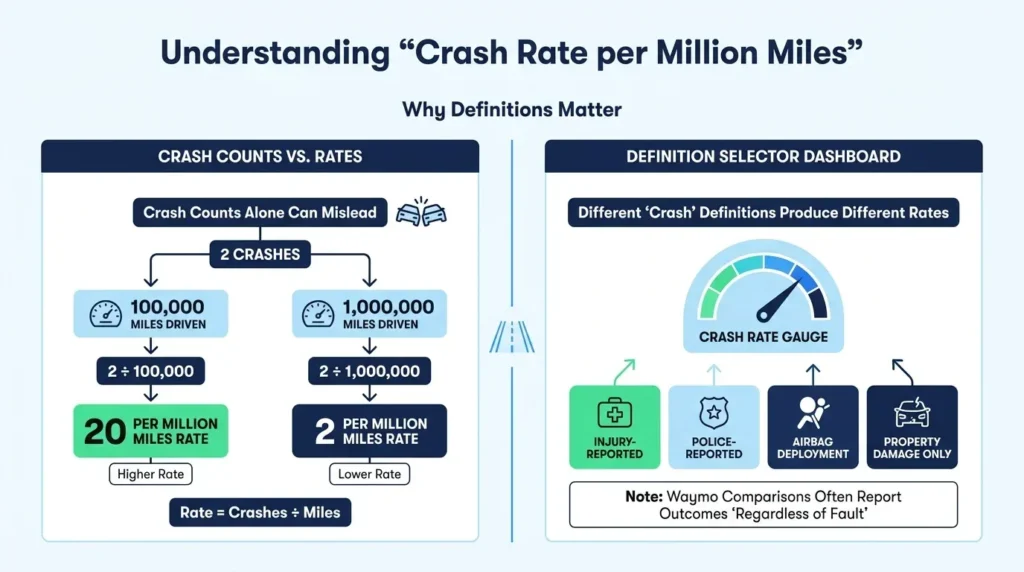
Waymo publishes its safety data through its Safety Impact hub, which includes methodology notes and downloadable comparisons against local human benchmarks. The company’s rider-only crash-rate comparison study covers over 7 million miles of autonomous driving and provides incident-per-million-miles figures.
However, these numbers depend heavily on context. For example, “injury-reported crashes” means something different than “police-reported crashes” or “airbag-deployment incidents.” A fender-bender in a parking lot and a high-speed collision on Loop 12 both count as crashes, but they lead to very different outcomes.
One key difference is that Waymo’s published comparisons often focus on the outcomes, “regardless of fault.” This answers a safety question (how often are crashes associated with these vehicles?) but not a legal one (who caused the crash?). These questions have different implications for anyone involved in a collision.
How Waymo Compares to Human Drivers
Waymo’s published data generally shows favorable outcomes, as compared to human-driver baselines in its operating areas. The company reports fewer injury-causing crashes and police-reported incidents than human-driven vehicles in cities like San Francisco and Phoenix.
However, these comparisons require careful consideration. These benchmarks are tied to specific operating areas, not statewide or nationwide driving. Waymo vehicles currently operate within defined geographic zones and often avoid certain road types or conditions.
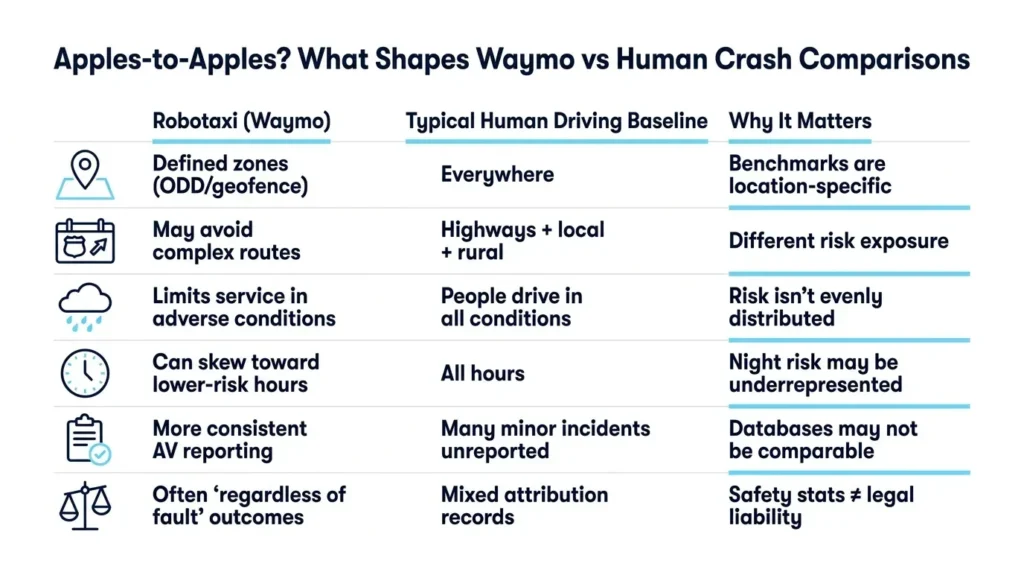
It is not fair to compare a robotaxi that operates primarily on suburban streets in good weather to a human driver traveling hundreds of miles down a highway in adverse conditions.
A separate insurance-claims study examined the frequency of claims, rather than the frequency of crashes. Claims data can show real-world costs and repair patterns, but it is not an exact match to crash rates for many reasons, including how people report incidents, fault disputes, deductibles, and how minor collisions are handled.
The NHTSA Standing General Order requires AV operators to report certain incidents consistently. This means robotaxi fleets may log minor collisions that human drivers would never report. Higher numbers in a federal database do not automatically mean higher real-world risk. They may simply reflect more thorough reporting.
What the Data Cannot Prove
Even favorable crash-rate comparisons have limits. They cannot prove that robotaxis will perform identically in every city, on every road type, or in every weather condition. Performance in Phoenix may not be the same as on rainy streets in Houston or during an unexpected ice storm near Fort Worth.
Additionally, robotaxis may drive more cautiously than average humans. They may operate during lower-risk hours or avoid routes with higher crash risks. These operational choices can improve outcomes, but it does not prove that the underlying technology is safer in all conditions.
Ultimately, anyone claiming that robotaxis are “proven safer everywhere” is overstating what the evidence supports.
Waymo’s Dallas-Fort Worth Rollout: What We Know
Waymo has announced plans to bring robotaxi service to Dallas. A City of Dallas memo documented a Waymo demonstration for the Mayor and City Council in September 2025, noting that Waymo was already road-testing in autonomous mode with a human safety driver across Dallas.
Testing with a safety driver is different from fully driverless operations. The rollout typically progresses through stages: demonstrations, testing with human backup, limited driverless service in defined areas, and eventually broader coverage. Each stage changes the exposure level and the types of interactions with other road users.
For Dallas drivers, this means robotaxis will likely appear in specific neighborhoods before expanding. Our firm’s office locations across Texas position us to help clients throughout the state as this technology spreads.
Texas roads present their own challenges. Significant daily crash volumes, and distracted driving remain persistent factors in human-caused collisions. Whether robotaxis can reduce these risks locally will depend on where and when they operate, and how much mileage accumulates in ideal driving conditions.
Liability When a Robotaxi Is Involved in a Texas Crash
If you are in a collision involving a Waymo or other robotaxi, the liability question expands beyond the typical two-driver scenario. Other potential parties may include:
- Other human drivers involved in the crash
- The robotaxi operator (the company running the service)
- The vehicle owner (which may differ from the operator)
- Maintenance or service vendors
- Component manufacturers (in some product liability scenarios)
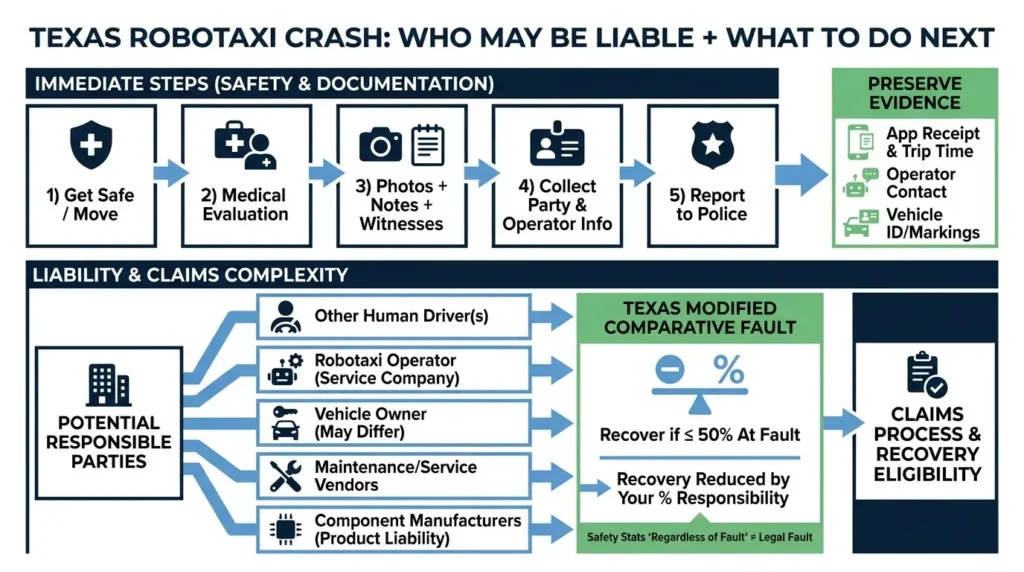
Texas follows a modified comparative fault system. Under Texas Civil Practice and Remedies Code § 33.001, you can recover damages as long as your percentage of fault does not exceed 50%.
Your recovery is reduced by your share of responsibility, which means fault determination is crucial. The “regardless of fault” framing in safety statistics does not translate to legal cases. Each collision requires a fact-specific analysis of who did what, when, and why.
Evidence preservation is especially important. Standard documentation must be collected, including photos, witness information, medical records, police report numbers, and vehicle damage. However, robotaxi crashes may involve additional evidence, such as trip records, in-app receipts, operator contact information, and video footage.
What you say to insurance adjusters early on can shape fault narratives. If injuries or disputed fault exist, getting legal advice before providing recorded statements will help protect your interests. Our client testimonials reflect the difference that experienced legal guidance can make for your claim.
What to Do After a Robotaxi Crash in Texas
The immediate steps to take are the same as with any other car accident in Texas. These steps are as follows:
- Ensure your safety and move to a secure location if possible.
- Seek medical evaluation, even if your injuries seem minor.
- Document the scene with photos and notes.
- Collect information from all parties, including the robotaxi operator’s contact details.
- Report the crash to police if required under Texas law.
Texas Transportation Code § 550.026 requires drivers to file a crash report with TxDOT within 10 days if the crash caused injury, death, or property damage of $1,000 or more and was not investigated by law enforcement.
For robotaxi-specific situations, identify the operator’s claims process and preserve any app-based trip information. Note the vehicle identification number and any visible company markings.
Consider getting legal help when your injuries are significant, fault is disputed, multiple parties are involved, or insurance coverage layers are unclear. Car accident claims involving commercial vehicles or new technology often benefit from experienced legal representation.
How Angel Reyes & Associates Can Help
Robotaxi technology is new, but the principles of protecting crash victims remain the same. Someone must be held accountable when negligence causes damage.
With over 30 years of experience and more than $1 billion recovered for clients, our firm has the resources to investigate complex crashes involving multiple parties. We offer free initial consultations and work on contingency, meaning you pay no fee unless we win. Our team is available 24/7 and can handle the majority of your case remotely.If you have been injured in a crash involving a robotaxi or any other vehicle in Texas, contact us to discuss your options. Understanding your rights is the first step toward protecting them.
Waymo Accident vs. Human Driver FAQs
Do Waymo robotaxis drive on Texas highways like regular cars?
Not necessarily. Robotaxi service areas are usually limited by the company’s operating design domain, so whether a vehicle only travels on highways, in certain neighborhoods, or in specific weather conditions can depend on where and how the service is launched.
Can you request records after a robotaxi crash?
In many cases you can request useful records like app receipts, trip timestamps, and customer support messages. Access to company-held data like internal logs or camera footage often depends on the claim, preservation requests, and legal process.
Who carries insurance for a robotaxi crash in Texas?
Coverage may involve more than one policy, including the robotaxi operator’s commercial coverage and any personal auto policy if another driver is involved. Which insurer pays first usually depends on the facts of the crash and the policy language.
Are federal self-driving crash reports the same as a Texas accident report?
No. Federal AV reporting serves a different purpose and does not replace the state and local reporting steps that may apply after a crash in Texas.
About the Authors

Angel Reyes
Writer
Angel L. Reyes, III is the Founder and Managing Partner of Angel Reyes & Associates. A nationally recognized trial attorney and business leader, Angel has helped over 70,000 injury victims recover more than $1 billion since founding the firm in 1993. Named to the Texas Super Lawyers list annually since 2008, Angel brings Wall Street experience, Ivy League education, and a deep commitment to client advocacy. He is a frequent legal commentator and published author with extensive contributions to legal scholarship, trial strategy, and consumer protection.

Graham Griffin
Editor
Graham Griffin is the Web & Content Manager at Angel Reyes & Associates, where he oversees content strategy, AI-powered workflows, a...

Angel Reyes
Reviewer
Angel L. Reyes, III is the Founder and Managing Partner of Angel Reyes & Associates. A nationally recognized trial attorney and business...