What to Do After a Bus Accident as a Passenger in Texas


Every article on this site is researched by our internal team, reviewed for legal accuracy against current Texas law, and held to State Bar of Texas advertising standards before publication. We do not publish content that overstates outcomes or makes promises about results.
Learn more about our
editorial standards .
Key Takeaways
- Texas Tort Claims Act requires written notice to public transit within six months of the crash.
- Houston city charter shortens the bus injury notice deadline to just 90 days for Metro claims.
- Photograph the bus number, route, driver ID, and your fare card before leaving the crash scene.
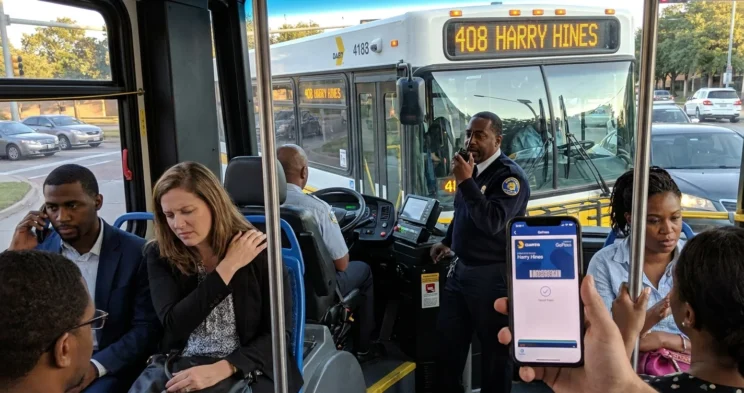
You were riding the DART bus down Harry Hines Boulevard on your way home from a shift when the driver braked hard, and you were thrown forward into the seat in front of you. Your shoulder is throbbing, the bus is stopped at an odd angle in traffic, and other passengers are checking themselves for injuries.
The driver is on the radio with someone, but no one has spoken to you yet. What you do in the next few minutes, hours, and days can affect the insurance claim you file later.
Your First Moves at the Scene
Bus passenger crashes call for a different evidence checklist than a regular car wreck. Your job at the scene is to confirm that you are safe, make sure that help is on the way, and capture the records that prove you were on the bus. The driver may report the incident to dispatch, but that report will not protect your claim. You’ll need your own documentation.
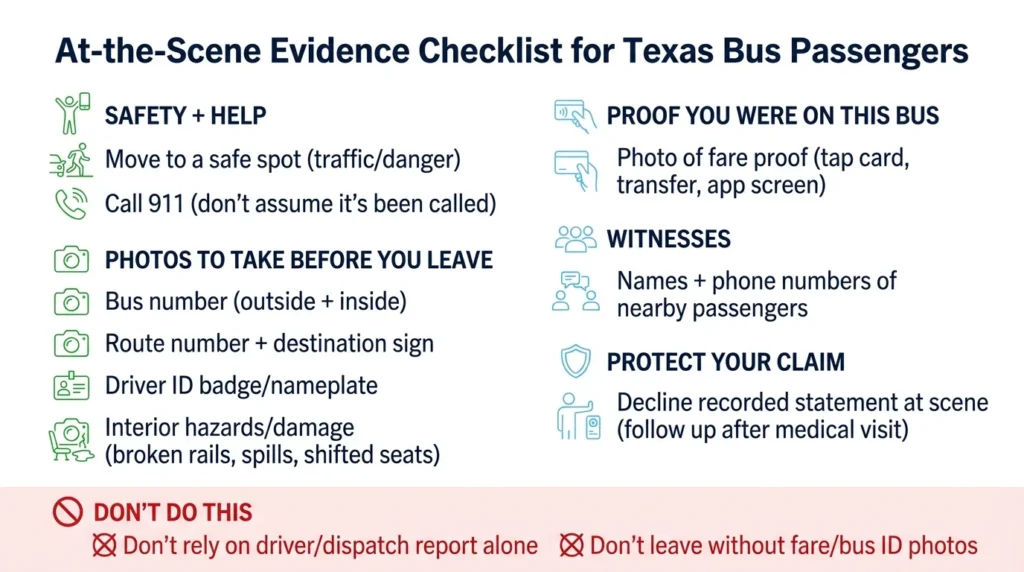
Move to a safe spot if the bus is in the middle of traffic or a dangerous position. Call 911 yourself or ask another passenger to call. Do not assume that anyone else has done it first.
Take photos before you leave. Capture the bus number on the outside and inside of the bus, the route number, the destination sign, and the driver’s ID badge or nameplate. Photograph any visible damage in the cabin, including broken handrails, fluid spills, or shifted seats.
Then photograph your fare. Take a picture of your transit card, paper transfer, or the mobile app screen showing your ride. This is how you prove you were a paying passenger on this specific trip.
Get names and phone numbers from passengers near you. Co-passenger witnesses are powerful testimony, but they will scatter once everyone is cleared from the bus. A few quick contacts now can save weeks of investigation later.
If a transit supervisor or insurance adjuster shows up and asks for a recorded statement, decline politely. Tell them you will follow up after you have seen a doctor. You are not required to give a statement at the scene, and anything you say while you are still in shock can be used to limit your claim. Resources for Texas bus accident victims explain how early statements often resurface during settlement negotiations.
Medical Care & Documenting Your Injuries
See a doctor the same day, even if your injuries feel mild. Soft-tissue injuries, whiplash, and concussion symptoms from a hard stop often peak within 24-72 hours after impact. A same-day medical record also ties your injuries directly to the crash, which will come into play later if an insurer argues that your pain came from something else.
Save every document related to your medical treatment. This includes ER discharge summaries, imaging reports, prescription receipts, physical therapy notes, and follow-up appointment records. These documents are the backbone of your damages.
Take dated photos of bruises, cuts, and swelling as they develop over the first week. Visible injuries can change quickly, and a series of photos will show the progression in a way no medical chart can.
Start a written symptom log. Note your pain levels, sleep problems, and any tasks you cannot do at work or at home. Insurers and courts see notes written during recovery as more credible than memories reconstructed months later.
Track your out-of-pocket costs from day one. Save receipts for rideshares to appointments, over-the-counter medications, and any missed work shifts. If you depend on the bus for your daily commute, lost wages will start adding up the moment you cannot get to your job. Reviewing average settlements in Texas bus accident cases can give you a sense of how these costs will affect your final settlement amount.
Public Bus vs. Private Carrier
Whether you were on a public transit bus or a private bus carrier changes the rules of your claim. Government-run transportation systems have special legal immunity and shorter deadlines for filing claims. Private bus carriers follow standard injury laws but have a higher duty to keep passengers safe. The type of bus involved in your accident can affect how much time you have to file your claim.
Government-Operated Transit Claims
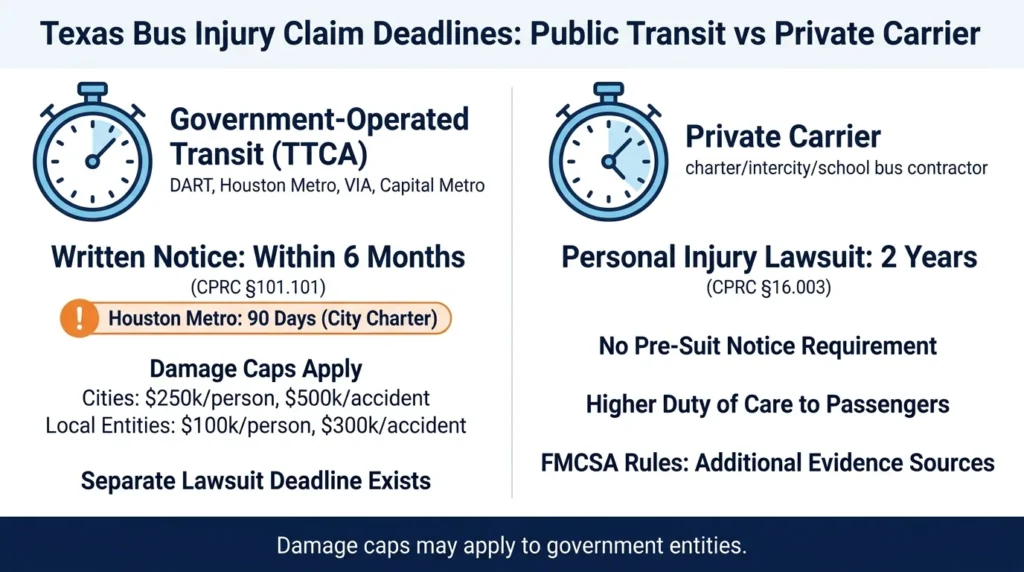
DART, Houston Metro, VIA, and Capital Metro are government-run transit systems. Claims against them fall under the Texas Tort Claims Act, which has strict rules and deadlines you must follow before filing a lawsuit.
Under Texas Civil Practice and Remedies Code (CPRC) § 101.101, you must give written notice of your claim to the transit authority within six months of the incident. Missing this deadline can end your case before it even starts.
The notice has to describe your injury, when and where it happened, and how to reach you. A complaint left on a customer service line does not count as a legal notice.
There are also limits to how much money you can recover from a government agency, and the amount depends on the type of governmental entity involved. Cities like Houston have limits of $250,000 per person and $500,000 total per accident for bodily injury or death. Other units of local government, including certain transit authorities, have lower limits of $100,000 per person and $300,000 total per accident. These limits are separate from the two-year deadline for filing a lawsuit.
Some Texas cities have shorter deadlines written into their city charters. For example, Houston requires claims against city entities to be filed within 90 days of the accident. If you were hurt on a Houston Metro bus, you may not have much time to act, so you should speak with an attorney quickly. Reading more about suing public transportation in Texas can help you understand how these notice rules work.
Private Carrier Claims
Charter buses, intercity coaches, and school bus contractors are private carriers. Different rules apply for private carriers.
The Texas Civil Practice and Remedies Code § 16.003 gives you up to two years to file personal injury claims against a private bus operator. You don’t have to give notice before filing a claim, but the two-year deadline is firm.
Private carriers in Texas have a legal duty to protect passengers. They must operate under the same degree of care that a very cautious and responsible person would use under the same or similar circumstances. This is a much higher standard than what applies to everyday drivers.
If the carrier crosses state lines, Federal Motor Carrier Safety Administration passenger carrier rules also come into play. Driver qualification files, hours-of-service logs, and inspection records become extra evidence sources in these cases.
Reporting the Incident & Preserving Records
First, file a written incident report with the transit authority or carrier within 24-48 hours. Ask for a copy with a confirmation number or timestamp. A verbal report to the driver is not enough.
Next, request your transit card transaction history from the transit authority. DART, Houston Metro, VIA, and Capital Metro all store tap-in records electronically, and account holders can request them. If you paid cash or used a paper transfer, hold onto whatever physical document you have.
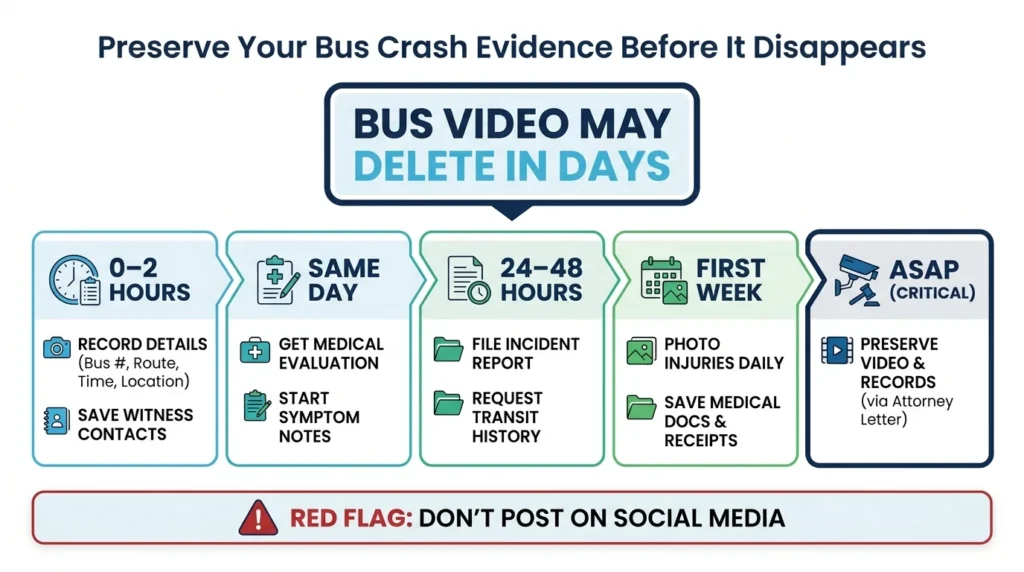
Write down the bus number, route, direction, time, and the stop or street where the incident happened. If you remember the operator’s badge number or nameplate, write that down, too. Memory fades fast, so don’t rely on it.
Don’t post anything on social media about the crash. Do not post photos, status updates, or comments about your injuries or treatment. Adjusters and defense attorneys check social media as part of their investigation.
Bus security video is your most powerful piece of evidence, and it disappears faster than most people expect. Different transit systems keep video footage for different amounts of time, and in some cases, the footage can be deleted in as little as a few days. An attorney can send a formal preservation letter to ensure the video footage is not deleted. Read more on whether you can sue a bus driver in Texas to understand how this evidence factors into liability.
When to Contact a Bus Accident Attorney
The Texas Tort Claims Act (TTCA) requires six months’ notice, and Houston’s 90-day charter deadline is even stricter. A passenger who misses either deadline often loses the right to sue at all. Calling an attorney early will give you more time to file a complaint notice.
An attorney can send preservation letters to the transit authority or carrier demanding that bus video footage, GPS logs, maintenance files, and driver records be kept before they are destroyed.
Bus accidents can involve more than one liable party. Fault may rest with the driver, the transit authority, a maintenance contractor, another motorist, or some mixture of these. A thorough investigation will lay out every potential defendant. TxDOT motor vehicle crash data shows that bus-involved crashes frequently result in serious injuries, typically because of the size and weight differences between buses and the vehicles or objects they hit.
Reviewing past Texas personal injury case results can help you understand what clients with claims like yours have received.
Talk to a Texas Bus Accident Attorney Today
Bus passenger claims involve tighter deadlines, stricter notice rules, and more potential defendants than a typical car crash case. Angel Reyes & Associates has over 30 years of experience helping Texas crash victims handle complex injury claims, with more than $1 billion recovered for clients.
We work on contingency, which means you pay no fee unless we win, and offer free consultations available 24/7. Meet our team of attorneys or contact us today to talk through your case.
Past results do not guarantee future outcomes.
Bus Accident FAQs
Can I still recover compensation if I was partially at fault for my injuries on the bus?
Yes. Texas follows a proportionate responsibility rule. You can still recover damages as long as you are not found more than 50 percent at fault, but your payout is reduced by your share of fault.
Does Texas workers' compensation cover a bus accident injury if I was commuting to work?
Generally no, Texas workers’ compensation does not cover injuries during a regular commute because the “going and coming” rule excludes travel to and from a fixed workplace. If your employer requires you to travel to a specific job site as part of your work duties, coverage may apply, but that determination depends on the specifics of your employment.
What happens if the bus driver was a contractor, rather than a direct employee of the transit authority?
If the driver was an independent contractor, the transit authority may argue that it is not liable for the driver’s actions under the employer-employee framework. However, Texas courts also examine whether the authority retained enough control over the driver’s work to create liability, regardless of how the relationship is labeled.
Can I file a claim if I was injured on a school bus in Texas?
Yes, but school districts in Texas are governmental units, so a claim against a public school district follows the Texas Tort Claims Act notice requirements, including the six-month written notice deadline. Some school districts also have their own shorter notice periods set by district policy.
Will my personal health insurance cover my medical bills from a bus accident?
Yes, your health insurance can pay your medical bills upfront, regardless of who caused the crash. If you receive money from the transit authority or carrier later on, then your insurer may put a claim on that money (called a “subrogation lien”) to get back what it paid on your behalf.
About the Authors

Alex Ivanov
Writer
Alex Ivanov is a personal injury attorney at Angel Reyes & Associates, focused on car, truck, and motorcycle accident cases. Licensed in Texas and multiple federal districts, Alex brings international legal experience and a global education to his practice. He earned his LL.M. from Texas A&M University School of Law after graduating from Belarussian State University in 2016. Alex is fluent in Russian, English, Ukrainian, and Belarussian, and is recognized by multiple national trial lawyer associations for his results and leadership under 40.

Kyle Nicolas
Editor
Kyle Nicolas is the Web Content & SEO Manager at Angel Reyes & Associates. He has more than 10 years of experience as a marketing co...

Angel Reyes
Reviewer
Angel L. Reyes, III is the Founder and Managing Partner of Angel Reyes & Associates. A nationally recognized trial attorney and business...