Can You Sue a Bus Driver in Texas?


Every article on this site is researched by our internal team, reviewed for legal accuracy against current Texas law, and held to State Bar of Texas advertising standards before publication. We do not publish content that overstates outcomes or makes promises about results.
Learn more about our
editorial standards .
Key Takeaways
- You may be able to sue a bus driver in Texas when the driver’s negligence caused your injuries.
- Many bus accident claims also involve the employer or bus company, especially when poor hiring, training, or maintenance played a role.
- Claims involving city buses, school buses, or other government-operated buses follow different rules and may require faster action.
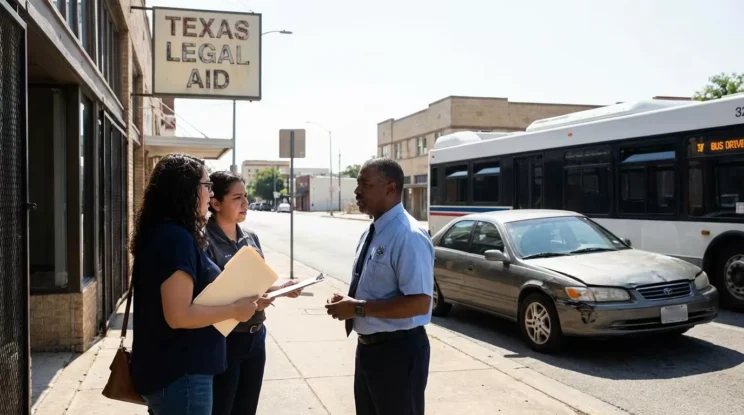
You are driving through Uptown Dallas when a DART bus swerves into your lane and forces you to collide with a parked car. Now you’re facing medical bills for whiplash and a sizeable liability claim against your policy for the damage to the car you were forced into.
In Texas, you may have a claim against the driver, the bus operator, or both, depending on the circumstances around the crash. This can apply to both other drivers who are involved in an accident with a bus and any passengers on a bus who may have been injured as a result of a collision.
When Can You Sue a Bus Driver in Texas?
Texas law allows you to pursue damages from a bus driver whose negligence resulted in sustained injuries and other property losses. Negligence means the driver failed to act with reasonable care under the circumstances.
In a bus accident case, that might include behavior like violating traffic laws, failing to keep a proper lookout, or operating a large vehicle in a way that puts passengers and others at risk.
Some examples of negligent driving include:
- Unsafe lane changes that sideswipe another vehicle
- Speeding in heavy traffic and rear-ending the vehicle ahead
- Distracted driving, including phone use or inattention to the road
- Driving under the influence of drugs or alcohol
- Falling asleep at the wheel
- Failing to yield, stop, or brake in time
However, bus drivers themselves are not always directly liable for accidents. More often than not, bus drivers are employees operating a vehicle professionally.
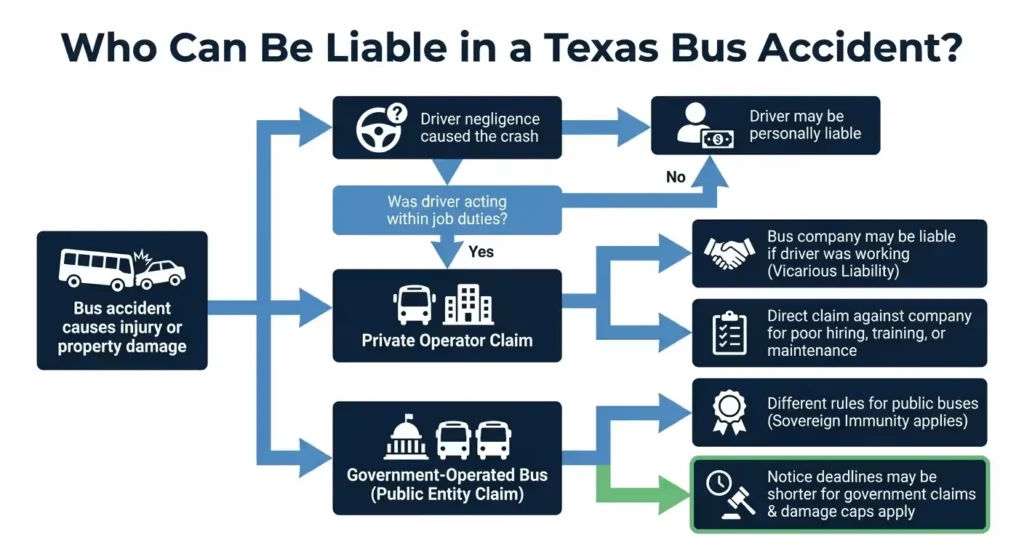
When pursuing a bus accident claim, an attorney may examine driver logs, training records, maintenance history, onboard camera footage, and the carrier’s safety practices. That is especially important in claims involving commercial carriers and bus accident cases.
Common Damages in Bus Accidents
Because buses are large, heavy vehicles, even low-speed accidents can have significant consequences. Bus accidents can involve serious injuries to all parties involved, including passengers on board who often do not have safety restraints or seatbelts that they can wear.
Your damages may include:
- Emergency care and follow-up treatment
- Lost income and reduced earning ability
- Physical pain and mental anguish
- Rehabilitation costs
- Long-term disability or impairment
Your Rights as a Bus Passenger
Passengers can have injury claims even though they were not driving and had no control over what caused the crash. If the bus was privately operated, the claim may be against the driver, the company, or both, depending on the facts. If the bus was government-operated, the claim is usually brought against the governmental unit under the Texas Tort Claims Act’s limited waiver rules rather than against the individual operator.
Under Civil Practice and Remedies Code § 101, also known as the Texas Tort Claims Act, bus passengers can sue operators for their injuries, even if the operator themselves might not be at fault. This means passengers typically have the opportunity to pursue substantial compensation should they be hurt in an accident.
Pursuing the Bus Operator
In many cases, the bus operating company is the most important defendant. Texas law says you can hold an employer responsible for the negligence of its employee when that employee was acting in the course and scope of employment. Texas Civil Practice and Remedies Code § 101.001 defines “scope of employment” as work performed for an employer in the performance of assigned duties.
This is the basic idea behind vicarious liability: if a bus driver causes a crash while driving a scheduled route, transporting passengers, repositioning the bus between stops, or otherwise doing assigned job duties, the operating company may be liable for the harm the driver caused.
In that situation, you usually do not need to prove the company personally made the bad driving decision—only that the driver was negligent and was working for the company at the time.
Vicarious liability usually applies when the driver is an employee, not an independent contractor, and when the driver was furthering the company’s business at the time of the wreck. It may not apply if the driver took the bus for a purely personal errand, acted far outside assigned duties, or was not working when the crash happened.
In rare cases, this detail may become important if a bus driver happens to be an owner-operator. If they were operating in an employment capacity at the time of the accident, their commercial insurance will apply. However, if they were not operating the vehicle for employment at the time, their insurer will dispute the claim.
A separate claim against the company may also exist if the company negligently hired an unqualified driver, failed to train the driver, ignored safety violations, or put an unsafe bus on the road.
This is different from vicarious liability. Vicarious liability ties the company to the driver’s negligence, while direct negligence claims focus on what the company itself did wrong.
What Changes if the Bus Is Publicly Operated?
A claim involving a private charter bus, tour bus, or company-operated shuttle is not handled the same way as a claim involving a city bus, county transit system, school district vehicle, or another government-operated bus.
When a governmental unit operates the bus, the Texas Tort Claims Act (§ 101.021) may control the claim, but it provides only a limited waiver of governmental immunity for certain cases involving a driver negligently operating a motor-driven vehicle.
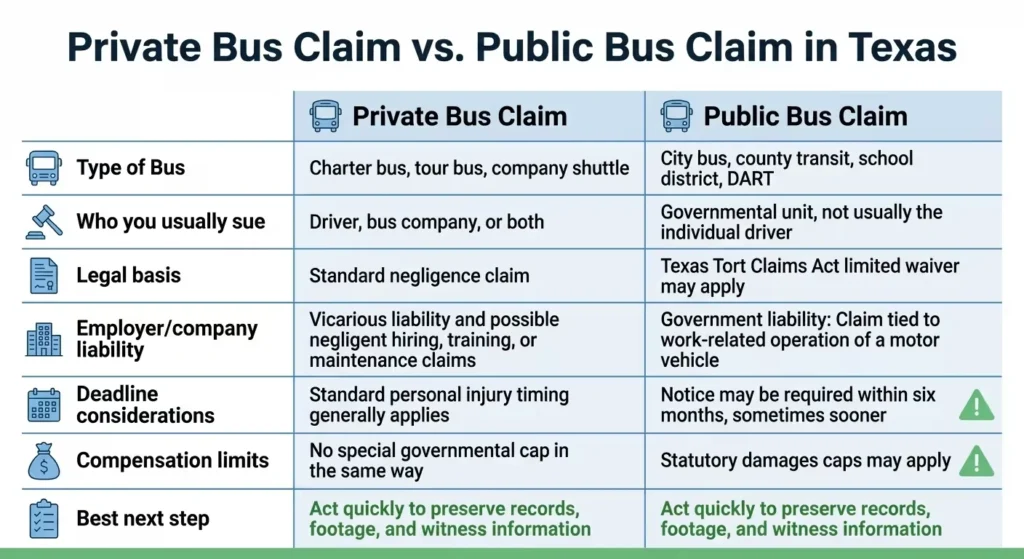
In many public bus cases, the claim is directed at the governmental unit rather than treated like a standard lawsuit against an individual bus driver. Under Texas law, a suit based on a public employee’s work-related conduct is generally treated as a suit against the employee in an official capacity, which means the governmental employer is usually the proper defendant.
These cases also move on a different timeline than a standard injury claim. § 101.101 generally requires notice of the claim within six months of the incident, and some city charter or ordinance provisions may require notice even sooner. That notice rule is separate from the ordinary two-year deadline that generally applies to personal injury lawsuits under § 16.003.
What Should You Do After a Bus Accident?
Acting quickly to pursue a claim after a bus accident is crucial, especially when the bus involved was publicly operated. Doing so also helps preserve evidence that may disappear, including surveillance footage, driver schedules, inspection records, and electronic vehicle data.
Immediately after a bus crash, try to:
- Get medical care right away
- Report the crash and request an incident report
- Take photos of the scene, the vehicles, and visible injuries
- Get contact information for witnesses
- Avoid giving detailed recorded statements to insurers before getting legal advice
- Keep records of treatment, expenses, and missed work
Consult an Attorney
Pursuing a bus accident compensation claim is considerably more complex than a standard car accident, so we strongly recommend having an attorney in your corner to help fight for you. At Angel Reyes & Associates, our team handles serious vehicle injury cases across Texas, including bus accidents involving both private and public sector operators.
Our team has offices across the state, and we have a long history of earning both big wins and satisfied clients.
Request a free case review for your bus accident claim to find out what options may be available to you. We offer free initial consultations, and you pay no fees unless we win.Past results do not guarantee future success.
Witness Statement FAQs
Can you sue a public bus driver personally in Texas, or do you have to sue the transit agency?
In government-bus cases, the claim is usually brought against the governmental unit under the Texas Tort Claims Act, and suing that entity generally bars a separate suit against the employee over the same crash.
Do buses in Texas owe passengers a higher duty of care than ordinary drivers?
Yes. Under Texas law, common carriers owe passengers a high degree of care, and the Texas Supreme Court has applied that rule to public transit buses.
Can you still recover compensation if you were partly at fault for a Texas bus accident?
Usually yes. Under Texas proportionate-responsibility rules, you can still recover if you were 50% or less responsible, but your damages are reduced by your share of fault.
Are damages capped in Texas claims against city buses, DART buses, or other public transit systems?
Yes. Public-bus claims under the Texas Tort Claims Act are subject to statutory caps that depend on the governmental defendant, and they can be as low as $100,000 per person and $300,000 per occurrence for bodily injury, with higher caps for the state and municipalities.
Can family members sue if a Texas bus accident is fatal?
Yes. Texas law may allow a wrongful death claim for the surviving spouse, children, or parents, and a separate survival claim can preserve the injured person’s own claim through the estate.
About the Authors

Spencer Browne
Writer
Spencer Browne is a partner at Angel Reyes & Associates and a Board Certified personal injury trial lawyer with nearly 100 jury trials across Texas. He focuses on car, truck, and wrongful death cases, with notable verdicts including a landmark win in the Choctaw Casino bus crash case. A recognized speaker and legal educator, Spencer is a member of the American Board of Trial Advocates and has been honored as a Texas Super Lawyer and one of D Magazine’s Best Lawyers in Dallas. He brings deep trial experience and relentless advocacy to every client he represents.

Kyle Nicolas
Editor
Kyle Nicolas is the Web Content & SEO Manager at Angel Reyes & Associates. He has more than 10 years of experience as a marketing co...

Angel Reyes
Reviewer
Angel L. Reyes, III is the Founder and Managing Partner of Angel Reyes & Associates. A nationally recognized trial attorney and business...