Flying Taxi Accidents: Who Do You Sue?


Every article on this site is researched by our internal team, reviewed for legal accuracy against current Texas law, and held to State Bar of Texas advertising standards before publication. We do not publish content that overstates outcomes or makes promises about results.
Learn more about our
editorial standards .
Key Takeaways
- Flying taxi service is not yet commercially available in Houston, but federal pilot program testing of eVTOL aircraft is coming to the region.
- Liability in a future flying taxi crash could reach the manufacturer, the operating company, software developers, government entities, and other third parties.
- Early legal action preserves critical flight data, software logs, and maintenance records that are often controlled by the defendants themselves.
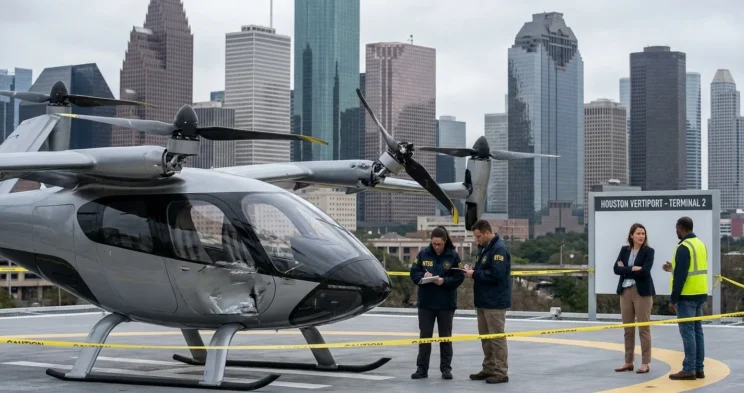
If you live in Houston, you have likely been reading headlines about flying taxis soon taking to the skies above the city. The idea of skipping I-10 traffic sounds appealing, but a natural question follows: if one of these aircraft crashes, who pays for the harm?
That question does not have a simple answer yet. But the legal principles that will apply are already on the books. Understanding them now helps you think clearly about risk, responsibility, and what legal options might look like when this technology arrives.
Federal Pilot Program & eVTOL Testing
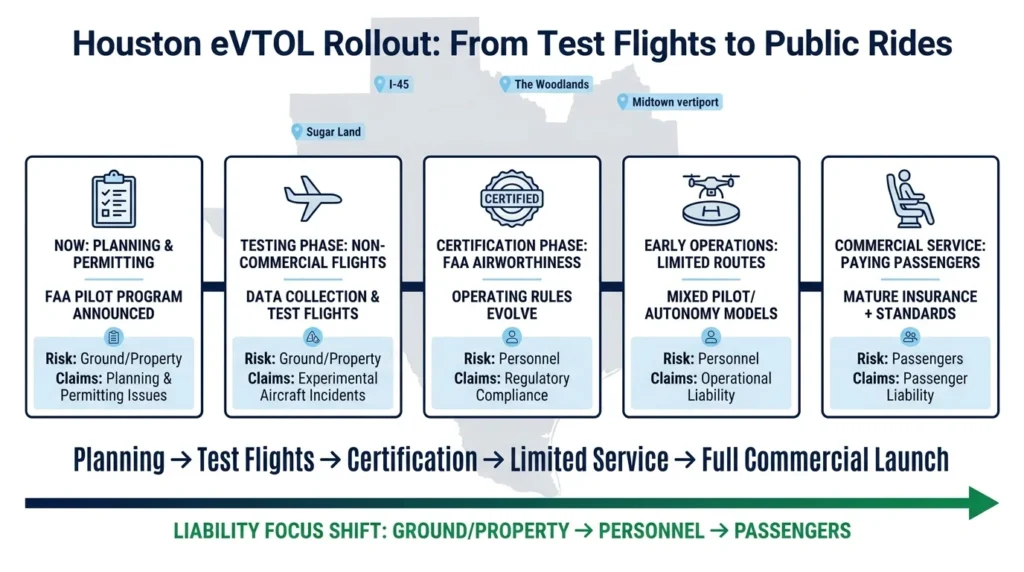
Houston is part of a federal pilot program set to host test flights for electric vertical takeoff and landing aircraft, commonly called eVTOLs. Commercial flying taxi service is not yet available to the public here. What is coming first is a testing and certification phase under the Federal Aviation Administration.
The FAA oversees airworthiness certification, pilot requirements, and operating rules for these aircraft. Test flights over areas near I-45, The Woodlands, and Sugar Land will help regulators and manufacturers gather data before any paying passenger ever boards.
That means the earliest liability scenarios will likely involve test operations, ground personnel, or property damage rather than commercial passengers. Still, planning for the commercial phase matters, because the rules being written now will shape who answers for future crashes.
eVTOL Technology & Safety System Basics
An eVTOL is an aircraft that lifts off vertically like a helicopter but flies forward on fixed wings or tilted rotors powered by electric motors. (If you know your military aircraft, think the V-22 Osprey.) Most designs rely on distributed propulsion, meaning several small rotors rather than one large one. The goal is quieter flight, lower emissions, and short hops across congested cities.
Some eVTOLs will carry a human pilot. Others are designed for remote operation or full autonomy, with software making real-time flight decisions. The level of human control matters because it changes who can be held responsible when something goes wrong.
These aircraft depend heavily on software, sensors, and data links. A hacked communication system, a sensor misreading weather data, or a software bug during landing at a Midtown vertiport could each trigger a different liability analysis.
Who Is Liable When Flying Taxis Crash?
Aviation accidents rarely involve just one responsible party. Flying taxi crashes will likely follow the same pattern, with claims potentially reaching several defendants at once.
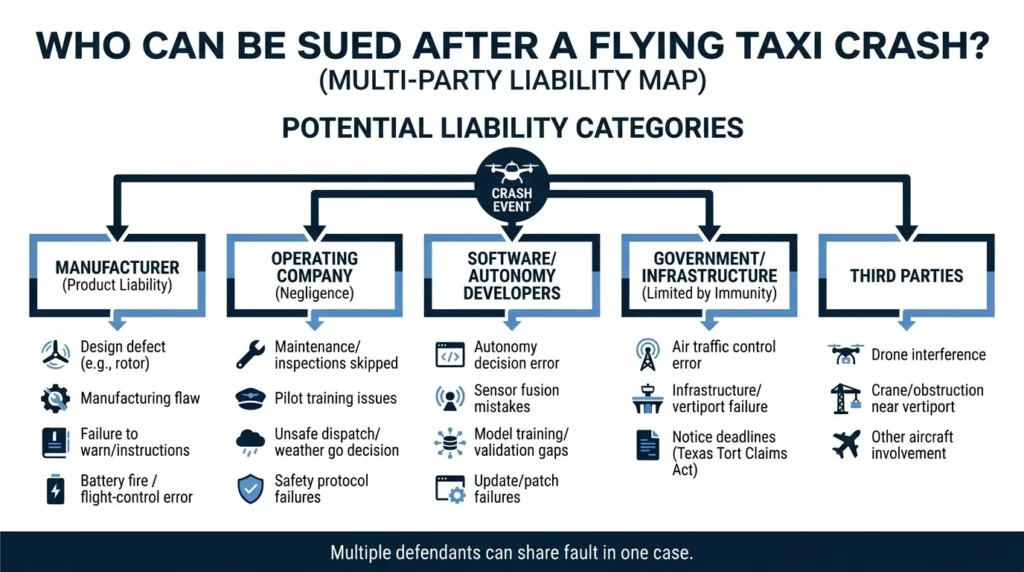
The eVTOL manufacturer may be liable under Texas product liability law if a design defect, manufacturing flaw, or inadequate warning contributed to the crash. Battery fires, rotor failures, and flight control software errors all fall within this category.
The operating company running the flying taxi service has duties around maintenance, pilot training, dispatch decisions, and safety protocols. A skipped inspection or a decision to fly in unsafe weather could support a negligence claim.
Software developers present a newer category of potential defendants. When autonomous flight systems make the wrong call, the company that wrote or trained that software may share responsibility. This area of law is still developing, and courts will be working through it for years.
Government entities may bear limited responsibility when air traffic control errors or infrastructure failures contribute to a crash. Sovereign immunity limits these claims significantly, and strict notice deadlines apply under the Texas Tort Claims Act.
Third parties can also be involved. A drone operator, a construction crane near a vertiport, or another aircraft could all contribute to an incident. Each adds another layer to the liability picture.
Damages & Compensation in Flying Taxi Accidents
Texas law recognizes several categories of damages that would apply to flying taxi injuries. The specific numbers depend on the facts of each case.
Economic damages cover measurable financial losses. These include emergency care, hospital stays, rehabilitation, lost wages, reduced earning capacity, and the cost of future medical treatment. For serious injuries, future care can dominate the claim.
Non-economic damages compensate for pain, suffering, mental anguish, disfigurement, and loss of enjoyment of life. Aviation crashes often cause lasting physical and psychological harm, which makes this category significant in eVTOL cases.
Punitive damages may apply when a defendant acted with gross negligence or willful misconduct. Under Texas Civil Practice and Remedies Code § 41.003, a plaintiff must show this conduct by clear and convincing evidence. Past results do not guarantee future outcomes.
Legal Challenges in eVTOL Accident Cases
Proving liability in a flying taxi case will be harder than a typical car accident claim. There is limited precedent, few established expert witnesses, and technology is evolving rapidly. Much of the evidence will live inside flight data recorders, software logs, and maintenance records controlled by defendants.
Insurance coverage is another open question. Aviation insurers are still developing products for urban air mobility, and early policies may have coverage gaps, low limits, or exclusions that do not match the real risks. Expect disputes over which policy responds and in what order.
Regulatory uncertainty adds another layer. Rules governing eVTOL operations, pilot certification, and maintenance standards are still being written. A crash during the testing phase may be governed by different rules than one that occurs after commercial certification.
These cases will also demand specialized expert witnesses. Aerospace engineers, software auditors, human factors specialists, and aviation meteorologists will all play roles. It’s important to consult with an attorney early who can start building a team of these witnesses to help your case.
What to Do After a Flying Taxi Accident
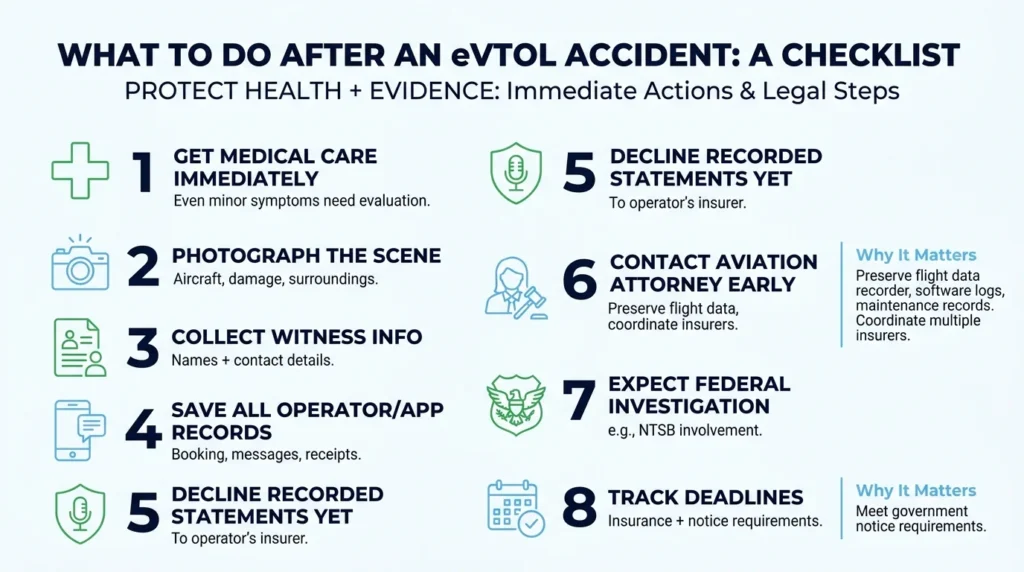
If you are ever involved in an eVTOL incident, the first priority is your health. Get immediate medical attention, even if injuries seem minor. Adrenaline can mask serious problems, and prompt records help connect your injuries to the crash.
Document everything you can. Take photos of the aircraft, the scene, and any visible damage. Get names and contact information for witnesses. Save any app data, booking confirmations, or communications from the operator.
Do not give recorded statements to the operator’s insurer before speaking with a lawyer. Contact an attorney with experience in aviation accidents who can preserve flight data, secure expert witnesses, and deal with multiple insurers at once.
Be aware that federal agencies like the National Transportation Safety Board may investigate the crash. Their reports can shape your claim, and deadlines for filing insurance and government claims can be short.
Why Choose Angel Reyes & Associates for Flying Taxi Cases?
Emerging transportation technology does not change the core work of protecting injured clients. It just raises the stakes and adds complexity. Our team handles complex aviation, product liability, and multi-party litigation, and we stay current on the laws shaping urban air mobility in Texas.
With over 30 years of experience and more than $1 billion recovered for clients, Angel Reyes & Associates is prepared to take on the difficult cases other firms will not. We offer free initial consultations, charge no fee unless we win, and serve clients across Texas from more than 20 locations, with service available in Spanish.
If you have been hurt in any aviation or transportation incident, schedule a free consultation to learn more about your options.
Flying Taxi Crash FAQs
What happens if a flying taxi crashes during the test flight phase?
Test flight incidents fall under experimental aircraft regulations with different liability rules than commercial operations. Operators may have limited insurance coverage, and claims could involve federal contractors or research agreements.
Can you sue for a flying taxi accident caused by weather conditions?
Weather-related crashes may involve liability if the operator failed to follow dispatch protocols, ignored weather warnings, or lacked proper training for Gulf Coast conditions like sudden thunderstorms or fog.
How does cybersecurity factor into flying taxi accident liability?
If hackers compromise flight systems, communication links, or ground control networks, liability may extend to cybersecurity vendors, software companies, or entities responsible for protecting critical aviation infrastructure from cyber attacks.
What insurance requirements will flying taxi companies need in Texas?
The FAA is developing minimum insurance requirements for commercial eVTOL operations. Texas may impose additional coverage mandates similar to current commercial aviation requirements under Transportation Code Chapter 21.
Do wrongful death laws apply differently to flying taxi accidents?
Texas wrongful death statutes apply the same way, but damage calculations may be higher due to aviation accident severity. Survival actions under Civil Practice and Remedies Code Chapter 71 also apply to conscious pain before death.
About the Authors

Angel Reyes
Writer
Angel L. Reyes, III is the Founder and Managing Partner of Angel Reyes & Associates. A nationally recognized trial attorney and business leader, Angel has helped over 70,000 injury victims recover more than $1 billion since founding the firm in 1993. Named to the Texas Super Lawyers list annually since 2008, Angel brings Wall Street experience, Ivy League education, and a deep commitment to client advocacy. He is a frequent legal commentator and published author with extensive contributions to legal scholarship, trial strategy, and consumer protection.

Kyle Nicolas
Editor
Kyle Nicolas is the Web Content & SEO Manager at Angel Reyes & Associates. He has more than 10 years of experience as a marketing co...

Angel Reyes
Reviewer
Angel L. Reyes, III is the Founder and Managing Partner of Angel Reyes & Associates. A nationally recognized trial attorney and business...