Who Is Liable After an Uber-Branded Air Taxi Crash in Texas?


Every article on this site is researched by our internal team, reviewed for legal accuracy against current Texas law, and held to State Bar of Texas advertising standards before publication. We do not publish content that overstates outcomes or makes promises about results.
Learn more about our
editorial standards .
Key Takeaways
- An Uber-branded air taxi crash may involve the operator, pilot, manufacturer, maintenance provider, and vertiport operator.
- Texas proportionate responsibility law allocates fault across multiple defendants based on the evidence each party's negligence produced.
- Texas imposes a two-year deadline for personal injury and wrongful death claims, making early evidence preservation essential.
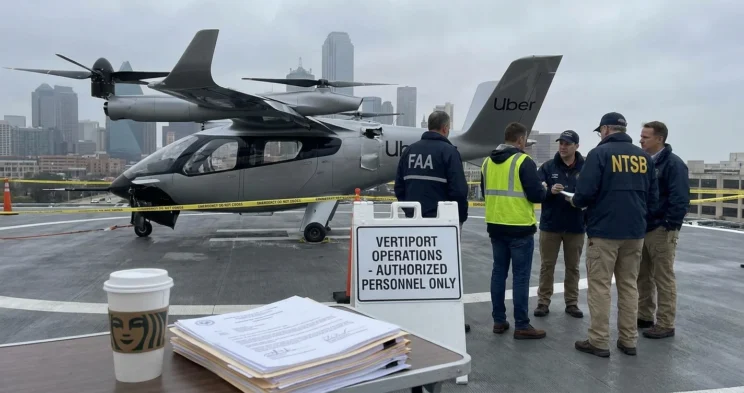
You’ve probably seen the headlines: electric air taxis are coming to Texas cities, and major companies like Uber are already putting their names on them. If one of these flights goes wrong and someone gets hurt, the question of who pays is far more complicated than a standard car accident.
The FAA has been actively working to bring powered-lift aircraft (the official term for eVTOLs — electric vertical takeoff and landing vehicles) into regular use across U.S. cities. Commercial routes are being planned for San Antonio, Dallas, and Houston. When these flights go wrong, multiple parties may share responsibility, and understanding who they are is the first step toward protecting your rights.
“Uber-Branded” Doesn’t Always Mean Uber Is the Operator
When you book through a familiar app, it’s natural to assume that company is responsible for everything. That assumption can be misleading in the air taxi context.
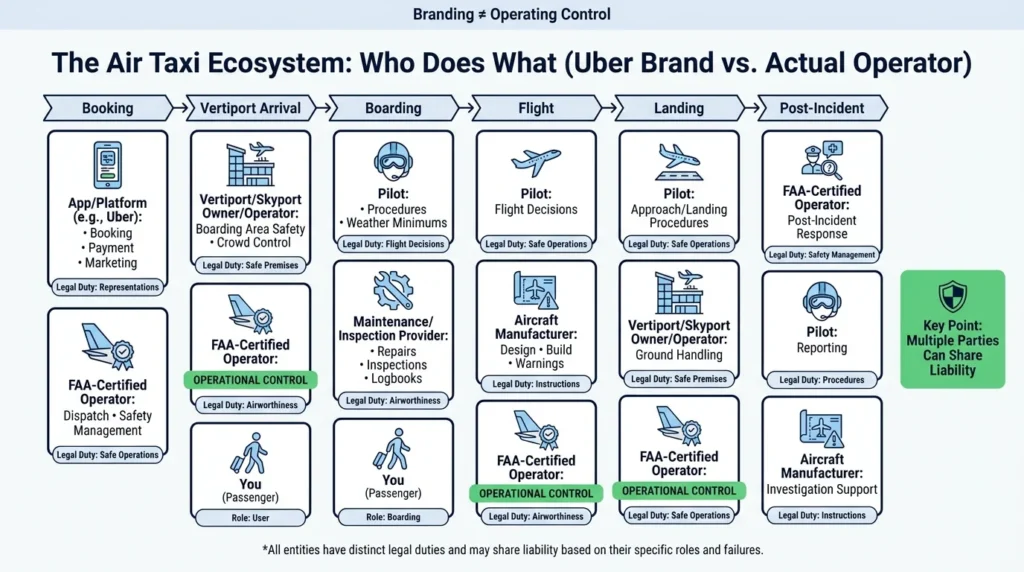
An Uber-branded air taxi experience will typically involve several distinct entities. The app or platform handles booking and payment. A separate FAA-certified operator actually conducts the flight. The pilot works for (or contracts with) that operator. The aircraft itself comes from a manufacturer. Maintenance providers keep it airworthy. And the vertiport or skyport where you board has its own owner and operator.
Each of these parties has different legal duties. When something goes wrong, more than one may bear responsibility for your injuries. Texas law allows claims against multiple defendants when evidence supports it.
The FAA has established standards for certifying aircraft, operators, and pilots in this new industry. These requirements help define what “reasonable care” looks like. When operators or pilots fall short, that failure can become central to a negligence claim.
What Counts as a Powered-Lift “Air Taxi?”
“Powered-lift” means an aircraft that takes off and lands vertically, like a helicopter, but transitions to fly more like a plane once airborne. This category includes the eVTOL vehicles being developed for urban routes across Texas.
“Air taxi” describes short, on-demand flights between city locations, similar to how a rideshare works but by air. The FAA’s air taxi hub explains how these operations fit into the broader aviation system.
Why does this matter for a future claim? FAA certification requirements and operational rules establish benchmarks for what operators and pilots are legally required to do. The FAA’s powered-lift FAQ provides plain-language explanations of these requirements.
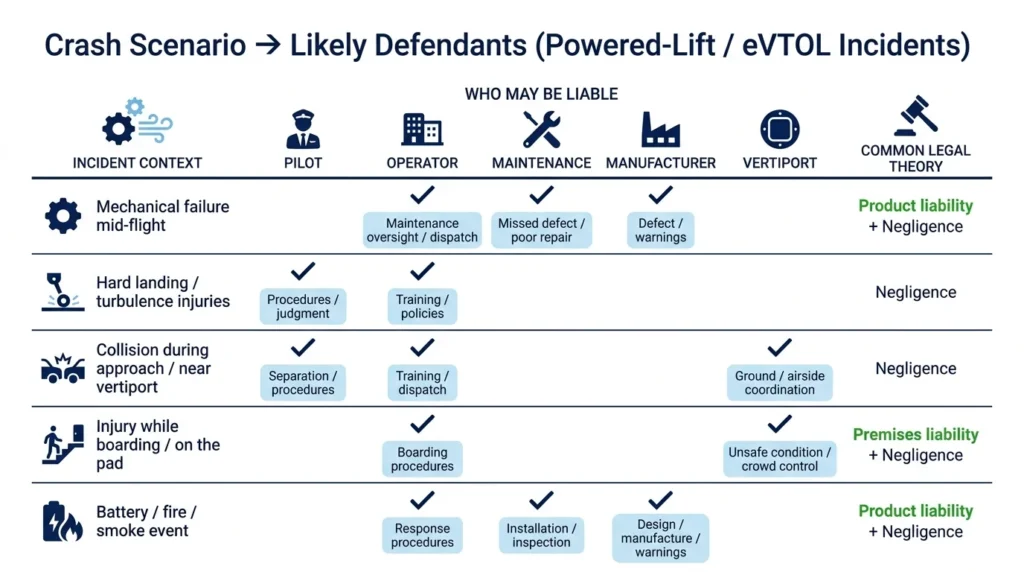
Different incident contexts point to different defendants. A mechanical failure during flight may implicate the manufacturer or maintenance provider. A collision during approach could involve pilot error or air traffic issues. An injury while boarding at a vertiport might be a premises liability matter, meaning the property owner or operator may be responsible for unsafe conditions.
The 2024 FAA Powered-Lift Final Rule
On October 22, 2024, the FAA issued a final rule establishing pilot qualifications and operating requirements specifically for powered-lift aircraft. This rule created training standards, weather and visibility minimums pilots must meet before flying, and instructor certification requirements.
Violations of these requirements can become evidence of negligence. If a pilot was not properly certified, or an operator dispatched a flight in conditions below required minimums, those facts would strengthen an injury claim.
FAA compliance doesn’t automatically answer “who pays.” But it provides a framework for analyzing whether the operator and pilot met their duties.
Who Can Bring a Texas Claim After an Air Taxi Crash?
Several categories of people may have valid claims after a powered-lift incident.
Passengers injured during commercial operations can pursue claims based on the operator’s duty to provide safe transportation. This includes injuries from crashes, hard landings, turbulence, or safety procedure failures. Families of passengers killed in crashes may have wrongful death claims.
People on the ground can also be harmed. Pedestrians, drivers, and property owners affected by debris, emergency landings, or vertiport incidents have potential claims. If you were driving on Bandera Road in San Antonio when an eVTOL made an emergency landing nearby, your injuries matter too. These situations may involve car accident or truck accident claims depending on the circumstances.
Occupants of other vehicles or aircraft involved in collisions near vertiports or in shared airspace may have claims against the parties whose negligence contributed to the incident.
Wrongful Death & Survival Claims in Texas
When an air taxi incident is fatal, families often have multiple potential claims. A wrongful death claim compensates surviving family members for their losses. A survival claim covers what the deceased person experienced before death, including pain, suffering, and medical expenses incurred.
These claims have different requirements regarding who can file and what damages are recoverable. Prompt legal consultation helps preserve deadlines and evidence. Official investigations may occur after aviation incidents, and coordination with those processes matters.
Potentially Liable Parties After an Air Taxi Incident
More than one company or person may owe you something after a powered-lift crash. Negligence, product liability, and premises liability claims can all arise from the same incident, against different defendants.
The FAA-certified operator holds responsibility for safe operations. This includes pilot training, dispatch decisions, maintenance oversight, and safety management systems. The operator is usually the first party named in a lawsuit.
Pilots may be individually liable for operational decisions, failure to follow procedures, or poor judgment. Not every crash involves pilot error, and facts drive this analysis.
Aircraft and component manufacturers can face product liability claims for design defects, manufacturing defects, or inadequate warnings. eVTOL technology is new, and design or manufacturing problems may not become apparent until aircraft enter regular service.
Maintenance and inspection providers who miss defects or perform improper repairs can bear responsibility when their failures contribute to incidents.
Vertiport and skyport operators have premises liability duties, meaning they are responsible for keeping boarding areas reasonably safe. Inadequate lighting, poor crowd control, or ground-handling errors can all cause injuries.
The app or platform (like Uber) presents more complex questions. Liability depends on the actual service model, contractual relationships, and what role the platform played beyond booking. If you’ve dealt with rideshare accidents before, you know these questions can be complicated even for ground transportation.
Separating Platform Responsibility From Operator Responsibility
Don’t assume the app company automatically owns the crash. Key documents reveal who actually controlled operations: operating authority certificates, pilot employment records, aircraft ownership and maintenance contracts.
What the platform promised you publicly can still matter in some cases. If the platform made specific safety representations that proved false, that could support claims. But these arguments are fact-specific.
Preserve your evidence early. Save app screenshots, booking confirmations, receipts, and any safety notices displayed before your flight. This information helps establish what happened and who was involved.
How Texas Proportionate Responsibility Affects Multi-Defendant Cases
Texas law allows fault to be divided among multiple parties based on evidence. This is called proportionate responsibility, and it means a jury can assign a percentage of blame to the operator, pilot, manufacturer, maintenance provider, and vertiport operator separately.
Your recovery depends on the total fault assigned to defendants and whether you’re assigned any portion yourself.
Defense strategies often try to shift blame. The operator may blame the manufacturer. The manufacturer may blame maintenance. Everyone may point to weather or pilot error. This makes thorough technical investigation essential.
Evidence that helps prove fault allocation includes flight operations records, training documentation, component failure analysis, maintenance logs, vertiport surveillance footage, and witness statements.
Insurance: What Policies May Apply
Multiple policies from different companies may apply to a single air taxi incident.
Operator commercial aviation liability insurance is often the primary coverage when operator negligence is involved. Policy limits and terms vary.
Manufacturer and supplier coverage may apply in product liability situations. Manufacturers may also carry additional coverage through broader company policies.
Vertiport premises coverage applies to injuries caused by unsafe conditions at boarding locations.
Platform-related coverage depends entirely on contracts and policy terms. Branding does not automatically equal coverage.
Your own insurance may also be relevant. Health insurance, medical payments coverage, or uninsured/underinsured motorist coverage (which pays when another party lacks enough insurance to cover your damages) could apply depending on circumstances.
Why “Who Is Liable” & “Who Insures It” Differ
A party may be legally responsible but underinsured. Another party may have substantial coverage but less fault. Both liability and insurance need separate analysis.
Document everything: policy information if available, correspondence with insurers, denial letters, and claim numbers.
Texas Deadlines & Early Claim Steps
Texas law generally gives you two years to file personal injury and wrongful death claims. This deadline comes from Texas Civil Practice and Remedies Code § 16.003. Exceptions exist, but waiting is risky.
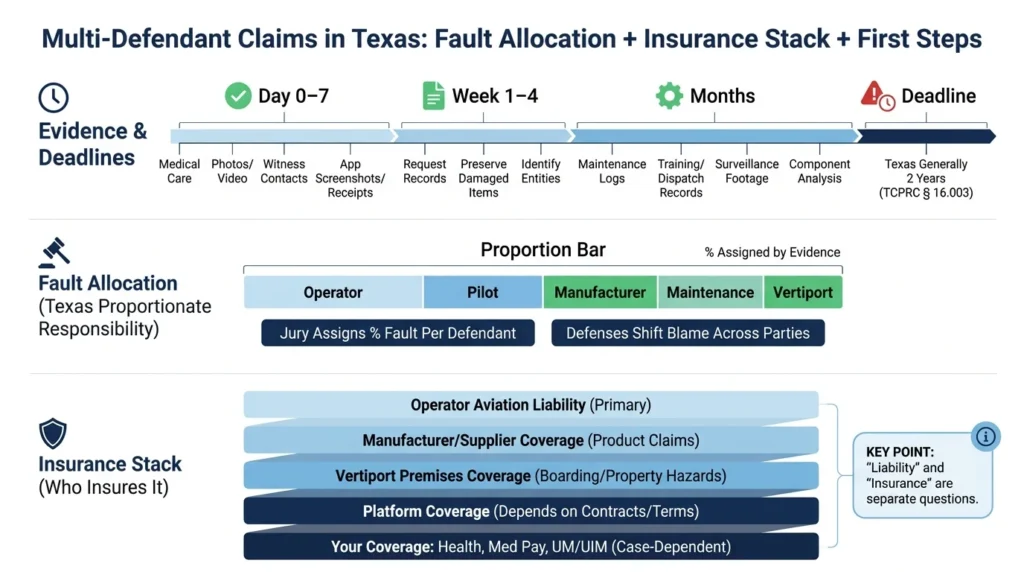
In the first days and weeks after an incident, focus on:
- Getting medical care and following up on treatment
- Preserving app receipts, booking confirmations, and itineraries
- Taking photos and video of injuries and any physical evidence
- Collecting witness contact information
- Keeping a log of symptoms and medical bills
Aviation incidents may involve official investigations. Be careful about giving recorded statements without legal guidance.
What to Avoid After an Air Taxi Injury
Giving recorded statements to insurance companies or other parties without legal guidance is one of the most common mistakes injured people make. In complex multi-party cases, your words can be used against you.
Do not delay medical treatment. Gaps in care can be used to dispute whether your injuries are as serious as claimed or whether the incident caused them.
Do not discard evidence. Boarding passes, app notifications, damaged personal items, and any photos or video from the scene all matter.
How We Can Help
Air taxi crashes involve new technology, multiple potential defendants, and overlapping state and federal regulations. Sorting through this while recovering from injuries is overwhelming.
At Angel Reyes & Associates, we have over 30 years of experience helping Texans injured by others’ negligence. We have recovered more than $1 billion for our clients across all types of injury cases. Our team includes investigators and reconstruction specialists who can help identify what went wrong and who should be held accountable.
We offer free consultations and work on contingency: you pay nothing unless we win. We serve clients throughout Texas from our more than 20 locations and can handle most of your case remotely. If you or a family member was injured in an air taxi incident, contact us today to discuss your options.
Past results do not guarantee future outcomes.
Uber Air Taxi Crash FAQs
Can FAA investigators decide who is legally at fault for an air-taxi crash in Texas?
Not by themselves. Government investigations can uncover important facts, but civil liability and damages are decided through insurance claims, settlement negotiations, or a court case.
What documents should I keep after an Uber-branded eVTOL incident?
Save your booking confirmation, app screenshots, payment receipt, emails or texts about the trip, medical records, and photos of injuries or property damage. These items can help identify which company handled the flight and what happened before and after the incident.
Can a defective battery or software problem lead to a product liability claim?
Yes, potentially. If a battery, flight-control system, sensor, or other component failed because of a design, manufacturing, or warning problem, the manufacturer or another product-chain company may be part of the case.
If I was hurt at the vertiport before takeoff, is that still an aviation claim?
It may be partly an aviation matter, but it can also look more like a premises liability claim. The answer often depends on whether the injury came from unsafe property conditions, boarding procedures, crowd control, or flight-related operations.
Will my health insurance pay first if I'm injured in an air-taxi accident?
In many cases, your health insurance may help cover treatment before liability is sorted out. If you later recover money from a claim, reimbursement or lien issues may need to be addressed depending on your plan and the facts.
About the Authors

Angel Reyes
Writer
Angel L. Reyes, III is the Founder and Managing Partner of Angel Reyes & Associates. A nationally recognized trial attorney and business leader, Angel has helped over 70,000 injury victims recover more than $1 billion since founding the firm in 1993. Named to the Texas Super Lawyers list annually since 2008, Angel brings Wall Street experience, Ivy League education, and a deep commitment to client advocacy. He is a frequent legal commentator and published author with extensive contributions to legal scholarship, trial strategy, and consumer protection.

Graham Griffin
Editor
Graham Griffin is the Web & Content Manager at Angel Reyes & Associates, where he oversees content strategy, AI-powered workflows, a...

Angel Reyes
Reviewer
Angel L. Reyes, III is the Founder and Managing Partner of Angel Reyes & Associates. A nationally recognized trial attorney and business...