What to Do After a Four-Way Stop Collision in Texas


Every article on this site is researched by our internal team, reviewed for legal accuracy against current Texas law, and held to State Bar of Texas advertising standards before publication. We do not publish content that overstates outcomes or makes promises about results.
Learn more about our
editorial standards .
Key Takeaways
- Texas law gives the first driver to stop the right of way at a four-way stop.
- When two drivers arrive at the same time, the driver on the right goes first.
- Camera footage and vehicle damage patterns often settle who has the right of way.
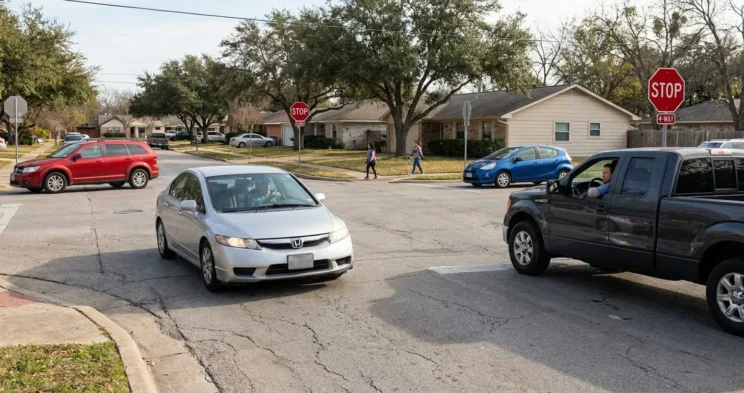
You come to a complete stop at a quiet four-way intersection near the Stockyards in Fort Worth, and another driver reaches the cross street at almost the same instant. You both start to go, and a few seconds later you’re standing on the curb comparing insurance cards. Neither of you agrees on who had the right of way.
Texas law actually settles that question with a specific, sequential rule. And, depending on the facts of your case, these laws may also create the framework that insurance companies will use to investigate the accident.
The Right-of-Way Rules at a Texas Four-Way Stop
Texas law settles a four-way stop the same way every time. The first driver to stop and start moving through the intersection gets to go first, and every other driver waits.
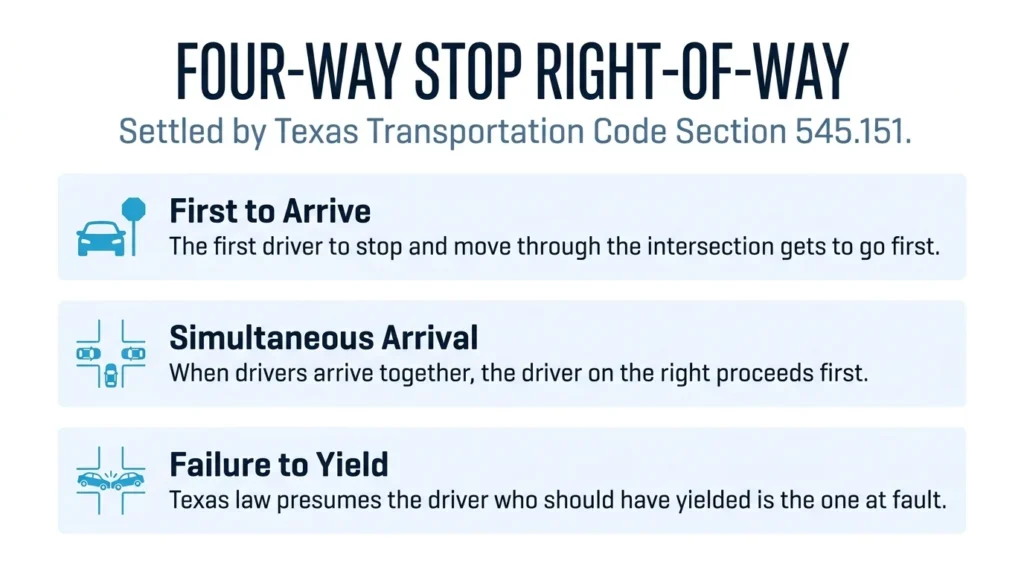
This sequence comes from Texas Transportation Code Section 545.151. The statute requires a driver at a stop sign or an uncontrolled intersection to stop and yield to any vehicle already in the intersection, or close enough to be a hazard.
First Driver to Arrive Goes First
Whoever stops first and moves through the intersection first has the right of way. That holds true even when another driver has a shorter path across the intersection.
A driver who stopped second must wait, regardless of which direction they came from or which way they plan to turn.
Simultaneous Arrival: Yield to the Right
When two drivers reach the stop sign at essentially the same moment, the rule shifts. The driver on the right proceeds first, and the driver on the left must yield.
With three or four cars stopped at once, the same principle repeats around the intersection. Each driver yields to whoever sits to their own right, one car at a time.
Texas law also presumes that a driver who was required to yield and didn’t is the one who failed to yield. That presumption shifts the burden onto that driver to prove otherwise.
How Fault Gets Assigned When Both Drivers Say They Went First
When both drivers claim they arrived first, fault comes down to which version of events the evidence actually supports, not which driver argues more forcefully at the scene.
A driver who never comes to a complete stop, sometimes called a rolling stop, is treated as failing to yield even if they insist they arrived first. Section 545.151 requires a full stop before entering the intersection, not a slow roll through it.
Failure-to-yield crashes at a four-way stop often strike the side of the vehicle that had the right of way, a pattern known as a T-bone crash.
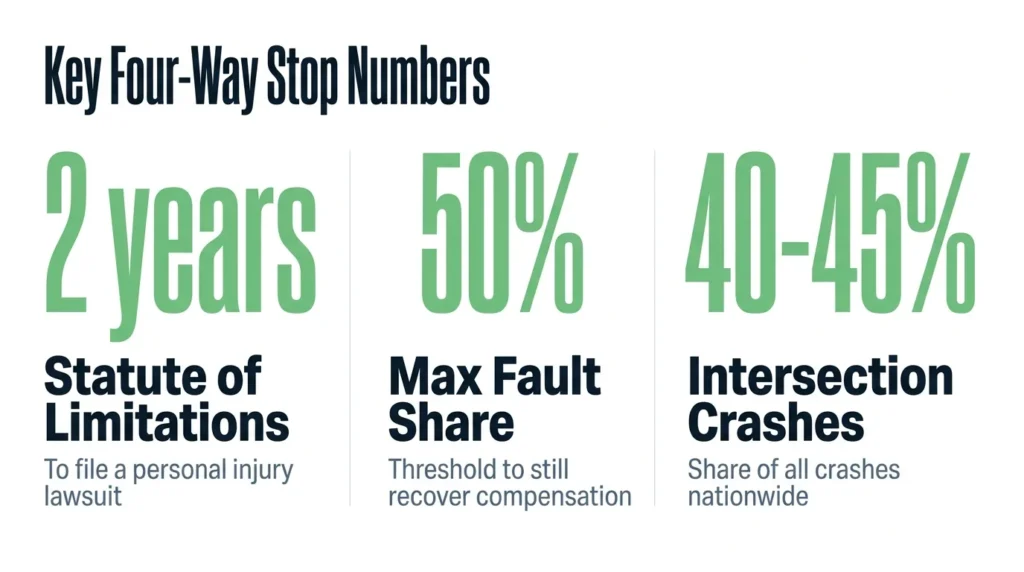
Fault does not have to land entirely on one driver. Under Texas Civil Practice and Remedies Code Section 33.001, each driver can be assigned a percentage of responsibility. A driver can still recover compensation as long as their own share of fault stays at 50 percent or less.
Insurance adjusters weigh the same evidence when neither driver will back down, since the adjuster’s job is to reconstruct the moment of impact just as a jury would.
The Evidence That Settles These Disputes
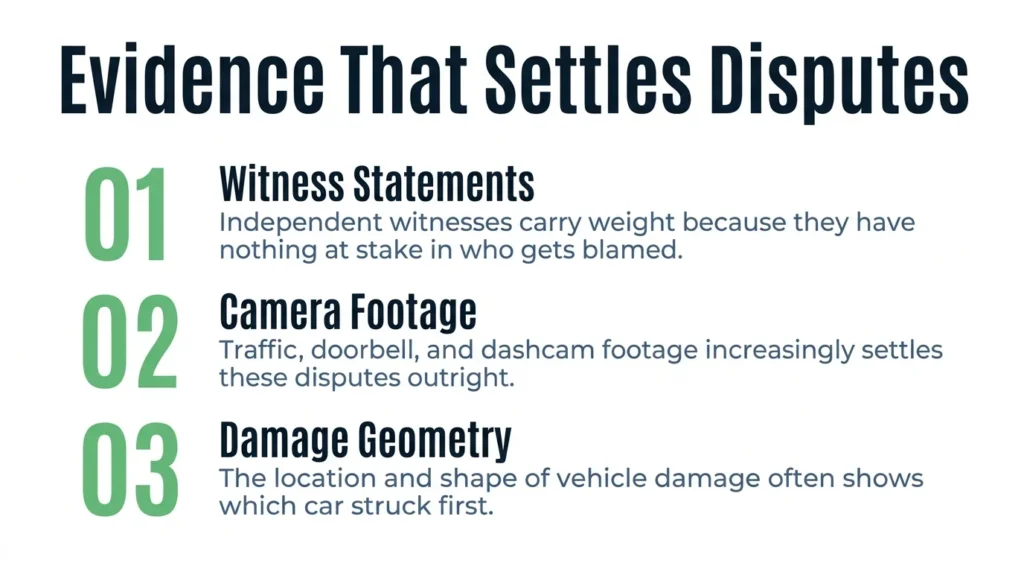
Three types of evidence tend to settle a disputed four-way stop claim: what witnesses saw, what a nearby camera recorded, and what the damage on each vehicle actually shows:
- Witness statements. An independent witness carries weight because they have nothing at stake in who gets blamed.
- Camera footage. Traffic cameras, doorbell cameras, and dashcams near busy intersections, including plenty across Fort Worth, increasingly settle these disputes outright, since footage removes the guesswork of competing memories.
- Damage geometry. The location and shape of the damage on each vehicle, sometimes called the damage geometry, often shows which car struck the other first. A vehicle hit squarely on the front bumper was likely still entering the intersection, while a vehicle struck along its side doors had probably already started through.
A car accident claim that hinges on a disputed four-way stop often comes down to whichever side has the stronger version of this evidence.
What to Do After a Four-Way Stop Collision
Take these steps right after a four-way stop collision to protect your health and your claim:
- Check for injuries. Look yourself over, then move to a safer spot if you can.
- Call the police. A police report becomes important evidence if your claim is ever disputed.
- Document the scene. Photograph vehicle damage, the stop signs, and any nearby traffic cameras.
- Gather witness information. An independent witness account can help establish who had the right of way.
- Get checked by a doctor. Some injuries, and the shock that follows a crash, can hide symptoms for hours or days.
- Talk to an attorney, especially once the other driver disputes who arrived first.
Work with a Knowledgeable Attorney
A disputed four-way stop claim often becomes a battle of narratives, and organizing the right evidence early makes the difference. Angel Reyes & Associates has represented Texas crash victims for more than 30 years, and our case results include more than $1 billion recovered for clients. You pay nothing unless we win.
Contact us for a free review of your four-way stop collision.
Past results do not guarantee future outcomes.
Four-Way Stop Collision FAQs
How long do I have to file a claim after a four-way stop crash in Texas?
Texas gives you two years from the date of the crash to file a personal injury lawsuit under Texas Civil Practice and Remedies Code Section 16.003. Missing that deadline generally means losing the right to sue over the crash.
What if the intersection has no stop sign at all?
Texas law still requires drivers to stop and yield to whoever is on their right at a completely unmarked intersection, under the same Texas Transportation Code Section 545.151 that governs four-way stops.
Can I be partly at fault even if I had the right of way?
Yes. Having the right of way does not excuse other negligence, like speeding, and a jury can still assign you a percentage of fault under Texas Civil Practice and Remedies Code Section 33.001, which reduces your recovery by that share.
How common are four-way stop crashes compared to other intersection crashes?
Intersection-related crashes account for roughly 40 to 45 percent of all crashes nationwide, according to the Federal Highway Administration, making intersections one of the most common crash locations in any state.
About the Authors

Spencer Browne
Writer
Spencer Browne is a partner at Angel Reyes & Associates and a Board Certified personal injury trial lawyer with nearly 100 jury trials across Texas. He focuses on car, truck, and wrongful death cases, with notable verdicts including a landmark win in the Choctaw Casino bus crash case. A recognized speaker and legal educator, Spencer is a member of the American Board of Trial Advocates and has been honored as a Texas Super Lawyer and one of D Magazine’s Best Lawyers in Dallas. He brings deep trial experience and relentless advocacy to every client he represents.

Kyle Nicolas
Editor
Kyle Nicolas is the Web Content & SEO Manager at Angel Reyes & Associates. He has more than 10 years of experience as a marketing co...

Angel Reyes
Reviewer
Angel L. Reyes, III is the Founder and Managing Partner of Angel Reyes & Associates. A nationally recognized trial attorney and business...