Dallas’s New Barnacle Devices Are Not the Parking Enforcement Answer it Needs


Every article on this site is researched by our internal team, reviewed for legal accuracy against current Texas law, and held to State Bar of Texas advertising standards before publication. We do not publish content that overstates outcomes or makes promises about results.
Learn more about our
editorial standards .
Key Takeaways
- The Barnacle blocks a driver's view but not the engine, so driving away is still possible.
- The $100 fee and $300 hold can trap cash-strapped drivers while the tow clock keeps running.
- Enforcement errors happen, and wrongful placements need a fast way to be contested.
This is an opinion piece, and is intended to provide analysis and commentary on current events and issues facing personal injury law. While resources are provided to support statements, opinion statements should not be misconstrued as fact, evidence, or argument in favor of or against any particular legislation. This is not legal advice.
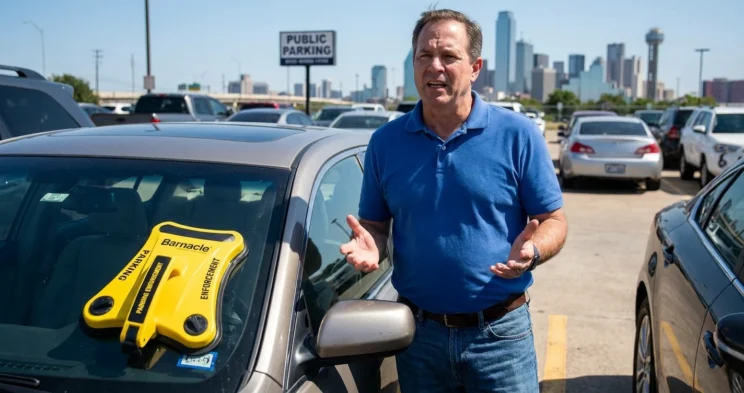
On August 24th, Dallas parking enforcement began locking windshields using a black and yellow device known as a Barnacle. Instead of towing cars with multiple outstanding parking tickets, law enforcement officers can stick this suction cup powered device on your windshield, blocking your view, and, at least in theory, preventing you from driving.
The city calls it modernization. I’ve spent 35 years representing people hurt in car wrecks, and I call it a potential liability the city hasn’t priced in.
Barnacles Don’t Disable the Car
Barnacle devices are supposed to stop the car they are placed on from driving, but they don’t do so by disabling the engine or locking the wheels. The device blocks the windshield, but the car still starts. It still drives. The only thing stopping the driver is a piece of plastic and that driver’s willingness not to drive around it.
That’s a bet on human judgment under stress, and stressed people don’t always bet well.
Picture the driver: running late, three tickets deep, staring at a blocked windshield with no time and no patience. Some will try to drive anyway, half-blind, through a school zone, a parking garage, or a busy Oak Cliff intersection. If they have no choice but to get to work or class, they’re going to do that however they can.
The devices carry GPS and trigger a siren the moment the car moves. The device’s creators clearly anticipated that people will try. But a siren might not be enough to stop someone, let alone someone who is already stressed, annoyed, or who feels they have been wronged.
And let’s also consider the rise in driver assist or self-driving technology. Some of the more advanced systems might still be able to get around the blocked windshield problem, or at least heavily mitigate it.
An Admission of Liability
Barnacle Parking’s own marketing team calls the device a deterrent because it blocks the driver’s view. That’s a fair sales pitch and a liability admission at the same time. The design only works because it obstructs the exact thing a driver needs to drive safely.
When that risk turns into a wreck, my first question won’t be whether the driver was negligent. It will be who else knew this was foreseeable and installed the device anyway.
Texas cities carry broad governmental immunity, but that immunity isn’t infinite. A device that blocks vision but leaves the car’s power plant operational is a design choice, not an accident. If someone gets hurt because of that choice, the city and the company that makes the device belong in that conversation right alongside the driver who chose to drive with their windshield blocked—as defendants.
The Financial Burden of Enforcement
Then there’s the money part of this new enforcement program.
To release the car, the driver must pay all three outstanding tickets in full, plus a $100 release fee. That’s real cash, due immediately, from people who probably couldn’t afford the original tickets in the first place.
And it doesn’t even stop there! Drivers who have their cars locked down by a Barnacle also have to pony up a temporary $300 hold on a credit card that is released when the driver brings the device back to the return drop box at the Oak Cliff Municipal Center. That hold might not fall off for three business days after the device is returned.
The city says payment plans are available for the tickets themselves. That helps with the total owed. It does nothing for the car sitting blocked in the driveway while a payment plan gets approved. Meanwhile, the impacted family has to figure out how to shift their budget for the month, and how to continue to get to work and school without their car.
What happens when a driver can’t afford their entire bill? What if they can clear their tickets, but they can’t afford the extra fees on top of it? For those who are struggling, an extra $400 in fees and holds is not a trivial amount. That driver has no choice but to wait.
While they’re waiting, 24 hours later, the city tows the car anyway. So the car sits there, blocked, until the tow truck shows up, at which point city roads experience the same congestion. That vehicle also then goes to the same impound lot. It’s the same outcome the Barnacle was supposed to prevent, delayed a day and marked up by $400.
A toll booth with a grace period is the same bill with different branding.
Wrongful Application Concerns
A barnacle isn’t supposed to come into play until a vehicle has three delinquent parking tickets. One mishap or forgotten fine isn’t going to see one of these devices slapped on your car. Or, at least, that’s what the city is telling us.
But every system built on volume makes mistakes: a plate misread, a paid ticket that never cleared the database, or a ticket given for an offense that never occurred. Even accident reports filed by police officers have mistakes that can jeopardize cases my firm handles.
Imagine buying a used car, only to discover the previous owner had a litany of outstanding tickets when your windshield is slammed with a yellow blocking device the first day you take the car to the office. The city would be holding your car hostage for tickets plus fees for parking offenses you never committed.
Dallas already runs an adjudication process for contesting parking citations, and they should. But before programs like the Barnacle are implemented, this process should be extended to include erroneous placements. And it needs to move fast, because right now a driver barnacled by the city’s mistake burns the same 24-hour clock as a driver barnacled for cause. Meanwhile, the city can sort out its own paperwork and resolve its own error on its own schedule, all while an otherwise innocent person literally pays the price.
I’m not arguing against parking enforcement. Pay your tickets. But a program that trades a towing risk for a driving-blind risk, and swaps a parking fine for a financial trap on people who are already stretched thin, isn’t smarter policy. If Dallas wants credit for reducing towing, it should also expect the liability that comes with a device built to leave the engine running and the windshield blocked.
About the Authors

Angel Reyes
Writer
Angel L. Reyes, III is the Founder and Managing Partner of Angel Reyes & Associates. A nationally recognized trial attorney and business leader, Angel has helped over 70,000 injury victims recover more than $1 billion since founding the firm in 1993. Named to the Texas Super Lawyers list annually since 2008, Angel brings Wall Street experience, Ivy League education, and a deep commitment to client advocacy. He is a frequent legal commentator and published author with extensive contributions to legal scholarship, trial strategy, and consumer protection.

Kyle Nicolas
Editor
Kyle Nicolas is the Web Content & SEO Manager at Angel Reyes & Associates. He has more than 10 years of experience as a marketing co...

Angel Reyes
Reviewer
Angel L. Reyes, III is the Founder and Managing Partner of Angel Reyes & Associates. A nationally recognized trial attorney and business...